Skip to content

💬 Prompting & Skills72

What you seeeverything
twitter.comthread

Anthropic Cracking Down on Video Game Rewrites

A tweet from chasmmmmmmmmmmm says Claude Code received a new rule around 27 October 2026, delivered from Anthropic's servers under the flag "tengu_heron_brook", with no setting to disable it. The quoted rule allows original games, genre games and games from the user's own designs and assets, but forbids recreating a specific existing game, even if renamed. The post asks whether this ends game rewrites and modding, and gives no verification beyond the quoted text.

Claude Code
Anthropictengu_heron_brook

coding-agents, prompting, ai-policy· Added 31 Oct 2026, published 30 Oct 2026

x.comthread

Eddy (@ieddysun) on X

Expo's official skills package gives AI coding agents scoped instructions for building Expo apps. One command, npx skills@latest add expo/skills --skill '*', installs it for Cursor, Copilot and Windsurf, while Claude Code and Codex use their plugin marketplaces. Skills include expo-router, expo-animation, expo-upgrade and eas-update. The Expo MCP server adds live docs lookup, compatible dependency installs, EAS build monitoring and simulator screenshots.

ExpoReact NativeExpo Router+9

coding-agents, prompting, mcp· Added 29 Oct 2026, published 28 Oct 2026

simonwillison.netwriteup

The October inflection point for vibe game development

Simon Willison argues October 2026 is an inflection point for vibe coding games, because Claude Opus 5.5 can now handle 3D modeling, music and game design. He describes four browser games built with three.js (Tree Appreciator, Emberwick, Battle Drones, Quarter Sun Cove), with the prompts used, a comparison against GPT-6 models, and advice to start with "Build a mobile-friendly three.js game where...".

three.jsPhaserClaude+7
Simon WillisonClaude Opus 5.5Claude Fable 5+6

coding-agents, prompting, models· Published and added 28 Oct 2026

x.comthread

Manoj | The AI Dude (@Manojkumar2257) on X

heditor is an open-source (MIT) agent skill from pycodebr that has Claude Code, Codex, Cursor or OpenCode edit talking-head videos. It transcribes with faster-whisper, picks a 30-70s segment, cuts frame-accurately, builds HTML + GSAP motion graphics, mixes audio at -14 LUFS, and runs QA with vision-reviewed previews. It offers 42 named styles and a long-form mode with chapters, SRT/VTT and lower thirds. Install: npx skills add pycodebr/heditor -g.

Claude CodeCodexCursor+6
heditorpycodebr

coding-agents, prompting, multimodal· Added 28 Oct 2026, published 27 Oct 2026

securitylabs.datadoghq.comarticle

Code security for new coders

Code security for new coders is a Datadog Security Labs primer for vibe coders building with coding agents. It lists setup and follow-up security questions to ask the agent, such as OWASP top 10 reviews, hardcoded secrets and outdated packages. It also explains first-party versus third-party code, supply chain risk, and SCA, SAST, IAST, DAST, IaC and secret scanning tools.

PHPGitHub ActionsDocker+2
DatadogOWASPPHP2Shell+2

coding-agents, prompting· Added 29 Oct 2026, published 26 Oct 2026

github.comrepo

alirezarezvani/claude-skills

claude-skills is an MIT-licensed library of about 398 Claude Code skills, agents, personas and plugins across 20 domains, including engineering, marketing, compliance and C-level advisory. Each skill is a SKILL.md with stdlib-only Python CLI tools and reference docs. Install scripts and convert.sh adapt it to Codex, Gemini CLI, Cursor, Aider, Windsurf and other coding agents, and it includes a skill-security-auditor scanner.

Claude CodeCodexGemini CLI+12
HermesMistralAnthropic+2

coding-agents, prompting, agents· Added 25 Oct 2026

repodir.comrepo

affaan-m/ECC | RepoDir

ECC (affaan-m/ECC) is an open-source performance optimization system for AI coding agents. It packages 261+ skills, 64+ agents and 84+ commands that tune Claude Code, Codex, Cursor and other agent harnesses for speed, memory and security. Practitioners can use it as a ready-made skills and harness configuration set. The RepoDir page gives only this short description, with no install steps or benchmarks.

Claude CodeCodexCursor+1

coding-agents, prompting· Added 24 Oct 2026

simonwillison.nettool

Quick Study

Quick Study is a browser artifact built by Claude Opus 5.5 (High) from a single prompt. The user opens a photo and the page repaints it in a few seconds with a simulated paintbrush on a canvas element. Simon Willison links it to an earlier experiment in which Claude Fable simulated a watercolor illustration with P5.js. The post gives the prompt but no code walkthrough.

ClaudeJavaScriptP5.js
Simon WillisonClaude Opus 5.5Claude Fable 5.1+1

prompting, models· Published and added 23 Oct 2026

x.comthread

Yash Patil (@yvshpvtil) on X

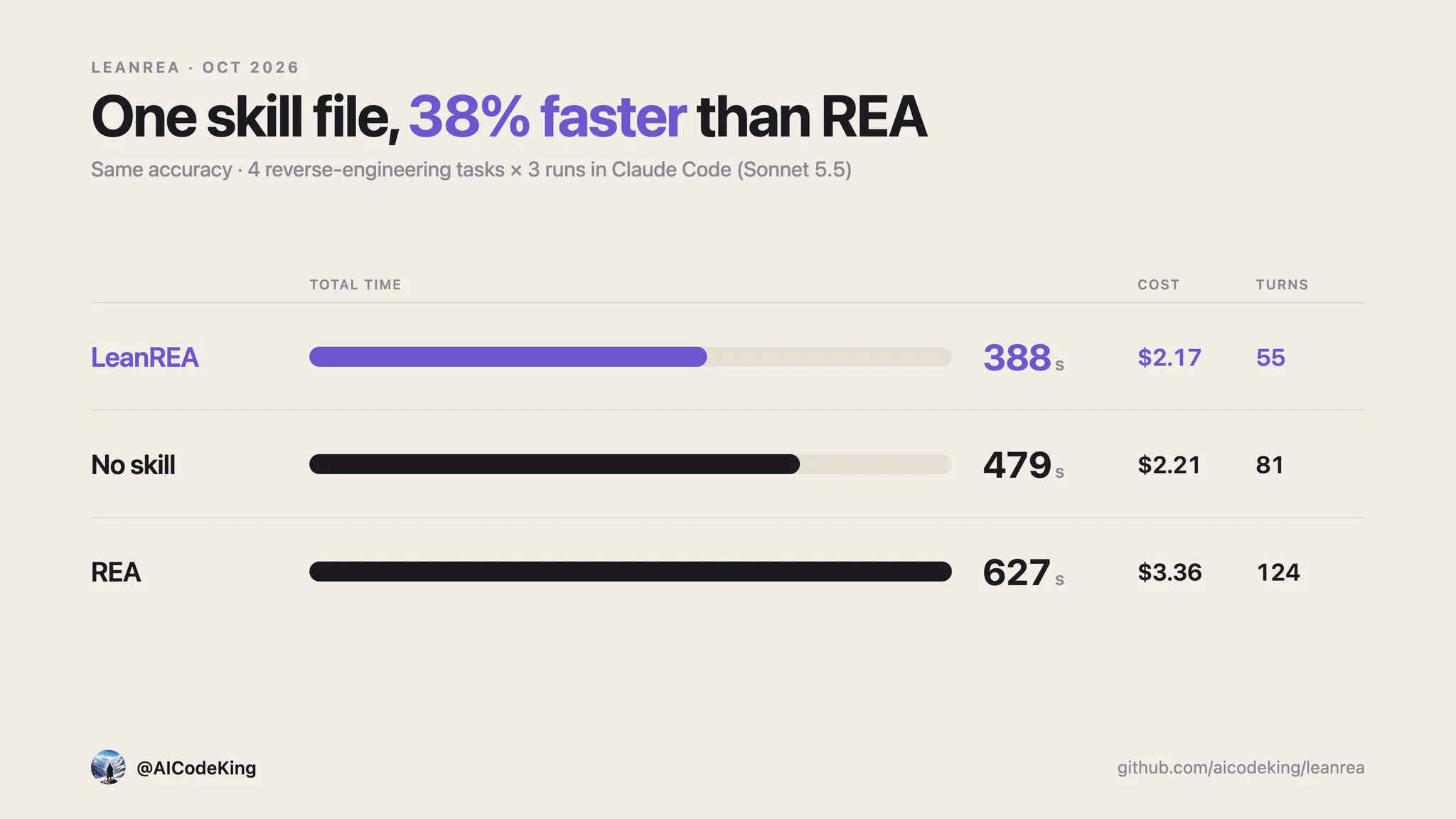
leanrea is an 8 KB skill file that tells a coding agent which plain CLI tools to use for reverse engineering, replacing REA, a 207-tool MCP server. In the author's test it ran 38% faster and 35% cheaper, scoring 74/75 against 75/75. The author lists caveats: 3 runs per task, one model, one machine, and Claude with no skill was already decent.

Model Context ProtocolClaude
leanreaREAYash Patil+2

prompting, mcp, coding-agents· Added 25 Oct 2026, published 23 Oct 2026

arxiv.orgpaper

Reproducible Evaluation as the Substrate for Safe Prompt Compression in Production Agents

This paper presents an offline evaluation harness for a production merchant-facing conversational agent. It stays reproducible when live backend data changes and can be regenerated when it goes stale. Used as the fitness function for GEPA prompt optimization under a correctness gate against reward hacking, it shrinks the full prompt surface by 3.5-7.6% without losing held-out correctness, across three subject-model families.

GEPALLM
arXiv

evals, prompting, agents· Added 26 Oct 2026, published 22 Oct 2026

simonwillison.netarticle

Donating Agent Skills to the Agentic AI Foundation

Simon Willison's link post covers Anthropic's 22 October 2026 announcement that it is donating the Agent Skills standard to the Agentic AI Foundation (AAIF) under the Linux Foundation. Anthropic co-founded the AAIF with Block and OpenAI and earlier donated MCP to it. Willison notes he predicted this in December 2025 and found his old post by querying his blog through datasette-mcp in Claude.

Model Context ProtocolClaudeDatasette
AnthropicAgentic AI FoundationLinux Foundation+3

prompting, ai-policy, coding-agents· Published and added 22 Oct 2026

arxiv.orgpaper

Causal Chain of Thought: Mitigating Attention Leakage via Context Isolation

CausalCoT is an inference framework that splits a problem into a directed acyclic graph of atomic sub-questions and evaluates each node in an isolated context holding only its direct causal parents. This removes attention paths to non-parent content, so intermediate steps drive the answer rather than leaking from global context. It keeps benchmark accuracy competitive and raises causal sensitivity of reasoning steps by 12 points on average, up to 21, over the strongest baseline. The graph also allows test-time corrections that propagate downstream.

LLMTransformer
arXiv

research, prompting· Added 24 Oct 2026, published 22 Oct 2026

github.comrepo

SnailSploit/Claude-Red

claude-red is an MIT-licensed library of offensive security skills for the Claude Skills system, planned at about 130 skills across 23+ categories (web, Active Directory, cloud, exploit development, EDR evasion and others). Each skill is a SKILL.md file that loads on conversational triggers, so unused skills cost no context. It installs by git clone, sparse checkout per category, install.sh or pasting into a system prompt.

ClaudeGitGitHub
Kai AizenSnailSploitSahar Shlichov

prompting, coding-agents· Added 22 Oct 2026

x.comrepo

Sadra Majidi (@SadraMajidi04) on X

Impeccable is an open-source skill for AI coding agents that steers them away from generic UI output such as purple gradients and nested cards. It provides 24 commands (critique, audit, polish, typeset) and 61 detector rules that run without an LLM. It works with Claude Code, Cursor and Codex, and the repo is pbakaus/impeccable on GitHub. The source is a short tweet and gives no further detail.

Claude CodeCursorCodex+1
Impeccable

coding-agents, prompting· Added 23 Oct 2026, published 22 Oct 2026

anthropic.comarticle

Donating Agent Skills to the Agentic AI Foundation

Agent Skills is an open standard in which a skill is a folder with a SKILL.md file plus scripts and reference material. Anthropic is donating the name, logo, GitHub organization and agentskills.io domain to the Agentic AI Foundation under the Linux Foundation. Over 70 platforms have integrated it, with 1 million skills published and nearly 280 million installs. The proposed roadmap covers versioned releases, a proposal process and security guidance.

Agent SkillsSKILL.mdClaude Code+8
AnthropicAgentic AI FoundationLinux Foundation+5

prompting, coding-agents, agents· Added 29 Oct 2026, published 22 Oct 2026

x.comarticle

Trail of Bits (@trailofbits) on X

Trail of Bits announces two open-source plugins, patching-bugs and regression-hunt, for AI coding agents that speed up bug patching. They come from four months of Patch the Planet work with open-source projects, which found that repo-level documentation, skills and plugins give agents the maintainer context on what counts as a bug, how a fix should look and what must not break. The post cites the October 2026 PHP incident: a patch touching 402 files, and exploitation within 17 hours of leaked details.

PHPCloudflare
Trail of BitsPatch the PlanetPatchstack+2

coding-agents, prompting· Added 23 Oct 2026, published 21 Oct 2026

x.comthread

Manish Kumar (@Manixh02) on X

Anatomy is an open-source agent skill that turns technical concepts into interactive visuals. Asked to explain a rate limiter or CDN cache, it builds a working model the user can explore. A tweet by Manixh02 says it works with Claude Code, Codex and other agents, and links to a GitHub repo under wheresryan22. The tweet gives no install steps or implementation details.

Claude CodeCodexGitHub
Anatomy

coding-agents, prompting· Added 22 Oct 2026, published 21 Oct 2026

socket.devarticle

vlt 1.5.0 Adds Agent Skills Management

vlt 1.5.0 adds a `vlt skills` command that finds agent skills (SKILL.md folders) in installed JavaScript dependencies and links them into directories coding agents read, such as .agents/skills and .claude/skills. Selections are saved as allow-skills in vlt.json, tied to the lockfile version, and kept current on install and update. Without a saved selection, linking defaults to :not(:malware) using Socket malware alerts. pnpm 12.11.0 added similar linking.

vltnpmJavaScript+7
SocketSarah Goodingagent-browser

coding-agents, prompting· Published and added 21 Oct 2026

github.blogarticle

How 3 Java Champions are using GitHub Copilot for increased productivity

Interviews with three Java Champions (Vlad Mihalcea, Patrick Baumgartner, Frank Delporte) on using GitHub Copilot in production and open source. Examples include a 900-slide Reveal.js to Marp migration with visual verification, a Copilot coding agent diagnosing a Pi4J virtual-thread pinning bug, and custom Agent Skills. Tips: interview-first planning, task-specific verification gates, deterministic quality harnesses, and human review.

GitHub CopilotJavaIntelliJ IDEA+12
GitHubVlad MihalceaPatrick Baumgartner+7

coding-agents, prompting, ai-policy· Added 29 Oct 2026, published 20 Oct 2026

huggingface.cowriteup

ALTK-Evolve: How learned memory tops the τ²-bench leaderboard on customer service tasks without a frontier model

ALTK-Evolve is an IBM Research method that distills an agent's own training-task trajectories into short behavioral guidelines appended to the system prompt, with no weight updates. On τ²-bench, a stock ReAct agent with gpt-4.1 reaches 67.5% Pass^4 on retail, and gpt-5.5 reaches 82% on airline. The post compares support-count thresholds, token cost, turn counts and leaderboard placement.

ALTK-Evolveτ²-benchReAct+1
IBMSierraGPT-4.1+4

agents, evals, prompting· Published and added 20 Oct 2026

github.comrepo

better-isms/grcskills

grcskills is a library of 60 plain SKILL.md files in the Agent Skills format, each describing how an experienced practitioner does one piece of governance, risk and compliance work. Examples are scope statements, risk registers, audit prep, vendor review and incident handling. Every skill names where the agent must stop and hand the decision to a person. Installs are pinned to reviewed release tags and checked by a validator.

Claude CodeCodexCursor+4
Better ISMSISMS CopilotNIST

prompting, agents· Added 20 Oct 2026

arxiv.orgpaper

How Effectively Do Security Skills Guide Coding Agents in Vulnerability Detection in Linux Kernel?

The paper is a large-scale study of 37 security skills run through Claude Code with four LLMs on 100 real Linux kernel vulnerabilities, 14,800 runs in all. Only 24.4 percent of runs found the correct function and 15.7 percent classified the vulnerability correctly. It proposes SKILL-SIF, which evolves skills from failure patterns and raised fully correct detection on 100 unseen vulnerabilities from 2 to 16 percent.

Claude CodeLinuxLLM
SKILL-SIF

evals, coding-agents, prompting· Added 21 Oct 2026, published 19 Oct 2026

securitylabs.datadoghq.comwriteup

Putting models to the secure coding test: Security rules

Datadog Security Labs tests whether Project CodeGuard v1.4.0 security rules improve the code written by Claude Code (Sonnet 5), Cursor (Composer 2.5) and Codex (GPT 5.5). Each model built the same document portal app once. Only GPT 5.5 closed the cross-user document IDOR and improved clearly. Sonnet 5 and Composer 2.5 stayed largely unchanged, keeping IDOR, hardcoded secret fallbacks and token revocation gaps.

Claude CodeCursorCodex+9
DatadogClaude Sonnet 5Composer 2.5+1

coding-agents, evals, prompting· Added 29 Oct 2026, published 19 Oct 2026
github.comrepo

DietrichGebert/ponytail

Ponytail is a single skill prompt (skills/ponytail/SKILL.md, with a compact AGENTS.md) that makes coding agents write only the code a task needs, reusing existing components while keeping validation, error handling, security and accessibility. The author benchmarked it in Claude Code with Opus 5.5 over 39 tasks, 5 runs each, including a real FastAPI + React repo. They report -53% code, -41% time, -26% cost and -45% tokens, and 98% of risky logic shipping with a test versus 68% without. It adds /ponytail-review and /ponytail-audit commands, a Claude Code cost/token band with a local board, and installs through Claude Code and Codex plugin marketplaces or as a rules file for Cursor, Copilot, Gemini, OpenCode and others.

Claude CodeCodexCursor+7
PonytailClaude Opus 5.5Windsurf+5

coding-agents, prompting, evals· Added 17 Oct 2026

simonwillison.netarticle

Tree Appreciator

Simon Willison describes another game experiment, this time in the Claude iPhone app in chat mode rather than Claude Code. He prompted Claude Opus 5.5 Max to build a three.js game called "Tree appreciator" with two algorithmically generated trees and a mechanic based on appreciating their differences, and added "think hard about how to make sure it is both fun and beautiful". After about 3 hours 7 minutes of work it returned a spot-the-difference game with music, animation and achievements. He notes that simply telling Opus 5.5 to "make sure it is fun" works surprisingly well.

Claudethree.js
Simon WillisonClaude Opus 5.5Anthropic

prompting, models· Added 15 Oct 2026, published 14 Oct 2026

simonwillison.netarticle

Quoting Geoffrey Huntley

Simon Willison quotes Geoffrey Huntley on keeping coding agents compliant with a project's conventions. Instead of updating AGENTS.md, which drifts, he adds a pre-commit hook that scans the git diff for direct calls to observability modules that bypass his diagnostics library. The hook fails the commit and injects a prompt telling the agent to use the library, which he says took compliance to ten out of ten.

GitAGENTS.md
Geoffrey HuntleySimon Willison

coding-agents, prompting· Published and added 13 Oct 2026

github.blogarticle

GitHub Copilot app for Beginners: How to teach Copilot about your codebase

Beginner-oriented GitHub blog guide to giving GitHub Copilot project context through four mechanisms: repository custom instructions (.github/copilot-instructions.md and path-specific .github/instructions files with applyTo), agent skills (SKILL.md folders under .github/skills), custom agents (.github/agents profiles), and MCP servers such as Playwright. It explains when to use each and how they combine, using examples like a quality-checks skill and an accessibility-review agent. Useful as a concrete reference for the repo layout Copilot reads, with a pointer to the community Awesome Copilot collection.

GitHub CopilotModel Context ProtocolPlaywright+1
Awesome Copilot

coding-agents, prompting, mcp· Published and added 12 Oct 2026

endorlabs.comarticle

Context Engineering for Application Security | Endor Labs

Endor Labs whitepaper on using context engineering to make AI coding assistants produce secure code. It covers secure prompting (priming, decomposition, refinement with design-spec and test-first patterns), reusable system rules such as Cursor rules and the CSA R.A.I.L.G.U.A.R.D. framework, and external SAST/SCA tools wired in through MCP servers with a rule that triggers scans. It also covers the costs and risks: extra token use, models ignoring rules, untrusted community rules, and MCP server supply-chain threats. It cites figures such as 62% of AI-generated solutions containing flaws and a 77.5% reduction in weaknesses from recursive prompting.

CursorModel Context ProtocolClaude+1
Endor LabsOWASPCloud Security Alliance

prompting, coding-agents, llm-apps· Published and added 12 Oct 2026

x.comarticle

Cloudflare Changelog (@CFchangelog) on X

Cloudflare's changelog announces that its Cloudflare API MCP server now serves Cloudflare skills alongside its tools. A connected MCP client discovers them by calling `skills/list`. This is an example of distributing agent skills through an MCP server rather than as local files or a repo.

Model Context ProtocolCloudflare

mcp, prompting· Published and added 11 Oct 2026

x.comthread

0xMarioNawfal (@RoundtableSpace) on X

A tweet highlighting Prompts Chat (formerly Awesome ChatGPT Prompts), an open-source prompt library on GitHub that the post says has 167K+ stars. It works across ChatGPT, Claude, Gemini and other models. The post lists a CLI, an MCP server, a Claude Code plugin and self-hosting with custom branding and auth, all free. It is worth cataloguing as a pointer to a widely used prompt collection that now plugs into coding-agent and MCP workflows.

Model Context ProtocolClaude CodeChatGPT+3
Prompts ChatAwesome ChatGPT Prompts

prompting, mcp· Published and added 10 Oct 2026

x.comthread

Confident AI (@confident_ai) on X

Confident AI announces Eval Skills, open-source (Apache 2.0) agent skills for Claude Code and Codex. The `eval-build` skill takes an app to a runnable baseline: it finds realistic examples in traces and incidents, annotates failures, groups them into failure modes, curates cases with independent data splits, and builds graders validated against human judgment. The `eval-descent` skill runs a bounded loop of hypothesis, app change, eval re-run, regression check, then keep or revert, with held-out cases kept out of the loop. It ships Python and TypeScript tooling for tracing, annotation, grading and reports, plus a local UI or Confident AI for managing the loop.

Claude CodeCodexPython+1
Confident AIEval Skills

coding-agents, evals, prompting· Published and added 9 Oct 2026

github.comrepo

Show HN: Let your AI agents paint big arrows, boxes and text on your screen

bigarrow is an MIT-licensed, single-binary Swift macOS CLI that draws a click-through arrow and sign over all windows so an AI agent can show a human where to click, paste or act (permission prompts, 2FA, OAuth consent). It ships an Agent Skills package (installed via `bigarrow install-skill`) for Claude Code and Codex, with JSON output and exit codes, and can target by Accessibility label, coordinates, window or Peekaboo snapshot. The README documents the skill's token cost (182 tokens for the description, 1,398 for the instructions) and 104 automated tests.

SwiftmacOSClaude Code+6
bigarrowNameplatePeter Steinberger+2

coding-agents, prompting, agents· Published and added 9 Oct 2026

github.comrepo

mattpocock/skills — agent skills for engineers

mattpocock/skills is a collection of small, composable "agent skills" for software engineering that install into Claude Code, Codex, GitHub Copilot, Gemini CLI, Cursor, OpenCode, Devin, Windsurf, Amp and Pi via plugin managers or the `npx skills` CLI. It packages practices like interview-driven requirement gathering (/grill-me, /grill-with-docs), domain-model/glossary building, test-driven development with red-green-refactor (/tdd), bug diagnosis loops, codebase architecture improvement, ticket triage and spec-to-implementation workflows (/to-spec, /to-tickets, /implement, /implement-spec), splitting skills into user-invoked orchestrators and model-invoked reusable disciplines. It's built by Matt Pocock as an alternative to heavier process-owning frameworks like GSD, BMAD and Spec-Kit, aiming to keep engineers in control while giving coding agents better feedback loops and shared vocabulary.

Claude CodeCodexGitHub Copilot+5
Matt PocockDevinWindsurf+5

coding-agents, prompting· Added 8 Oct 2026

arxiv.orgpaper

Autonomous Code Migration for Quantum Programming Languages: A Case Study with QED-C Benchmarks

Case study in which Opus, GPT and Gemini coding agents port thirteen QED-C Application-Oriented Benchmark methods from Qiskit to CUDA-Q. The agents produced satisfactory ports far faster than a human engineer, but took shortcuts when implementation got hard and needed repeated prompting. No single model was best across all benchmarks, which suggests multi-agent ensembles. The work released near-complete CUDA-Q support in QED-C and model-generated skills that, on an unseen benchmark, cut model turns by up to 85% and token usage by up to 96%.

CUDA-QQiskitCUDA
QED-COpusGPT+2

coding-agents, research, prompting· Added 9 Oct 2026, published 8 Oct 2026

arxiv.orgpaper

Skill Constellations: Tracing the Supply Chain of Agent Skills on GitHub

The paper builds the first dated copy network of agent skills (SKILL.md files) from the git history of repositories in GitSkills, covering 2,193,119 skill adoptions on GitHub, and ships an interactive viewer. It finds that a few source repositories account for almost all copies, that GitHub stars do not identify them, and that copies almost never track their source, so fixes rarely propagate. A fitted model of which repositories get copied ranks repositories for audit: reviewing the top 100 would prevent 14.9% of later adoptions of high-risk skills, against 0.5% for the 100 most-starred. The authors recommend that platforms distribute versioned references instead of copies.

Claude CodeCodexGitHub+1
GitSkills

coding-agents, prompting, research· Added 9 Oct 2026, published 8 Oct 2026

huggingface.coarticle

The model that didn't exist, so you made it yourself

A Hugging Face blog post describing hands-on use of "ML Intern," an agent in HuggingChat that plans a training job, asks for a spending budget, runs a smoke test, then fine-tunes, evaluates and publishes a model to the Hub. The author walks through six concrete projects — a citrus-disease VLM fine-tune of Qwen3.5-2B, a Huggy character LoRA on FLUX.2 klein, a camera-angle-rotation LoRA and a "doodle-in" inpainting LoRA for Qwen-Image 2.1, and two distilled text-to-image/text models (a 0.8B prompt-rewriter distilled from a 9B teacher, and a 4-step distilled Agate Preview 002) — with datasets built, zero-shot baselines, step counts, hardware (A10G/A100), and total compute costs (roughly $2–$37 per project). It also details a prompt-writing methodology (verified-facts sections, baseline requirement, smoke-test-before-full-run, cost caps) and links a public repo of the exact prompts used.

Hugging FaceLoRAGGUF+5
ML InternQwen-Image 2.1Qwen3.5-2B+12

agents, training, prompting· Published and added 8 Oct 2026

aws.amazon.comwriteup

Configuring your AI vulnerability harness, Part 2: The steering file

Part 2 of an AWS Security Blog series detailing the design of a "steering file" — a persistent instruction set (deployable as a Kiro steering file, Kiro skill, or Claude Code CLAUDE.md) that constrains an LLM performing vulnerability triage. It walks through five configuration sections: requiring structural/dataflow verification before reporting findings, replacing self-reported confidence with a weighted formula based on binary structural signals (e.g., 0.30 weight for confirmed taint flow), mapping infrastructure controls (AWS WAF, IAM) to severity multipliers with a 0.15 floor, incorporating CISA KEV and EPSS threat-intelligence boosts capped at +0.50, and a four-tier priority classification that suppresses low-confidence P3 findings. Validation against a 10-vulnerability test app showed the steered model eliminated fabricated findings and correctly downgraded mitigated vulnerabilities while preserving full severity for a command injection reachable only via authenticated access.

KiroClaude CodeCursor+7
CISAEPSS

prompting, coding-agents· Added 8 Oct 2026, published 7 Oct 2026

fiveminutesforward.comwriteup

Write Like It's 1866: LLMs Relearn Telegraphese

The author revives "cablese," the terse telegraph-era writing style, as an LLM prompting technique: instructing a model to write dense, article-dropping summaries cuts output tokens 25–49% depending on model family, while downstream models (including ones never shown the instruction) answer comprehension questions from the compressed text at parity or better than from plaintext. The piece introduces the "Telegraph Test," an open benchmark (github.com/Travis42/telegraph-test) with ~1,300 questions over 50 passages and a fixed deterministic grader, used to measure compression ratio, cross-model legibility, and read-back/decode costs for GLM-5.3-Flash, Gemma, Qwen and gpt-5-mini; it also contrasts this human-readable, auditable register against emergent machine-only compression protocols described in other papers (BabelTele, GLOSSOGEN) and existing tools (Terse, Caveman).

GLMGemmaQwen+1
GLM-5.3-Flashgpt-5-miniZ.ai+4

prompting, evals, ai-infra· Published and added 7 Oct 2026

simonwillison.netwriteup

llm-openai-decisions 0.1a0

Simon Willison built llm-openai-decisions, a plugin for his `llm` CLI tool that wraps OpenAI's newly announced Decisions API (unveiled at DevDay), modeled on his existing llm-typesafe plugin for Jev's competing API. Both APIs support structured yes/no, multiple-choice, and score-style questions, but OpenAI's gpt-6-luna model also accepts image input (at 10 cents per million input tokens, versus Jev's 4.2 cents), and the plugin itself was built by having GPT-6 Astra read OpenAI's docs. The post includes install instructions and a worked example querying an image attachment for a yes/no answer.

OpenAI APIllm
Simon WillisonOpenAIJev+3

prompting, multimodal· Added 7 Oct 2026, published 6 Oct 2026

x.comthread

Rajashekar Sudireddy (@raja_sudireddy) on X

A tweet thread recapping Nate Herk's 18-concept guide to running OpenAI's Codex as a non-coder "AI operating system," organized around four pillars: a place to work (projects, AGENTS.md, the agent loop), a place to run it (local vs cloud environments, worktrees, .codex), controls (models, effort, permissions, skills, plugins), and tools/scale (browser, Sites, subagents, scheduled tasks, voice). It highlights AGENTS.md as the ground-rules file that replaces repeated context-setting (Herk ported his Claude Code CLAUDE.md into it), frames reusable "skills" as an iteratively refined recipe, and describes scheduled tasks as the mechanism that injects prompts into sessions automatically for always-on workflows.

CodexClaude Code

coding-agents, prompting· Published and added 4 Oct 2026

developers.openai.comarticle

Rethinking skills and prompts for GPT-6 Astra

OpenAI guidance for Codex users on adapting instructions, skills, AGENTS.md, and task prompts, now that GPT-6 Astra is more capable than prior models like GPT-5.6 Sol and GPT-6 Luna. It covers writing shorter, non-contradictory skill descriptions, using progressive disclosure (a minimal router skill pointing to supporting docs and scripts rather than loading everything into context), trimming over-eager AGENTS.md instructions such as forced doc-reading and excessive test-running reminders, recalibrating decision-boundary language since Astra is more cautious by default, and explicitly defining completion so the model does not stop after a first implementation when more work is expected.

Codex
OpenAIGPT-6 AstraGPT-5.6 Sol+1

coding-agents, prompting· Added 3 Oct 2026

claude.devarticle

Getting the most out of Opus 5.5 in Claude and Claude Code

Anthropic's practitioner guide to working with Claude Opus 5.5 in Claude apps and Claude Code, covering prompting changes (dropping "think carefully" lines since the model always reasons internally), steering long autonomous runs with clear finish lines and mid-run follow-ups, CLAUDE.md rules for when to stop vs. keep going, delegating work to subagents with evidence checks, maintaining a TASKS.md checklist across context compaction, using Opus 5.5 for diff/PR review and deck fact-checking, and how the model's new bio/cyber safety classifier can switch a flagged conversation to an older model mid-session. It also covers the Claude Code fast-mode research preview (/fast) for faster, lower-latency responses.

Claude CodeClaude
Claude Opus 5.5Opus 5

prompting, coding-agents· Added 4 Oct 2026, published 3 Oct 2026

github.comrepo

Jakeschincariol/replica-skill

replica-skill is an MIT-licensed set of eleven Claude skills that run an app-cloning pipeline: recon, architect, design, build, backend, test, diff, entrepreneur, brand, launch and deploy. Six standard-library Python tools handle image diffing, parity scoring, review ranking, contrast checks, rebrand sweeps and store-listing lint. It installs as a Claude Code plugin or by copying folders, and states clean-room and rebranding limits.

Claude CodeClaudePython+5
Jake SchincariolAnthropic

coding-agents, prompting· Added 29 Oct 2026, published 3 Oct 2026

openai.comarticle

A model guide for the GPT-6 family

OpenAI's practical guide to the GPT-6 family (Astra, 6.1 Sol, Luna), with per-token pricing and when to use each model. It gives guidance on picking a reasoning level (low to max), Fast and Ultrafast speed modes, and rewriting skills, AGENTS.md and prompts with clear decision boundaries and a definition of "done". For long-running agent work it covers mid-turn steering over the Responses WebSocket API, async tool calling, multi-agent delegation (beta) and computer use with Playwright or PyAutoGUI. It also gives production advice on prompt caching, compaction, monitoring and measuring cost per successful task.

OpenAI APICodexResponses API+3
OpenAIGPT-6 AstraGPT-6.1 Sol+1

prompting, agents, ai-infra· Published and added 2 Oct 2026

arxiv.orgpaper

Ranking-Aware Prompt Optimization for Multimodal Clinical Diagnosis

The paper introduces Ranking-PE, a modification to reflective prompt-optimization methods like GEPA that replaces per-instance accuracy scoring with pairwise AUROC-equivalent scoring (via the Wilcoxon-Mann-Whitney identity) across the scores matrix, reflection feedback, and candidate selection. Applied to multimodal clinical diagnosis on MIMIC with fine-tuned Qwen3-VL-8B and MedGemma-4B, it shows accuracy-based prompt evolution can degrade ranking performance under class imbalance, while Ranking-PE improves AUROC by +5.8pp and +16.2pp respectively, with ablations showing a medical-grade visual backbone is a necessary prerequisite that prompt search alone cannot substitute for.

Qwen3-VLvision-language model
GEPAMedGemma-4BMIMIC

research, prompting, multimodal· Added 1 Oct 2026, published 30 Sep 2026

latent.spacetalk

Claude Code’s Next Era — Thariq Shihipar, Anthropic

A Latent Space podcast interview with Thariq Shihipar, Anthropic's Claude Code lead, covering the evolution of Claude Code's harness: Ask User Question and elicitation, artifacts as persistent generative interfaces, the cloud-brain/local-hands split, Claude Tag for multiplayer agent workflows, Claude Projects, effort levels, implementation notes, and the new Claude Mods system for customizing the execution loop. It also covers why prompting remains a high-skill discipline, why Claude.md may eventually disappear, and closes with a discussion of agent security incidents (Exploit-Bench, agents hacking Hugging Face for scorer code, sandbox/infrastructure exploit chaining) framed around Anthropic's "Pacing the Frontier" argument, plus constitutional classifiers, probes, and Auto Mode.

Claude CodeModel Context ProtocolHugging Face
Thariq ShihiparAnthropicClaude Tag+8

coding-agents, prompting, agents· Published and added 29 Sep 2026

github.blogarticle

How we found 24 Android vulnerabilities using our open source AI security agent

GitHub Security Lab describes the architecture behind its open-source "Taskflow Agent," a set of YAML-defined prompt workflows (e.g. gather_mobile_entry_point_info.yaml, classify_application_local.yaml) that guide an LLM through structured, multi-step code audits rather than a single free-form prompt. Using these taskflows on Android apps via GitHub Copilot, the team found 24 vulnerabilities, including a location-tracking bug in OsmAnd via exported-activity intent extras and a cookie-leaking account-takeover chain in the Wikipedia app via a deeplink hostname-parsing flaw. The post's more durable contribution is its analysis of LLM auditing behavior: strong at recognizing API-level unsafe patterns and generating working PoCs, but unreliable at severity estimation and prone to false positives from mitigating factors the model doesn't account for, requiring human review and repeated/guided runs.

GitHub CopilotSQLiteYAML
GitHub Security LabOsmAndWikipedia

coding-agents, agents, prompting· Added 8 Oct 2026, published 28 Sep 2026

arxiv.orgpaper

The Regression Tax: Decomposing Why Skills Help and Hurt LLM Agents

This arXiv paper studies why adding procedural "skills" to LLM agents can hurt as well as help performance, running nearly 6,000 evaluation runs across two office automation benchmarks and three model harness stacks. It distinguishes "regressions" (tasks solved without skills but failed after adding them) from "residual failures," and identifies three regression causes: skill description osmosis, grounding displacement, and verification displacement. The authors argue procedural skills are overemphasized relative to grounding and verification, and that skill evaluation should decompose net effect into gains vs. regressions rather than reporting aggregate improvement alone.

prompting, evals, research· Added 26 Sep 2026

arxiv.orgpaper

Configuration, Not Conscience: A Large-Scale Empirical Study of LLM System Prompts

An empirical study analyzing a merged corpus of 407 leaked, reconstructed, or officially published LLM system prompts from 62 vendors, using a block-level classifier to categorize content. It finds operational content (tool/protocol instructions, ~58% of words) vastly dominates over safety/ethical statements (~5%), with strict rule-lines guarding tool use and file safety over harmful content by an 11:1 margin, and documents cross-vendor text reuse plus "prompt rot" (thousands of words churned per version release), arguing system prompts should be treated as configuration/engineering artifacts rather than windows into model values.

Constantinos Patsakis

prompting, research· Added 28 Sep 2026, published 25 Sep 2026

github.comrepo

https://github.com/davila7/claude-code-templates/tree/main/cli-tool/components/skills/security/security-threat-model

A directory within the davila7/claude-code-templates repo containing a "security-threat-model" Skill for Claude Code: a SKILL.md instruction file plus supporting agents and reference files that package a reusable threat-modeling workflow for the coding agent. It's an example of the emerging pattern of distributing structured, invocable skills (instructions + sub-agents + reference docs) that extend Claude Code's capabilities, rather than a security research artifact itself.

Claude Code
GitHub

coding-agents, prompting· Added 2 Oct 2026, published 25 Sep 2026

arxiv.orgpaper

WanPE: Towards Cinematic Prompt Enhancement for Modern Text-to-Video Generation

WanPE is a 397B-parameter prompt enhancement model trained on 1.05M real-world videos to convert user prompts into director-level cinematic shot plans (camera, lighting, sound, multi-shot structure) for text-to-video generation. It uses video-grounded reverse construction plus Semantic-Consistency GRPO (SC-GRPO) to keep user intent faithful across shots and time, and the authors introduce WanPEval, an 11K-pairwise human-annotated benchmark, showing large human-preference gains (10-50+ points) when powering Wan3.0's video generator versus raw prompts.

WanPEWanPEvalWan3.0+1

research, multimodal, prompting· Added 26 Sep 2026, published 24 Sep 2026

huntress.comwriteup

Fighting AI Slop in Production Codebases: How Huntress Improved Fable 5.1’s API Recall

Huntress ran a controlled eval (forked from Rails core team's rails/lemans harness) measuring whether Claude Fable 5.1 in Claude Code chooses built-in Rails APIs over hand-rolled equivalents, starting from a 48% baseline. They tested three interventions—a four-line CLAUDE.md rule, a Rails-gem lookup tool, and a Claude Code Stop-hook reviewer that has a second model critique the diff—and combined they reached 100% (28/28) API recall across seven eval tasks, with statistical significance via McNemar's test. The piece includes concrete prompts, the CLAUDE.md rule text, and the reviewer hook prompt, making it directly reusable for other coding-agent harnesses.

Claude CodeRuby on RailsRSpec+2
HuntressAnthropicClaude Fable 5.1+7

coding-agents, evals, prompting· Added 23 Sep 2026, published 22 Sep 2026

simonwillison.nettool

llm-typesafe 0.1a0

llm-typesafe is a plugin for Simon Willison's LLM CLI that adds support for TypeSafe AI's Jev model, exposing three structured answer types: "noul" (probabilistic yes/no scoring), "choice" (classification into a set of labeled categories), and "score" (rubric-based scoring against ordered criteria). It lets users pipe text into the CLI with a system prompt and get back structured JSON judgments, useful for tasks like routing support messages or triaging bug reports by severity.

JevTypeSafeSimon Willison

prompting, llm-apps· Added 29 Sep 2026, published 22 Sep 2026

github.comrepo

Oldcircle/geo-sleuth

geo-sleuth is an open-source Agent Skill that lets any tool-using agent (Claude Code, Codex, Cursor, Gemini CLI, OpenCode, GitHub Copilot) geolocate a photo without relying on text, license plates or landmarks, instead using OpenStreetMap geometry, elevation data, satellite tiles and street view. It structures the task as a scored candidate board with ~20 single-purpose Python scripts (sun/terrain/osm/pose analysis, CLIP-ranked satellite matching, DINOv2+SIFT street-view matching) that do the ranking, while the LLM only judges among top candidates and must cite the command/file behind every claim. Output includes coordinates with an error radius, camera heading, and an evidence image.

Claude CodeCodexCursor+4
OldcircleOpenStreetMapDINOv2+2

coding-agents, prompting· Added 26 Sep 2026, published 18 Sep 2026

github.comrepo

Dicklesworthstone/skillranker

SkillRanker (sr) is a standalone Rust CLI that ranks which skill an agent should load next, combining local context/roster signals with TypeSafe.ai's Jev model for evaluation and FrankenSearch's Quill BM25 engine for local candidate prefiltering when a skill library exceeds 254 entries. It integrates with Claude Code and Codex via hooks, offers dry-run/explain/replay/eval workflows for inspecting and reproducing ranking decisions, and is explicitly advisory only — it never executes skills or overrides agent instructions.

RustClaude CodeCodex
JevTypeSafe.aiQuill+1

coding-agents, prompting· Added 26 Sep 2026, published 17 Sep 2026

arxiv.orgpaper

ESPO: Error-Structured Prompt Optimization via Diagnose, Diversify, and Stabilize

ESPO (Error-Structured Prompt Optimization) is a prompt-optimization method that addresses prompt bloat in evolutionary optimizers like GEPA by splitting the process into Diagnose (clustering training errors into structural patterns), Propose (generating diverse candidates via four independent strategies), and Select (bootstrap stability selection). Across seven NLP benchmarks (Tweet, MMLU, GSM8K, HotpotQA, ScoNe, HoVer, PUPA) it beats GEPA by 3.76pp average accuracy (74.67% vs 70.91%) while producing prompts 47% shorter, and generalizes well across student models including Gemma 3 12B, Mistral 14B, Qwen3 32B, and Claude Haiku 4.5.

GEPA
ESPOGemma 3 12BMistral 14B+8

prompting, research· Added 22 Sep 2026, published 3 Sep 2026

github.comrepo

kajisho5/ffmpeg-skill

ffmpeg-skill is an Agent Skill (SKILL.md plus 42 stdlib-only Python tools) that lets Claude Code, Cursor, Codex and other agents edit video and audio with local ffmpeg/ffprobe. It enforces a probe → edit losslessly → check → verify workflow, and every tool takes --dry-run, --json and --plan. A machine-readable contract, whose input schemas are derived at run time from each script's argparse parser (the author's "SPEC" pattern), drives an MCP server that lists a core 12 tools by default. The repo also ships per-platform render templates, a doctor capability check, a test suite and evals. It is useful as a worked example of a deterministic, verifiable skill/tool layer in which the agent supplies judgement and the tools do the work.

FFmpegPythonNode.js+10
ffmpeg-skillkajisho5whisper+2

coding-agents, mcp, prompting· Added 16 Oct 2026, published 3 Sep 2026

github.comrepo

emlai/defi-native-skill

An open-source Agent Skill ("defi-native") that teaches Claude Code, Cursor, Codex and other Agent-Skills-compatible agents capital-markets and DeFi domain knowledge, including yield decomposition, vault/curator anatomy, oracle classes, and stablecoin/RWA taxonomy. It is structured with progressive disclosure (SKILL.md routes to task-specific reference files only when needed), an api-routes.json router that forces live data pulls (vaults.fyi, DefiLlama, Morpho's GraphQL, rwa.xyz, Merkl, 130+ protocol docs) before any numeric claim, and a verified 90+ source manifest. The author describes an eval-gated release process (paired with/without-skill runs graded on structure) and adversarial review by independent models before publishing, making it a useful case study in skill engineering even for readers uninterested in DeFi itself.

Claude CodeCursorCodex+1
Emily Lai

prompting· Added 2 Oct 2026, published 28 Aug 2026

github.comrepo

galleonlabs/hypergrok-trading-desk

HyperGrok Trading Desk is an open-source "Agent Skills" pack (MIT licensed) that turns a Grok Bot, Claude Code or Cursor instance into a coordinated seven-agent trading desk for Hyperliquid perpetuals, using seventeen portable SKILL.md skills covering bootstrap/setup, exchange API access, and desk operating procedures. Each trade moves through a fixed pipeline — idea, evidence, risk sign-off, explicit human approval by ticket id, a single execution agent that sends the order, reconciliation, and a separate review agent — with read-only "opening bell" and "desk doctor" scripts for zero-key market snapshots and release/connectivity checks. The design choices worth noting for agent builders are the one-writer/many-readers pattern, sizing risk off the stressed (slipped) cost of a stop rather than its trigger price, and keeping the approval gate (Grok Bot's Require Approval rule) outside the chat the agent itself can write to.

PythonHyperliquidGrok+3
Galleon LabsAndrew Wilkinson

agents, prompting· Added 5 Oct 2026, published 16 Aug 2026

github.comrepo

Andrej Karpathy Skills

A single CLAUDE.md file (also packaged as a Claude Code plugin and Cursor rule) that encodes four principles derived from Andrej Karpathy's public observations on LLM coding failure modes: surfacing assumptions and ambiguity instead of silently guessing, avoiding overengineered/bloated code, touching only what's necessary when editing, and using verifiable success criteria for goal-driven execution loops. It's distributed as a drop-in instructions file, a Claude Code marketplace plugin, and a committed Cursor project rule.

Claude CodeCursor
Andrej KarpathyMultica

coding-agents, prompting· Added 22 Sep 2026, published 15 Aug 2026

Showing 60 of 72

Show more