- Show HN: Overtone – Transcribe, correct and cut captions for any screen shape
Overtone is a caption format (.overtone.json), a CLI and a video.js plugin that store each spoken word once and cut captions separately per screen shape (16:9, 9:16 or custom). The transcribe pipeline combines gpt-transcribe, Azure AI Speech and optional ElevenLabs Scribe, resolves disagreements with an LLM vote, and uses an LLM editor for corrections. A small public benchmark reports 5.3% word error rate and $0.023–0.025 per audio minute.
 github.comrepoAdded 30 Oct 2026, published 29 Oct 2026
 Glance: The Generator Is Its Own Reranker
Glance is a RAG method in which the generator also reranks. It adds a lightweight decision adapter and pointer head that score candidate passages from one shared prefill, so a single resident 9B backbone does generation and reranking. After 39 minutes of MS MARCO fine-tuning it reaches nDCG@10 of 0.741 on SciFact and 0.345 on NFCorpus, against 0.721 and 0.326 for bge-reranker-v2-m3. On 300 HotpotQA questions it improves answer F1 by 0.045 over cross-encoder-selected context. Evaluation covers two retrieval datasets, one QA dataset and one backbone family.
 arxiv.orgpaperAdded 31 Oct 2026, published 29 Oct 2026
- Retrieving from Your Own Mistakes: On-Policy Training of Embedding Models for Multi-Hop Retrieval-Augmented Generation
On-policy state training is a method for training chain embedding retrievers for multi-hop RAG on the states the encoder itself reaches, including those built on its own wrong retrievals. Each state is labeled with the earliest missing gold passage, other missing gold passages are masked, and updates are contrastive and mixed with teacher-forced states. It retrieves complete evidence more often than teacher-forced training and graph-based systems, and transfers to harder long-chain HotpotQA and 2WikiMultiHopQA variants the authors built.
arxiv.orgpaperAdded 31 Oct 2026, published 29 Oct 2026 - Decompose, Estimate, Select: Coverage-Aware Context Construction for Long-Form RAG
Decompose, Estimate, Select is a coverage-aware retrieval pipeline for long-form RAG. It splits a query into subquestions, ranks candidates with a coverage-trained bi-encoder, predicts a document-by-subquestion coverage matrix with a cross-encoder, and picks documents by greedy maximum-marginal coverage. On TREC RAG 2024, α-nDCG@10 rises from 0.625 to 0.702 (gold-nugget bound 0.718). A grounded self-feedback loop raises V_strict by 0.086 over two passes.
arxiv.orgpaperAdded 31 Oct 2026, published 29 Oct 2026 - TCC-RAG: Temporal Causal Chain-Guided RAG for Temporal Knowledge Graph Question Answering
TCC-RAG is a retrieval-augmented generation method for temporal knowledge graph question answering (TKGQA). It turns the temporal knowledge graph into a multi-view causal cue graph, builds a query-specific temporal causal chain to guide retrieval, and applies a causal evidence filter to the results. The authors report gains of 10.72% and 8.40% on two TKGQA benchmarks and 62.97% on multi-step temporal reasoning.
arxiv.orgpaperAdded 30 Oct 2026, published 28 Oct 2026  Early progress on accelerating drug development with Claude
Anthropic's life sciences update describes research partnerships with six drug developers (BigHat, Bristol Myers Squibb, Divergence Labs, Enveda, Generate Biomedicines, The Column Group) and its own Mithril Medicine programs. Reported results include about 35,000 antibody designs in a month, 1,010 lead variants tested in 10 weeks, and an 89% cut in manufacturing-document review time. Work is mostly preclinical.
 anthropic.comarticleAdded 28 Oct 2026, published 27 Oct 2026
- Statistical Detection of Positional Bias in LLM-Based Recommender Systems: Methodologies and Empirical Evidence
The paper proposes POB-ICM (contingency matrix with Chi-square independence testing) and POB-UNBP (a uniformity null model under permutation-based evaluation) to detect positional bias in top-1, single-turn LLM recommenders. On a RAG product-recommendation testbed with 2000 queries and 20 permutations each (40,000 instances), both methods reject positional independence in all evaluated models. Three metrics quantify the effect, and the bias persists across candidate-set size and temperature. Code is public.
arxiv.orgpaperAdded 30 Oct 2026, published 27 Oct 2026 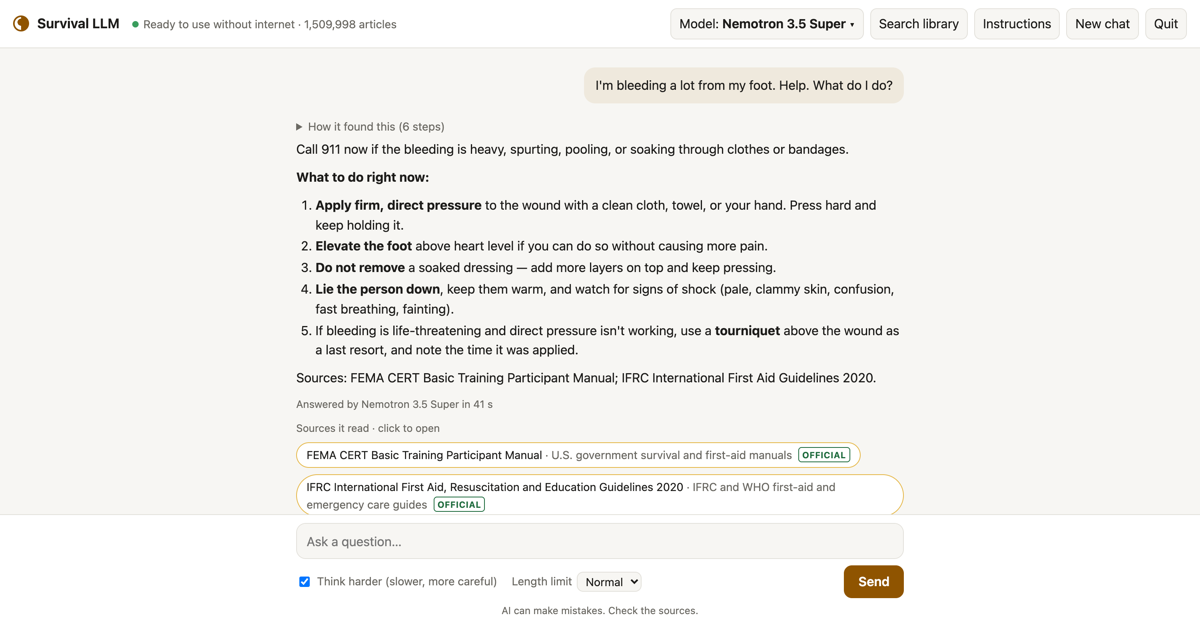 Survival LLM: AI assistant and emergency library that runs on your own computer
Survival LLM is a free, open-source desktop app for macOS (Apple Silicon) and 64-bit Windows that runs an AI model and an offline emergency library on the user's computer. It checks the machine's memory, downloads a fitting model, and answers from sources such as Wikipedia, WikiMed, Ready.gov and CDC guidance, citing each article. Users can add their own files; version 0.3.2 is dated October 2026.
 brangus.iotoolAdded 28 Oct 2026, published 27 Oct 2026
- When Is Additional Retrieval Worthwhile? A Cost-Aware Study of Evidence Gain and Answer Reliability in RAG
This paper studies a cost-aware, two-action RAG routing policy that chooses between dense retrieval plus reranking and a hybrid lexical-dense retriever, using a regularized linear model to predict per-question evidence gain. On 60 held-out QASPER articles (188 questions), it triggers hybrid retrieval on 24.5% of questions and matches always-hybrid Hit@10 (78.70%). Answers from 4-bit Qwen3-4B show no clear correctness or faithfulness gain, and the assessments are model-assisted.
arxiv.orgpaperAdded 28 Oct 2026, published 27 Oct 2026 - Tessera: Structure-Completed Evidence Units for Web Retrieval-Augmented Generation
Tessera is a training-free evidence delivery layer for web retrieval-augmented generation. It rebuilds retrieved pages' HTML into fine-grained evidence units, each completed with page title, section path and table headers, then packs the relevant units into the reader context at the same token budget. Tracing evidence over full English Wikipedia shows chunking loses table and infobox content. Tessera adds 5 to 6 accuracy points on three QA benchmarks and carries over to agentic search.
arxiv.orgpaperAdded 28 Oct 2026, published 27 Oct 2026 - p-DCIM: A 28nm Probabilistic SRAM DCIM based Ising Machine for Near-Memory Context Selection in LLM-RAG Pipeline
p-DCIM is a 28 nm SRAM digital compute-in-memory macro (0.16 mm2, 0.41 mW) that works as an Ising machine for RAG evidence selection. Selection is cast as a QUBO problem, and the same MAC datapath computes embedding similarities and annealing steps. Replacing LLM reranking with it gives a selection-energy estimate over six orders of magnitude lower and cuts total energy per query by 67%, with comparable token-level F1 on the evaluated examples.
arxiv.orgpaperAdded 28 Oct 2026, published 27 Oct 2026 - Show HN: Hob - Open-source, on device alternative to Claude Cowork and ChatGPT
Hob is an MIT-licensed desktop app from Frigade that runs open-weight models such as Gemma and gpt-oss locally on Mac, Windows and Linux. It picks the best open-weight model that fits the user's computer and sets it up. It is positioned as a free, private, offline alternative to Claude and ChatGPT for tasks like filling out PDFs and working through documents. The page gives no technical detail on its runtime.
github.comrepoAdded 27 Oct 2026, published 26 Oct 2026 - Reversible Pseudonymisation of Documents Sent to External LLMs: an Open Bilingual Benchmark and an Engine
This paper presents an open benchmark of five existing pseudonymisation tools and a regex baseline on Russian and UK English documents, plus an open engine built on the two strongest tools. On a held-out set of 1,000 synthetic documents per language, the best existing tools leave a whole value visible in 58 to 61% of documents. The engine does so in 0.2 to 0.3%. Russian name restoration reaches only 94.6%, below the 99% threshold. Real documents were not tested.
arxiv.orgpaperAdded 27 Oct 2026, published 25 Oct 2026 - HerHealthGPT: An Evidence-Grounded Conversational AI System for Women's Reproductive Health Copy title
HerHealthGPT is a conversational AI system for women's reproductive health that combines retrieval-augmented generation, context-aware clarification and source validation in a web interface. Evidence retrieval raises concern-category accuracy from 54.1% to 59.3% over fine-tuning alone on 540 messages from 90 cases. The clarification router reaches 85.6% recall and 86.2% specificity. In a 30-adult study, 83.3% preferred the retrieval-enabled version. The authors say clinical validation is still needed.
arxiv.orgpaperAdded 27 Oct 2026, published 24 Oct 2026 - DRILS: Dependency-based Requirement Change Impact Analysis Using LLMs
DRILS is an LLM-based agentic framework for requirements change impact analysis. It uses multiple agents to generate candidate impact sets, with an LLM-as-a-judge promoting diversity in selection. It adds RE-RAG, a tuned retrieval technique, and a requirement dependency graph as a knowledge source. On three curated datasets it reaches 87.1% recall, 76.3% precision and 81% F1 at lower cost than baselines. The authors release the datasets.
arxiv.orgpaperAdded 27 Oct 2026, published 24 Oct 2026 - Big Bull (@BIGBULLapp) on X
5ire is a desktop AI assistant and MCP client that connects to OpenAI, Anthropic, Google, Mistral, Grok, DeepSeek and Ollama from one window. It has a local knowledge base and tool calls over Model Context Protocol. The tools feature needs Python, Node and uv installed because it runs a local MCP server; without them it works only as a chat client.
 x.comthreadAdded 25 Oct 2026, published 24 Oct 2026
- TriageRAG: Failure-Aware Self-Training for Adapting Retrieval-Augmented Language Models to Specialized Domains
TriageRAG is a failure-aware self-training method for adapting retrieval-augmented LLMs to specialized domains using only an unlabeled corpus. It probes the student on self-generated questions with and without retrieved context, sorts them into known, solved, context-failure and retrieval-failure, and routes each to a matching training signal. With Qwen3-4B on 11 datasets it beats budget-matched SimRAG by 1.2-6.4 points and recovers closed-book accuracy where retrieval hurts.
arxiv.orgpaperAdded 27 Oct 2026, published 24 Oct 2026  LitPivot: Developing research ideas through dynamic contextualization within the literature landscape
LitPivot is a system from Ai2 and the University of Pennsylvania that helps researchers revise early research ideas when reading prior work changes their direction. It splits a proposal into problem, contribution and evaluation facets, groups papers from Asta Paper Finder per facet, and offers critiques with supporting excerpts and suggested rewrites. In a 17-researcher study, domain experts rated LitPivot ideas as better grounded in the literature than ideas made with a text editor and an AI chat tool.
 huggingface.coarticlePublished and added 23 Oct 2026
- Semantically Rich, Metrically Affect-Blind: A Geometric Blind Spot in Modern Text Embedders
Sentiment-Injected Sentence Embeddings (SISE) addresses a finding across eleven frozen text encoders (2021 to 2026): linear probes recover sentence polarity at up to 91.3% accuracy, but cosine similarity separates polarity by only 0.003-0.064. A small supervised-contrastive head (0.13M-0.69M parameters) trained on CPU raises retrieval MAP by up to 26 points, but the 128-d head loses 38-41 STS-B Spearman points. The paper also releases the Attribute Alignment Gap diagnostic.
arxiv.orgpaperAdded 26 Oct 2026, published 23 Oct 2026 - Build more responsive apps with the Decisions API
The Decisions API is an OpenAI endpoint, built on GPT-6 Luna, that answers bounded questions about text, images or native JSON inputs, up to 10x faster than Luna through the Responses API. It returns a probability (predicate), a choice or a score. It is generally available, accepts up to 400 questions per request, and costs $0.10 per million input tokens with no output charges.
 openai.comarticlePublished and added 22 Oct 2026
- How Ground Truth Shapes Retrieval Scores: Evidence-Aware Evaluation of a Retrieval-Augmented Generation System for Breast Lesions
This paper describes an evidence-aware retrieval evaluation protocol for a clinical RAG system over breast lesion management literature. Relevance is defined by evidence spans mapped to all containing chunks. A hybrid retriever (dense, BM25, cross-encoder reranking) with 384-token chunks and 20% overlap reached 0.94 Recall@3 on 18 queries. Expanding ground truth from 25 to 37 spans did not change rankings. The authors note the small set needs independent validation.
arxiv.orgpaperAdded 24 Oct 2026, published 22 Oct 2026 - From Structured Records to Patient Narratives: Preserving Clinical Alignment in LLM-Generated Health Summaries
This paper studies evidence-grounded health summarization for menstrual health monitoring. It combines structured evidence conditioning with RAG in a prompt-based constrained generation framework, and scores 4,500 summaries from three LLMs with NLI, atomic factuality metrics and readability measures. Grounding constraints improved uncertainty preservation and generally kept or improved faithfulness against retrieved evidence, while omission effects varied by model. Clinical alignment came with harder reading and more medical terminology.
arxiv.orgpaperAdded 24 Oct 2026, published 22 Oct 2026  You are the Team — Anekha Sokhal, Moshi
Latent Space interview with Anekha Sokhal, CEO of Moshi, recorded at AI Engineer New York. Moshi is a market-intelligence product for commodity and energy traders. It ingests structured and unstructured data, builds an ontology and graph, and pushes recommendations to each trader's book. She covers confidence scoring across divergent sources, an in-house vision-language model for messy PDFs, and build-versus-buy tradeoffs.
 latent.spacetalkAdded 23 Oct 2026, published 22 Oct 2026
 The Recommendation Engine for Commodity Traders — Anekha Sokhal, Moshi
Latent Space podcast episode recorded at AI Engineer New York, in which Moshi CEO Anekha Sokhal, a former JPMorgan energy derivatives trader, describes a recommendation engine for commodity traders. Moshi ingests structured and unstructured market data plus private user data, tags it into a graph ontology and pushes items relevant to a trader's book. She covers confidence scores across divergent sources, an in-house vision-language model for messy PDFs, and build versus buy.
latent.spacetalkPublished and added 22 Oct 2026- You are the Team — Anekha Sokhal, Moshi
Latent Space interview with Anekha Sokhal, CEO of Moshi, recorded at AI Engineer New York. Moshi is a recommendation engine for commodity and energy traders that ingests structured data, news, X posts, podcasts and private user documents into a graph. Topics include confidence scores for divergent sources, a self-built vision-language model for PDFs, build versus buy, and engineers told "you are the team".
latent.spacetalkPublished and added 22 Oct 2026 - Chunk Recomputation under Real Document Revisions: Measuring Update Cost and Retrieval Quality of Fixed, Recursive, and Content-Defined Chunking
Chunk Recomputation under Real Document Revisions measures how much text must be re-embedded after edits for three stateless chunkers (non-overlapping fixed-size, recursive paragraph-first, content-defined) on 120 pairs of adjacent Chinese and English Wikipedia revisions. Fixed-size recomputes 57-68% of the new-version workload, recursive 38-56%, content-defined 43-54%, while evidence recall at a 2048-token budget differs by under two points. The authors argue update cost should be reported alongside retrieval quality.
arxiv.orgpaperAdded 24 Oct 2026, published 22 Oct 2026 - OpenAI CLI
OpenAI CLI is OpenAI's official Go command-line client for the REST API. It lets users generate images, upload and download files, create and wait on batches, call the Responses API, and query admin usage endpoints from a terminal or shell script. It supports JSON, JSONL and YAML output, GJSON transforms, shell completion, and install via Homebrew, go install or release binaries.
github.comrepoAdded 23 Oct 2026, published 22 Oct 2026 - SpyTech Ai (@RizeOnline) on X
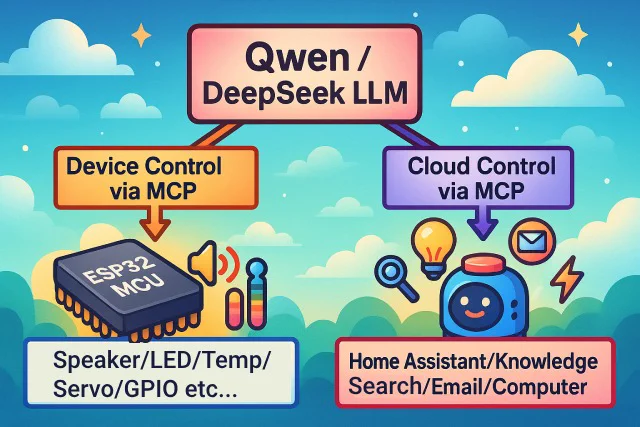
XiaoZhi ESP32 is an open-source, MIT-licensed firmware stack that turns ESP32 boards into MCP-based voice chatbots using models such as Qwen and DeepSeek. It streams Opus audio over WebSocket or MQTT + UDP through ASR, LLM and TTS, adds offline ESP-SR wake words, and uses device-side MCP to drive speakers, LEDs, servos and GPIO. It supports 138 board directories and builds with ESP-IDF 6.0.1 or newer.
x.comthreadAdded 23 Oct 2026, published 21 Oct 2026 - How we built ChatGPT’s novel ad stack for user trust and relevance
OpenAI's ChatGPT ad stack uses a custom post-trained LLM, the orchestrator, that makes tool calls for retrieval, filtering, scoring and auction nomination across stateful ad sessions. Ad selection runs in a separate service from answer generation, so ads cannot influence responses or delay them. The post covers ANN retrieval, a model-generated preamble, delivery versus impression, logging, and model-based evaluation.
openai.comarticlePublished and added 21 Oct 2026 - Protection Is Not One Event: A Survey of RAG Protection Research by Measured Endpoint
Protection Is Not One Event is a survey and human-coded evidence map of 118 RAG defense papers, grouped by measured endpoint into a seven-family taxonomy (kappa=0.867 across 32 annotators). It finds that only 17.8% of studies use content disclosure as their primary endpoint, and that most evaluations use general QA data and non-adaptive attacks. In a testbed on Qwen3-8B, an 8-gram guard cut copying to 0.0%, yet a three-query adaptive attacker still recovered 48.3% of hidden facts. Taxonomy, dataset, coding protocols and testbed are released.
arxiv.orgpaperAdded 24 Oct 2026, published 21 Oct 2026 - 0xMarioNawfal - The Roundtable Show (@RoundtableSpace) on X
Headroom is an open-source GitHub project that compresses logs, files and tool outputs before they reach an AI coding agent. The tweet by RoundtableSpace claims up to 95% fewer tokens for JSON and about 20% fewer overall, with the same answers and lower API bills. The tweet gives no method or benchmarks, and the repo link is truncated.
x.comthreadAdded 21 Oct 2026, published 20 Oct 2026 - DeclineCraft: A RAG Abstention Benchmark for Jointly Measuring Combined Retrieval and Parametric Knowledge
DeclineCraft is a dynamic RAG abstention benchmark whose unanswerable questions target Minecraft feature additions made after a corpus cut-off, with audits for parametric exposure. Across 27 LLMs, single-shot retrieval raises Correct Abstention Rate in 38 of 40 configurations, while iterative RAG lowers it in 30 of 40. Enabling thinking without retrieval lowers abstention for 8 of 13 models, shifting responses to premise denial.
arxiv.orgpaperAdded 22 Oct 2026, published 20 Oct 2026 - A Multimodal Engineering GraphRAG Framework for Post-Wind-Event Building Assessment and Recovery Inference
This paper presents a multimodal engineering GraphRAG framework that links post-wind-event damage evidence from images and reconnaissance reports to building-condition states, recovery actions and downtime. Evidence is stored as a provenance-preserving, component-level representation, and graph-aligned retrieval uses compatibility, contradiction, evidence-precedence and abstention checks. Demonstrated on tornado-affected low-rise homes, it beats BaselineRAG and Structured Baseline RAG, and ablations test each component.
arxiv.orgpaperAdded 22 Oct 2026, published 20 Oct 2026  Publish fake stats, get cited in LLMs
StateGlobe is an experiment in which a Peec AI researcher generated 50,000 fake statistics pages with GPT-4.1 for about $50. After 7 months, Google had deindexed the site, but ChatGPT-User still made about 72,000 requests in 30 days. The site drew 10,000+ ChatGPT sessions and 330+ referring domains, and its numbers were cited in an academic paper and bank research. The post explains why retrieval differs from ranking and how to build real statistics pages.
 peec.aiwriteupAdded 21 Oct 2026, published 20 Oct 2026
 AnyLanguageModel 1.0: One Year of Local Models on Apple Platforms
AnyLanguageModel 1.0 is a Swift package that gives apps Apple's Foundation Models API across the system model, llama.cpp, MLX, Core ML and hosted providers. This release post covers tool calling and guided generation on every provider, image input, and hosted support for OpenAI, Anthropic, Gemini, Ollama and Hugging Face Inference Providers. It also ships swift-huggingface 1.0 and swift-xet 1.0, and lists small open-weight models that fit on iPhone and Mac.
huggingface.coarticlePublished and added 20 Oct 2026 Introducing Clairic, a new System One class of extraction models
Clairic is Cloudflare's preview System One extraction model, hosted on Workers AI as @cf/cloudflare/clairic, with open weights planned. It reads text or images in one forward pass and returns typed values with spans, confidence, p_null, 80% intervals for estimates and forecasts. A claim-handling cascade with Clef and GLM-5.3 ran in 19.3 seconds against 61.7 for an all-LLM version.
 blog.cloudflare.comarticleAdded 29 Oct 2026, published 19 Oct 2026
- EpiLens: Lightweight RAG for Epidemiological Knowledge Acquisition
EpiLens is a lightweight, open-source retrieval-augmented generation package that applies a fixed retrieval template and output schema to every paper in a corpus and links outputs to source passages. On a corpus of 2,297 epidemiology papers, its classifier matches or exceeds supervised and zero-shot baselines on four tasks without task-specific training data, scored against 214 manual labels. It also compares model-based study shares across parameters and pathogens.
arxiv.orgpaperAdded 21 Oct 2026, published 19 Oct 2026 - Large-Scale Biomedical RAG: Corpus Scaling, Document Representation, and Efficiency Trade-offs
This paper is a controlled, large-scale evaluation of biomedical Retrieval-Augmented Generation across growing corpus sizes. It compares abstract, flat full-text and hierarchical full-text representations, with and without reranking, on multiple-choice QA over five external benchmarks and a held-out test set. RAG gave mean gains of up to 9.6 points externally and 10.2-30.3 points on the held-out set. Hierarchical indexing used 67% fewer units and 44-56% less storage than flat full-text.
arxiv.orgpaperAdded 21 Oct 2026, published 19 Oct 2026 - Saylor (@Kev96790724) on X
G-Krusch is an MIT-licensed, local-first Google Workspace hub built on Node.js 22 and SQLite WAL. It runs a 12-tool MCP server (SSE and Stdio) plus a REST bridge on port 5446 for Drive, Calendar and Gmail. It includes a 1,024-dimension hybrid Drive RAG with an embedding cascade (Ollama bge-large, then Gemini, then offline fallback) and FTS5 BM25. PDF extraction returns page citations. Tokens are kept in an AES-256-GCM vault; 30 of 30 tests pass.
x.comrepoAdded 21 Oct 2026, published 19 Oct 2026  DeepSeek search and fetch – $0.75 per 1000 successful requests
DeepSeek Search & Fetch are two JSON APIs for agents and RAG apps. Search (/v1/tools/search) returns structured results from DeepSeek's in-house engine, with count, need_content and operators such as site:, lang: and after:. Fetch (/v1/tools/fetch) returns a page as Markdown. Both use bearer auth, bill only successful requests ($0.75 per 1000), and have account-level QPS limits. Calls from DeepSeek Harness, Claude Code or Codex are free until 1 November 2026.
 api-docs.deepseek.comotherAdded 19 Oct 2026, published 18 Oct 2026
 Show HN: Things to Do API
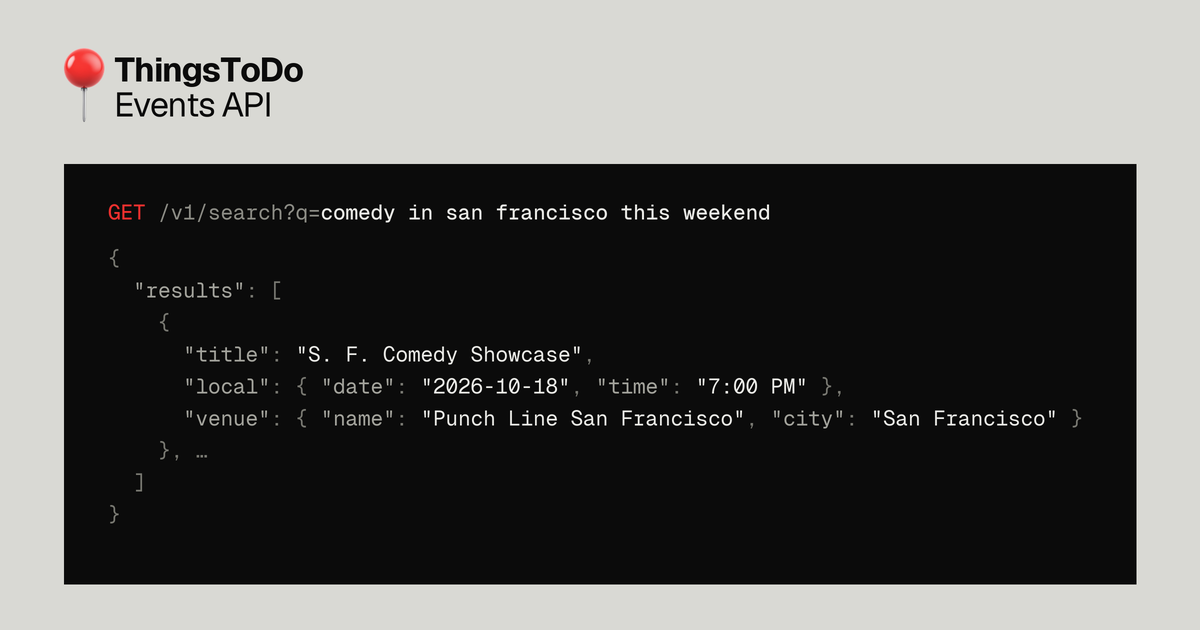
Things to Do API is a hosted knowledge base of local events (shows, talks, pop-ups, markets, festivals) that you query in natural language, for example `/v1/search?q=comedy+in+san+francisco+this+weekend`. It returns structured JSON with title, category, local start time, venue and ticket and source links. It also exposes an HTTP MCP endpoint, added with `claude mcp add --transport http thingstodo https://api.thingstodoapi.com/mcp`, so agents can use it as a tool. Coverage is live for the San Francisco Bay Area, with New York City and Los Angeles coming. Pricing is pay-as-you-go from $5 per 1,000 calls, the first 1,000 a month are free, and there is a 300 calls/min limit.
 thingstodoapi.comtoolAdded 18 Oct 2026, published 16 Oct 2026
- ThetreStageAI: Multi-View Retrieval-Augmented Generation for Structured Bengali Theatre Production Planning
ThetreStageAI is a retrieval-augmented framework for structured Bengali theatre production planning. It keeps separate scene, actor-blocking and lighting views, embeds Bengali text with BGE-M3, indexes it in view-specific Qdrant collections, and has Gemini generate schema-constrained JSON, with validation and at most one repair attempt. The authors build a synthetic dataset of 500 records (1,500 retrieval documents) and compare single-combined retrieval with multi-view retrieval. Code and data are public.
arxiv.orgpaperAdded 20 Oct 2026, published 16 Oct 2026 - Enhancing RAG-based Medical VQA with Gated Multimodal Representations
This paper presents a multimodal retrieval-augmented generation framework for Medical Visual Question Answering. A Gated Multimodal Unit learns a joint query representation from the medical image and the clinical question, so evidence retrieval uses both modalities while the Med-LVLM stays frozen. On benchmark datasets it consistently beats a reference Med-LVLM and stays competitive with state-of-the-art methods. The page gives no dataset names or numbers.
arxiv.orgpaperAdded 20 Oct 2026, published 16 Oct 2026 - PrairieFire: Igniting High-Throughput Updates in Large-Scale Approximate Nearest Neighbor Search
PrairieFire is an SSD-based approximate nearest neighbor search system for billion-scale vectors, built for high update throughput. It uses buffered updates and batched local rebuilds, with cascaded adjustments, concurrency control and CPU-GPU-SSD cooperation. Against state-of-the-art systems it reports about 3-35x update throughput, 3-5x search throughput and 1.5-8.7x cost efficiency. It has run in RedNote production for two months.
arxiv.orgpaperAdded 20 Oct 2026, published 16 Oct 2026 - Private Retrieval Augmented Generation via Random Projection
Proposes protecting the retrieval datastore in RAG systems by applying the same random projection to datastore embeddings and query embeddings. This provably preserves query-item semantic similarity while substantially mitigating data extraction attacks. Across multiple RAG architectures and datasets it beats prior differential-privacy-based methods on retrieval and generation quality, with comparable empirical privacy under strong attacks, making it a practical baseline for privacy-preserving RAG.
arxiv.orgpaperAdded 17 Oct 2026, published 15 Oct 2026 - Librarian Agents: Training LLMs to Curate Long-Context Workspaces that Anticipate Future Queries
Introduces Librarian Agents, where a builder agent turns raw unstructured documents into a hierarchical filesystem of synthetic files and reference links, forming a workspace for a downstream answering agent. Workspace construction is cast as a Markov decision process and the builder policy is trained with reinforcement learning to maximize downstream answering accuracy. It beats the strongest retrieval and precomputation baselines by 33 points on BrowseComp-Plus, amortizes construction cost over repeated queries, and generalizes zero-shot to BRIGHT with a 31-point average gain.
arxiv.orgpaperAdded 17 Oct 2026, published 15 Oct 2026 - Multi-sourced AI Tutor for Non-Native English Speaker Students
Describes a general-purpose LLM-based AI tutor for computing courses that accepts questions in Mandarin and replies bilingually, also generating glossaries of technical terms. It uses a specialized multi-source RAG pipeline with a novel question extraction mechanism to draw on diverse course materials. Evaluated on 91 Piazza posts: 83.52% answered correctly and helpfully, 76.92% of questions got high-quality translations, and 64.47% got glossaries.
arxiv.orgpaperAdded 17 Oct 2026, published 15 Oct 2026 - GACC-Bench: Benchmarking Goal-Adaptive Context Compression Ability across Large Language Models
GACC-Bench is a benchmark for Goal-Adaptive Context Compression, testing how well LLMs retain goal-relevant information when compressing a source context under a length budget before downstream questions are known. It has 500 goals and 2,571 human-reviewed questions over 281 document and agent-trace contexts from seven collections; a fixed reader answers the withheld questions from the compressed context. Ten LLM compressors show large gaps to full-context performance, especially in answering every question tied to a goal. Target-goal conditioning improves accuracy over goal-agnostic compression, while mismatched goals hurt it.
arxiv.orgpaperAdded 17 Oct 2026, published 15 Oct 2026 - Show HN: Graphicle, a Rust port of Graphify with memory for coding agents
Graphicle is a local-first Rust program that parses a repository into a tree-sitter code graph (a port of Graphify) and adds project memory: docs, reviewed decisions and captured Claude Code/Codex sessions. It serves cited file-and-line excerpts within a token budget via one MCP server, CLI and browser app, backed by a single SQLite file, with no API key or telemetry. The README reports a code-only extract on Kubernetes (31k files) in 3m18s versus 26m38s for Graphify 0.9.88, and a memory comparison against seven systems. Agent-proposed memories need user approval and go stale when the code they reference changes.
github.comrepoPublished and added 14 Oct 2026 - Legal-R1: Agentic Retrieval for Evidence-Based Legal Reasoning
Legal-R1 is an agentic retrieval framework for evidence-based legal question answering that splits reasoning across three agents. A Lawyer agent decides when to retrieve, which legal source to query, what evidence to seek and when it has enough. A Legal Assistant retrieves statutes and precedent cases with authority-aware and diversity-aware selection, and a Judge agent writes the final answer from the full evidence trajectory. Only the Lawyer agent is post-trained, using masked supervised fine-tuning and trajectory-aware reinforcement learning. The paper reports gains over general-purpose, legal-specific and retrieval-augmented baselines on several Chinese legal benchmarks.
arxiv.orgpaperAdded 14 Oct 2026, published 13 Oct 2026 - Configuring RAG Systems: What Breaks, Where Originates, and How to Fix
First large-scale empirical study of RAG configuration issues, covering 654 real-world issues collected from 10 diverse RAG systems. It categorizes symptoms, root causes, affected pipeline stages and fix patterns. It finds that symptoms mostly appear at early or late stages, while the root cause often sits in a different stage from where the symptom shows. It closes with nine actionable insights for testing, localizing and fixing RAG configuration problems.
arxiv.orgpaperAdded 14 Oct 2026, published 13 Oct 2026  How to engineer an AI harness for game development
Blog adaptation of an Indie Rodeo talk arguing that LLMs struggle with games because much of a game is opaque non-code, and that this is a context problem. It prescribes concrete architecture so a game becomes its own agent harness: seeded randomness, a single "Thing" fat-struct object model, serializable commands, external data editable without recompiling, a standalone simulation core, odiff image diffing for screenshot evaluation, and samply text profiling. The aim is an agentic loop that runs in seconds per change.
 kylekukshtel.comwriteupPublished and added 13 Oct 2026
- AI Agents for Cybersecurity: A Guided Tour of a Repository with Tons of Resources and Examples
A guided tour of a GitHub repository of resources and examples for building AI agents, published on the Becoming a Hacker blog. Per the routing note, it covers LangChain 1.x, LCEL, RAG, LangGraph, CrewAI, DeepAgents, MCP servers and token-cost control such as caching, routing and budget guards. The fetched page held only a LinkedIn redirect notice, so the article text was not read.
 linkedin.comarticleAdded 13 Oct 2026
- santosomar/AI-agents-for-cybersecurity
Companion repository for Omar Santos's Pearson and O'Reilly trainings and books. It has eight parts of runnable Python labs: chat models, embeddings, prompt templates, LCEL prompt chaining, Chroma-based RAG, ReAct/LangGraph/CrewAI/DeepAgents agents, and FastMCP servers (nmap, CISA KEV, Shodan). It also includes guides to six agentic frameworks (OpenClaw, Hermes, Agent Zero, OpenHands, Paperclip, Buzz), a tokenomics module on agent cost (context compounding, prompt caching, model routing, token budget guards, batch API, cost per accepted outcome), and a vendor-neutral design spec for a human-gated multi-agent assessment harness. It is a current, practical curriculum for building and operating agents. Some examples act on real systems and should only be run in an authorized lab.
github.comrepoAdded 13 Oct 2026  google/embeddinggemma-2
Model card for EmbeddingGemma 2, an open (Apache 2.0) 740M-parameter multimodal embedding model from Google DeepMind built on Gemma 4. It maps text, code, images, video and audio into one 768-d space, with a 270M text backbone and optionally loadable 170M vision and 300M audio encoders, an 8K context, and Matryoshka truncation to 128/256/512/768 dims. The card gives practical guidance: task instruction prefixes, re-normalising after truncation, avoiding float16 (NaN or degraded embeddings), interleaved multimodal inputs with placeholder tokens, and vision token budgets. It targets on-device search, RAG, classification and clustering.
huggingface.corepoAdded 12 Oct 2026 Context Engineering for Application Security | Endor Labs
Endor Labs whitepaper on using context engineering to make AI coding assistants produce secure code. It covers secure prompting (priming, decomposition, refinement with design-spec and test-first patterns), reusable system rules such as Cursor rules and the CSA R.A.I.L.G.U.A.R.D. framework, and external SAST/SCA tools wired in through MCP servers with a rule that triggers scans. It also covers the costs and risks: extra token use, models ignoring rules, untrusted community rules, and MCP server supply-chain threats. It cites figures such as 62% of AI-generated solutions containing flaws and a 77.5% reduction in weaknesses from recursive prompting.
 endorlabs.comarticlePublished and added 12 Oct 2026
- Igor Carron (@IgorCarron) on X
Igor Carron's tweet highlights LightOn's open-source ColGrep-Agent-2B, a 2B model released on Hugging Face for code search and retrieval that works with Claude Code. LightOn reports 34% fewer API tokens and 40% lower API costs. It matters because usage limits and token costs are a pain point for coding agents. A reply thread in the same post notes quota exhaustion across Grok, Cursor, Devin, Claude and Codex, and argues for quota dashboards.
x.comthreadPublished and added 12 Oct 2026 - bilawalsidhu/gods-eye-view
God's Eye View is an open-source, vanilla JavaScript + CesiumJS + Vite 3D globe that fuses live public feeds (aircraft, ships, satellites, quakes, public cameras, weather) into one explorable scene. Its AI layer is a hands-free voice agent on the OpenAI Realtime API with 30 tools: camera fly-to, whiteboard annotations, analyst queries over live layers, and scene-context and screenshot grounding. Keys stay server-side and the browser gets only a short-lived session token. An experimental ChatGPT/Codex OAuth path is also supported. The app doubles as an MCP server, so Claude Desktop, Codex or ChatGPT can open the globe from a conversation.
github.comrepoAdded 11 Oct 2026 - Talorys – A self-hosted personal AI agent on Cloudflare's free tier
Talorys is an open-source, single-user personal AI assistant deployed with one command (npx create-talorys) into the user's own Cloudflare account. It uses a Cloudflare Agents SDK Durable Object with SQLite for conversations, memories, tasks, notes and automations, Workers AI (@cf/zai-org/glm-4.7-flash) for streaming chat with tool calling, and Durable Object alarms for reminders and scheduled AI routines. It stays within the Workers Free plan, with a private Worker behind a Pages Function service binding, owner-password auth, per-day AI usage guardrails, and fallback to non-AI features when quota runs out.
github.comrepoPublished and added 10 Oct 2026 - Verifiable Retrieval for Legal Reasoning through Structure-driven Knowledge Graph
The paper builds a Knowledge Graph from German Legal Code by structure-driven parsing, then uses it to navigate sources and retrieve from them in a RAG pipeline. It compares several KG-informed chunking and retrieval strategies and measures their effect on the accuracy of retrieved citations. The aim is verifiable, transparent retrieval for reliability-critical domains, where naive retrieval degrades as the number and size of sources grows.
arxiv.orgpaperAdded 12 Oct 2026, published 9 Oct 2026 - Show HN: Apogee: Rebuilding Mozilla's Orbit, fully local and private
Apogee is a privacy-first browser extension (Chrome/Firefox) that summarizes articles, YouTube/Bilibili videos, PDFs, DOCX and pasted text entirely on-device, inspired by Mozilla's discontinued Orbit. It runs models via WebGPU or WebAssembly in the browser, or connects over loopback to a local Ollama or llama.cpp server, with local passage retrieval for Q&A, grounded sentence highlighting, and Opus-MT translation. It shows a practical no-backend, no-API-key architecture for local LLM apps, with a Node.js extractor test harness for contributors.
github.comrepoPublished and added 9 Oct 2026 - The Geometry of Hierarchical Navigation: Accuracy and Query Cost for Point Process Input
Theoretical analysis of greedy search on a hierarchy of proximity graphs built from n points on the d-dimensional torus. It gives a deterministic coverage condition guaranteeing a (1+ε)-approximate nearest neighbor for any query. The condition holds w.h.p. for homogeneous Poisson, Hermitian determinantal and bounded-density Cox point processes when d = o(log n / log log n), and the expected hop count is O(exp(½ d log d + O(d)) log n), so logarithmic in fixed dimension. It gives formal grounding for the hierarchical ANN indexes used in RAG and recommendation retrieval.
arxiv.orgpaperAdded 9 Oct 2026, published 8 Oct 2026 - Is Memorization Context-Sensitive? Prefix-Based Extraction Beyond Isolated Prefixes
The paper measures whether retrieved context, as in RAG, reduces LLM memorization. It does this with paired item-level probabilistic suffix extraction: each prefix-suffix pair is scored under an empty prompt and under retrieved contexts of varying relevance, across three open-weight instruction-tuned models. Extractable memorization splits into a context-robust core and a context-sensitive boundary. Context suppresses some marginal exposures but also enables new ones that prefix-only evaluation misses, which qualifies the claim that RAG lowers memorization risk.
arxiv.orgpaperAdded 9 Oct 2026, published 8 Oct 2026 - RECAST: Learning to Compute the Right Context through Adaptive Evidence Routing
RECAST (Routing Evidence through Computation, Access, and Synthesized Tools) reframes retrieval-augmented generation as a sequential decision process: a lightweight RouterLM iteratively selects or formulates primitive/custom operations, a frozen CompilerLM turns custom operations into executable code, and a frozen AnswerLM produces the final answer once evidence is judged sufficient. RouterLM is trained with supervised fine-tuning followed by GRPO, and the system reaches a 75.6% mean success rate across six heterogeneous benchmark families, beating the strongest large-model baseline by 15.9% and a training-free Gemini 3.5 Flash router by 5.0%, with strong zero-shot generalization on three held-out benchmarks. It targets tasks where evidence must be derived through filtering, aggregation, or computation across multiple sources rather than retrieved verbatim.
arxiv.orgpaperAdded 8 Oct 2026, published 7 Oct 2026 - Does Document Structure Help Dense Retrieval? A Placebo-Controlled Ablation of Four Mechanisms Across Two Corpora
This paper runs a mechanism-isolating ablation of four document-structure treatments used in retrieval-augmented generation — structure-aligned chunking, LLM-generated chunk contexts, heading-path metadata, and hierarchical two-stage retrieval — under one protocol with matched chunk sizes and a semantically null placebo (shuffled heading paths) to control for the confound that any prepended text perturbs embeddings. Using a coverage-aware nDCG metric and document-clustered bootstrap with Holm correction across 200 Wikipedia Featured Articles (951 queries) and 1,585 QASPER papers (4,303 questions), it finds that structure-aligned chunking with real heading paths beats both contextualized fixed windows and the placebo, naive hierarchical retrieval hurts performance (traced to first-stage section recall failures), and gold structure beats LLM-induced structure on Wikipedia but not QASPER. Effect sizes are small but statistically significant and consistent across corpora, giving RAG practitioners evidence-based guidance on which structure-aware retrieval tricks actually help versus which are placebo effects.
arxiv.orgpaperAdded 8 Oct 2026, published 7 Oct 2026 - EntroPrefill: Renyi-Guided Context Pruning with Conditional Stability Guarantees for Retrieval-Augmented Generation
EntroPrefill proposes a Renyi-entropy-guided mechanism for pruning context mid-prefill in retrieval-augmented generation, using sink-isolated regularized head pooling compatible with grouped-query attention to decide which tokens can be safely discarded. It derives a mixture-to-head deletion envelope bounding feasible token removal, a finite-sample observer guarantee valid under adaptive layer selection, and a conditional transformer perturbation bound with explicit Lipschitz constants and a first-token decision-margin corollary, plus a systems-level break-even analysis of KV-transfer payload versus pruning savings. The paper is explicitly theoretical, defining assumptions and formal limits without reporting empirical speedup or accuracy-preservation results.
arxiv.orgpaperAdded 8 Oct 2026, published 7 Oct 2026 - GPT-6 and Intelligent UI for everyone
GPT-6 in ChatGPT adds Intelligent UI, where the model composes answers from text, charts, forms, buttons and small interactive tools using a library of native streamable components and a compiler that renders the interface as it generates. It can also start answering while still reasoning. OpenAI reports GPT-6 Instant starts web-search answers 44% sooner than GPT-5.6 Instant. GPT-6 Sol serves paid tiers and GPT-6 Luna serves Free and Go.
openai.comarticlePublished and added 7 Oct 2026 - EC-RAG: Event Chain Retrieval-Augmented Generation for Long Video Understanding
EC-RAG (Event Chain Retrieval-Augmented Generation) is a training-free framework for long-video question answering that organizes video content into an explicit, temporally ordered "event chain" instead of retrieving isolated frames or snippets. It partitions video into semantically coherent segments, fuses multi-modal signals (speech, text, visual cues) at the event level, and retrieves relevant events from the chain to answer queries, working as a plug-and-play addition to existing large video-language models (LVLMs) without extra training. Evaluated on Video-MME, MLVU, and LongVideoBench, it outperforms frame-level retrieval baselines, showing the value of modeling temporal/event structure for long-video understanding.
arxiv.orgpaperAdded 7 Oct 2026, published 6 Oct 2026 - Show HN: OpenChart – OSS TradingView alternative with your own AI agent
OpenChart is an open-source TradingView-style desktop charting app (Electron, Node.js/Bun, Effect runtime) that embeds AI agents into statistical/technical analysis, real-time market alerts and agentic opportunity research. It ships a custom DSL called Tea (inspired by TradingView's Pine Script) for writing indicators, and a conversation interface built on assistant-ui and the AG-UI event protocol so users converse with agents while charting.
github.comrepoPublished and added 6 Oct 2026 - UNREAL: Unifying Retrieval and Long-Context with a Single Model
UNREAL is a model-native evidence-selection framework that unifies corpus retrieval and long-context inference using a single mechanism built on top of a frozen LLM, adding fewer than 500K trainable parameters. It derives retrieval queries and chunk encodings directly from the LLM's internal representations, outperforming retriever-reranker systems on a 21M-chunk Wikipedia index (e.g. HotpotQA recall 49.1%→73.2%) and improving long-context accuracy (NoLiMa 1.0%→24.83% at 128K tokens) while cutting FLOPs and time-to-first-token versus full-context inference.
arxiv.orgpaperAdded 7 Oct 2026, published 6 Oct 2026 - CLIMB: Confidence-Guided Complementary Evidence for Multimodal Retrieval-Augmented Generation
CLIMB is a training-free, inference-time framework for multimodal retrieval-augmented generation that improves knowledge-intensive visual question answering. It first builds a compact, non-redundant evidence pool using an MMR-style objective balancing query relevance and redundancy, then applies an R/E/C critic (relevance, evidence specificity, cross-modal alignment) alongside a confidence estimator that only accepts an answer update when estimated confidence increases, giving a built-in stopping criterion without modifying the underlying retriever or MLLM. Experiments on Encyclopedic-VQA and InfoSeek show consistent gains over existing multimodal RAG baselines.
arxiv.orgpaperAdded 5 Oct 2026, published 2 Oct 2026 - Investigating the Role of Reasoning-Language Alignment in Monolingual Retrieval-Augmented Generation
This paper studies whether forcing an LLM to reason in a specific language helps or hurts accuracy in retrieval-augmented generation (RAG), extending prior findings from short-prompt reasoning to settings where the model must integrate large retrieved context. The authors build a fully monolingual German RAG QA benchmark set in the fictional world of the tabletop RPG "The Dark Eye" — a domain richly documented in German but too niche for the model to answer from memory — forcing retrieval rather than memorization. They find that aligning reasoning language with the query/document language (German) outperforms a mismatched but higher-proficiency language (French), showing the benefit comes from language alignment rather than raw language skill, though forced German reasoning still only matches, and never exceeds, the model's native unconstrained English reasoning. The testbed and QA benchmark are publicly released.
arxiv.orgpaperAdded 5 Oct 2026, published 2 Oct 2026 - duyet (@_duyet) on X
AI;DR is an open-source automated pipeline that scrapes AI news from 20+ sources daily, then uses an LLM (routed through AnyRouter) to rank and summarize the stories into a single edition, publishing it to a website, email newsletter, and Telegram channel. It's hosted on Cloudflare and the creator notes it was largely built and is maintained by AI agents. The tool is a concrete example of using LLM-based ranking/summarization to turn a noisy multi-source feed into one curated digest.
x.comthreadPublished and added 1 Oct 2026  Show HN: Breadcrumb, record everything on your mac + context manager for AI
Breadcrumb is a macOS app that runs locally to continuously record screen activity, meetings and app usage, then exposes that history as queryable context to AI assistants like Claude, ChatGPT, Cursor and OpenCode. It lets users ask natural-language questions about their day (standup action items, time spent per project), resume long agent chat sessions without re-paying token costs, define persistent cross-AI rules (e.g. 'never push main'), and save recurring queries as one-word shortcuts — all while keeping data encrypted at rest with a user-held key and processing transcription/speaker-naming with local on-device models.
 innerloop.workstoolAdded 2 Oct 2026, published 1 Oct 2026
- From Knowledge Access to Source Learning: Developing Source-Specific Competence
This paper introduces "source learning," the idea that an LLM agent repeatedly consulting the same authoritative external source should progressively build reusable competence in understanding it, rather than treating each access as independent retrieval. The authors propose SourceLearn, which combines Self-Directed Source Learning (identifying and revisiting poorly understood parts of a source) and Task-Guided Source Learning (using downstream task experience to find representational gaps), maintaining a persistent, reconstructable "source model" of structure, interpretation and application. Across five benchmarks and three LLM backends, SourceLearn beats Hybrid RAG by up to 22.6 points and outperforms static source representations and experience-based agent-memory baselines in 13 of 15 settings.
arxiv.orgpaperAdded 2 Oct 2026, published 1 Oct 2026 - Dan Kornas (@DanKornas) on X
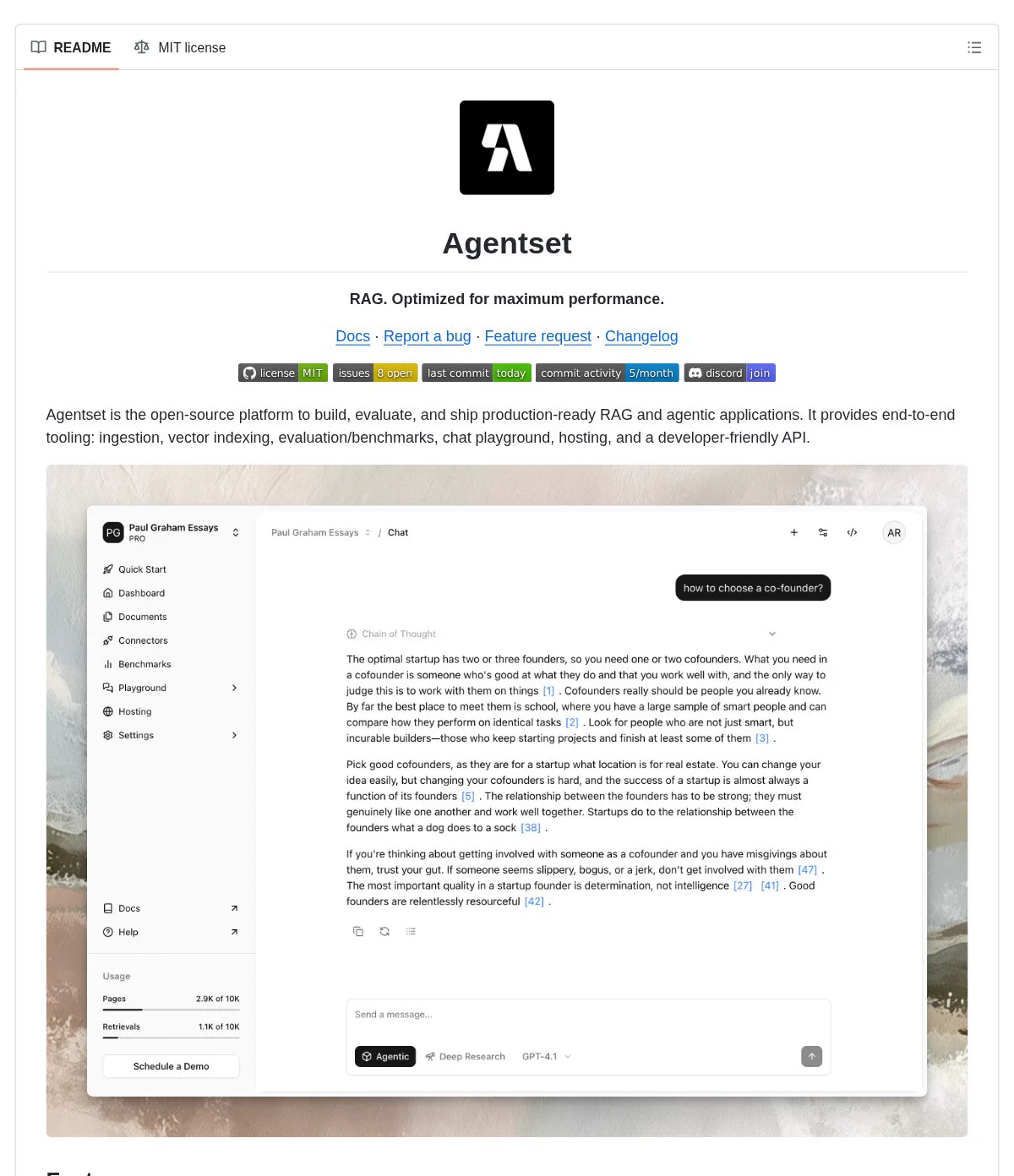
Agentset is an open-source (MIT-licensed) platform for building RAG and agentic applications, bundling ingestion, chunking, embeddings, retrieval, vector indexing, a citation-aware chat playground, evaluation/benchmark tooling, and a deployment layer (hosting, preview links, custom domains, typed SDKs, OpenAPI spec) into one codebase. It lets builders choose their own LLM, embedding model, and vector database rather than locking into a single stack.
x.comthreadPublished and added 1 Oct 2026 - Mapping the RAG Landscape: A Four Axis Taxonomy of Efficiency, Defense, Interactivity, and Reasoning
This arXiv survey organizes recent Retrieval-Augmented Generation (RAG) research into a four-axis taxonomy covering retrieval efficiency, robustness/security, user-driven interactivity, and multi-step reasoning. It formalizes RAG framework components, reviews dense/sparse retrieval, fusion strategies, embedding optimization, and RL-based retrieval policies, and compares Naive, Advanced, and Modular RAG architectural variants alongside evaluation practices and domain applications. The paper closes by outlining open challenges in retrieval quality, reliability, domain adaptation, scalability, and explainability.
arxiv.orgpaperAdded 2 Oct 2026, published 1 Oct 2026 - A Matryoshka Hierarchical RAG for Efficient Multi-Hop Question Answering
MatRAG is a hierarchical Retrieval-Augmented Generation framework for multi-hop question answering that organizes a document corpus into a Directed Acyclic Graph of clusters with progressively coarser granularity, indexing each level with a correspondingly lower Matryoshka embedding dimension. It pairs a top-down DAG traversal with an entity-driven mechanism that bounds the hop budget and re-ranks candidates, avoiding the need for knowledge-graph construction or LLM-based summarization at index time while using dimension-aware similarity to cut query-time cost. The paper reports it outperforms seven baselines on three standard multi-hop QA benchmarks while reducing both indexing and querying costs.
arxiv.orgpaperAdded 2 Oct 2026, published 1 Oct 2026 - A Citation-Grounded Benchmark for Trustworthy Earnings Call Transcript Analysis with Large Language Models
This arXiv paper introduces a benchmark for evaluating whether LLM-generated financial analyses of earnings call transcripts are properly grounded in citable evidence. It proposes a numeric evidence evaluation method that assesses groundedness without expert annotation, an automated dataset construction pipeline, and the resulting ECTs-100 dataset built from the top 100 S&P 500 constituents. The study also examines "conscious incompetence" — whether models correctly abstain when evidence is insufficient rather than hallucinating — finding LLMs ground claims well but still struggle with factual correctness and recognizing insufficient evidence.
arxiv.orgpaperAdded 2 Oct 2026, published 1 Oct 2026  Introducing zkAPI: private usage credits for any API
zkAPI, built by the Open Anonymity Project with the Ethereum Foundation, separates payment from identity for metered APIs, with AI inference first. Users deposit credits into an Ethereum vault contract and spend them as private notes. Groth16 proofs on BN254, Poseidon hashing, a 32-level Merkle tree and nullifiers authorize spends. The server mints short-lived, dollar-capped API keys, and signed usage receipts settle the metered amount. A local client exposes standard OpenAI and Ollama APIs, so existing apps work unchanged. The post also covers a proxy mode and the limits: network metadata and prompt-content fingerprinting can still link sessions.
 blog.ethereum.orgarticlePublished and added 1 Oct 2026
- Stevan Bogosavljević (@stevyhacker) on X
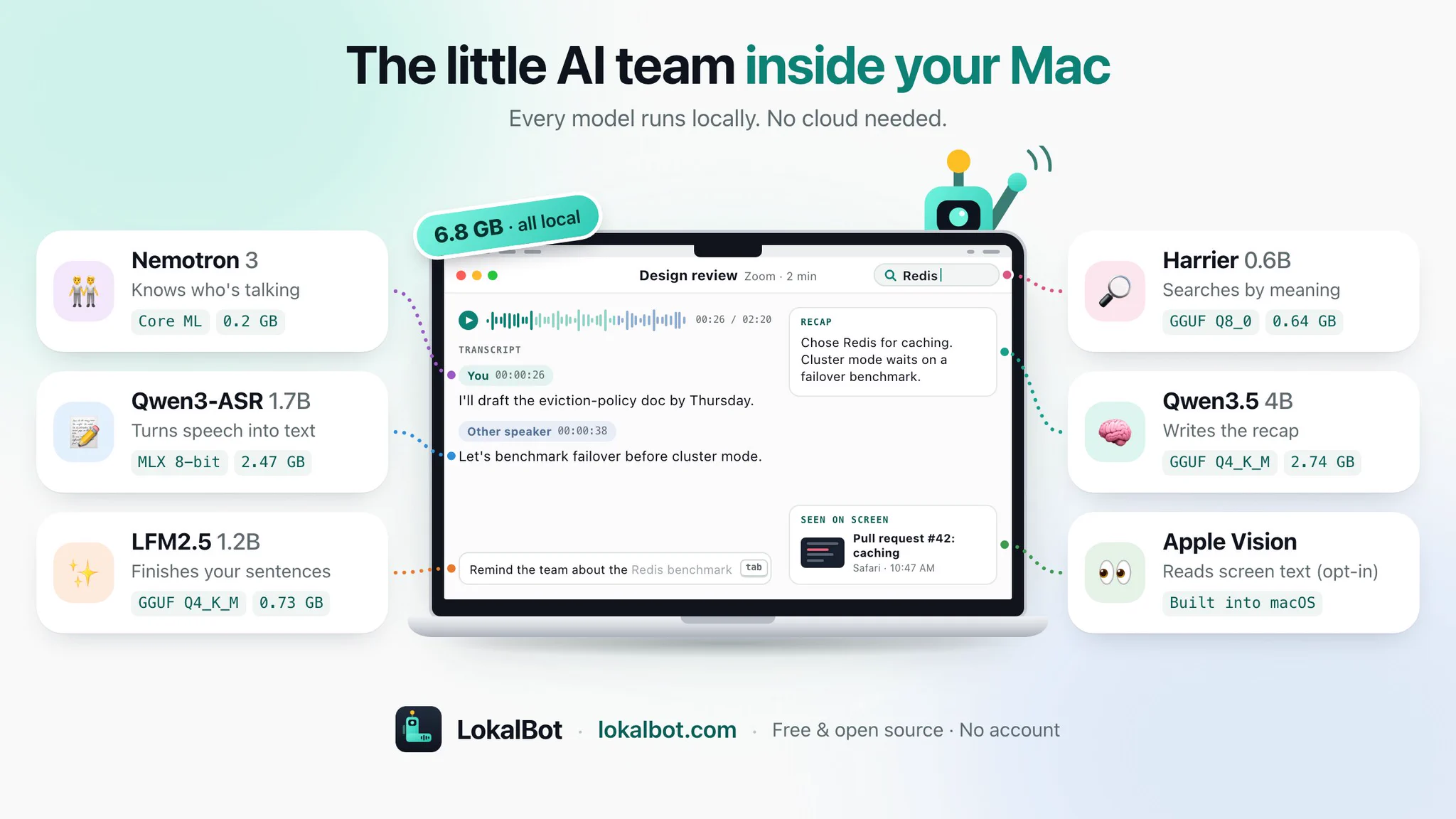
LokalBot 0.9.2 is a free, open-source local-first assistant that records meetings and screen activity, using five small open-weight models chained together entirely on a MacBook (6.8 GB total): Nemotron 3 for speaker diarization, Qwen3-ASR 1.7B for transcription, LFM2.5 1.2B for sentence completion, Harrier 0.6B for semantic search, and Qwen3.5 4B for recap generation. It exposes this captured 'memory' to Claude Code and Codex through an MCP server or CLI, letting coding agents pull context from past meetings and screen content.
x.comthreadPublished and added 30 Sep 2026 - Source-preserving alignment for robust evidence localization in scientific PDFS
Presents a source-preserving alignment framework for locating extracted evidence strings within the original PDF text layer, addressing mismatches caused by line wrapping, Unicode variants, superscripts, and citation markers. The method normalizes text for matching while preserving provenance to map matches back to exact source-character spans and render only the matched geometry, falling back to line-break-aware token alignment when exact matching fails. On 1,020 chemistry papers it achieves a 92.6% quote-level automatic localization rate versus 43.6% for plain text search and 19.1% for a precomputed bounding-box baseline.
arxiv.orgpaperAdded 29 Sep 2026, published 28 Sep 2026 - Re:CAP: Auditing Retrieval Coverage in Production RAG Pipelines
Re:CAP (REtrieval Coverage Audit by iterative Probing) is a reference-free method for auditing retrieval coverage in production RAG systems where exhaustive relevance labels don't exist. It iteratively probes a deployed pipeline's answer and retrieved context for plausibly missing topics, retrieves candidates, and uses an LLM-as-judge to keep only documents that add previously-unretrieved information. On four public benchmarks it recovers 9-48% of gold documents that flat BM25/hybrid top-500 retrieval misses (up to 48% on TREC-COVID), beats a hybrid baseline by +12.9pp recall on MuSiQue at half the document budget, and is validated by human annotators (Fleiss κ = 0.79) on both benchmark and live production traffic.
arxiv.orgpaperAdded 26 Sep 2026 - SCAR: Semantic Continuity-Aware Retrieval for Efficient Context Expansion in RAG
SCAR is an adaptive retrieval policy for RAG that combats boundary fragmentation from fixed-length chunking by selectively expanding neighboring chunks, using a relative expansion threshold tied to each chunk's own query-relevance rather than a fixed window size. Tested on four corpora (RFC, GDPR, a 10-K filing, a merger agreement; 320 queries) it hits 92.8% recall on boundary-fragmented queries using 22.9% fewer chunks than static windowing, transfers across three embedding models (text-embedding-3-large, BGE-large-en-v1.5, zembed-1) without recalibration, and cuts context tokens by 27.1% while preserving RAGAS-measured generation faithfulness.
arxiv.orgpaperAdded 26 Sep 2026 - Better prompt caching for GPT-6
OpenAI describes the improved prompt caching system for the GPT-6 family. Eligible shared prefixes reused within a 30-minute window get discounts of up to 90% on cached input tokens. It adds a Prompt Caching Dashboard for hit rates and input composition, and a diagnostics tool that reports why a request missed the cache (for example `tools_changed`) with affected token counts. It also adds explicit cache breakpoints and cache prewarming. On GPT-6 models, reasoning effort can be changed mid-conversation through an appended `configuration_update` without breaking the cache. For tool changes, it advises keeping tool definitions stable and using `allowed_tools` or `tool_choice: none` instead of removing them. Instruction changes should be appended as new developer messages. This is practical guidance for cutting cost and latency in long-running agent loops.
openai.comarticleAdded 29 Sep 2026, published 22 Sep 2026 - llm 0.36
Changelog for version 0.36 of Simon Willison's `llm` command-line tool: adds support for new OpenAI models gpt-6-sol and gpt-6-luna, lets model plugins declare supports_conversation = False so single-turn-only models raise llm.ConversationNotSupported instead of silently accepting chat history (first used by the llm-typesafe plugin), and wraps reasoning traces in collapsible details/summary tags in the Markdown output of `llm logs`. These are small but practical improvements to a popular open-source CLI for scripting and logging LLM interactions across providers.
 simonwillison.netarticleAdded 29 Sep 2026, published 22 Sep 2026
- llm-typesafe 0.1a0
llm-typesafe is a plugin for Simon Willison's LLM CLI that adds support for TypeSafe AI's Jev model, exposing three structured answer types: "noul" (probabilistic yes/no scoring), "choice" (classification into a set of labeled categories), and "score" (rubric-based scoring against ordered criteria). It lets users pipe text into the CLI with a system prompt and get back structured JSON judgments, useful for tasks like routing support messages or triaging bug reports by severity.
simonwillison.nettoolAdded 29 Sep 2026, published 22 Sep 2026 - yibie/jev-engineering-zh
A Chinese translation (with original source notes) of a design essay synthesizing TypeSafe founder Diogo Almeida's notes on 'Jev,' a typed decision model that drives a coding-agent harness. It argues coding agents are simple loops whose real leverage lies in how context is assembled each turn, and works through six problems inherited from KV-cache-driven, append-only context design: costly model routing, tool-schema bloat, lossy compaction, rare sub-agents, destructive session restarts, and the built-in-capabilities tradeoff. It proposes fixes including query-aware context scoring/visibility tiers, cost-aware routing that accounts for cache reprocessing, tiered tool disclosure, conditional AGENTS.md loading, and shared read-only background retrieval.
github.comrepoAdded 26 Sep 2026, published 22 Sep 2026 - V7 cuts costs 78% while boosting accuracy with GPT-5.6 Luna
Case study of V7 Go, an agentic workflow platform for finance and insurance. It builds a Context Graph of entities, relationships and cited evidence extracted from SharePoint and Google Drive files, with RAG fallback and an MCP server for querying and ingestion. Workflow steps are tiered across GPT-5.6 Luna (high-volume extraction), Terra and Sol (reasoning and tool use), and GPT-6 Astra (hardest graph queries). Reported results: 78% lower cost per document with Luna versus GPT-5.4 mini, tool-call error rate down from 2.7% (GPT-5.5) to 0.2% (GPT-5.6 Sol), and GPT-6 Astra at 89% versus Sol's 78% on very-hard graph-query questions. V7 also reports ~5% token savings from moving Chat Completions to the Responses API and a 69% gain over the HERB baseline. The figures are vendor and customer reported.
openai.comarticleAdded 29 Sep 2026, published 21 Sep 2026 - ruc-datalab/EvoOntology
EvoOntology is an open-source, self-evolving semantic ontology layer for data agents from Renmin University of China, exposed as MCP tools and installable as Claude Code and Codex plugins. It automatically builds a versioned ontology from tabular/file/database workloads, then continuously evolves it from agent execution trajectories using a build-use-evolve-evaluate-publish loop that validates candidate updates against a parent version before promotion. The accompanying paper reports gains over plain ReAct agents on DDR-Bench, InsightBench, and BIRD across GPT-5.5, GPT-5.6-sol, Claude-Sonnet-5, and Claude-Opus-4.8 backbones.
github.comrepoAdded 26 Sep 2026, published 15 Sep 2026  Rebuilding AUTOMATIC1111 with Gradio Workflow
A Hugging Face blog post walking through Workflow1111, a 73-node graph built with Gradio's gr.Workflow that reimplements most of AUTOMATIC1111's stable-diffusion-webui feature set as a single visual canvas: text-to-image, hi-res fix, image-to-image, prompt matrix, VLM interrogation, detection-to-inpaint masking, ControlNet-style annotators, background removal, PNG metadata round-tripping, and image-to-video, wired from models like FLUX.1-Kontext, Qwen3-4B, Qwen2.5-VL, DETR, AuraSR, BRIA RMBG-2.0, and Wan 2.2 I2V A14B. It contrasts gr.Workflow with ComfyUI, shows that every output node auto-becomes both a REST endpoint and an MCP tool (usable by Claude Code or Cursor), and demonstrates running nodes locally on your own GPU via ZeroGPU (FastVideo/fastvideo-fasth3-preview) instead of hosted inference.
huggingface.cowriteupAdded 29 Sep 2026, published 10 Sep 2026- iamzulx/crypto-rag
crypto-rag is an Indonesian-language CLI crypto assistant that pairs a static knowledge-base RAG pipeline with live market data tool calls, built on the principle that volatile numbers (price, funding rate, TVL, sentiment) must never be embedded in the vector store since they go stale instantly. It implements hybrid retrieval (BM25 keyword search + FAISS dense embeddings fused via Reciprocal Rank Fusion) over a 146-topic knowledge corpus, an optional cross-encoder reranker, and an intent router that dispatches price/derivatives/on-chain/sentiment queries to live sources (Binance, DefiLlama, Fear & Greed Index) versus concept questions to the corpus. A tool-calling agent handles multi-step queries, and an OpenAI-compatible LLM synthesis layer (works with StepFun, OpenAI, Groq, LM Studio, Ollama) grounds answers with citations and falls back to extractive answers when no LLM is configured.
github.comrepoAdded 2 Oct 2026, published 5 Sep 2026 - rollroyces/py-idp
py-idp is a Python framework for intelligent document processing with a six-stage pipeline (parse, classify, extract, assess, validate, human review). It supports 23 LLM backends including OpenAI, Anthropic, Ollama, and self-hosted Nanonets-OCR2-3B. It adds Pydantic schema extraction, auto-chunking of oversized documents, an eval harness, and a review-driven policy update for confidence. It is dual-licensed AGPL-3.0 and commercial.
github.comrepoAdded 23 Oct 2026, published 31 Aug 2026 - Dify
Dify is an open-source LLM application development platform combining a visual workflow builder, RAG pipeline, agent capabilities (with MCP server and tool integration), model management across hundreds of providers, and LLMOps observability. It offers both a hosted cloud service and self-hosted Community/Enterprise editions deployable via Docker Compose, aiming to take LLM apps from prototype to production with a backend-as-a-service API layer.
github.comrepoAdded 22 Sep 2026, published 31 Aug 2026 - Mintplex-Labs/anything-llm
AnythingLLM is an open-source, MIT-licensed all-in-one LLM application from Mintplex Labs that lets users chat with their documents, run no-code AI agents, and connect to a wide range of LLM providers, embedders, vector databases, and TTS/STT services. It ships as a monorepo (frontend, server, collector, embed widget, browser extension) with multi-user permissioning, MCP compatibility, scheduled tasks, dynamic model routing, and both self-hosted (Docker) and desktop (Mac/Windows/Linux) deployment options.
github.comrepoAdded 23 Sep 2026, published 31 Aug 2026  Training and Finetuning Multi-Vector Embedding Models with Sentence Transformers
A detailed Hugging Face blogpost on training and finetuning multi-vector (ColBERT-style late-interaction) embedding models using the new MultiVectorEncoder class in Sentence Transformers. It walks through model selection (finding that "-unsupervised" pre-supervised checkpoints adapt better to new domains than finished ones), dataset formatting, loss functions (CachedMultiVectorMultipleNegativesRankingLoss, MultiVectorDistillKLDivLoss), training arguments, and evaluators, then presents a full worked example finetuning mLateOn-medical on 1M MIRIAD medical question-passage pairs in 14.5 hours on a single RTX 3090, beating over 50 dense/sparse/lexical/multi-vector baselines by +0.062 NDCG@10. It closes with index optimization via HierarchicalTokenPooling and PLAID-style quantization (with Omar Khattab) showing a 13x storage reduction with minimal quality loss.
huggingface.coarticleAdded 29 Sep 2026, published 26 Aug 2026 Wire It, Run It, Deploy It: AI Workflows in Gradio
This Hugging Face blog post introduces gr.Workflow, a Gradio primitive that lets developers describe an AI pipeline as a graph of typed nodes (references for inputs, operators for steps, subjects for outputs) and get a runnable drag-and-drop canvas, an auto-generated REST API per output, and one-command deployment to Hugging Face Spaces from the same definition. Operator nodes can call Hugging Face Inference Providers, other Gradio Spaces, Hub dataset rows, or plain Python functions decorated with @spaces.GPU for in-Space GPU inference via ZeroGPU. Worked examples include an image-editing pipeline using Qwen-Image-Edit, a multi-model media studio chaining FLUX, background removal, and TTS, a parallel fan-out image-generation demo, a Hugging Face dataset profiler using the Datasets Server API, and a GPU-based image animator using Lightricks/LTX-Video via Diffusers.
huggingface.coarticleAdded 29 Sep 2026, published 25 Aug 2026- Superior-Trade/trading-terminal
Open-source (Apache-2.0) AI trading terminal for Hyperliquid where a user sketches a chart read (trendlines, levels, fib retracements) and an agent turns it into a ranked trade setup with entry, stop and target, then generates a Freqtrade Python strategy to trade it. The generated strategy passes through a validator that catches unsafe patterns and sends failures back to the model in a repair loop until the code is safe to deploy, a pattern documented in docs/strategy-pipeline.md. It is self-hostable or available as a hosted build, and also exposes an agent-facing entry point (SKILL.md) for coding agents like Claude Code, Codex and Cursor to trade directly without the UI.
github.comrepoAdded 2 Oct 2026, published 21 Aug 2026  How Hugging Face Inference Endpoints, Jobs, and Buckets Power Search on Papers with Code
A Hugging Face engineering blog post detailing how Papers with Code built a hybrid search system combining PostgreSQL full-text search with pgvector-based dense retrieval, fused via reciprocal rank fusion (RRF). It walks through using Hugging Face Jobs for batch embedding of 110,000+ papers with Qwen3-Embedding-0.6B (using Matryoshka Representation Learning to shrink vectors to 256 dimensions), Storage Buckets as an immutable, checksummed handoff layer between database, compute, and production, and an authenticated Inference Endpoint (backed by Text Embeddings Inference) for low-latency query embedding with graceful fallback to lexical search on cold starts or failures.
huggingface.coarticleAdded 29 Sep 2026, published 21 Aug 2026- calmrocks/ai-engineer-notebooks
A GitHub repo of self-contained, runnable Colab notebooks teaching the AI Engineer / Forward Deployed Engineer skill set from raw model APIs rather than frameworks like LangChain. It covers model APIs, evals (treated as central rather than an afterthought), RAG, agents (loop from scratch, tool design, guardrails, MCP), LoRA fine-tuning, security, operations, and serving/inference performance, all runnable free on the Groq API with optional Colab-GPU appendices for GPU-only topics. Includes real end-to-end case studies and a capstone project brief aimed at people moving from backend/full-stack roles into applied AI roles.
github.comrepoAdded 23 Sep 2026, published 11 Aug 2026 - wanmol/goal-flow
goal-flow (goalflow) is a production-oriented framework built on LangGraph that offers two complementary ways to build LLM apps: transpiling Dify Studio's drag-and-drop workflow DSL export into a version-controllable, runnable LangGraph Python file, and building ReAct/Deep/custom agent loops with a vendored agent_kit SDK. It includes a FastAPI HTTP layer, a node library (LLM, code, HTTP, if/else, classifier, iteration, loop, tool, agent, doc-extractor), a chunk-processor that turns raw LangGraph streams into semantic SSE events consumable by pluggable data adapters (Dify/OpenAI/custom), Redis/MySQL persistence, human-in-the-loop interrupts, a skills engine, and Langfuse tracing. It was extracted from an internal production system and reports sustaining 100 concurrent conversations on modest hardware (2 vCPU/4GB per replica).
github.comrepoAdded 30 Sep 2026, published 6 Aug 2026 - Semantica
Semantica is an open-source Python pipeline (pip install semantica) that ingests enterprise data and builds a queryable Context Graph and knowledge graph with deterministic (LLM-optional) reasoning, ontology management (OWL/SHACL/SKOS), and W3C PROV-O provenance for full decision auditability. It ships modules for ingestion (Databricks, Snowflake, SAP, Kafka, Git, etc.), NER/relation/event extraction, conflict detection and deduplication, Rete/Datalog/SPARQL reasoning, bi-temporal graph queries, polyglot graph storage (RDF stores and LPGs like Neo4j/Neptune), and integrations with Agno, CrewAI, LangChain, and MCP.
github.comrepoAdded 22 Sep 2026, published 1 Aug 2026 - genspark-ai/genoffice
GenOffice is an open-source (Apache-2.0) desktop office suite for macOS/Windows/Linux that opens native .docx/.xlsx/.pptx/PDF/Markdown/HTML files and puts an AI agent inside the editor, applying edits as byte-preserving diffs, tracked changes and live spreadsheet formulas rather than pasted text. It exposes the same engines to coding agents via a `genoffice` CLI, a bundled skill for Claude Code, Codex, Cursor, Gemini CLI, GitHub Copilot, OpenCode and Windsurf, and an MCP server with 29 tools (plus an HTTP variant for headless/remote use), and includes a local SQLite full-text file search optionally reranked by TypeSafe's Jev judgment model. Users can bring their own key (Claude, OpenAI, Gemini, DeepSeek, and others) or sign in with Genspark to route model calls through a proxy.
github.comrepoAdded 30 Sep 2026, published 31 Jul 2026 - Pan-Chera/Multi-Agent-CAD
Multi-Agent CAD (MAC) is a LangGraph-orchestrated multi-agent system that turns natural-language design briefs into editable engineering geometry (STEP/STL/GLB), decomposing mechanisms into separately generated, mated, and QA-validated parts and exporting URDF for robotics/physics simulation. It extends an earlier single-part Text-to-CAD workflow (~1,000 GitHub stars) with visual verification, an independent Judge agent, and an experimental assembly pipeline, reporting on a 10-prompt/141-feature benchmark that it matches a reproduced "CAD Skills" baseline's pass rate (140/141) while using tens-of-times fewer tokens and lower cost under Qwen-based configurations.
github.comrepoAdded 30 Sep 2026, published 30 Jul 2026 - yuezhiai/jonex
Jonex is an open-source enterprise AI knowledge platform that combines multimodal document/video parsing with an ontology-based knowledge compiler, indexing content into both a vector store (Milvus) and a knowledge graph (Neo4j) for source-grounded retrieval. It exposes ontology-first hybrid search APIs with reasoning traces and references, and integrates with LightRAG, RAG-Anything, and MinerU for graph-enhanced retrieval and document parsing, plus an MCP server for tool exposure.
github.comrepoAdded 2 Oct 2026, published 19 Jul 2026 - fangqian616/consensus-pipeline
Consensus Pipeline is a multi-agent research assistant that turns a topic into a literature review: it searches OpenAlex, Semantic Scholar, and arXiv, runs a 3-layer QC filter down to core papers, then has 10-11 AI "departments" (2-4 debaters each) argue every claim across multiple rounds with dynamic termination via stance quantification (coefficient of variation) and Kendall's W agreement. Every conclusion carries an evidence-count confidence tag (e.g. "42/77 papers, high confidence") and is separately checked by an NLI citation verifier against source abstracts (and full text when available), explicitly flagging unverifiable claims rather than silently counting them. It ships as a Streamlit app, headless CLI, DSH plugin, or zero-dependency MCP server, and targets any OpenAI-compatible API (built/tested against DeepSeek).
github.comrepoAdded 30 Sep 2026, published 16 Jul 2026 - JoshithReddyAleti/AI_Engineer_Interview_Prep
Companion repo to a newsletter offering structured interview prep for AI Engineer roles across eleven weeks, with hundreds of questions spanning LLM fundamentals, tool calling, RAG variants, LangChain, LlamaIndex, CrewAI, LangGraph, fine tuning, agentic decision making, evaluation and governance, production deployment, and observability. Each week includes prep files with interviewer intent notes and follow up questions, plus a terminology disambiguation file and a cross cutting bonus question set. Targets interview prep at MAANG level and frontier AI labs.
github.comcourseAdded 30 Sep 2026, published 3 Jul 2026 - Sim
Sim is an open-source (Apache 2.0) workspace for building, deploying and managing AI agents and workflows, offering a visual flow editor, 1,000+ integrations (Slack, Notion, HubSpot, Salesforce), knowledge base ingestion, and support for every major LLM plus local models via Ollama and vLLM. It ships as a cloud service (sim.ai), a desktop app, or a self-hosted Docker/Kubernetes deployment set up via an npx sim-setup wizard, and is built on Next.js, Bun, PostgreSQL/Drizzle, and ReactFlow.
github.comrepoAdded 22 Sep 2026, published 13 May 2026 - OpenUI
OpenUI is a full-stack, renderer-agnostic Generative UI framework centered on OpenUI Lang, a compact streaming-first language for model-generated UI that uses up to 67% fewer tokens than JSON. It provides React runtime and headless packages, prebuilt component libraries (charts, forms, tables), prompt generation from component libraries, and integrations for LangChain/LangGraph, Vue, Svelte, and Angular, plus a CLI scaffolder and an Agent Skill for coding assistants like Claude Code and Cursor.
github.comrepoAdded 22 Sep 2026, published 12 May 2026 - Forward Deployed AI Engineer.pdf
A PDF handbook on the Forward Deployed AI Engineer role, meaning engineers who ship LLM and AI systems at customer sites. Going by the security catalog's reading, it covers a skills roadmap, AI system design and case studies. The page itself returned no readable text, so none of this is checked against the document. It would be useful to practitioners moving from prototypes to customer deployments.
 drive.google.comarticleAdded 13 Oct 2026, published 7 May 2026