 x.comthread
SpyTech Ai (@RizeOnline) on X
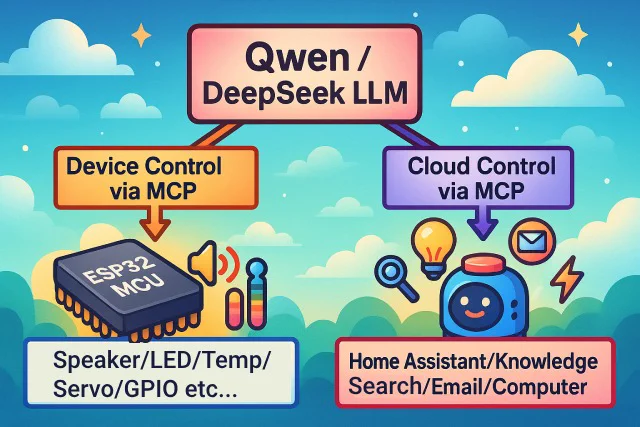
XiaoZhi ESP32 is an open-source, MIT-licensed firmware stack that turns ESP32 boards into MCP-based voice chatbots using models such as Qwen and DeepSeek. It streams Opus audio over WebSocket or MQTT + UDP through ASR, LLM and TTS, adds offline ESP-SR wake words, and uses device-side MCP to drive speakers, LEDs, servos and GPIO. It supports 138 board directories and builds with ESP-IDF 6.0.1 or newer.
What it claims
XiaoZhi ESP32 is an MIT-licensed firmware stack for building voice chatbots on ESP32 boards. It targets the ESP32, C3, C5, C6, S3 and P4 chip families, with 138 board directories and 171 release variants. Beyond the ASR, LLM and TTS pipeline, it supports realtime voice models, camera input, battery management, OLED/LCD expressions, multilingual prompts and customizable wake words. The source is a post on X; the repository link is truncated on the page as "github.com/78/xiaozhi-esp…".
How it works
MCP runs on both sides of the network. Device-side MCP drives local peripherals: speakers, LEDs, servos and GPIO. Cloud-side MCP extends the assistant to smart-home control, desktop actions, knowledge search and email. Audio is Opus, carried either over WebSocket or over MQTT for control plus UDP for audio. Wake-word detection uses ESP-SR and runs offline on the device.
flowchart LR
  Mic[Mic + ESP-SR wake word] --> T{Transport}
  T -->|WebSocket| S[Server: ASR, LLM, TTS]
  T -->|MQTT + UDP| S
  S --> D[Device-side MCP]
  S --> C[Cloud-side MCP]
  D --> P[Speaker, LEDs, servos, GPIO]
  C --> X[Smart home, desktop, search, email]
How to use it
The build requires ESP-IDF 6.0.1 or newer, and the README recommends the release/v6.1 branch. Beginners can flash prebuilt firmware without building. Developers can build in Cursor or VS Code with the ESP-IDF plugin. After changing SDK revisions, the project says to update submodules, source export.sh, and clean before rebuilding:
idf.py fullcleanThe page does not give the exact submodule command. The firmware can be adapted to custom boards, displays, wake words, languages and assets.
Limits
The MIT licence permits commercial use. The post lists several security points to check before deployment:
- Protect Wi-Fi, MQTT, server and model credentials.
- Validate network payloads and MCP tool inputs.
- Scope cloud tools to least privilege.
- Keep firmware dependencies and board secrets out of public builds.
The page names Qwen and DeepSeek as example models but does not say which server software runs the ASR, LLM and TTS stages. It also does not say whether a hosted backend is required, and it gives no latency, memory or per-board performance figures.
Organisations named here
- DeepSeek
- Model Context Protocol
- Qwen
- SpyTech Ai
Technologies named here
- Qwen
- XiaoZhi ESP32
- DeepSeek
- MCP
- ESP-SR
- ESP-IDF
- Cursor
- Visual Studio Code
- idf.py
- Model Context Protocol
- Opus
- VS Code
- GitHub
- ESP32
- MQTT
- UDP
- WebSocket
Techniques named here
- Device-side and cloud-side MCP tool use
- Streaming voice pipeline
- Offline wake-word detection
Related in mcp


 github.comrepo
OKX Agent Trade Kit (okx-trade-mcp / okx-trade-cli)

 developers.googleblog.comarticle
Announcing ADK for Kotlin 1.0: Building Production-Ready AI Agents in Kotlin, Android, and Beyond
github.comrepo