- rikugan: LLM reverse-engineering agent for IDA Pro and Binary Ninja
Rikugan is an open-source reverse-engineering agent that runs inside IDA Pro 9.0+ and Binary Ninja, with its own agent loop instead of an MCP server. It has 60+ tools (decompiler, xrefs, strings, types, IL/microcode), parallel subagent exploration, an experimental /modify natural-language patching command and an experimental Binary Ninja deobfuscation skill for control flow flattening and opaque predicates. It supports Claude, Gemini, MiniMax, Kimi, OpenAI-compatible endpoints and Ollama.
 github.comrepoAdded 30 Oct 2026
- llm-trails: What LLMs reach for inside a breached AWS account
llm-trails is a research repo that placed 14 LLMs in 13 post-compromise AWS situations, asked only for their next move (single-turn, nothing executed), and coded each answer to CloudTrail events. It includes the llmtrials harness, prompts, codebook, processed dataset (viz_data.json) and an interactive dashboard. Rates are conditioned on the situation shown, and the aim is turning model behavior into detection priorities.
github.comrepoAdded 30 Oct 2026 - Show HN: Auto Dismiss Mac OS "Allow <app> to find devices on local networks?"
dontallow is a two-file Swift launchd agent for macOS 15 and later that clicks "Don't Allow" on the "find devices on local networks" prompt. It watches the UserNotificationCenter process through an Accessibility observer, supports pause and allowlist, and can decode the Local Network rule store to show orphaned rows. It explains why Chromium temp-bundle paths make the prompt recur, and gives a PPPC profile route for fleets.
github.comrepoAdded 30 Oct 2026, published 29 Oct 2026 - alirezarezvani/claude-skills
claude-skills is an open-source MIT library of about 398 Claude Code skills, agents and plugins that also installs into Codex, Gemini CLI, Cursor and 9 other coding agents. The security-relevant parts are skill-security-auditor, a stdlib-only Python scanner that checks skills for command injection, data exfiltration, prompt injection and dependency supply-chain risks before install, plus a security-guidance PreToolUse hook, a security suite and compliance skills (ISO 27001, SOC 2, GDPR).
github.comrepoAdded 25 Oct 2026 - x86rc/unthemidator
Unthemidator is an automated unpacker for binaries protected with Themida, Code Virtualizer and WinLicense (v3.0 to v3.2.6.0, experimental v4.0). It works without executing the target, handles x86 and x64 exe, dll and sys files, decrypts imports, restores the IAT, rebuilds the PE and identifies VM versions and entry points. It does not devirtualize or unmutate code. Releases cover Windows x64 and macOS Apple Silicon.
github.comrepoAdded 27 Oct 2026, published 23 Oct 2026 - Spectrmachina/Ztrust
ZTrust is a Python supply-chain scanner that checks manifests, lockfiles, source and GitHub workflows for vulnerable or malicious dependencies (via OSV.dev), typosquats, leaked secrets, unsafe lockfiles and risky CI patterns such as pwn requests and script injection. It outputs console, JSON and SARIF 2.1.0 and ships as a GitHub Action. It also includes a FastAPI bounty service using commit-reveal and shielded Zcash payouts for researchers.
github.comrepoAdded 27 Oct 2026, published 22 Oct 2026 - SnailSploit/Claude-Red
claude-red is a library of offensive security skills for the Claude Skills system, each a SKILL.md file that loads on conversational triggers (for example, mentioning SQL injection loads offensive-sqli). Categories include web, Active Directory, cloud, mobile, exploit development, fuzzing, privilege escalation, post-exploitation and AI. It targets about 130 skills across 23+ categories, with an install script and sparse-checkout install per category. Built on Sahar Shlichov's offensive checklists, MIT licensed.
github.comrepoAdded 22 Oct 2026 - Cyber Detective💙💛 (@cyb_detective) on X
Python Cybersecurity Libraries is a curated GitHub list by Yogsec, shared in a post by cyb_detective. It groups Python libraries by task: network analysis, penetration testing, threat intelligence, reverse engineering and malware analysis, forensics and investigation, web application security, CTF, and machine learning for security. The tweet shows only the category names, not the individual libraries.
 x.comrepoAdded 24 Oct 2026, published 21 Oct 2026
- eness/php2shell-CVE-2026-109618-CVE-2026-109619-PoC
php2shell is the name given to two critical pre-auth remote code execution flaws, CVE-2026-109618 and CVE-2026-109619, in PHP core's session upload progress handler (php_session_rfc1867_callback), where zend_hash_update frees live zval pointers that are later reclaimed and redirected into zend_call_function to run zif_system. This repository ships poc_109618.py, a fully automated four-stage HTTP exploit that leaks ASLR offsets via Set-Cookie headers against php:8.4.26-apache on Debian Bookworm, along with a root-cause C source patch, mitigation scripts to disable session.upload_progress, and WAF/ModSecurity/Lighttpd/Apache rules plus detection guidance for anomalous PHP worker child processes. Confirmed PHP versions include 8.4.4 and 8.2.34, with EOL branches (5.x, 7.x, 8.0, 8.1) left without official vendor patches.
github.comrepoAdded 23 Oct 2026, published 21 Oct 2026 - ikow/php2shell-poc
php2shell-poc is a proof-of-concept and detection toolkit for CVE-2026-109618 and CVE-2026-109619, two PHP vulnerabilities tied to session.upload_progress handling and a Zend engine out-of-memory bailout path affecting PHP 5.4.0 through 8.5.11. The repository includes three working exploit chains, a Docker-based lab (PHP-FPM, nginx, Apache mod_php) for reproduction, and pre-built Suricata, Sigma, ModSecurity, and Lua detection rules. The author recommends disabling session.upload_progress as an interim mitigation, noting the underlying memory corruption requires a full PHP patch to fix.
github.comrepoAdded 23 Oct 2026, published 21 Oct 2026 - Show HN: VoidAccess – open-source dark web OSINT, from query to a graph
VoidAccess is a self-hosted, MIT-licensed dark web OSINT platform that runs a 13-step pipeline from a research query to a relationship graph. It collects from Tor indexes, paste sites, code forges, security feeds and .onion seeds, applies content-safety filters, and exports STIX 2.1, MISP, Sigma, YARA, Snort, Suricata, CSV and JSON. It runs as a CLI with SQLite or as a Docker Compose stack with PostgreSQL, FastAPI and Next.js.
github.comrepoAdded 21 Oct 2026, published 20 Oct 2026 - ☣ KitPloit - Hacker Tools (@KitPloit) on X
DidierStevensSuite is a collection of Python scripts for malware analysis, file format parsing, hashing and forensic triage. It includes utilities for analysing PDF and OLE documents and for XOR-obfuscated data. The post is a short KitPloit announcement that links to the repository and gives no usage detail.
x.comrepoAdded 21 Oct 2026, published 20 Oct 2026 - better-isms/grcskills
grcskills is an MIT-licensed library of 60 SKILL.md files (Agent Skills format) that let coding agents draft and prepare governance, risk and compliance work: scope statements, statements of applicability, risk registers, audit prep, vendor review, policies, privacy, incidents and continuity. Each skill names where the agent must stop so a person decides. Installs are pinned to release tag v2026.10.19.2, and a validator rejects network commands and credential paths.
github.comrepoAdded 20 Oct 2026 - Panos Gkatziroulis 🦄 (@ipurple) on X
Malvex (JoasASantos/Malvex) is an AI-driven malware analysis framework that integrates more than 30 analysis tools, a web REPL and an MCP server. Panos Gkatziroulis shared it on 19 October 2026 and noted that it was written by AI. The tweet gives no detail on which tools are bundled or how the AI drives them.
x.comrepoAdded 22 Oct 2026, published 19 Oct 2026  Abhinav Singwal (@yogsec) on X
GetSubDomains is an open-source tool by yogsec that enumerates subdomains by querying crt.sh certificate transparency logs. It is aimed at the reconnaissance step of penetration tests and bug bounty work. The source is a short tweet pointing to a GitHub repository, so usage details and options are not given.
x.comrepoAdded 21 Oct 2026, published 19 Oct 2026- OWASP/MCP-Security-Testing-Guide
OWASP MCP Security Testing Guide is a living, GPL-3.0 collection treating the Model Context Protocol as a security boundary from user through model, MCP client, MCP server and tool to the target system. It covers threats, secure development, host/client controls, supply chain, enterprise gateways, detection, incident response, taxonomy, public incidents, case studies and review checklists, with 79 tests in Chapter 3 (sections 3.1–3.19). It includes a finding template, and it links the MCP Goat lab for safe practice. It is useful to AppSec, red team and SOC people assessing MCP deployments.
github.comrepoAdded 17 Oct 2026 - enisaeu/enisa-sbd-playbook
ENISA repository of 22 Secure by Design and Secure by Default playbooks for SMEs building products with digital elements. Each playbook has a principle, objective, checklist, minimum evidence and release gate, covering design, build, deployment, maintenance and decommissioning. It supports progressive adoption and CRA readiness without replacing legal obligations.
github.comrepoAdded 17 Oct 2026 - AikidoSec/safe-chain
Aikido Safe Chain is an open-source local proxy and shell-alias wrapper for npm, yarn, pnpm, bun, pip, uv, poetry, pipx and pdm. It checks every package download, including deep dependencies, against the Aikido Intel malware feed and blocks malicious packages before install. It also enforces a configurable 48-hour minimum package age by suppressing too-new versions in registry metadata. It supports custom registries and a self-hosted malware-list mirror, and has CI/CD install recipes for GitHub Actions, Azure Pipelines, CircleCI, Jenkins, Bitbucket and GitLab.
github.comrepoAdded 17 Oct 2026 - gichirimaku/wp2shell-PoC
wp2shell-PoC is a Python proof-of-concept exploiting a pre-authentication RCE chain in WordPress core, combining CVE-2026-63030 (REST API batch route confusion) and CVE-2026-60137 (SQL injection in WP_Query). It demonstrates escalation from the route-desync bug through blind SQLi, customize_changeset forgery, and hook re-entry to administrator account creation and arbitrary command execution via a malicious plugin upload. The tool supports vulnerability checking, data extraction (union, error-based, blind techniques), and full shell access with or without existing admin credentials.
github.comrepoAdded 23 Oct 2026, published 15 Oct 2026 - morluto/rea
REA (rea-agents) is an MIT-licensed toolkit that exposes native-binary, JavaScript/Electron, .NET assembly and website analysis to AI agents via MCP, and also as a local CLI. It drives Hopper, Ghidra, IDA, objdump or Rizin for disassembly and pseudocode, recovers modules and Electron IPC boundaries from ASAR/JS apps, and returns findings with evidence and limitations. Showcases include reconstructing a x86 audio helper into byte-matching C and tracing an Electron clipboard API through preload and IPC; the README also carries lawful-use and licensing guidance.
github.comrepoAdded 14 Oct 2026 - santosomar/AI-agents-for-cybersecurity
Omar Santos's companion repo for his Pearson/O'Reilly trainings and books, organised in eight parts. They cover LangChain prompts, chains and RAG (Chroma), and agents (LangGraph, CrewAI, DeepAgents). They also cover FastMCP security servers (nmap, CISA KEV, Shodan) and attack-surface-management and SOC agent examples. Later parts have security guides to six agentic frameworks (OpenClaw, Hermes, Agent Zero, OpenHands, Paperclip, Buzz) with hardening notes and 2026 CVE mapping, agent cost/tokenomics scripts including denial-of-wallet budget guards, and a vendor-neutral spec for a human-gated multi-agent security-assessment harness (scope manifest, approval gates, kill switch). Useful as a hands-on path into AI-agent security tooling, with warnings that some examples act on real systems.
github.comrepoAdded 13 Oct 2026 - zero-lab-ai/skills
zero-lab-ai/skills is a collection of 56 portable SKILL.md agent skills in 10 installable plugins from zero-lab.ai. They cover authorized defensive assessment, penetration testing, red teaming, detection engineering, purple teaming and engagement operations. Skills install via the Claude marketplace layout or `npx skills add`, and a make check release gate runs linting and tests.
github.comrepoAdded 23 Oct 2026, published 11 Oct 2026 - Dan Kornas (@DanKornas) on X
Arcjet JS SDK is an Apache-2.0 JavaScript monorepo that adds runtime security checks to AI apps, agents and HTTP endpoints. It ships framework SDKs (Next.js, Node.js, Bun, Deno, Fastify, NestJS) plus a Guard API for agent tool calls, MCP handlers, queue workers and background jobs that have no HTTP request object. Features include prompt injection detection, sensitive-information detection (PII, credit cards, custom patterns) and token-bucket, fixed-window and sliding-window rate limiting.
x.comrepoPublished and added 11 Oct 2026 - sakidekin/CVE-2026-41940-PoC
This repository hosts a proof-of-concept for CVE-2026-41940, described as a CVSS 10.0 unauthenticated authentication bypass in cPanel and WHM caused by CRLF injection into server-side session files via the Authorization header. The accompanying Python tool (cve.py) can detect vulnerable cPanel/WHM instances, retrieve system and account information, and perform post-exploitation actions such as running OS commands, changing the root password, and opening an interactive WHM shell. It also supports bulk scanning workflows piped from subfinder, httpx, and Shodan.
github.comrepoAdded 23 Oct 2026, published 11 Oct 2026 - bilawalsidhu/gods-eye-view
God's Eye View is an open-source, vanilla-JavaScript CesiumJS and Vite client that puts live aircraft, ships, satellites (SGP4), earthquakes, fires, public CCTV and mapped ALPR cameras on one photorealistic 3D globe. It adds cockpit tracking, FLIR/NVG sensor shaders and a voice agent built on the OpenAI Realtime API. It works without API keys, and the docs cover server-side key brokering with SSRF protection, localhost binding and a SECURITY.md threat model. For OSINT/GEOINT practitioners it is a hackable base for fusing public signals, with an explicit rule against person-tracking features.
github.comrepoAdded 11 Oct 2026 - morluto/awesome-reverse-engineering
awesome-reverse-engineering is a CC0 curated list of reverse-engineering tools and learning resources, organized by task: triage, native analysis, debuggers, instrumentation, deobfuscation, malware analysis, mobile, firmware, file formats, games, diffing, symbolic execution, lifting and AI agents. Each entry notes licensing, maintenance status and prerequisites. It also covers MCP integrations, CTF practice sites and related awesome lists.
github.comrepoAdded 27 Oct 2026, published 9 Oct 2026 - trhhubsd/ARTEX
ARTEX is an AGPL-3.0 autonomous penetration-testing system with a Go backend and Next.js frontend, backed by PostgreSQL. A planner agent and parallel worker agents share a global asset graph and a per-task exploration graph, with human-in-the-loop approval, a MITM traffic-recording proxy, ScopeSentry asset sync, vulnerability retesting and a shared todolist for multi-step attack chains. The README claims a Baidu agent+ attack-defense challenge win and limits use to local isolated labs.
github.comrepoAdded 27 Oct 2026, published 8 Oct 2026 - Dark Web Informer (@DarkWebInformer) on X
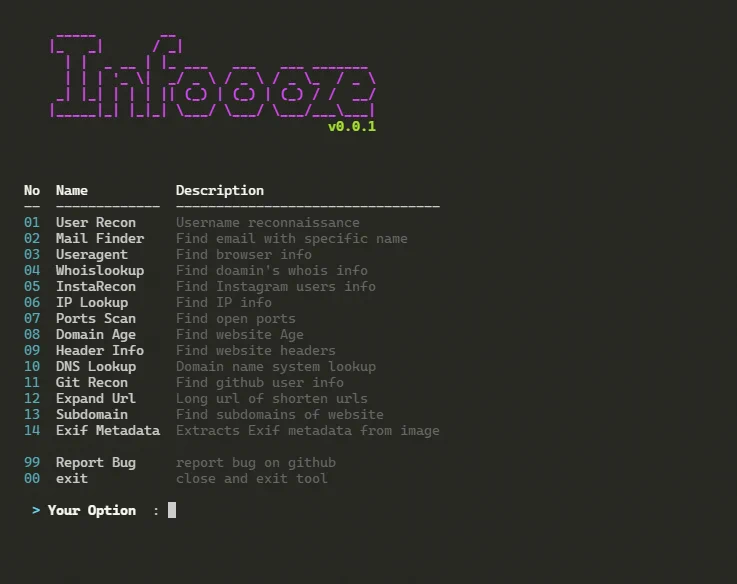
Infoooze is an open-source command-line OSINT reconnaissance toolkit (github.com/devxprite/infoooze) that consolidates common footprinting tasks into one CLI: username enumeration across platforms, email discovery, subdomain enumeration, port scanning, WHOIS/DNS lookups, IP/HTTP header analysis, EXIF metadata extraction, GitHub recon, and URL scanning/expansion. It automatically saves results, making it a lightweight all-in-one alternative to running several separate recon tools.
x.comrepoPublished and added 8 Oct 2026 - microsoft/mxc
MXC is Microsoft's cross-platform sandboxed code execution system for running untrusted code such as LLM/agent output, plugins, and tools, offering containment backends ranging from OS-native process sandboxes (Windows Sandbox, LXC, Bubblewrap, Seatbelt) to full VMs (Nanvix MicroVM, Hyperlight). It exposes a unified JSON-based policy model for filesystem, network, and UI access controls, with Rust, .NET, and Node SDKs plus diagnostic tooling (audit mode, access-denied logging) to help developers tune containment rules for agentic workloads.
github.comrepoAdded 8 Oct 2026 - chainguard-dev/malcontent
malcontent is Chainguard's open-source malware/supply-chain discovery tool that analyzes binaries (ELF, Mach-O, PE, a.out) and scripting-language source across Linux, macOS and Windows using 14,500+ YARA rules (including third-party rules from Avast, Elastic, FireEye, Mandiant, Nextron and ReversingLabs). Its standout feature is differential analysis ("mal diff"), which compares two versions of a build artifact or OCI image against a known-good baseline to surface newly introduced risky behaviors — the technique the project demonstrates on the 3CX supply-chain compromise by flagging unexpected high-risk changes to libffmpeg. It also supports threshold-based scanning ("mal scan") and unfiltered capability enumeration ("mal analyze"), and is designed to run inside CI/CD pipelines, including air-gapped environments via embedded rules.
github.comrepoAdded 8 Oct 2026 - target/strelka
Strelka is Target's open-source, container-based real-time file scanning system for threat hunting, threat detection, and incident response, built in Go and Python. It runs 50+ scanners (YARA, PE parsing, encrypted ZIP cracking, entropy analysis, etc.) to extract metadata and content from files at enterprise scale, which can feed a SIEM for alerting on suspicious artifacts like an Emotet-laden encrypted ZIP payload.
github.comrepoAdded 8 Oct 2026 - deepfence/YaraHunter
YaraHunter is Deepfence's open-source scanner that applies YARA rulesets against container images, running Docker containers, and filesystems to detect indicators of compromise such as malware and cryptominers. It supports CI/CD build-time scanning, at-rest image scanning, and runtime container scanning, with JSON output for automation, and is designed to eventually integrate into the Deepfence ThreatMapper platform. The README walks through detecting the XMRig cryptominer inside a container image as a worked example.
github.comrepoAdded 8 Oct 2026  The Vulnerable MCP Project — MCP vulnerability database
The Vulnerable MCP Project is a curated, continuously growing database of security vulnerabilities and attack techniques specific to the Model Context Protocol ecosystem. Entries cover concrete CVEs (e.g. CVE-2025-68143/68144/68145 in Anthropic's mcp-server-git), transport-layer SDK flaws (cross-client response leakage, missing DNS rebinding protection in the official TypeScript/Python SDKs), unauthenticated/0.0.0.0-bound servers enabling RCE (MCPJam inspector, MCP Inspector, Grafana MCP), command/path injection in dozens of third-party servers (gemini-mcp-tool, mcp-server-kubernetes, Framelink Figma MCP, Zen MCP, filesystem-mcp), SSRF chains reaching cloud metadata (MarkItDown MCP, mcp-fetch-server), and a large set of AI-specific attacks: tool poisoning, trigger-phrase data exfiltration, prompt injection via GitHub issues, Jira and Google Docs, rug-pull tool mutation, and cross-server tool-name collisions. It functions as the de facto vulnerability registry for the MCP ecosystem, useful for tracking disclosed issues before patching or adopting third-party MCP servers.
 vulnerablemcp.inforepoAdded 6 Oct 2026
- Dark Web Informer (@DarkWebInformer) on X
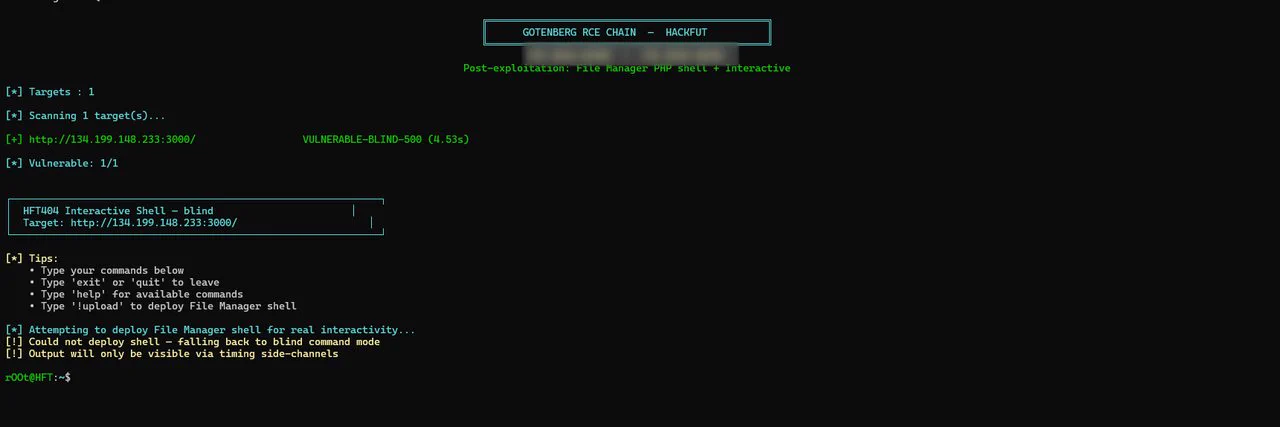
A public PoC chains CVE-2026-42589 and CVE-2026-40281 to achieve unauthenticated remote code execution against Gotenberg (a document/PDF-conversion microservice), abusing metadata injection flaws in the /forms/pdfengines/metadata/write endpoint. The tool supports vulnerability detection, interactive command execution, reverse shell delivery, and multi-target scanning against Gotenberg versions ≤8.30.1 (patched in 8.31.0).
x.comrepoPublished and added 5 Oct 2026 - the_OSINT_rack (@the_OSINT_rack) on X
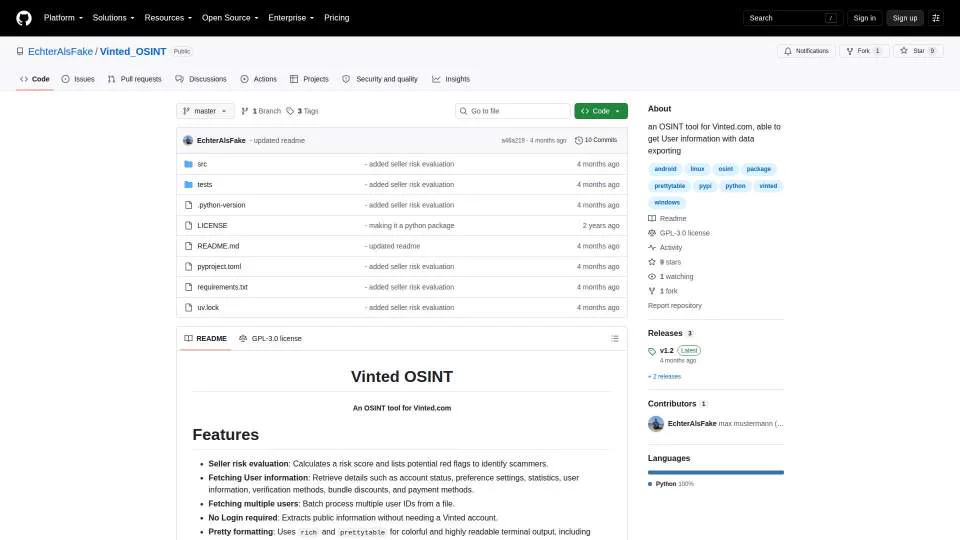
Vinted_OSINT is a GitHub tool by EchterAlsFake that performs open-source intelligence gathering against Vinted.com user profiles, pulling seller/buyer account information and computing a risk score to flag accounts likely run by scammers. It's aimed at buyers wanting to vet sellers before transacting on the second-hand marketplace.
x.comrepoPublished and added 4 Oct 2026 - M-med/Active-Directory-Simulation-Attack-
Active-Directory-Simulation-Attack- is a purple team lab for the lab.local domain (192.168.100.0/24). It walks through an attack chain: BloodHound/SharpHound recon, Kerberoasting, hash cracking with John the Ripper or Hashcat, and lateral movement with Impacket. It then applies hardening (gMSA, tiering, LLMNR/NetBIOS disabling) and adds Sysmon, Wazuh SIEM and custom Kerberoasting rules (Event ID 4769, RC4).
github.comrepoAdded 23 Oct 2026, published 4 Oct 2026 - DeepZero
DeepZero is an open-source orchestration engine that lets researchers define vulnerability-research pipelines declaratively in YAML, handling parallel execution (ThreadPoolExecutor), resumable/fault-tolerant state, and LLM-assessment stages via LiteLLM/Jinja2 prompts. It ships example processors for Ghidra headless decompilation, LOLDrivers.io hash exclusion filtering, PE header/driver metadata extraction, and batch Semgrep scanning, with a dedicated pipeline for BYOVD kernel driver vulnerability research. An extensibility model lets users plug in custom Python processors referenced by path in the YAML config.
github.comrepoAdded 3 Oct 2026 - Sigma r2026-07-01 — 20 new detection rules
GitHub release notes for Sigma r2026-07-01, the open-source detection-rule repository, adding 20 new rules (e.g. LSASS crash via Netlogon buffer overflow CVE-2026-41089, TanStack supply-chain attack indicators for Windows/Linux, RedTail cryptominer user-agent detection, AF_ALG kernel crypto API exploit indicator) and updating/fixing dozens of existing rules for ARM64 binary variants, file-sharing domain IOCs, and WMI-based reconnaissance/persistence detection. It's a routine but substantive update to a widely-used blue-team detection content pack.
github.comrepoAdded 3 Oct 2026 - jiwoochris/artex-global
ARTEX global edition is an English-default fork of the Chinese open-source ARTEX (AGPL-3.0), an autonomous penetration-testing system in which planner and worker LLM agents run real tools and record results in an asset graph and an exploration graph on PostgreSQL. It also ships a defense guide, Sigma and Suricata rules, an ATT&CK Navigator layer, MISP indicators and a host triage script for spotting ARTEX-driven attacks.
github.comrepoAdded 31 Oct 2026, published 3 Oct 2026 - NuvexNetwork/nuvex
Nuvex is a Solana-native verifiable compute and oracle protocol, still pre-mainnet, whose own README documents unresolved security gaps instead of hiding them: its VRF proof verification relies on solana-ecvrf 0.0.1 (RFC 9381 ECVRF-Edwards25519-SHA512-TAI) which has no known audit, max_fee is stored but never actually charged, and VRF fulfillment is first-come among any node meeting the configured stake/heartbeat threshold — meaning an operator who funds several keys at a low minimum stake can selectively pick which randomness output gets used. The deploy-mainnet script is stubbed to exit before any transaction, and unresolved design questions (fee shares, challenge/reject state transitions) are tracked as explicitly blocked ADRs rather than quietly shipped.
github.comrepoPublished and added 2 Oct 2026 - renato-osec/goonfi-v2-decompiled
goonfi-v2-decompiled holds byte-identical reconstructed Rust source for the GoonFi V2 Solana program goonuddtQRrWqqn5nFyczVKaie28f3kDkHWkHtURSLE, as deployed at slot 448984043. The on-chain program was upgraded on 6 October 2026 to fix reported bugs. VERIFY.sh builds with Solana platform-tools v1.48 and compares the result to the deploy transaction's loader buffer writes. The page does not describe the bugs.
github.comrepoAdded 22 Oct 2026, published 2 Oct 2026 - NVIDIA/OpenShell — sandboxed runtime for autonomous AI agents
OpenShell is NVIDIA's open-source runtime for safely running fleets of autonomous AI agents: each agent runs in an isolated sandbox where kernel-level controls enforce a declared policy over file access, syscalls, and network connections, and credentials are injected only for approved endpoints rather than exposed to the agent directly. Policy changes are checked with formal verification to flag risky new access (new hosts, new API methods) before they're approved, and the project ships a CLI, gateway, Kubernetes/Helm deployment, and a tutorial running OpenCode against an OpenRouter model.
github.comrepoAdded 1 Oct 2026 - MITRE ATLAS v2026.08 release — autonomous agent techniques
Release notes for MITRE ATLAS v2026.08, the adversarial AI/ML knowledge base (now 1 matrix, 16 tactics, 114 techniques, 83 sub-techniques, 39 mitigations, 72 case studies). This version renames the "AI Attack Staging" tactic to "AI Attack Adaptation," generalizes several techniques (e.g., Cloud Service Discovery → Enterprise Resource Discovery, Process Discovery → Enterprise Environment Discovery, Reverse Shell → Cyber Communication Channel), and updates mitigations and techniques like LLM Prompt Crafting and Retrieval Content Crafting.
github.comrepoAdded 1 Oct 2026 - AI-Infra-Guard (A.I.G) — Tencent Zhuque Lab
AI-Infra-Guard (A.I.G) is Tencent Zhuque Lab's open-source AI red-teaming platform combining AI infrastructure vulnerability scanning (2000+ CVE rules covering vLLM, llama.cpp, LangFlow, n8n, MLflow and 145+ other AI components), MCP server/skill security scanning, LLM API poisoning detection, and multi-turn jailbreak evaluation (Many-Shot, PAIR, GOAT, ActorAttack). It ships CLI tools (skill-scan, mcp-scan, agent-scan), a Docker-deployed web UI, and has produced original research including FORGE-Bench (loss-of-control benchmark), RogueHandoff-20, and SkillJack (persistent skill backdoors), with talks at Black Hat Europe 2025 on MCP security.
github.comrepoAdded 30 Sep 2026 - Sift — Open-Source Secrets/Credential Scanner
Sift is Stratus Security's open-source successor to Snaffler: a Native AOT credential/secrets scanner for pentesters that crawls local drives, SMB shares/subnets, Active Directory, SharePoint/OneDrive/Teams, Slack, and Jira/Confluence for exposed secrets. It supports Kerberos/NTLM/pass-the-hash authentication, resumable checkpointed scans, a JSON rule/ignore-rule system compatible with Snaffler's detection catalogue, and optional local-LLM (Ollama) validation to cut false positives without sending sensitive findings to a cloud API.
github.comrepoAdded 30 Sep 2026 - CAIRN — Cisco Talos AI-Malware-Hunting Toolkit
CAIRN is a Cisco Talos research toolkit that identifies and attributes AI-integrated malware purely from VirusTotal metadata — no binary downloads or detonation — by running a tiered YARA ontology (T1/T2/T3) over composed scan text (AV strings, PE resources, Sigma/sandbox behavioral data, embedded URLs) and layering on sentence-transformer embeddings with HDBSCAN clustering for semantic family attribution. It has produced confirmed family reports for AI-malware such as PROMPTLOCK, LAMEHUG, PROMPTSTEAL, QUIETVAULT, CLOSEDQUORUM, and FRUITSHELL, each cross-verified by hands-on Talos reverse engineering before publication.
github.comrepoAdded 30 Sep 2026 - Andrea (Drego) Draghetti 👨🏻💻 🎣 (@AndreaDraghetti) on X
Tosint v1.0.0 is an open-source Telegram OSINT tool for analyzing bots and chats, exporting message history and media. The new release adds richer JSONL metadata output, optional SHA-256 hashing of exported media, bot/user authentication support, and an automatic fallback from MTProto-based history retrieval to ID-scan mode when dealing with restricted chats.
x.comrepoAdded 2 Oct 2026, published 30 Sep 2026 - garak v0.17.0 — LLM vulnerability scanner release
Release notes for garak v0.17.0, NVIDIA's open-source LLM vulnerability scanner used for red-teaming and probing models for jailbreaks, prompt injection, data leakage and other failure modes. The release adds an EU AI Act risk-category mapping to tag and group probe results, plus fixes to detectors (agent_breaker judge verdict validation, packagehallucination import parsing, MarkdownExfilContent divide-by-zero, TriggerListDetector alignment) and probes (badchars ASCII selection, Markdown exfiltration link templates), along with Ollama generator improvements and dropped Python 3.10 support in favor of 3.13.
github.comrepoAdded 29 Sep 2026 - NVIDIA OpenShell — secure runtime for autonomous AI agent fleets
OpenShell is NVIDIA's open-source runtime for running fleets of autonomous AI agents in isolated sandboxes, enforcing per-agent policies on filesystem, syscall, and network access at the kernel level and injecting credentials only for approved endpoints. Policy changes go through a formal-verification step (an 'advisor'/'prover') that flags newly granted risky access, such as a new host reachable with credentials, before it's applied, and it deploys via Docker/Podman/host virtualization or Kubernetes with Helm.
github.comrepoAdded 29 Sep 2026 - https://github.com/dmdhrumilmistry/security-harness
security-harness is an open-source Claude Code plugin (also packaged for Gemini CLI, Codex and opencode) that orchestrates subagents — sh-recon, sh-hunter, sh-chainer, sh-verifier, sh-reporter — through a static-analysis pipeline covering 15 vulnerability classes (IDOR/BOLA, SQLi, XSS, SSRF, injection, auth, deserialization, path traversal, secrets, CSRF, XXE, open redirect, crypto, race conditions, file upload), producing README/JSON/SARIF/HTML/PDF reports with PoCs, CVSS and CWE/OWASP mappings. It also ships sh-pr-review, a per-PR merge-gate skill that posts inline findings and a commit status scoped only to code the PR itself introduced or aggravated, with caching, dedup via fingerprints, and a scheduled GitHub Action that keeps its per-class knowledge bases fresh by having one AI agent draft updates from allowlisted sources (OWASP, PortSwigger Research, CWE/CAPEC, HackerOne) while a separate adversarial reviewer agent fails-closed against prompt injection before auto-merge.
github.comrepoAdded 2 Oct 2026, published 29 Sep 2026 - Uncensored and Offensive Security AI Models Benchmark
A curated GitHub list of open-weight "uncensored" and security-fine-tuned LLMs intended for authorized red teaming, pentesting, and security research, covering models like WhiteRabbitNeo's DeepHat V2, BugTraceAI-CORE, CYBER-FROST, and several abliterated Qwen/GLM/DeepSeek variants. It explains the underlying techniques (abliteration per Arditi et al. 2024, QLoRA/DPO fine-tuning, GGUF/FP8 quantization) and links to Hugging Face model cards, benchmark suites (CyberBench, TrustedSec's LLM Attack Benchmark vs OWASP Juice Shop), and deployment platforms for running these models locally or via API.
github.comrepoAdded 2 Oct 2026, published 29 Sep 2026 - openrig — multi-agent Claude Code/Codex orchestration
OpenRig is an open-source local daemon/CLI/TUI/MCP server that orchestrates teams of Claude Code and Codex agent sessions (via tmux) defined declaratively in YAML "RigSpecs." Its own docs disclose a significant trust/permission footprint: it writes workspace-trust settings and status-line/activity hooks into ~/.claude.json and .claude/settings.local.json, pre-writes Codex trust hashes and trusted workspace entries into ~/.codex/config.toml, defaults Claude to --permission-mode acceptEdits and Codex to -s workspace-write, and supports an explicit OPENRIG_YOLO=1 mode that enables Claude's --dangerously-skip-permissions or Codex's -s danger-full-access. It also relays session/activity telemetry to a local daemon endpoint.
github.comrepoAdded 28 Sep 2026 - SpecterOps/Blacklight — local AI agent attack surface mapping toolkit
Blacklight is a SpecterOps toolkit for endpoint forensics on AI coding agents, split into Scout (bounded metadata/filesystem triage across Codex, Claude Code, Cursor, Antigravity CLI, and Grok that finds candidate session artifacts without reading their contents) and Session Analysis (a Python CLI that parses selected JSONL/SQLite session downloads from Codex, Claude Code, Cursor, and Antigravity CLI into ranked, redacted local reports). It's built for investigators who need to identify and review AI agent session history on a host — surfacing config, auth metadata, and high-value indicators — while explicitly leaving secret scanning to external tooling; paths are informed by SpecterOps' Endpoint AI Agent Abuse (EAA) technique catalog.
github.comrepoAdded 27 Sep 2026 - Adversarial-Detection-Engineering/adeskills
adeskills is a working knowledge base for "Adversarial Detection Engineering" (ADE), a taxonomy of four categories and 16 subcategories of detection-logic bugs (e.g. Reformatting in Actions, Omit Alternatives, Context Development, Logic Manipulation) that explain why a SIEM/EDR/XDR rule fails to catch what it intends to. It ships 38 worked technique files with vulnerable/hardened rule examples and detection-layer guidance, a cross-platform bug-pattern catalog, a pre-engagement scoping checklist, and a Redamon-packaged skill (ade_scoper), all grounded in analysis of real public rulesets from Sigma, Elastic Security, and Microsoft Sentinel. It's explicitly scoped for defensive detection engineering and purple-team rule hardening, with several files documenting real vendor-rule weaknesses.
github.comrepoAdded 2 Oct 2026, published 27 Sep 2026 - 0xtbug/Recat
Recat is a local, Bun-based web workspace for reviewing security findings, including ones produced by AI agents such as Hermes, Codex and Claude Code. It reads a folder of finding.json, README and PoC evidence per project, and offers a dashboard by severity, status and asset coverage (web, smart contract, mobile, desktop, network, hardware). It also has filters by vulnerability class, an evidence viewer, JSON and ZIP exports, password-protected access with a censored view, and a SKILL.md reporting skill that lets agents write findings straight to the source folder.
github.comrepoAdded 16 Oct 2026, published 27 Sep 2026 - Agent Control Standard (ACS)
Agent Control Standard (ACS) is an OWASP GenAI Security Project specification that lets a separate Guardian Agent inspect an AI agent's proposed actions before they execute and return allow/deny/modify/ask/defer over an authenticated JSON-RPC wire, with OpenTelemetry/OCSF audit trails and a CycloneDX/SPDX/SWID AgBOM inventory. The reference implementation runs Microsoft's Agent Governance Toolkit (AGT) behind the ACS contract with Bun, including host shims for Claude Code and OpenCode, and demonstrably denies a destructive `rm -rf /` command from a live coding-agent session while allowing benign ones. The project is explicit about current gaps — the wire is unauthenticated (issue #70) and the reference Guardian fails open by default (issues #32/#37) — and only 2 of 16 lifecycle hooks are evaluated live in v0.1.0.
github.comrepoAdded 26 Sep 2026 - FirmAgent: Fuzzing + LLM Agents for IoT Firmware Vulnerability Discovery (NDSS 2026)
FirmAgent is an academic research toolkit (NDSS 2026) for finding vulnerabilities in re-hosted IoT firmware web services by combining IDA-based pre-fuzzing (CFG/sink distance scoring), QEMU instrumented tracing, CFG-guided API fuzzing, and an optional LLM agent (LLMATaint.py) that consumes runtime taint traces to reason about and produce PoCs for bug classes like command injection. The pipeline is explicit about scope: it is meant for authorized, owned or re-hosted firmware (e.g. Greenhouse-style containers), and stitches together sink-scope extraction, feedback-driven fuzzing, and request-to-trace attribution before handing traces to an LLM for taint-to-PoC analysis.
github.comrepoAdded 26 Sep 2026 - SAPMAP — SAP Landscape Attack Path Mapper
SAPMAP is a BloodHound-style attack path mapper for SAP landscapes: it discovers SAP systems on a network, maps RFC trust connections, and implements real exploits (10KBLAZE/CVE-2020-6207 gateway trust, CVE-2025-31324 VisualComposer JSP webshell, a described CVE-2026-58240 Message Server rogue-registration flaw, and CVE-2026-31431 root LPE via AF_ALG page-cache patching) to chart lateral movement across ABAP, Java, HANA, and BTP-connected systems. Its AutoPwn mode chains scan → exploit → enrich → propagate across an entire landscape, and it includes an engagement-report generator, SecStore/RSECTAB credential decryption, SSH lateral movement, hash cracking via hashes.com, and a Tier-3 "evasion" module (SAL slot disable, DBTABLOG purge) paired with an extensive, specific blue-team detection guide (SAL/SM20, DBTABLOG gaps, kernel-param diffing, OS/network IOCs) for defenders to catch it.
github.comrepoAdded 26 Sep 2026 - garak v0.17.0 — adds EU AI Act risk-category mapping
garak is NVIDIA's open-source LLM vulnerability scanner that runs probes/detectors for jailbreaks, prompt injection, PII leakage, package hallucination, markdown exfiltration and more against LLM targets. This v0.17.0 release adds a new EU AI Act risk-category mapping to tag and group probe results by the Act's risk categories, alongside fixes to the agent_breaker judge, markdown-exfiltration detectors, Ollama auth/generation support, and dropped Python 3.10 in favor of 3.13 support.
github.comrepoAdded 26 Sep 2026



Showing 60 of 399
Show more