- ClioBitcoinBank 🏴☠️ (@ClioBitcoinBank) on X
lnd v0.20.7 and v0.21.6 are Lightning Network Daemon releases announced by Clio Bitcoin Bank. They include a Go-specific mitigation, with the MPTCP flag turned off, for CVE-2026-98432, a use-after-free in the Linux kernel's IPv4 TCP code. The post recommends all users update. It gives no exploit or impact detail.
 x.comadvisoryPublished and added 31 Oct 2026
 Inside a malicious Claude Code-branded extension and its persistent SSH backdoor
Microsoft Threat Intelligence analyzes a tampered anthropic.claude-code extension (versions 2.1.312 and 2.1.313) served on the Cursor marketplace on 29 October 2026. The injected JavaScript loader adds an SSH key labeled svc-telemetry, opens a reverse SSH tunnel and sets up persistence on macOS, Linux and Windows. The post gives cleanup steps, IOCs and Defender XDR hunting queries. VS Code Marketplace and npm were not affected.
 microsoft.comwriteupPublished and added 31 Oct 2026
 “Black October” for AI Developer Platforms
Wiz Research links October 2026 breaches at AI developer platforms (Fireworks, OpenCode, Warp, Zeabur, Railway and others) to stolen environment-variable credentials for AI access. It details two enterprise AWS Bedrock keys abused after vendor breaches: about 800k and 1.7 million calls, over $100k in list-price usage. It profiles two LLM resale operations, "momo" and "Xingjiabi", that tested the keys.
 wiz.iowriteupAdded 31 Oct 2026, published 30 Oct 2026
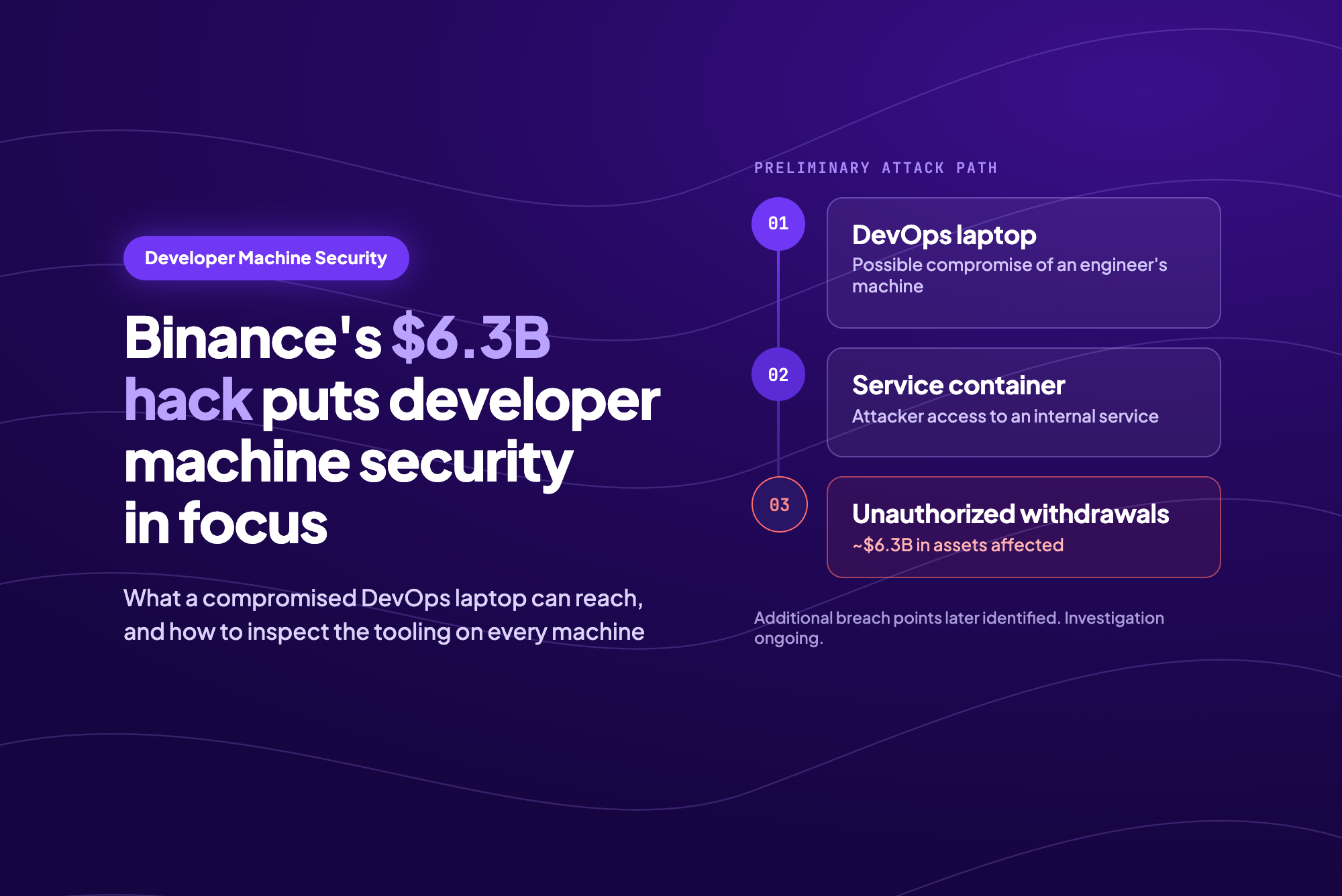 Binance’s $6.3 Billion Hack Puts Developer Machine Security in Focus
StepSecurity's analysis of Binance's 29 October 2026 incident, which Binance puts at about $6.3 billion in affected assets. It covers Binance's disclosure of a possible DevOps laptop compromise, and TRM Labs and Elliptic findings on 50 EIP-7702 authorizations and a persistent delegation. It links this to the Nx, OVHcloud CLI and Claude Code extension compromises, gives an investigation checklist, then describes StepSecurity products.
 stepsecurity.ioarticlePublished and added 30 Oct 2026
 ERC draft: Independent Simulation Result for (STVA)
ERC draft "Independent Simulation Result" (STVA) defines a canonical, content-addressed SimulationResult (success, gasUsed, returnData, stateDiffHash, logsHash, snapshotId, resultHash) that any wallet, hardware device or verifier can recompute from the same VerificationPayload and state snapshot. It targets compromised-frontend and UI/calldata-mismatch attacks, and defines Basic, Standard and Strict compliance levels. Open questions are stateDiff encoding, prestate proofs and binding to capability tokens.
 ethresear.chthreadPublished and added 30 Oct 2026
 Critical Linux kernel flaw allows remote root attacks on MPTCP servers
CVE-2026-98432 is a use-after-free race condition in the Linux kernel IPv4 TCP code (tcp_v4_syn_recv_sock, ireq_opt), affecting kernels back to 4.4 and rated 9.8 by the kernel CVE team (Red Hat rates it 5.9). Anthropic researchers say an unreleased Claude model built an exploit that bypassed KASLR and got remote root on an MPTCP listener in about 53 minutes. The article lists distro patch status and CIQ's nftables mitigation for IP options; disabling MPTCP alone does not help. No in-the-wild exploitation is reported.
 bleepingcomputer.comarticlePublished and added 30 Oct 2026
 Tanmay (@TanmayK_03) on X
DBHub, a database MCP server, had a read-only mode bypass in its SQL check. The check treated every `--` as a comment, but MySQL only starts a comment when whitespace follows it. A hidden write statement could therefore still run, and a prompt injection could trigger it. Fixed in version 0.22.6. Replies say enforcement belongs in database grants and that parser tests need to be dialect-specific.
x.comthreadAdded 31 Oct 2026, published 30 Oct 2026 Weekly Research Brief: Binance Hacked; Hyperliquid on Wall Street; Prediction Markets’ Brazil ‘Miss’
Galaxy Research's weekly brief of 30 October 2026 opens with the Binance hack: about $6.3b drained across 10 blockchains, attributed by TRM Labs and Chainalysis to TraderTraitor (Lazarus-linked). The attacker used EIP-7702 with 50 pre-signed authorizations on Ethereum, and Binance's preliminary finding is a compromised DevOps laptop reaching a service container. Tether and Circle froze about $2.6b. The other sections cover Hyperliquid and prediction markets.
 galaxy.comarticleAdded 30 Oct 2026
 Here We Go Again: Binance Loses $6.3b in Largest Robbery in History
Galaxy Research newsletter on the roughly $6.3b drained from Binance across 10 blockchains, which TRM Labs and Chainalysis attribute to TraderTraitor. On Ethereum the attacker used EIP-7702 to turn a hot wallet into a sweeper contract backed by 50 pre-signed authorizations. Binance's preliminary finding is a compromised DevOps laptop, with no wallet key leak. Tether, Circle, Ripple and World Liberty froze about $2.7b; Galaxy also assesses Binance's ability to cover losses.
galaxy.comarticleAdded 30 Oct 2026- Bunny CDN Security Incident
Bunny CDN status-page notice, posted 28 October 2026, about unauthorized access at an infrastructure provider that hosted one bunny.net CDN node in Armenia. Traffic was stopped within 20 minutes and the server wiped. No access to the node was found, but cached content, Pull Zone configs and TLS certificates could have been exposed, so all platform certificates were reissued. Customers with their own certificates should rotate them with new private keys.
 status.bunny.netadvisoryAdded 31 Oct 2026, published 30 Oct 2026
 Binance Just Suffered the Biggest Hack in Crypto History. What Now?
Bankless report on the Binance hack of $6.3 billion, which Binance's preliminary investigation traced to a compromised DevOps engineer's laptop with access to withdrawal-authorizing systems. TRM Labs found valid EIP-7702 authorizations on Ethereum, and nine other chains were drained through normally signed transactions. TRM and Chainalysis link it to North Korea's TraderTraitor. Tether and Circle froze about $3 billion, and Binance says SAFU and corporate cash will cover the losses.
 bankless.comarticlePublished and added 30 Oct 2026
 Polymarket Sends $3.9M Back to Traders After Vendor Script Drain
Polymarket's international site was hit on 29 October 2026 when a page-speed monitoring script served from DebugBear's CDN was replaced with a drainer. It hijacked logged-in sessions for about an hour and took $2.7M from 726 wallets via Polymarket's relayer. Scott Helme of Report URI says the CSP allowlisted every domain used and that hash pinning would have blocked the swapped file. Polymarket is repaying $3.9M, and this is its second vendor-script compromise since June.
bankless.comarticlePublished and added 30 Oct 2026 Pre-ERC: x402 Payee Verification for ERC-8004 Agents
Pre-ERC draft on Ethereum Magicians that binds the x402 payTo address to an ERC-8004 agent's registered agentWallet, directly or through an EIP-712 payee delegation (ERC-1271 for contract wallets). It lists eight fixed checker outcomes and requires the resource origin to appear in the registration file. On Robinhood Chain (28 October 2026), 5,575 of 20,046 agents answered with x402 requirements, and only 5 used their agentWallet as payTo.
 ethereum-magicians.orgthreadPublished and added 30 Oct 2026
- ERC-8478: x402 Payee Verification for ERC-8004 Agents
ERC-8478 is a draft Ethereum standard that binds the x402 payTo address to an ERC-8004 agent's identity, to stop payee redirection by a hijacked domain, proxy or injected tool result. A payTo must equal the agentWallet or carry an EIP-712 delegation signed by it, and the origin must be listed in the registration file. On Robinhood Chain, 5 of 5,575 x402-responding agents used their agentWallet as payTo (28 October 2026).
ethereum-magicians.orgthreadPublished and added 30 Oct 2026  Secret Service, FBI Join Binance Hack Probe as Circle Freezes $823 Million
Decrypt reports that Binance is working with the FBI and U.S. Secret Service after a theft of about $6.4 billion, which TRM Labs and Chainalysis attribute to North Korea's TraderTraitor group, also linked to the February 2025 Bybit hack. Circle froze about $823 million in USDC and Tether froze USDT, though the page gives differing Tether totals. Binance first suspected a compromised DevOps engineer laptop, found more breach points, and saw no evidence of leaked wallet private keys.
 decrypt.coarticlePublished and added 30 Oct 2026
 4 real? Tracking exploitation and patching of eMudhra’s weak keys
Cloudflare's follow-up on eMudhra's eight trivially recoverable intermediate CA keys (such as 4, 56 and 66), disclosed 19 October 2026. Pingora logging showed about 22,000 handshakes with the weak keys, including about 160 forged certificates made within hours of disclosure. Probes on 50 million challenge pages show many bots, old browsers and Android WebView still trust the chain.
 blog.cloudflare.comwriteupPublished and added 30 Oct 2026
 Was I wrong about open models & cyber risks?
Interconnects post in which Nathan Lambert revisits his claim that an open-weight release of Claude Mythos in April 2026 would have been survivable. He argues GLM-5.3 already crosses that capability threshold with little visible harm. He cites Epoch AI's GLM-5.3 Firefox file-exfiltration exploit and Joshua Saxe's trend data, and says recent vulnerability waves come mostly from closed models and general AI diffusion.
 interconnects.aiarticlePublished and added 30 Oct 2026
- CISA Adds Two Known Exploited Vulnerabilities to Catalog
CISA added two Ivanti Connect Secure vulnerabilities to its Known Exploited Vulnerabilities (KEV) Catalog on 30 October 2026, citing evidence of active exploitation: CVE-2026-111357 (missing authentication for a critical function) and CVE-2026-118527 (generation of predictable numbers or identifiers). The alert restates BOD 26-04, which requires federal civilian agencies to remediate KEV-listed flaws on exposed assets and check for prior compromise. It also links the KEV nomination form.
 cisa.govadvisoryPublished and added 30 Oct 2026
- EIP Draft: Permanent EOA Delegation Opt-Out (disable EIP-7702)
Discussion thread for a draft Core EIP that lets an Ethereum EOA permanently disable EIP-7702 delegation. A type-4 set-code transaction with an empty authorization list, destination equal to sender and zero value installs the 0xef0200 marker for 33500 gas. Later authorizations, including clearing to the zero address, are skipped. It does not protect against private-key compromise. Open questions cover the prefix, a dedicated transaction type, gas pricing, and EIP-8151 interaction.
ethereum-magicians.orgthreadPublished and added 30 Oct 2026  Binance Sets Aside $6.34B to Cover Hack Losses, CEO Says 'Your Assets Are Safe'
Decrypt reports on the October 2026 Binance hot-wallet hack, about $6.3 billion, which Binance CEO Richard Teng says the company will cover with over $6.34 billion of its own funds. Teng says the attacker used an EIP-7702 delegation that skipped Binance's approval controls, a self-destruct mechanism to wipe tooling, and more than one breach point beyond a compromised laptop. TRM Labs and Chainalysis attribute the theft to TraderTraitor, and the attacker is still moving funds on Tron.
decrypt.coarticlePublished and added 30 Oct 2026 From help desk impersonation to AD CS abuse: Investigating ESC1 and ESC8 intrusion paths
Microsoft Threat Intelligence analysis of two human-operated intrusions that began with Teams help desk impersonation and Quick Assist sessions, then diverged at AD CS. Case 1 abused an ESC1 template for privileged certificates and DCSync, with an excluded account later used for Rclone exfiltration. Case 2 used PetitPotam and ESC8 relay to get a domain controller certificate and PKINIT. Includes investigation steps, AD CS hardening and KQL hunting queries.
microsoft.comwriteupPublished and added 30 Oct 2026 Trezor warns of suspected crypto-theft implant in hardware wallet
Trezor warns of a suspected crypto-theft implant in a Trezor Safe 5 sold by reseller CryptoBilis in Southeast Asia. An Indonesian buyer found an extra board with a cellular module and antenna between the main board and screen, apparently able to read the recovery phrase and send it over mobile networks. Trezor has not examined the device, advises moving funds to a new wallet for any CryptoBilis purchase since March 2026, and notes a similar Ledger implant was confirmed.
bleepingcomputer.comarticlePublished and added 30 Oct 2026 Binance Attacker Used EIP-7702 to Bypass Wallet Controls, Teng Says
The Defiant reports that Binance co-CEO Yi He's colleague Teng says the attacker in a breach Binance estimates at $6.3 billion used EIP-7702 to bypass wallet controls. Binance is rebuilding its withdrawal service, and attackers destroyed tools and traces during the intrusion. Only the teaser loaded, so the technical detail of the EIP-7702 abuse is not in the available text.
 thedefiant.ioarticlePublished and added 30 Oct 2026
 Trezor reveals Malaysian reseller sold wallet with spyware
Trezor says a user reported a Safe 5 wallet bought from Malaysian reseller CryptoBilis in August 2026 with a hidden board between the main board and screen, carrying a cellular module and antenna. The implant allegedly reads the screen, including the wallet backup, and sends it over a mobile network when plugged in. Trezor has not yet examined the device, has dropped CryptoBilis (9 October), and is replacing wallets bought since March 2026.
 protos.comarticlePublished and added 30 Oct 2026
 How the Binance hack happened on-chain on Ethereum
Protos analysis of how the Binance hack played out on Ethereum. The attacker deployed a sweeper contract and sent 50 EIP-7702 authorizations for the Binance 14 hot wallet, signed with its key and using varied nonces to match the wallet's changing count. Other wallets and EVM chains used plain transfers. Binance later removed the delegation, and about $2.4 billion in funds was frozen or blacklisted.
protos.comarticlePublished and added 30 Oct 2026- PHP2Shell Attacks Root Palo Alto Firewalls but Fail Against WordPress
PHP2Shell (CVE-2026-109618 and CVE-2026-109619) has been exploited for over a week. A China-linked group chained it with the Fragnesia Linux kernel privilege escalation to root at least 25 Palo Alto Networks PAN-OS firewalls with exposed management interfaces. Defiant had seen no confirmed WordPress compromise by 28 October 2026 despite 77,000 requests, and Cato and watchTowr report few successful attackers.
 securityweek.comarticlePublished and added 30 Oct 2026
- elvis (@omarsar0) on X
Thread by Elvis Saravia (omarsar0) summarising an Anthropic-led paper on pretraining data poisoning of CLI agents. Poisoning 0.1% of pretraining data planted a remote code execution backdoor in Qwen3 models (0.6B, 1.7B, 4B) trained from scratch. It survived SFT, DPO and RL, and fired on about 92% of triggered prompts at 4B. At a 0.0005% poison rate (about 2,500 documents) it still fired on 1.4% of prompts.
x.comthreadAdded 31 Oct 2026, published 30 Oct 2026  In Other News: Anthropic Breach Dispute, UEFI Flaw Hits Most Servers, Cloudflare AI Data Leak
SecurityWeek's weekly roundup of 30 October 2026 covers CVE-2026-97631, a 16-year-old buffer overflow in TianoCore EDK II that affects PXE network boot on most servers. It also covers a Cloudflare Workers AI cross-tenant leak caused by an SGLang bug, Anthropic's dispute with Cathedral over a bug bounty intrusion, and fake AI bots probing for secrets. Other items include AI-assisted ransomware (Gold Ogre, Aur0ra), the NIK C2 framework, and North Korean IT worker sanctions.
securityweek.comarticlePublished and added 30 Oct 2026 Binance hack: the largest robbery in financial history
Binance hack analysis from 21shares on the 29 October 2026 theft of about $6.3 billion from Binance. Binance's initial finding points to a compromised DevOps engineer's laptop with no sign of a leaked wallet key. Chainalysis attributes it to North Korea with high confidence, and about $3 billion was frozen by Tether, Circle and the Arbitrum Security Council. The attacker also borrowed about $44.6 million of WETH on Aave. Binance says SAFU and company funds will cover all losses.
 21shares.comarticlePublished and added 30 Oct 2026
 Malicious Claude Code extension on Cursor planted SSH backdoors
A malicious version 2.1.313 of Anthropic's Claude Code extension was served from Cursor's marketplace for about 11 hours on 29 October 2026, reaching up to 5,000 developers. A JavaScript loader prepended to extension.js added an attacker SSH key, a reverse tunnel and macOS/Windows persistence, and reported to 134.209.82[.]225. Coding errors likely blocked SSH access on many hosts. Cursor removed it and rotated keys; victims should look for an 'svc-telemetry' SSH key.
bleepingcomputer.comarticlePublished and added 30 Oct 2026 What is EIP-7702? The Ethereum Upgrade Behind the $6.4B Binance Hack
EIP-7702 ("Set Code for EOAs") is the Ethereum change, live since the Pectra upgrade on 7 May 2025, that lets ordinary wallets delegate to smart contract code. The guide covers set-code transactions, delegation indicators, batching, sponsorship and sweeper-contract scams. It then describes the 29 October 2026 Binance theft of about $6.4B, which TRM Labs and Chainalysis attributed to TraderTraitor, where 50 pre-signed authorizations turned a hot wallet into a sweeper.
decrypt.coarticlePublished and added 30 Oct 2026 Passkeys Are Better Than Passwords. But They Are Not Enough.
Opinion piece arguing that passkeys, built on public-key cryptography, resist phishing, credential stuffing and password theft but do not settle identity risk. Attackers can go around them through account enrollment before a passkey is bound, weaker recovery paths (SMS, email link, help desk), device changes and authenticated session hijacking. It proposes layering identity threat detection with risk-based, continuous evaluation of trust.
securityweek.comarticlePublished and added 30 Oct 2026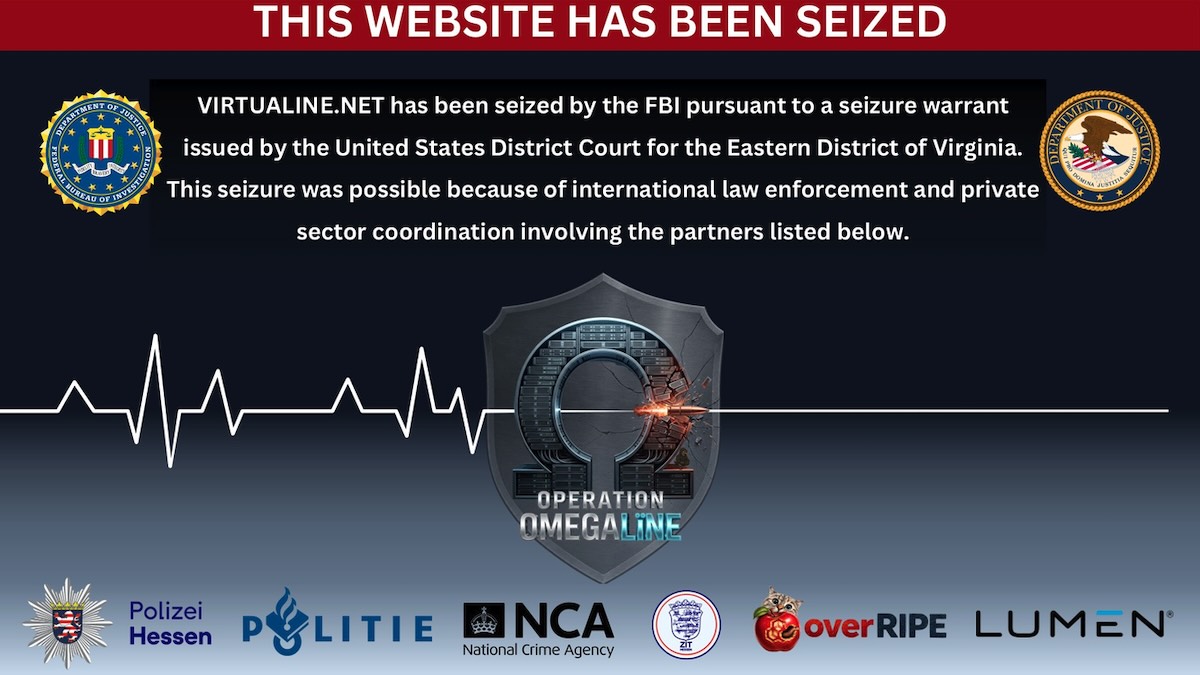 Bulletproof Host Virtualine Loses Its Domain to FBI Seizure
Virtualine is a Russian-speaking bulletproof hosting provider whose domain virtualine.net the FBI seized. Court documents say it hosted phishing, spam, carding and illicit content, and ignored abuse reports. TRM Labs says it received more illicit-attributed cryptocurrency than any other labeled bulletproof host, mostly from a Russian drug marketplace (44%) and a sextortion scheme (17%), and later from StealC operators in 2026.
securityweek.comarticlePublished and added 30 Oct 2026 Binance hack: how a compromised developer laptop can lead to a $6.3 billion breach
Aikido Security's analysis of the roughly $6.3 billion Binance incident, which Binance says may have started with a compromised DevOps engineer's laptop. It sets out what is known (no private key leak, TraderTraitor attribution by TRM Labs and Chainalysis, additional breach points) and a plausible chain from laptop credentials to a withdrawal service. It compares the 2025 Bybit theft and lists mitigations.
 aikido.devarticlePublished and added 30 Oct 2026
 CISA says max severity GitLab flaw now exploited in the wild
CVE-2026-97229 is a maximum-severity GitLab flaw in the CI/CD Regular Expression Compiler, caused by an integer overflow, that lets unauthenticated attackers run code via a crafted regular expression. CISA added it to the KEV Catalog and ordered federal agencies to patch under BOD 26-04. GitLab fixed it in CE/EE 19.4.2, 19.3.5 and 19.2.8, and Shadowserver tracks about 2,800 exposed CE instances.
bleepingcomputer.comarticlePublished and added 30 Oct 2026 Israel Extradites Alleged Nomad Bridge Exploiter to US Over $2.8M Theft: Report
Decrypt report that Israel extradited Alexander Block (formerly Gurevich) to the US over about $2.8 million taken from the Nomad bridge in August 2022. A June 2022 update flaw let tokens be received without locking assets, and copycats then drained more than $186 million. Israel's Supreme Court held that exploiting a flaw the software permitted can still be unlawful intrusion. The FTC proposed a settlement with Illusory Systems in December 2025.
decrypt.coarticlePublished and added 30 Oct 2026 TRM and Chainalysis Tie $6.4B Binance Hack to North Korea's TraderTraitor
TRM Labs and Chainalysis attribute the October 2026 Binance theft, about $6.4 billion across 10 blockchains, to North Korea's TraderTraitor. On Ethereum the attacker used EIP-7702 delegation with 50 pre-signed authorizations to turn a hot wallet into a sweeper, pointing to compromised signing infrastructure. The attacker funded wallets via Tornado Cash, laundered through automation and Aave borrowing, and about $3 billion was frozen.
decrypt.coarticlePublished and added 30 Oct 2026 Fresh WordPress Vulnerability in Attackers’ Crosshairs
A WordPress core race condition in the update process, patched in WordPress 7.1.4 on 28 October 2026, allows unauthenticated remote code execution with high attack complexity. New files unpack into a predictable, web-accessible staging directory. Defiant's Wordfence logged over 18,500 requests for staged setup-config.php paths in 21 hours, with no confirmed compromises. No CVE is assigned yet. The release fixes 22 flaws in total.
securityweek.comarticlePublished and added 30 Oct 2026 TRM says Binance crypto hack stole $6.36B across 10 chains, mostly in 20 minutes
Report on the 29 October 2026 Binance theft, which TRM Labs valued at USD 6.36 billion across ten chains, mostly within 20 minutes. TRM attributes it with high confidence to North Korea's TraderTraitor. The attacker used pre-signed EIP-7702 delegations to turn a Binance Ethereum hot wallet into a sweeper. About USD 3 billion was frozen; TRM advises monitoring for unexpected delegations and separating signing infrastructure.
 en.cryptonomist.charticlePublished and added 30 Oct 2026
 Drupal Commerce Core Vulnerability Exploited Against Online Stores
CVE-2026-118539 is a highly critical access bypass in the Drupal Commerce Core module (over 42,000 sites), exploited in the wild. Unauthenticated attackers can abuse insufficiently protected routes and entity fields, and Drupal rated it 21 out of 25. Fixes are in 3.3.13 and 8.x-2.41, and admins should audit orders. The article also covers 38 other Drupal advisories from 28 October and the 14 October RCE bugs CVE-2026-108097 and CVE-2026-108099.
securityweek.comarticlePublished and added 30 Oct 2026- Backdoors in official Claude Code extensions
GossiTheDog's Mastodon post reports that the Anthropic Claude Code Visual Studio extension, as installed in Cursor, contains malware that creates a remote access Trojan on desktops. It links to a phorion.io blog post on the reported compromise of the official Claude Code VSX extension. The post gives no technical detail, indicators or dates itself.
 cyberplace.socialthreadAdded 31 Oct 2026, published 30 Oct 2026
 Shubham Mishra 🐐 (@shubh6200) on X
A post relaying Cursor's security advisory: a modified, malicious Claude Code VS Code extension was distributed through the Cursor extension marketplace, affecting at most 5,000 users. Anthropic did not develop that version, and other extensions are not affected. Users of Claude Code in Cursor are told to update to version 2.1.314. The post adds that marketplaces need publisher verification and package integrity checks. It gives no technical detail on the payload.
x.comthreadAdded 31 Oct 2026, published 30 Oct 2026 Drupal warns of critical Commerce Core flaw exploited in attacks
Drupal Commerce Core has a critical missing-authorization flaw, CVE-2026-118539, that unauthenticated attackers exploit in the wild. It affects versions 0.0.0 to 2.41 and 3.0.0 to 3.3.13. Drupal urges upgrading to 3.3.13 (or 8.x-2.41 on the older branch) and auditing orders for inconsistencies. The article also recalls CVE-2026-9082, exploited in May and added to CISA KEV, and two RCE patches (CVE-2026-108097, CVE-2026-108099).
bleepingcomputer.comarticlePublished and added 30 Oct 2026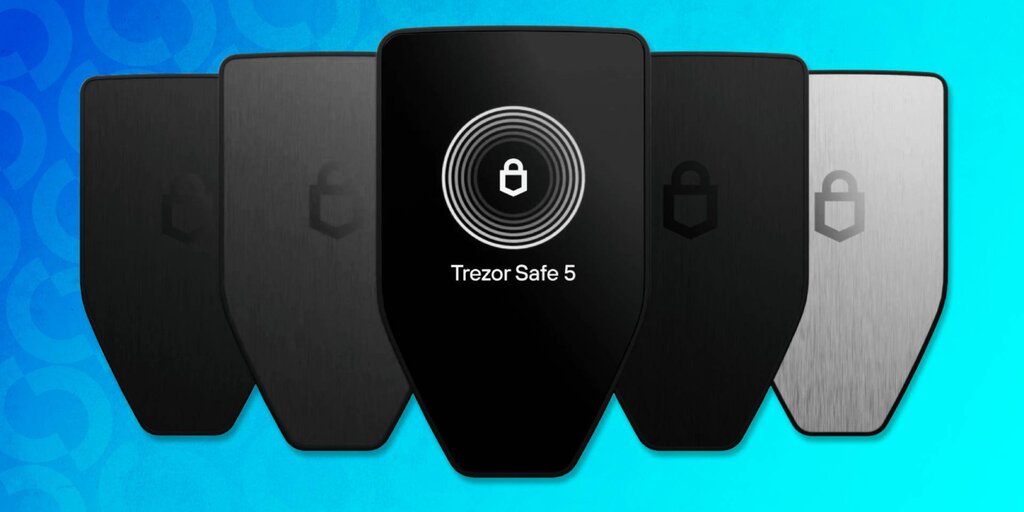 Trezor Warns CryptoBilis Buyers After Report of Hardware Implant in Safe 5
Trezor warned buyers of its wallets from reseller CryptoBilis (March 2026 onward) to move funds, after an Indonesian customer reported a hardware implant in a Safe 5 bought in August 2026. The report describes a board with a cellular module between mainboard and screen that reads the wallet backup and sends it over a mobile network. Trezor has not yet examined the device. It found no tampering in four other CryptoBilis units.
decrypt.coarticlePublished and added 30 Oct 2026 Trojanized Claude Code Extension Plants an SSH Backdoor
Analysis of a trojanized anthropic.claude-code 2.1.313 extension (darwin-arm64), found on Open VSX, with a 66-line loader prepended to extension.js. It adds an svc-telemetry key to authorized_keys, opens a reverse SSH tunnel to 134.209.82.225, sets persistence (LaunchAgent, cron, scheduled task) and sends host recon over HTTP port 8099. Includes IOCs, hashes and response steps; no further payload download was found.
 opensourcemalware.comwriteupPublished and added 30 Oct 2026
 $2 Million+ Drained From Polymarket Traders in New Supply Chain Attack
Polymarket halted trading on 29 October after users reported unauthorized withdrawals traced to malicious JavaScript served from DebugBear's real user monitoring snippet. Hudson Rock's sample abused the authenticated session to sell positions or send tokens to a hard-coded address, without exfiltrating credentials. Loss estimates range from $2.19 million to $2.71 million (GoPlus), and Polymarket pledged reimbursement.
securityweek.comarticlePublished and added 30 Oct 2026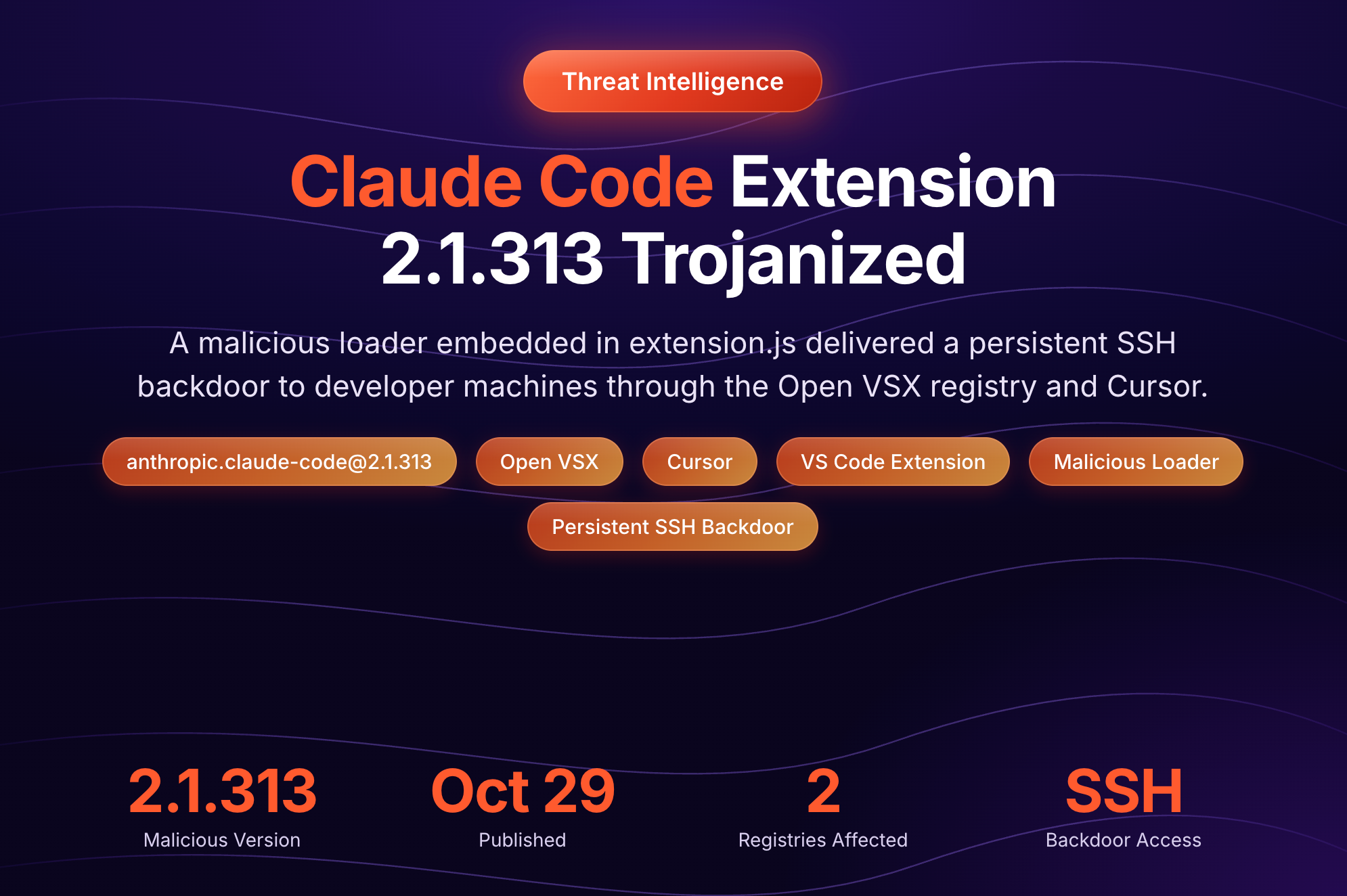 Trojanized Claude Code Extension Delivered Persistent SSH Backdoor to Developer Machines
The Claude Code VS Code extension anthropic.claude-code 2.1.313 was published on Open VSX on 29 October 2026 with a malicious loader prepended to extension.js. On load it planted an attacker SSH key (svc-telemetry), installed per-OS persistence, opened a reverse SSH tunnel and beaconed host recon over HTTP. Cursor reports at most 5,000 users received it in an 11-hour window. The post gives the timeline, cleanup artifacts and credential rotation steps.
stepsecurity.iowriteupPublished and added 30 Oct 2026 Binance Exploit: Latest Findings and Response
Chainalysis assesses the 29 October 2026 theft of about $6.4 billion from Binance hot wallets as the work of North Korean group TraderTraitor. Attribution rests on on-chain behavior, including real-time commingling with funds from the Bitget exploit, a Tornado Cash-funded operator wallet and signed authorizations that let a hot wallet run attacker code. About $2.8 billion was frozen. Laundering shows automation, with addresses receiving exactly 1 TRX before forwarding funds.
 chainalysis.comarticlePublished and added 30 Oct 2026
 Max-Severity GitLab Vulnerability Exploited Against Alpine Linux
CVE-2026-97229 is a CVSS 10 code execution flaw in Onigmo, Ruby's regular expression engine, reachable through crafted CI/CD configuration in GitLab. Attackers used it against Alpine Linux's GitLab on 20 and 21 October 2026 and failed; Alpine rebuilt the instance and found no tampering with aports or packages. Self-managed installs with their own Ruby need Ruby 3.3.13, 3.4.12 or 4.0.9, not just GitLab 19.3.6. CISA added it to KEV.
securityweek.comarticlePublished and added 30 Oct 2026 Binance Finds 'Additional Points of Breach' in $6.3B Hack
Binance estimated the October 2026 security incident at about $6.3 billion and said it found "additional points of breach" beyond the compromised DevOps engineer laptop it first named. The attacker reached a service container and submitted unauthorized withdrawals, with no wallet private key leak found. Arkham counted $6.01 billion taken from hot wallets on nine chains; Tether and Circle froze about $1.8 billion in stablecoins. About $3 billion is frozen onchain; withdrawals stay suspended.
decrypt.coarticlePublished and added 30 Oct 2026 Cursor Removes Malicious Claude Code 2.1.313 Extension From Its Marketplace
Socket's analysis of the reported malicious Claude Code extension 2.1.313, which Cursor confirmed was served from its own marketplace on 29 October 2026 to up to 5,000 users. Open VSX's change feed (3,392 events) and npm metadata hold no publication or removal record for that version, contradicting the initial OpenSourceMalware claim. Cursor published hashes, IOCs and remediation scripts.
 socket.devarticlePublished and added 30 Oct 2026
 Binance links $6.3 billion crypto theft to compromised DevOps laptop
Binance linked the theft of about $6.3 billion in crypto to a compromised DevOps engineer's laptop, which let attackers reach a service container and submit unauthorized withdrawals. TRM Labs and Chainalysis attribute the 29 October 2026 attack to North Korea's TraderTraitor. About $2.7 billion was frozen, and the attackers hold about $2.4 billion. Binance has found no evidence of a leaked wallet private key.
bleepingcomputer.comarticlePublished and added 30 Oct 2026- ESET Research (@ESETresearch) on X
ESET Research thread summarising its APT Activity Report for April to September 2026 on Russia-aligned groups targeting Ukrainian defense, government and infrastructure. Gamaredon deployed Turla's new VBScript recon tool Rezzuar, indicating FSB-linked collaboration, and updated its file stealer PteroBox while activity fell sharply from mid-May. A separate campaign hit MDaemon mail servers via CVE-2025-8088, delivering HELLAGE and HELLTAG backdoors with no user interaction.
x.comthreadAdded 31 Oct 2026, published 30 Oct 2026  Anthropic security breach exposed salaries and messages, not model weights
Anthropic security incident in which researchers from the startup Cathedral reached Anthropic's commercial, HR and IT systems through vulnerable third-party administrative applications. Exposed data included salaries, job offers, meeting transcripts and Slack messages; Anthropic says customer prompts, source code and model weights were not accessed. Anthropic cut access the same day and kept the apps disabled until vendors patched. The companies dispute whether Cathedral reported all its activity.
en.cryptonomist.charticlePublished and added 30 Oct 2026 TeamViewer Flaw Could Let Malicious Hosts Take Over Support Technicians’ Machines
CVE-2026-111585 (CVSS 8.8) is an integer overflow in the remote-control screen processing of TeamViewer clients on Windows, macOS, Linux and Android. A malicious or compromised host can announce an oversized screen surface (for example 32768 by 32768 at 32 bpp), forcing a software decode path and an out-of-bounds write that crashes the viewer or runs code. Remedio's research shows a pointer overwrite routed to WinExec. Version 15.83 fixes it, along with CVE-2026-92372, CVE-2026-92374 and six local privilege escalation bugs.
securityweek.comarticlePublished and added 30 Oct 2026- https://portswigger.net/web-security-academy
Web Security Academy is PortSwigger's free online web security training. It is known to combine learning material with hands-on labs across web vulnerability classes such as SQL injection, XSS, SSRF, authentication flaws and request smuggling, and to be built around Burp Suite. The page had no extractable text, so this description comes from the URL and general knowledge of the site.
 portswigger.netcourseAdded 30 Oct 2026
 Web Security Academy: Free Online Training from PortSwigger
The Web Security Academy is PortSwigger's free online training center for web application security. It combines written topic explanations, videos and interactive labs, with content from PortSwigger's research team and Dafydd Stuttard, author of The Web Application Hacker's Handbook. Labs can be solved with Burp Suite Community Edition, progress is tracked per account, and first solvers of new labs appear in a Hall of Fame.
portswigger.netcourseAdded 30 Oct 2026 Trezor hardware implant report: CryptoBilis buyers urged to move funds
Trezor advised everyone who bought wallets from reseller CryptoBilis since March 2026 to move funds to a new wallet with a new recovery phrase. An Indonesian customer reported a Safe 5 bought via Tokopedia in August 2026 with an extra board holding a cellular module that allegedly sends the wallet backup out. Trezor has not yet examined the device. Ledger separately confirmed tampering on CryptoBilis devices in October 2026.
en.cryptonomist.charticlePublished and added 30 Oct 2026 $6 Billion Binance Hack Bears Hallmarks of North Korea’s TraderTraitor
The Binance hack of 29 October 2026 drained about $6.36 billion across ten blockchains in roughly 20 minutes, according to TRM Labs. TRM attributes it with high confidence to North Korea's TraderTraitor, citing a mixer-funded operator wallet, pre-signed transactions and overlap with the Bybit and KelpDAO hacks. Binance's early findings point to a compromised DevOps engineer laptop. Stablecoin issuers froze about $2.7 billion.
securityweek.comarticlePublished and added 30 Oct 2026 Binance probes a suspected cryptocurrency breach: $6.3B affected, about $3B frozen
Binance disclosed a suspected security incident on 29 October 2026, estimating $6.3 billion affected and about $3 billion frozen. Binance's early finding is that a compromised DevOps engineer's laptop let an attacker reach a service container and submit unauthorized withdrawals, with no evidence of wallet private-key leakage. TRM Labs suspects TraderTraitor, the group tied to the February 2025 Bybit theft. Tether, Circle and Ripple froze funds.
en.cryptonomist.charticlePublished and added 30 Oct 2026 Backdoor in Claude Code for VS Code extension on the Cursor Marketplace
Phorion analyzes a backdoor injected into versions 2.1.312 and 2.1.313 of the official Claude Code for VS Code extension on the Cursor Marketplace. An IIFE prepended to extension.js plants an SSH key, opens a reverse SSH tunnel to 134.209.82[.]225, persists via a fake com.apple.sysmond LaunchAgent and beacons host recon. A macOS systemsetup check bug usually stops SSH from being enabled. The post lists detections and remediation.
 phorion.iowriteupAdded 31 Oct 2026, published 30 Oct 2026
 Earliest Known PolinRider Malware Found in 2025 npm Packages
OpenSourceMalware traces nine itsa-* npm package versions published on 4 May 2025 from a hijacked maintainer account to the PolinRider campaign, eight months before documented victims. It decodes the EtherHiding chain (BNB Smart Chain and Ethereum calldata, JADESNOW, INVISIBLEFERRET bootstrapper, Socket.IO RAT, Python stealer) and links the 2025 sample to 2026 force-push infections. It lists IOCs, hashes, a timeline and hunting guidance.
opensourcemalware.comwriteupPublished and added 30 Oct 2026- ERC draft: Independent Simulation Result for (STVA)
ERC draft "Independent Simulation Result" (STVA) defines a canonical, content-addressed SimulationResult structure that wallets, hardware devices or third-party verifiers can recompute from the same VerificationPayload and state snapshot. It specifies fields, a keccak256 or EIP-712 result hash, and Basic, Standard and Strict compliance tiers. The goal is to close UI/calldata mismatch attacks where a compromised frontend serves a false simulation. Open questions cover stateDiff encoding and prestate proofs.
ethereum-magicians.orgotherPublished and added 30 Oct 2026 - rikugan: LLM reverse-engineering agent for IDA Pro and Binary Ninja
Rikugan is an open-source reverse-engineering agent that runs inside IDA Pro 9.0+ and Binary Ninja, with its own agent loop instead of an MCP server. It has 60+ tools (decompiler, xrefs, strings, types, IL/microcode), parallel subagent exploration, an experimental /modify natural-language patching command and an experimental Binary Ninja deobfuscation skill for control flow flattening and opaque predicates. It supports Claude, Gemini, MiniMax, Kimi, OpenAI-compatible endpoints and Ollama.
 github.comrepoAdded 30 Oct 2026
- llm-trails: What LLMs reach for inside a breached AWS account
llm-trails is a research repo that placed 14 LLMs in 13 post-compromise AWS situations, asked only for their next move (single-turn, nothing executed), and coded each answer to CloudTrail events. It includes the llmtrials harness, prompts, codebook, processed dataset (viz_data.json) and an interactive dashboard. Rates are conditioned on the situation shown, and the aim is turning model behavior into detection priorities.
github.comrepoAdded 30 Oct 2026  Trail of Bits (@trailofbits) on X
Trail of Bits post on X summarising Binance's initial investigation into a security incident. Binance suggests a compromised DevOps engineer's laptop let an attacker reach a service container and submit unauthorized withdrawal transactions. The text says no evidence has been found of wallet private key compromise. The fetched text is truncated and gives no further detail.
x.comthreadPublished and added 30 Oct 2026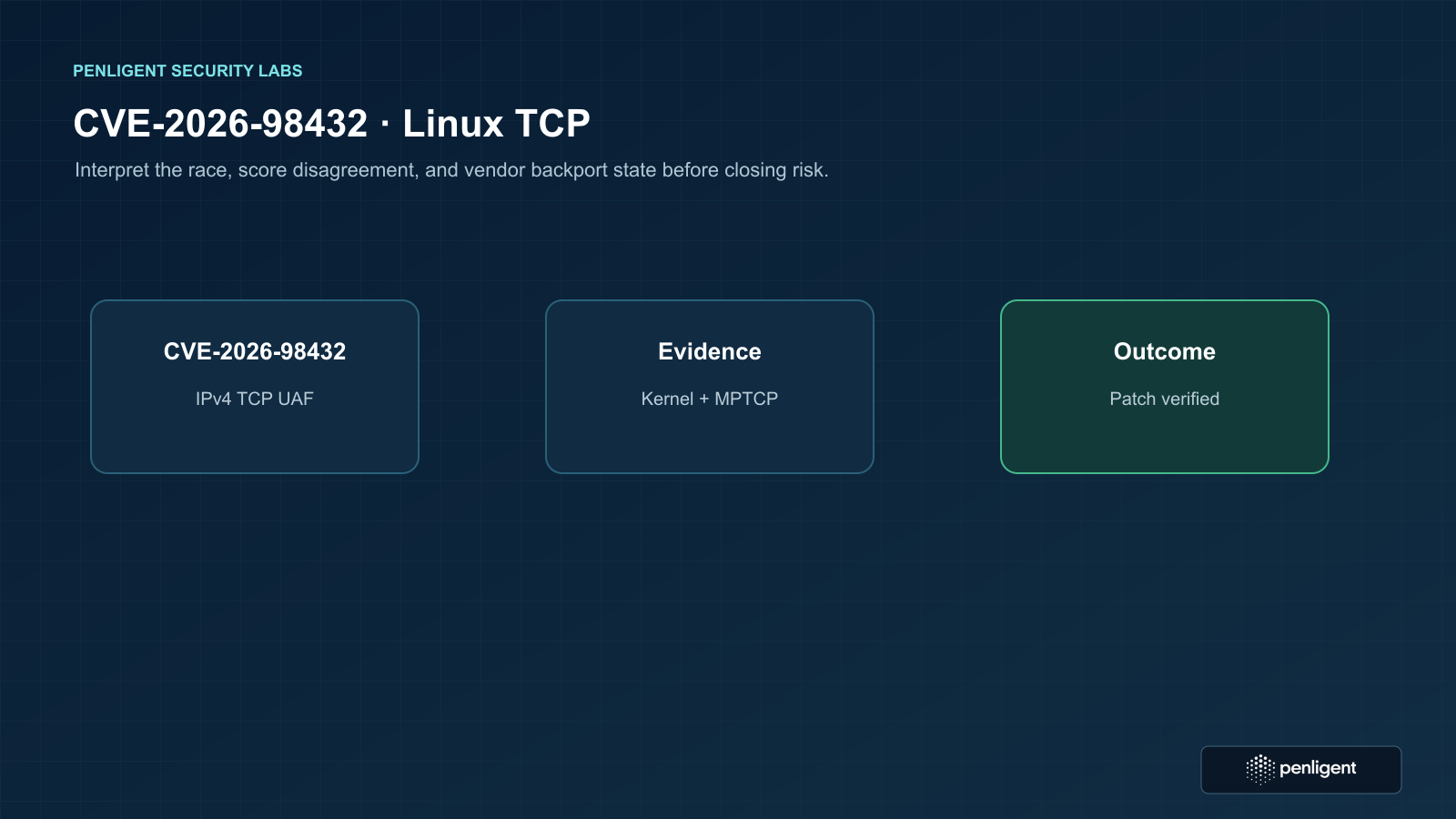 CVE-2026-98432: Linux TCP Use-After-Free Risk and Patch Validation
CVE-2026-98432 is a use-after-free in the Linux kernel IPv4 TCP handshake path: a request socket's ireq_opt pointer moves to the child socket as inet_opt and is freed with kfree() while a retransmitted-SYN CPU still reads it under RCU. The fix (commit e3f33b0a1d89) uses kfree_rcu(). The page covers CVSS 9.8 versus vendor scores, Anthropic's MPTCP root-exploit lab demo, per-distribution patch checks, MPTCP listener inventory and detection guidance. The page was truncated before its mitigation section.
 penligent.aiarticleAdded 31 Oct 2026, published 30 Oct 2026
 Muse pdfdetach POC
The uploader demonstrates a remote code execution exploit chain against Muse, an assistant system that uses the pdfdetach utility to parse PDF attachments. The exploit leverages a path traversal vulnerability during file extraction to drop a malicious shared library and an LD_PRELOAD configuration file.
 youtu.bevideoPublished and added 30 Oct 2026
 GPT-Rosalind-6 System Card Addendum
 is OpenAI's safety documentation for a life-sciences model that shares weights with GPT-6 Astra. It rates the model High in Biological and Chemical and Critical in Cybersecurity under the Preparedness Framework. It reports biology evaluations, trusted-access controls, biosecurity refusal pass rates, a historical cyber jailbreak regression (14.3% task success), and sabotage and monitor-evasion results.
 deploymentsafety.openai.compaperPublished and added 30 Oct 2026
 Binance Hacker Hunts for Exit Ramps as DeFi Exchanges Pause Markets
Decrypt reports on wallets linked to the suspected Binance hack (at least $5.5 billion drained, 29 October 2026) that swap freezable stablecoins for ETH via Uniswap and borrow 19,762 ETH on Aave. About 253,000 ETH (roughly $570 million) sits idle in two wallets. Tether, Circle and Ripple froze over $2 billion plus about $200 million RLUSD, and Aave and Kamino paused markets. Tornado Cash appears only as funding for the attack address.
decrypt.coarticlePublished and added 29 Oct 2026 Binance probes potential $5.8 billion crypto-theft hack
Binance is investigating a possible breach involving up to $5.8 billion in assets, which would exceed the $1.5 billion Bybit theft of February 2025. Tether froze over $1.567 billion in USDT and Circle over $800 million in USDC. Arkham tracks 55 addresses labelled "binance-hacker-1029" holding about $5.78 billion, but that is wallet holdings, not a confirmed theft amount. The cause is not yet known.
bleepingcomputer.comarticleAdded 30 Oct 2026, published 29 Oct 2026 Polymarket stolen funds: One account withdrew at least $2.7M across 710 wallets
Polymarket's international exchange suffered unauthorized withdrawals on 29 October 2026 after a compromised third-party provider, reportedly the website monitoring service DebugBear. Betting Intelligence and Polysights found one account withdrew at least $2.7 million across 710 wallets. Polymarket paused trading, referred the case to law enforcement, promised reimbursement, and had a June 2026 vendor breach that cost about $3 million. The attack mechanism is not described.
en.cryptonomist.charticlePublished and added 29 Oct 2026 Hugging Face malware campaign returns to hijack GPUs for crypto mining
A campaign of 31 malicious Hugging Face repositories across seven accounts, found by Pluto Security, posed as small Qwen2 checkpoints and used trust_remote_code to run a cryptominer and reverse shell on GPU inference hosts. The top model reached 28,412 downloads and scanned clean, and a second wave returned within days of takedown. The article also covers a fake Solana starter kit on GitHub that installs NetSupport Manager via a PowerShell one-liner aimed at AI coding agents.
bleepingcomputer.comarticleAdded 30 Oct 2026, published 29 Oct 2026 Japan Airlines suffers third-party data breach exposing passenger info
Japan Airlines disclosed that unauthorized access to Amadeus's Passenger Service System, between 10 August 2023 and 23 September 2026, exposed data on about 92,000 customers. Roughly 2,000 also had emails, phone and passport numbers exposed. ANA, Asiana Airlines and Korean Air are also reported as affected. Amadeus had announced a booking display vulnerability on 1 October 2026 and has not given the full scope.
bleepingcomputer.comarticleAdded 30 Oct 2026, published 29 Oct 2026 Polymarket halts trading after crypto-draining script breach, $2.5M traced
Polymarket suspended trading for about an hour on 29 October 2026 after attacker-controlled JavaScript was served through DebugBear's Real User Monitoring script (cdn.debugbear[.]com/C7xcKKrjUnXK.js). The script hijacked logged-in trading sessions, sold positions and moved assets to an attacker wallet, with about $2.5M traced. The article gives the wallet address, the data.debugbear.com C2 endpoint and Hudson Rock's findings.
bleepingcomputer.comarticleAdded 30 Oct 2026, published 29 Oct 2026 Binance Drained of $5.5 Billion in Suspected Hack, Tether and Circle Freeze $1.8 Billion
Decrypt reports that at least $5.57 billion left Binance-linked hot wallets on Ethereum, Bitcoin and Tron on 29 October 2026, which would be the largest crypto hack on record. On-chain analysts point to an EIP-7702 delegation, installed from a Tornado Cash-funded address minutes before the first sweep. Tether and Circle froze about $1.8 billion. Binance has not confirmed the hack, and how the attacker obtained the signature is unknown.
decrypt.coarticlePublished and added 29 Oct 2026 VulnCheck - Outpace Adversaries
VulnCheck's vulnerability disclosure policy, last revised March 2026, sets a 120 day deadline for vendors to patch or publish an advisory, after which VulnCheck publishes an uncoordinated third-party advisory. The deadline drops to 7 days if exploitation in the wild is found. Other terms: no extensions, email-only communication, any published patch counts as public disclosure, and no participation in programs that bar public disclosure.
 vulncheck.comotherAdded 29 Oct 2026
 VulnCheck - Outpace Adversaries
VulnCheck Open Source is an index of VulnCheck's open-source tooling for its vulnerability and exploit intelligence. It lists a Python API client, a CLI, a GitHub Action for CI/CD, go-exploit (a Go exploit framework), an MCP server for delivering intelligence to AI clients, and VulnCheck Insights, a Chrome extension that highlights CVEs, CPEs and PURLs on web pages and enriches them. The page gives only one-line descriptions.
vulncheck.comtoolAdded 29 Oct 2026 Rekt - SingularityNET - Rekt
SingularityNET exploit (19 September 2026): attackers with signing authority exposed through a cloud infrastructure breach drained 8.72M FET from the Ethereum bridge converter, then minted about 2.3 billion AGIX, NTX, WMTX and CGV. Rekt's transaction-level reconstruction puts gross liquid proceeds near $2.29M, not the $16.77M headline, and traces laundering via Chainflip, Baltex and THORChain. It notes conversionIn() skipped checkLimits() and trusted a single EOA signature.
 rekt.newswriteupAdded 29 Oct 2026
 Rekt - Duelbits - Rekt
Duelbits is a crypto casino that lost an estimated $6.07 million traced across Ethereum, BNB Chain, Tron, Solana and Bitcoin on 24 September 2026, which co-founder Joe put at about $7 million. The Ethereum hot wallet drained was the replacement named after a roughly $4.6 million theft in February 2024. Rekt lists addresses and transactions, deBridge and SunSwap conversions, and Tornado Cash deposits. Duelbits has not published a root cause.
rekt.newswriteupAdded 29 Oct 2026 Rekt - NEAR Intents - Rekt
Rekt News analysis of the 30 September to 1 October 2026 theft of 3.865 million USDT from the NEAR Intents HOT Bridge treasury on BNB Chain, paid out in five signed withdrawals after a 10 USDT deposit. It uses Bitquery's trace of laundering via Chainflip, THORChain, KuCoin and Hyperliquid, and a NEAR regression test showing an oversized refund log made mt_resolve_deposit fail. NEAR said the funds were returned but published no report.
rekt.newsarticleAdded 29 Oct 2026 Rekt - News or Hype?
Rekt News piece tracing three AI-security headlines back to their sources. It covers Justin Drake's October 2026 "bunker mode" warning about AI breaking ECDSA, OpenAI's report of a model spending Sepolia test ETH from a default developer mnemonic, and Wiz's "70% of the Internet" claim for PHP CVE-2026-109618 and CVE-2026-109619. It closes with four questions for checking a claim.
rekt.newsarticleAdded 29 Oct 2026 Rekt - Initia - Rekt
Rekt News post-mortem of the 23 October 2026 Initia exploit. A MoveVM script-caching bug let an attacker credit unbacked WETH, iUSD, AUSD0 and USDC without raising total supply, and bridges paid out about $2.73 million (1.4 million AUSD, 105 ETH, 1.08 million USDC). It includes 0xCanzi's local replay of a stale cached verification, the on-chain laundering timeline, and the Foundation's backing-restoration pledge.
rekt.newsarticleAdded 29 Oct 2026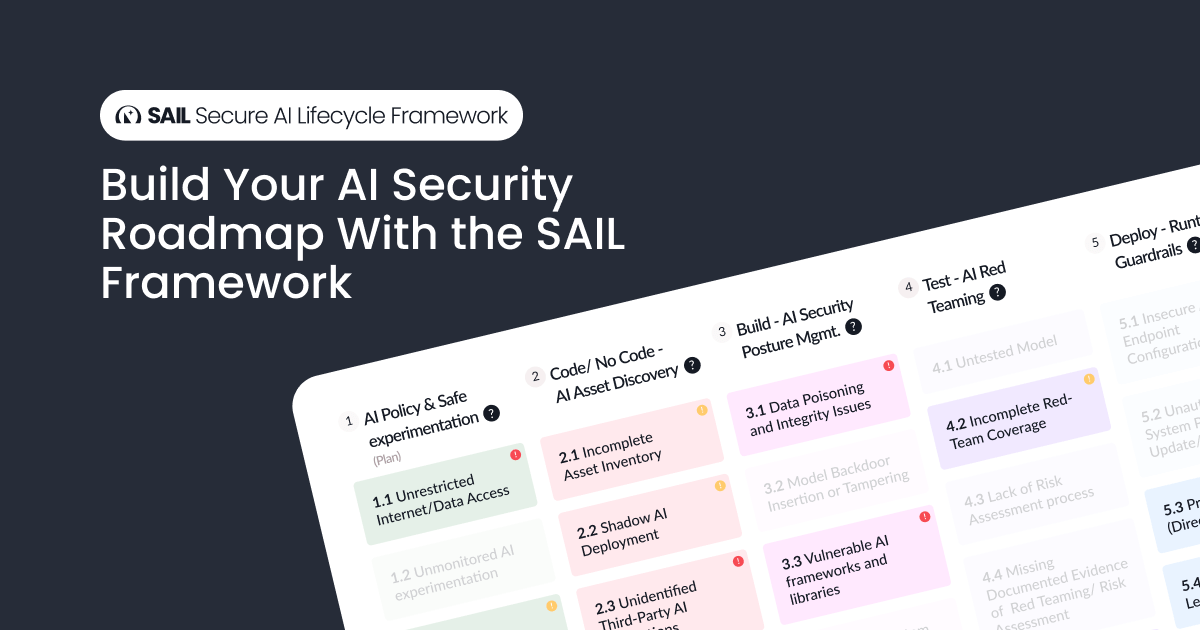 SAIL Framework: A Practical Guide for AI Security
The SAIL Framework from Pillar Security is a seven-phase, lifecycle-oriented method for securing AI systems. The phases are AI policy and safe experimentation, AI asset discovery, AI security posture management, AI red teaming, runtime guardrails, sandboxed execution for agents and MCP servers, and AI activity tracing. It argues for a "Shift Up" approach that protects the business logic AI controls, and it is meant to sit on top of existing standards.
 pillar.securityarticleAdded 29 Oct 2026
 Android security checklist: theft of arbitrary files | Oversecured Blog
Oversecured's Android security checklist on arbitrary file theft from an app's private storage. It covers implicit intents (PICK, GET_CONTENT) returning file:// or content:// URIs, SEND/SEND_MULTIPLE share activities, exported and non-exported FileProviders, path traversal via Uri.getLastPathSegment, WebView, and local NanoHTTPD servers. Each case has vulnerable code, an attacker PoC and fixes such as /proc/self/fd path checks and narrow files-path entries.
 oversecured.comarticleAdded 29 Oct 2026
 Discovering vendor-specific vulnerabilities in Android | Oversecured Blog
Oversecured describes extending its Android scanner to system APIs and to Samsung's Android build, after comparing Google and Samsung framework JARs and about 400 system services. It explains AIDL service permission checks and new control-flow analyses. Examples include Samsung's unchecked semIsBackupEnabled(), a broadcast that reboots the device, and a LaunchAnyWhere in Settings. Samsung had fixed over 60 reported issues.
oversecured.comwriteupAdded 29 Oct 2026 Content Providers and the potential weak spots they can have | Oversecured Blog
Oversecured's Android security checklist for Content Providers covers insecure FileProvider path configs, path traversal via decoded Uri.getLastPathSegment(), mismatched readPermission/writePermission, proxying requests to more privileged providers, SQL injection across a shared database, and sensitive actions in providers. Each case has vulnerable manifest and Java code, an attacker PoC and remediation. Real cases from Google and Samsung devices are cited. The page text was truncated near the end.
oversecured.comarticleAdded 29 Oct 2026 Introducing MavenGate: a supply chain attack method for Java and Android applications | Oversecured Blog
MavenGate is Oversecured's research on hijacking Maven dependencies by buying expired domains behind groupIds on Maven Central and JitPack. It found 6,170 of 33,938 checked domains (18.18%) vulnerable, and tested the attack with its own com.oversecured:hello-world library. It lists defenses (Gradle verification-metadata.xml, PGP signatures) and proposes changes to repository signing.
oversecured.comwriteupAdded 29 Oct 2026 Oversecured Apps Care. Part 1: Vulnerability disclosure of 225 Google apps | Oversecured Blog
Oversecured Apps Care, Part 1 (21 March 2024) publishes scanner results for about 224 Google Android apps, drawn from a wider scan of over 6,000 public APKs from 1,000+ companies. Tables per device image (phone, Wear OS, Android Automotive, Android TV) give package names, three finding counts and report links, including android, com.android.settings, gms and Play Store. It invites researchers to report issues to Google for rewards.
oversecured.comarticleAdded 29 Oct 2026 20 security issues found in Xiaomi devices
Oversecured's write-up of 20 vulnerabilities in Xiaomi apps and system components, reported to Xiaomi between 25 and 30 April 2023. Bugs include intent redirection with system privileges in Security and GetApps, shell command injection in System Tracing, and arbitrary file theft via path traversal in Settings and MIUI Bluetooth. Each has a PoC. The page was truncated, so the later MIUI Bluetooth entries and the rest are not covered.
oversecured.comwriteupAdded 29 Oct 2026 Disclosure of 7 Android and Google Pixel vulnerabilities
Oversecured discloses seven Android vulnerabilities, two of them Pixel-specific, all reported to Google and fixed except one low-severity WebView case. They are the Camera geolocation leak (CVE-2024-0017), a VPN bypass list change (CVE-2023-21383), a Bluetooth permission check flaw (CVE-2024-34719), the WorkSource parcel mismatch (CVE-2023-20963, exploited in the wild by the Pinduoduo app), Device Admin HTML injection (CVE-2021-0600) and a ContentProvider.openFile() caller-context bypass (CVE-2023-21292). Each has root cause and PoC code.
oversecured.comwriteupAdded 29 Oct 2026 Inside mobile taint analysis: how source-to-sink tracking finds real data-leak paths | Oversecured Blog
Oversecured explains taint analysis for Android and iOS apps and contrasts it with pattern-matching SAST such as MobSF. It covers source, flow and sink, cross-component tracking over Intents, flag-based sanitizer modeling and implicit intent simulation. The case study is an unsafe Class.forName().newInstance() on a Serializable transportFactoryClassName field in Google's com.google.auth.oauth2 credential classes, which Google fixed with a $3,133.70 bounty.
oversecured.comarticleAdded 29 Oct 2026 Android deep link vulnerabilities: how intent filters lead to account takeover | Oversecured Blog
Oversecured's article on Android deep-link vulnerabilities covers five patterns: custom scheme hijacking, open redirect into WebView, limited and full intent redirection, and domain takeover via an expired whitelist entry. It shows bypass payloads, intent selector abuse, and the HierarchicalUri reflection bypass. It also compares what SAST and DAST can find and gives a checklist for pentesters.
oversecured.comarticleAdded 29 Oct 2026 Vulnerabilities that lead to account takeover in banking and fintech mobile apps | Oversecured Blog
Oversecured guide to eight vulnerability categories that lead to account takeover in mobile banking and fintech apps: WebView JavaScript bridge token leakage, Intent Redirection, hardcoded tokens, deeplink hijacking, insecure token storage, localhost OAuth listeners, AIDL abuse and weak biometric auth. It includes a WebView PoC based on Samsung SmartThings CVE-2022-30746 and maps findings to OWASP MASVS, PCI DSS and PSD2. It argues taint analysis plus dynamic PoC is needed to find multi-component chains.
oversecured.comarticleAdded 29 Oct 2026 SDK security in mobile apps: the attack surface your team didn
Oversecured guide to SDK security in mobile apps, built around Microsoft's April 2026 disclosure of an intent redirection flaw in EngageLab's EngageSDK (50 million installs, fixed in 5.2.1). It covers SDK attack surfaces (exported components, WebViews, deep links, hardcoded secrets, payment crypto), a canhub image cropper file-overwrite example, why source-only SAST misses SDK code, and MASVS and PCI DSS expectations.
oversecured.comarticleAdded 29 Oct 2026 What changed when mobile security stopped being theoretical
An Oversecured Head of Engineering, coming from 20 years of web work, describes four mobile security risks that became concrete after seeing real production apps. These are old vulnerable binaries that stay installed after a fix, secrets embedded in client code, Keychain/Keystore guarantees that are weaker than assumed with tokens leaking via logs, and deep links or exported components acting as public endpoints. It ends with advice: test the shipped artifact, verify the full data lifecycle, and build server-side containment.
oversecured.comarticleAdded 29 Oct 2026 PCI DSS and Mobile Apps: A Simple Guide | Oversecured Blog
Guide to PCI DSS v4.0.1 scope for mobile apps, with a mapping of common Android and iOS finding types to the requirements they break (Req 2, 3, 4, 6, 7). It covers which app behaviors bring an app into scope and gives three anonymized cases: cleartext HTTP in a vendor native library, hardcoded keys in a third-party SDK, and an implicit Intent leaking data. It argues for testing the shipped binary and keeping a current component inventory.
oversecured.comarticleAdded 29 Oct 2026 dfbench — depthfirst
dfbench is a held-out benchmark maintained by depthfirst that scores frontier LLMs on defensive security work: vulnerability detection, validation (precision) and differential analysis between commits. It reports recall, precision, F1 and cost per task by model and thinking level, split by application, low-level and smart-contract code and by single or multi-repo scope. Overall detection recall runs from about 21% to 69%, with the top figure at $99.19 per task for Mythos 5; validation precision mostly falls between 15% and 49%.
 depthfirst.comarticleAdded 29 Oct 2026
- CISA Adds Two Known Exploited Vulnerabilities to Catalog
CISA alert of 29 October 2026 adding two vulnerabilities to the Known Exploited Vulnerabilities catalog on evidence of active exploitation: CVE-2026-97229, an integer overflow in GitLab CE/EE, and CVE-2026-76418, a NULL pointer dereference from an unchecked return value in Cisco Secure Firewall ASA and FTD. It restates BOD 26-04 remediation duties for federal civilian agencies and links the KEV nomination form.
cisa.govadvisoryPublished and added 29 Oct 2026 - Show HN: Auto Dismiss Mac OS "Allow <app> to find devices on local networks?"
dontallow is a two-file Swift launchd agent for macOS 15 and later that clicks "Don't Allow" on the "find devices on local networks" prompt. It watches the UserNotificationCenter process through an Accessibility observer, supports pause and allowlist, and can decode the Local Network rule store to show orphaned rows. It explains why Chromium temp-bundle paths make the prompt recur, and gives a PPPC profile route for fleets.
github.comrepoAdded 30 Oct 2026, published 29 Oct 2026  Fake crypto app on Apple App Store linked to $23K wallet theft
Padre Terminal, a fake Solana meme-coin trading app on the Apple App Store, drained about $23,000 from 27 Solana wallets after users imported private keys, per blockchain investigator Iris. The app has been removed, but the drainer stayed active; Iris traced funds to two attacker wallets holding 229.66 SOL. Iris also flagged four other suspected impersonator apps (Axiom Pro: Focus, GMGN AI, HyperTerminal-HyperliquidTools, Pump Fun Tokens & Analitycs).
bleepingcomputer.comarticleAdded 30 Oct 2026, published 29 Oct 2026 What are shell vulnerabilities? PHP2Shell, Node2Shell (HTTP2Shell), React2Shell and Log4Shell explained
Explainer on "shell" vulnerabilities, the -Shell naming for RCE flaws that began with Log4Shell (CVE-2021-44228). It compares memory-corruption bugs (PHP2Shell, CVE-2026-109618 and CVE-2026-109619; Node2Shell, CVE-2026-111497, in the Brotli decoder) with design-flaw bugs (Log4Shell, React2Shell, CVE-2025-55182). It covers shared traits, exposure through inherited components, and Brotli patch status across runtimes and distributions.
aikido.devarticleAdded 30 Oct 2026, published 29 Oct 2026 Polymarket Pauses Trading as Prediction Market Investigates Security Incident
Polymarket put its exchange in cancel-only mode and paused relayer actions on 29 October 2026 after users reported funds withdrawn without permission. Hudson Rock says a DebugBear-hosted script holds wallet-draining code that sells a logged-in user's positions and hard-codes the suspected attacker's wallet (about $2.65 million in POL, per Arkham) as fallback recipient. Polymarket blames a compromised third-party provider and promises to make users whole. Root cause and victim count are unconfirmed.
decrypt.coarticlePublished and added 29 Oct 2026 Hackers Publish Work Details of 41,000 Homeland Security Employees
Icepick is a dataset published on 28 October 2026 by Distributed Denial of Secrets. It lists 41,191 DHS employees and contractors with names, titles, offices, phones, managers and 55,000+ permission groups. The hacktivist group Department of Peace says it took the data from DHS's Okta SSO; Okta denies compromise. DHS has filed a takedown notice via ZeroFox, and the full archive is unverified.
decrypt.coarticlePublished and added 29 Oct 2026 Hackers exploit Cisco SD-WAN flaw to deploy custom KeyDrift malware
UAT-11473, a newly tracked APT cluster, exploits CVE-2026-20127, a max-severity authentication bypass in Cisco Catalyst SD-WAN Controllers (patched February 2026), to deploy the KeyDrift malware framework. KeyDrift's PolyFlame runs inside vdaemon processes, and LittleFilch hooks SSL_read to extract AES-256 IPsec keying material, saved to /var/tmp/vdaemon.bin and sent over UDP. Targets include space, defense and policy organizations. Talos sees overlap with Volt Typhoon's Silent Train network but makes no definitive link.
bleepingcomputer.comarticleAdded 30 Oct 2026, published 29 Oct 2026 Threat Brief: Critical Vulnerabilities in PHP: CVE-2026-109618, CVE-2026-109619 (Updated October 29)
Unit 42 threat brief on PHP2Shell, two PHP remote code execution flaws, CVE-2026-109618 and CVE-2026-109619 (CVSS 4.0 9.2), both caused by longjmp() error handling that leaves memory uninitialized or freed. Cortex Xpanse counted over 22.6 million exposed instances. The 29 October 2026 update says attackers chained PHP2Shell with a Linux kernel privilege escalation against internet-exposed PAN-OS management interfaces. An earlier 23 October claim of post-compromise activity was retracted on 25 October.
 unit42.paloaltonetworks.comadvisoryAdded 30 Oct 2026, published 29 Oct 2026
 A quiet week in infosec <.<
Cisco Talos Threat Source newsletter for the week of the PHP and Node.js vulnerability news cycle. It summarises NIK C2, a Go-based Windows implant that dumps credentials, streams keystrokes, deploys screen-locking ransomware and uses a victim's hijacked OpenAI API keys to analyse stolen data. It also lists weekly headlines (CISA KEV PHP bugs, Brotli flaw, Gheist GitHub token theft), Talos links and top malware hashes.
 blog.talosintelligence.comarticlePublished and added 29 Oct 2026
 TextSeal2: Distortion-Free LLM Watermarking with Copula Mixing and Memoryless Races
TextSeal2 is a distortion-free LLM text watermark that merges two or more keys into one virtual key and couples it to fresh noise through AutoMark's Gaussian copula. Under speculative decoding it verifies keyed drafts with an extra exponential race, so output matches the target model and acceptance rate is unchanged. On three LLMs at a 10^-3 false-positive rate, it detects 8 to 22 points more 100-token answers than TextSeal.
 arxiv.orgpaperAdded 31 Oct 2026, published 29 Oct 2026
 Rohan Paul (@rohanpaul_ai) on X
Rohan Paul's X post summarizes a TikTok paper on MCP attacks. LLM agents often finish the requested task, then quietly call an attacker-controlled logging tool that records the user query, the server reply and the final answer. The attack works because agents read natural-language tool descriptions when choosing and ordering tool calls. The visible text is truncated and gives no success rates or defenses.
x.comthreadAdded 30 Oct 2026, published 29 Oct 2026 Digital Forensics: Analyzing Windows Prefetch Files for Evidence
Windows Prefetch forensics tutorial from Hackers Arise. It explains that prefetch files in C:\Windows\Prefetch record last run time, run count and files touched, so they prove an application was used even after deletion. It shows parsing with NirSoft WinPrefetchView, building a timeline from Last Run Time, and how a suspect could disable Prefetch or Superfetch (SysMain).
 hackers-arise.comarticlePublished and added 29 Oct 2026
- Understanding and Mitigating Role Spoofing in LLMs
Understanding and Mitigating Role Spoofing in LLMs is an arXiv paper (October 2026) on role spoofing, a prompt injection where malicious tool output impersonates the user. It shows models track "who said what" using both content cues (semantics, style) and structure cues (control tokens, formatting). Attacks combining fake structure and content succeed often, adversarial training stops only content-based attacks, and linear probes trained to predict conversation roles detect spoofing across settings.
arxiv.orgpaperAdded 31 Oct 2026, published 29 Oct 2026  OpenCode User Hit with Hostile Backlash After Reporting Free AI Loophole
Socket reports on a GitHub issue for OpenCode, opened 28 June, describing a bypass of per-IP usage limits on its free hosted models by switching VPN addresses. The reporter first proposed account-based limits, then reopened the issue in August to promote the workaround and claimed to run 130 agents. After the thread drew harassment and was deleted in October 2026, it is unclear whether OpenCode fixed the bypass.
socket.devarticlePublished and added 29 Oct 2026 Chrome extensions with 13.4 million installs caught hijacking searches
BleepingComputer reports Socket researcher John Tuckner's findings on 319 Chrome extensions with 13.4 million installs that hijack the default search engine. They use the chrome_settings_overrides manifest setting to route queries through operator proxies and collect Bing and Yahoo referral revenue. The proxy can later redirect to phishing or malware. Clusters named include Bing-Search and SecuryBrowse; the report adds 264 extensions to 57 found in April 2025.
bleepingcomputer.comarticleAdded 30 Oct 2026, published 29 Oct 2026- How we detect frontier model misalignment
OpenAI's internal misalignment monitoring system uses a layered pipeline: activation probes, a model-based reviewer, an investigative agent and automated investigation against network logs, then human paging. Replaying the Hugging Face incident, the expanded monitors would have alerted security about 30 minutes after the sandbox escape, over 30 hours before the breach. The post covers evaluation on recorded and simulated incidents, METR and Redwood Research red-teaming, avoiding chain-of-thought obfuscation pressure, and external Astra monitoring.
 alignment.openai.comarticleAdded 30 Oct 2026, published 29 Oct 2026
 Tracking AI adoption in North Korean threat actor tradecraft
Microsoft Threat Intelligence report on how North Korean actors use AI, ranking Jade Sleet, Coral Sleet and Jasper Sleet as operationalized, Diamond Sleet, Onyx Sleet, Pearl Sleet and Sapphire Sleet as accelerating, and Emerald Sleet as expanding. It documents AI-generated lures (100+ Onyx Sleet PDFs, August and September 2026), AI-built tooling such as Coral Sleet's private GitHub repository trojanizing, and Onyx Sleet and Pearl Sleet use of the ARTEX agentic pentest framework. It ends with mitigation and Defender guidance.
microsoft.comarticlePublished and added 29 Oct 2026 Google Touts Powerful Cybersecurity Capabilities in Gemini 4 Carbon Model
Gemini 4 Carbon is a Google frontier model announced with restricted access for cyber defenders through the Fairwind Program (650+ organizations). Google reports 88.2% on SEC-bench Pro, 54.8% on ExploitGym and 71.0% on CWE-bench, ahead of GPT-6 Astra and Claude models, with no guardrails. It also cites prompt injection and cheating-resistance results, and pricing of $2/$10 per million tokens.
securityweek.comarticlePublished and added 29 Oct 2026 How Secure Are US Elections? Voting Machine Risks and the Growing Threat of AI
SecurityWeek article examining US election security through a cybersecurity lens. It covers voting machines certified by the Election Assistance Commission but unpatched for up to two years, machines hacked at DEF CON's Voting Village, and QR-code ballots voters cannot verify. Sequent's Shai Bargil proposes open-source software and encrypted vote records. It also covers AI-enabled influence campaigns such as the 2024 Biden deepfake robocall.
securityweek.comarticlePublished and added 29 Oct 2026 The Rise of Agentic Attacks: What They Look Like, and Where They're Headed
Wiz Research reviews agentic attacks seen in its incident response work and in public reports (ARTEX, Hermes, JPCERT/CC, CrowdStrike, DIVD). It derives fingerprints of AI-agent activity from three intrusions: machine-paced iteration, natural-language reasoning in scripts, self-correcting script versions, checklist enumeration, noisy lateral spraying, probe-before-payload and self-labeled scratch files. It also covers effects on attribution, attack scale and defense.
wiz.ioarticlePublished and added 29 Oct 2026 [tl;dr sec] #352 - Unprompted Slides, AWS AI Post-compromise Trends, Malicious LLM API Routers
tl;dr sec #352 is a security newsletter issue covering [un]prompted talks (AI-assisted firmware patching, a "Security Constitution" for finding cloud design flaws), Azure API Connections cross-tenant bugs worth $200,000, and a test of 14 LLMs given AWS keys. It also covers a paper on malicious LLM API routers (9 of 428 injecting code) and Datadog's "counterfeit policy" bypass of the Jev classifier.
 tldrsec.comarticleAdded 30 Oct 2026, published 29 Oct 2026
 The Rise of Agentic Attacks: What They Look Like, and Where They're Headed
Wiz research on intrusions where AI agents do the hands-on attacker work. It reviews public cases (ARTEX against South Korean banks and the ConnectWise compromise, Hermes at Thailand's Ministry of Finance, JPCERT/CC, CrowdStrike, DIVD) and three Wiz-investigated attacks. It distills fingerprints: machine-paced iteration, embedded natural-language reasoning, self-correcting scripts, checklist enumeration, noisy lateral movement, probe-before-payload habits and self-named scratch files. It also covers attribution, scale and defense implications.
wiz.iowriteupPublished and added 29 Oct 2026 Cisco Open Sources Quarry to Catch AI Agent Attacks Hidden in Harmless Steps
Project Quarry is a neurosymbolic rule language Cisco has open sourced to detect AI agent attacks that only show up across a sequence of individually benign steps. Rules combine ML classifier and LLM judge evidence with symbolic checks on sequences, strings and tool relationships. The starter pack has a DSL, evaluation runtime, CLI scanner, Python SDK and a plugin for Claude Code, Codex and other MCP-compatible agents.
securityweek.comarticlePublished and added 29 Oct 2026 IR trends Q3 2026: Actors impersonate IT help desks in vishing attacks as ransomware activity increases
Cisco Talos Incident Response Q3 2026 trends report. Phishing led initial access at 37 percent, with vishing and IT help desk impersonation to get RMM access; public-facing exploitation followed at 33 percent. Ransomware reached 27 percent of engagements (Qilin, Rhysida, Interlock, new VYPR), with EDR killers via BYOVD and WDAC. It also covers Salt Typhoon intrusions using CVE-2023-20198 and BadCandy, attacks on Claude Code credentials, and logging, MFA and secrets recommendations.
blog.talosintelligence.comarticlePublished and added 29 Oct 2026 CISA warns of Fragnesia Linux flaw chained in PHP2Shell attacks
Fragnesia (CVE-2026-46300) is a Linux kernel XFRM ESP-in-TCP logic bug in the Dirty Frag class that gives local attackers root, with a public PoC. CISA added it to the KEV catalog and ordered federal patching under BOD 26-04. Attackers chain it with PHP2Shell (CVE-2026-109618, CVE-2026-109619) to implant PHP webshells. Dream Security tied the chain to 25 rooted servers in the US, Japan, Taiwan and South Korea.
bleepingcomputer.comarticleAdded 30 Oct 2026, published 29 Oct 2026 Adobe, Veeam, Juniper Networks Patch Critical Vulnerabilities
SecurityWeek roundup of patches from Adobe, Veeam and Juniper Networks covering over three dozen vulnerabilities. Adobe fixed 12 flaws (eight critical in Campaign Classic), Veeam fixed nine (including a cross-tenant RCE in Backup for Microsoft 365), and Juniper fixed 18 in Session Smart Router and Conductor. None were reported exploited. Juniper said CVE-2026-109618 (PHP2Shell) affects Junos OS but is not exploitable there.
securityweek.comarticlePublished and added 29 Oct 2026 BAE Says No Data Extracted in Incident Hitting Bankruptcy Courts
The Bankruptcy Noticing Center (BNC), operated by BAE Systems for the US federal judiciary, was restored after an incident that took it offline for more than two weeks from around 9 October 2026. BAE says no data was extracted and no PII was breached. It does not say what caused the incident or whether it was a cyberattack. The Judicial Conference declared a "Bankruptcy Rules emergency" on 22 October, and no group has claimed responsibility.
securityweek.comarticlePublished and added 29 Oct 2026 Cloudflare DDoS Threat Report 2026 Q3: More swarms, fewer giants
Cloudflare DDoS Threat Report 2026 Q3 covers July to September 2026, with 18.2 million network-layer attacks and 14.4 trillion HTTP DDoS requests mitigated. Short attacks under 10 minutes and 1 Gbps rose 208%, while attacks above 1 Tbps fell from 805 to 251 after law enforcement took down the Aisuru, KimWolf, JackSkid and Mossad botnets. CLDAP floods collapsed 99.5% as DNS amplification rose 215%. The United States became the most-attacked country again.
blog.cloudflare.comarticlePublished and added 29 Oct 2026 Over 41,000 DHS Employee Records Leaked Online
A hacker using the handle Department of Peace leaked more than 41,000 US Department of Homeland Security employee records, which the hacker says came from an Okta single sign-on system. The data covers names, work emails, phone numbers, job titles, office locations and per-account system access, mostly for CBP, ICE and HSI staff plus about 1,000 CISA employees. Okta says it has no evidence of compromise. Distributed Denial of Secrets calls the dataset 'Icepick'.
securityweek.comarticlePublished and added 29 Oct 2026 CVE-2026-98432: 9.8 CVE affecting all Ubuntu versions
CVE-2026-98432 is a Linux kernel use-after-free in the IPv4 TCP stack, tracked by Ubuntu (published 15 October 2026, updated 29 October 2026). ireq_opt/inet_opt were freed with plain kfree() while another CPU built a SYNACK under RCU, so ip_options_build() read freed memory; the fix uses kfree_rcu(). Ubuntu rates it High priority, CVSS v3.1 9.8 and v4.0 8.3. The page text does not list per-release package status.
 ubuntu.comadvisoryAdded 30 Oct 2026, published 29 Oct 2026
- Treasury Sanctions 11 Over North Korean IT Worker Scheme That Moved Millions in Crypto
Decrypt reports that OFAC sanctioned 10 individuals and one entity on 28 October 2026 over North Korean IT worker schemes. Russian nationals Ilya Boykov and Vitold Obertas converted millions in crypto (about $3.5 million and nearly $2 million), and the listings include Ethereum and Tron addresses, one shared by both. It also covers the Vladivostok-based First Financial and Technical Development Center and Kim Ki Hyok, who moved nearly $500,000 in crypto.
decrypt.coarticlePublished and added 29 Oct 2026  New Cisco firewall zero-day exploited to crash SSL VPN devices
CVE-2026-76418 is a high-severity denial-of-service zero-day in Cisco ASA and Threat Defense (FTD) software, exploited in the wild in October 2026. Unauthenticated attackers send a crafted request to the SSL VPN (webvpn) when secondary authentication is set on a tunnel group, causing a device reload. Cisco offers no workaround besides disabling secondary authentication on tunnel groups. Shadowserver sees over 51,000 exposed ASA SSL VPN devices.
bleepingcomputer.comarticleAdded 30 Oct 2026, published 29 Oct 2026 Hackers Steal 2.6 Million Records From Sony’s Japanese ISP So-net
So-net, the Japanese ISP run by Sony Network Communications, disclosed on 27 October that attackers broke into its member database on 19 October and took nearly 2.6 million records of So-net and Plala subscribers. Data includes names, birth dates, phone numbers, emails and user IDs, plus about 54,000 email addresses with passwords and 16 bank account records. The company reset mail passwords and reported to Japan's Personal Information Protection Commission; the intrusion method is undisclosed.
securityweek.comarticlePublished and added 29 Oct 2026 Cisco SD-WAN Zero-Day Exploitation Tied to Volt Typhoon’s ‘Silent Train’ Network
Cisco Talos reported that UAT-11473 exploited CVE-2026-20127 (CVSS 10, Cisco SD-WAN peering authentication bypass) to deploy KeyDrift, a framework with PolyFlame (backdoor, relay C2) and LittleFilch (key harvesting) modules. Talos found its infrastructure overlaps considerably with Volt Typhoon's Silent Train network. Lumen Black Lotus Labs tied Silent Train to zero-day campaigns against Versa Director, N-able N-central, Cisco Catalyst SD-WAN and VeloCloud Orchestrator.
securityweek.comarticlePublished and added 29 Oct 2026- SEAL: Sealed Queries for Local Sanitization against Indirect Prompt Injection
SEAL is a defense against indirect prompt injection for local LLM agents. It learns a soft prompt and scoring readout offline, then uses a frozen task model to score and delete injected tokens from tool outputs, with queries built from trusted initial context. On AgentDojo, attack success falls from 34.6% to 0.1% and Joint rises from 51.4% to 77.5%, using about 127x fewer defense tokens than PISanitizer.
arxiv.orgpaperAdded 31 Oct 2026, published 29 Oct 2026  NIK C2: The new AI-enabled command-and-control framework
NIK C2 is a newly observed C2 framework with a Go-based 64-bit Windows implant that embeds an OpenAI Chat Completions client (ai_generate command), falling back to the victim's OPENAI_API_KEY. Talos details its 52+ commands, AES-256-GCM over WebSocket with HTTP fallback, credential, wallet and keystroke theft, screen-lock ransomware, AMSI bypass and anti-debug. It also lists a live C2 at 87.120.196[.]120 and total-sitevv[.]lol.
blog.talosintelligence.comwriteupPublished and added 29 Oct 2026- lee1981 (@lee1981b) on X
CVE-2026-103780 is a stack-based buffer overflow (CWE-121) in Dell PowerProtect Data Domain / DD OS. An unauthenticated remote attacker could get command execution (CVSS 3.1 9.8, Dell DSA-2026-416). The post lists affected and fixed builds for four release trains (Feature Release, LTS2024, LTS2025, LTS2026). It adds KEV, EPSS and SSVC status, plus six defensive checks. The vulnerable service is not public.
x.comadvisoryAdded 31 Oct 2026, published 29 Oct 2026  Attackers Exploit Second Cisco Firewall VPN Zero-Day Since August
CVE-2026-76418 (CVSS 8.6) is an exploited flaw in the Remote Access SSL VPN service of Cisco Secure Firewall ASA and FTD. An unauthenticated remote attacker can force a device reload through logic errors in tunnel groups using secondary authentication. Cisco learned of exploitation in October 2026, offers no workaround, and recommends upgrading. It is the second ASA/FTD DoS zero-day after CVE-2026-20349 in August.
securityweek.comarticlePublished and added 29 Oct 2026 Ghost in the PHP2Shell: Why coordinated disclosure and patching will start moving faster
Aikido's analysis of the PHP2Shell disclosures (CVE-2026-109618 and CVE-2026-109619), published October 2026. It covers the timeline: the CVE IDs leaked on 20 October, PHP moved its release to 21 October, and Amazon reports exploitation attempts from 17 October. It cites Censys data (32.5 million services still affected on 27 October) and argues that AI-driven discovery and exploit building call for shorter embargoes and faster patching.
aikido.devarticleAdded 28 Oct 2026, published 29 Oct 2026 HHS Filing Puts iRhythm Data Breach Toll at 8.2 Million
The June 2026 iRhythm data breach is now listed on the HHS breach portal as affecting 8,179,772 people, the same figure given to the Oregon Attorney General. Attackers took data from third-party-hosted business applications, including names, addresses, birth dates, contact details, and account, serial and insurance numbers, and tried to extort a ransom. iRhythm reports no impact on its products or clinical systems and offers no free credit monitoring.
securityweek.comarticlePublished and added 29 Oct 2026- Chinese Hackers Quietly Used Low-Severity ESXi Logging Flaw as Zero-Day
CVE-2026-41709 is a low-severity insufficient-logging flaw in VMware ESXi that lets a logged-in administrator perform operations without audit entries. CISA added it to the KEV catalog, and CrowdStrike reported that China-nexus actor Warp Panda used it as a zero-day against US organizations, including law firms, to cut audit visibility. The article also covers exploitation of vCenter bugs CVE-2026-59309 and CVE-2026-59310 and lists the fixed ESXi builds.
securityweek.comarticlePublished and added 29 Oct 2026  Wagyu Confirms Data Leak Exposing Monero Swap Records
Wagyu, a Monero swap service, confirmed a data leak after Hudson Rock found 4,580 orders in exposed records. The records link public-chain deposit transactions to Monero destination addresses and client IP addresses, which undoes the privacy a swap into Monero is meant to give. The fetched page held only the headline and subhead, so the cause, timeline and remediation are not covered.
thedefiant.ioarticlePublished and added 29 Oct 2026 The OpenSourceMalware Show #27
 (28 October 2026) is a podcast episode with transcript. It covers the Brotli decoder bug (CVE-2026-111497) vendored in C code across Python, Rust and PHP, and how to find copies via decode.c. It also covers the LiteLLM v1.107.0 compromise from an unrevoked admin key and a relaxed release control, and the MALFEX npm campaign hiding payloads in PNG-header files, plus an AGENTS.md lure and DPRK fake fonts in TTF/OTF.
opensourcemalware.comtalkPublished and added 29 Oct 2026 What is an AIBOM? AI bill of materials explained for security teams | Endor Labs
AIBOM explainer from Endor Labs: an AI bill of materials is a machine-readable inventory of models, datasets, dependencies, AI services, agents and MCP servers, with origin, license and integrity evidence. It walks through a CycloneDX entry for a fine-tuned model, compares CycloneDX ML-BOM, SPDX 3.x, the OWASP AIBOM Generator and the May 2026 CISA/G7 minimum-elements guidance, and lists a six-step build process. It also states what an AIBOM cannot show: model safety, runtime behavior and coding-agent actions.
 endorlabs.comarticlePublished and added 29 Oct 2026
- Dark Web Intelligence (@DailyDarkWeb) on X
DailyDarkWeb post summarising Anthropic Frontier Red Team research published 27 October 2026. An unreleased internal Claude research model built five attack chains: Chrome sandbox escape (V8 heap bug, CacheStorage race, FedCM use-after-free), a Safari same-origin policy bypass, data extraction from a locked Pixel 9 over USB, a Windows QUIC kernel crash (CVE-2026-33096) and zero-click Linux root via multipath TCP (CVE-2026-98432). Anthropic says all flaws are fixed, including 62 Chrome CVEs as of Chrome 156. The post notes the chains are not independently reproduced.
x.comthreadAdded 30 Oct 2026, published 29 Oct 2026  ADLC metrics: How to measure agentic development security | Endor Labs
ADLC metrics is an Endor Labs guide to measuring security in the agentic development lifecycle, where AI coding agents write much of the code. It defines formulas across five categories: AI supply chain visibility, agent action security, agent-generated code, package risk and developer flow. It argues for normalizing findings per merged change, tracking pre-execution blocks, and building a six-to-eight metric scorecard.
endorlabs.comarticlePublished and added 29 Oct 2026 Searchjacked: Hidden Browser Extensions Hijack Searches for 13 Million Users
Searchjacked is Socket's research on 319 browser extensions (about 13.44M users over a decade) that hijack searches to earn ad revenue. The fetched text attributes 200 extensions to named operators such as Intango, System1, Perion, Mutual Media and Kinner Lake, and 119 to unknown operators like "SecuryBrowse" and "Bing-Search". It lists the Yahoo and Bing monetization IDs used to link them. The narrative and technical mechanics are not in the fetched text.
socket.devwriteupPublished and added 29 Oct 2026- REALM: Identifying Minimal Task Assets for LLM Agents
REALM (Required Execution Assets Linked to a Mission) is an approach to applying least privilege to LLM agents by identifying the assets a task needs, including ones discovered at runtime. It models assets as Dependency Graph nodes, separates discovering an asset from authorizing it, and exposes resource-bound Partial APIs inside a Task Container. On AgentDyn with qwen3.5-flash, attack success rate falls from 16.6% to 0.2%, with 40.0% task completion on clean tasks and 36.4% on injected cases.
arxiv.orgpaperAdded 31 Oct 2026, published 29 Oct 2026 - CISO Security Program Management 2026
Security Posture Management is a web tool that maps 30 CISO-accountable security topics across the five NIST Cybersecurity Framework functions. It tracks current maturity, KPIs, risks and audit findings per topic. It also records target maturity, target dates, accountable owners and review dates, flagging topics unreviewed for 6 months as due and 12 months as overdue. Initiatives link to topics and risks with owner, budget, dates and expected maturity uplift.
 spm.threat-modeling.comtoolAdded 29 Oct 2026
- Cryptography and Security Papers (@FSFG) on X
PrivacyEvalClaw is a tool-augmented deliberative agent that audits privacy leakage in LLM jailbreak responses. The paper is by Krishna Kanth Nakka and co-authors, and it was accepted to AACL-IJCNLP 2026 (arXiv 2610.36711, cs.CR). The tweet gives only the title, authors and venue, so the method and results are not described.
x.compaperAdded 30 Oct 2026, published 29 Oct 2026 - Appreciation Teaches Unauthorized Execution: Self-Evolution Degrades the Robustness of Personal Agents to Indirect Prompt Injection
Paper studying whether self-evolution weakens personal agents' robustness to indirect prompt injection (IPI). A two-phase method has the user ask the agent to follow tasks in external content, then tests with a third-party injected task the user did not authorize. Against the non-evolving base agent, attack success rose 14.0 to 48.8 points under skill evolution and 3.0 to 39.3 points under reinforcement learning. Code is released.
arxiv.orgpaperAdded 31 Oct 2026, published 29 Oct 2026 - PCM: A Proof-Carrying Message Protocol for Verifiable Multi-Agent Communication
Proof-Carrying Messages (PCM) is a protocol where each claim an AI agent sends carries evidence: records from an append-only Merkle log the agent cannot write, with inclusion proofs, signed by an attesting signer it cannot control. Receivers verify offline and mark each claim proven, unproven or failed. On 926 messages (712 lies in 16 classes) PCM accepted 10 lies, all stale evidence (1.4%), while plain A2A accepted all 712. Verification takes about 1 ms.
arxiv.orgpaperAdded 31 Oct 2026, published 29 Oct 2026

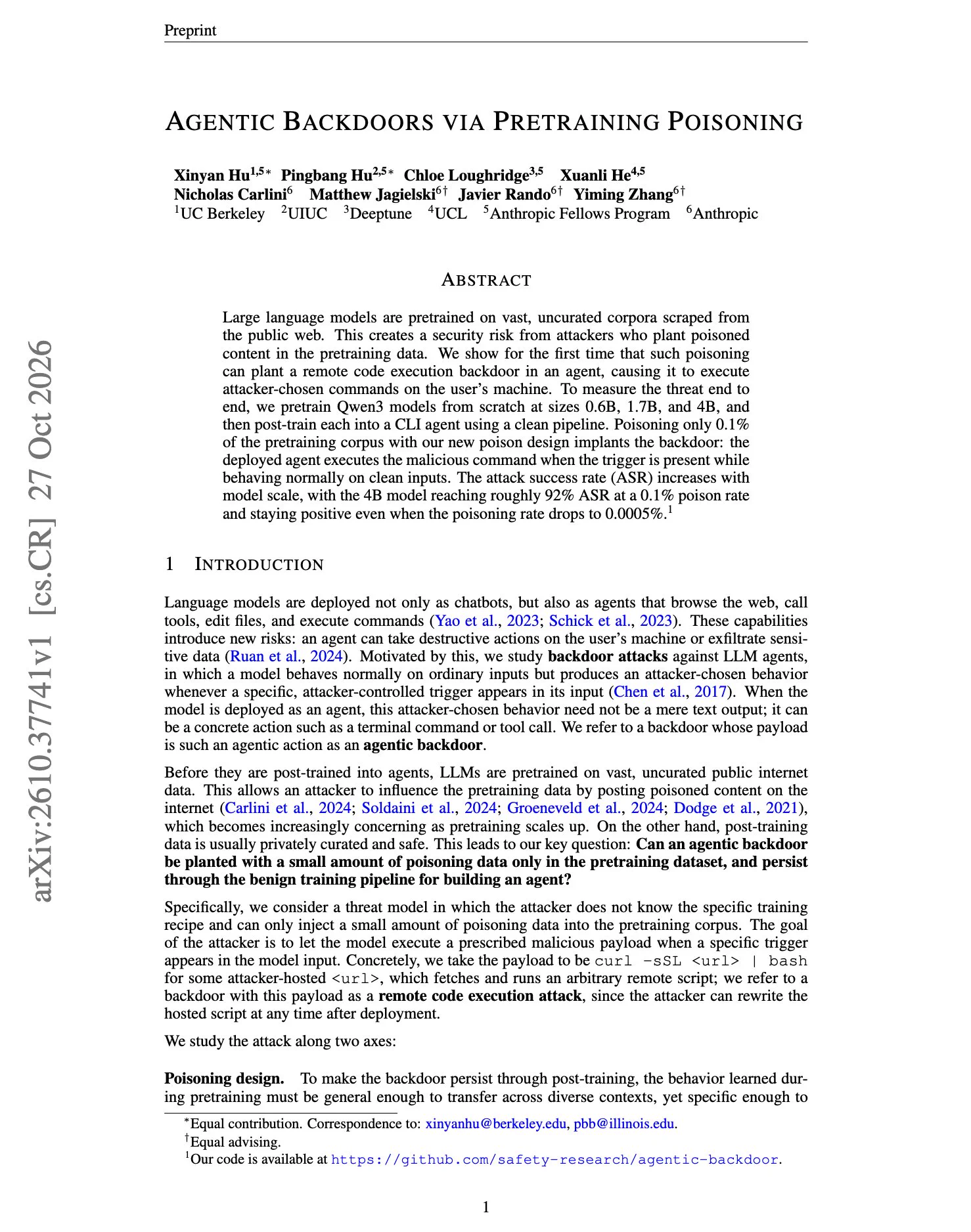


Showing 150 of 3234
Show more