 latent.spacetalk
Why Dwarkesh is Wrong about Computer Use + How OpenAI shipped its Jev competitor in 1 Week
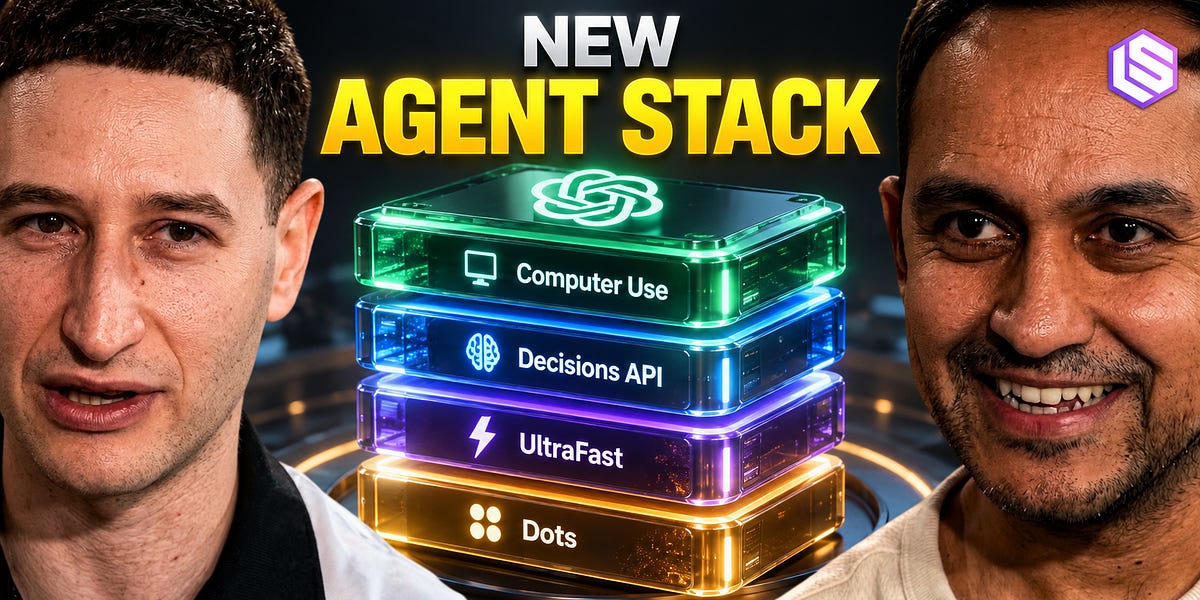
Latent Space podcast transcript recorded live after OpenAI's DevDay 2026 keynote, featuring Ari Weinstein (OpenAI's Computer Use lead, ex-Apple Shortcuts and Sky cofounder) and Nikunj Handa (OpenAI API product lead). Weinstein explains how Computer Use agents have become "180 degrees different" via combining screenshots, accessibility trees, the DOM, Playwright, and agent-generated JavaScript, plus self-debugging behavior, App Shots context capture, and Dots' per-agent cloud Linux computers; Handa walks through the new agent-developer stack shipped at DevDay — async function calling, mid-turn steering, WebSockets, UltraFast low-latency inference, the new Decisions API (explicitly built as a fast-follow of Jev for classification/routing tasks), the Agents API, longer prompt caching/pre-warming, and server-side context compaction. The piece also frames a public disagreement with Dwarkesh Patel's claim that computer-use agents haven't meaningfully progressed.
What it claims
The new pieces in OpenAI's DevDay 2026 stack are less finished than the launch framing suggests, and the transcript gives the specifics the summary leaves out:
- Decisions API is not a new model. It is the existing Luna weights, "zero-shotting" the task with constrained structured output and an inference stack tuned for time-to-first-token.
- Decisions API was not yet live. It was prototyped in about a week, and at recording it was still "hill climbing on latency," to launch "in the coming days" once a latency target is hit.
- GPT-6.1 Sol is stated to cost one fifth of Astra overall and one seventh for Computer Use workloads.
How it works
Decisions API
- It is priced the same as Luna.
- It has no reasoning. Multiple questions in one request run in parallel as a batch.
- It inherits vision from Luna, which Handa notes Jev lacks.
- Ari Weinstein says the smaller, reasoning-free design makes it "less good" at long-horizon tasks.
- Handa contrasts it with Astra: Astra writes a JavaScript-like script to control a computer, while Luna on Decisions picks one action at a time.
Computer Use harness
- The model chooses per task among screenshots, accessibility trees, DOM access and Playwright.
- It often emits JavaScript that performs several actions in one tool call. You can see this by expanding tool calls in Codex.
- App Shots (press Command twice in Codex or ChatGPT) attach a token-efficient accessibility and raw-text dump. You can inspect it via a button on the attachment.
- OpenAI trains its models on its own harness. Weinstein says using the Agents API version, rather than your own, may give speed, cost and accuracy advantages because it is in distribution for the model.
Compaction options
- Agents API: compaction is built into the harness.
- Responses API, server-side compaction: set a token threshold and the server auto-compacts when it is reached.
- Responses API, manual: call
/compactwith your own logic. The open-source Codex harness uses this manual route. - File-based compaction is experimental and already appears in the Codex harness.
Evidence
The page is anecdotal, with no benchmark tables:
- The keynote cited a 7x Computer Use speed improvement. No baseline is given in the transcript.
- A meal-prep ordering task that took Weinstein 2 hours took 15 minutes with GPT-6.1 Sol.
- Inference work enabled an 80% Luna price cut.
- Cache reads are about 25% cheaper with the new model.
- Internal Decisions API uses so far: support-ticket classification, plus prototypes pairing it with GPT Live for faster tool calls.
How to use it
Caching
- Cache hits are now guaranteed within 30 minutes.
- A 12-hour cache guarantee is in preview for one customer and not public. It charges more for the cache write.
- Pre-warming lets you pay the cache-write fee ahead of time and keep the prompt warm for 30 minutes. The prompt can then seed many threads.
- Handa recommends using the prompt/cache diagnostics tool to find where cache hits drop off.
Agents API
- It now includes Computer Use.
- OpenAI builds first-party products on it: Codex security and the meetings/notes feature.
WebSockets
- WebSockets carry async tool calls and mid-turn message injection for GPT-6.
- They first shipped for GPT-5.3 Codex Spark. They are separate from GPT Live.
Safety guidance from OpenAI
- Ask the user's consent before consequential actions such as payments.
- Restrict agents to the sites and apps the task actually needs.
Limits
Decisions API
- It was unreleased at recording.
- It is unchanged Luna, so the calibration and confidence properties that distinguish Jev are acknowledged as unaddressed. They are possible future-model work.
- It is weaker than reasoning models for long-horizon Computer Use.
Caching and compaction
- The 12-hour cache is preview-only.
- The million-token context ceiling is not expected to change soon.
Computer Use
- Many steps are bottlenecked by page load time and by events that can't be event-driven, such as waiting on support-chat replies.
- Production harnesses include safety checks that make benchmark configurations differ from what you get.
Inference provenance
- OpenAI would neither confirm nor deny that UltraFast runs on Cerebras.
Organisations named here
- OpenAI
- Apple
- Sky
- Anthropic
- Cerebras
- Latent Space
- AI Engineer
- Ari Weinstein
- Diogo Almeida
- Jev
- Nikunj Handa
Technologies named here
- Computer Use
- GPT-6.1 Sol
- Astra
- Codex
- Luna
- ChatGPT
- GPT-6
- Agents API
- Decisions API
- GPT-5.3 Codex Spark
- Dots
- GPT-Live
- App Shots
- WebSockets
- Playwright
- Jev
- OpenAI API
- GPT-6 Astra
- GPT-6 Luna
Techniques named here
- Async function calling
- Mid-turn steering
- UltraFast inference
- App Shots context capture
- Multimodal Computer Use control
- Computer Use self-debugging
Related in agents

