- Anthropic Cracking Down on Video Game Rewrites
A tweet from chasmmmmmmmmmmm says Claude Code received a new rule around 27 October 2026, delivered from Anthropic's servers under the flag "tengu_heron_brook", with no setting to disable it. The quoted rule allows original games, genre games and games from the user's own designs and assets, but forbids recreating a specific existing game, even if renamed. The post asks whether this ends game rewrites and modding, and gives no verification beyond the quoted text.
 twitter.comthreadAdded 31 Oct 2026, published 30 Oct 2026
 Eddy (@ieddysun) on X
Expo's official skills package gives AI coding agents scoped instructions for building Expo apps. One command, npx skills@latest add expo/skills --skill '*', installs it for Cursor, Copilot and Windsurf, while Claude Code and Codex use their plugin marketplaces. Skills include expo-router, expo-animation, expo-upgrade and eas-update. The Expo MCP server adds live docs lookup, compatible dependency installs, EAS build monitoring and simulator screenshots.
 x.comthreadAdded 29 Oct 2026, published 28 Oct 2026
 The October inflection point for vibe game development
Simon Willison argues October 2026 is an inflection point for vibe coding games, because Claude Opus 5.5 can now handle 3D modeling, music and game design. He describes four browser games built with three.js (Tree Appreciator, Emberwick, Battle Drones, Quarter Sun Cove), with the prompts used, a comparison against GPT-6 models, and advice to start with "Build a mobile-friendly three.js game where...".
 simonwillison.netwriteupPublished and added 28 Oct 2026
- Manoj | The AI Dude (@Manojkumar2257) on X
heditor is an open-source (MIT) agent skill from pycodebr that has Claude Code, Codex, Cursor or OpenCode edit talking-head videos. It transcribes with faster-whisper, picks a 30-70s segment, cuts frame-accurately, builds HTML + GSAP motion graphics, mixes audio at -14 LUFS, and runs QA with vision-reviewed previews. It offers 42 named styles and a long-form mode with chapters, SRT/VTT and lower thirds. Install: npx skills add pycodebr/heditor -g.
x.comthreadAdded 28 Oct 2026, published 27 Oct 2026  Code security for new coders
 is a Datadog Security Labs primer for vibe coders building with coding agents. It lists setup and follow-up security questions to ask the agent, such as OWASP top 10 reviews, hardcoded secrets and outdated packages. It also explains first-party versus third-party code, supply chain risk, and SCA, SAST, IAST, DAST, IaC and secret scanning tools.
 securitylabs.datadoghq.comarticleAdded 29 Oct 2026, published 26 Oct 2026
- alirezarezvani/claude-skills
claude-skills is an MIT-licensed library of about 398 Claude Code skills, agents, personas and plugins across 20 domains, including engineering, marketing, compliance and C-level advisory. Each skill is a SKILL.md with stdlib-only Python CLI tools and reference docs. Install scripts and convert.sh adapt it to Codex, Gemini CLI, Cursor, Aider, Windsurf and other coding agents, and it includes a skill-security-auditor scanner.
 github.comrepoAdded 25 Oct 2026
 affaan-m/ECC | RepoDir
ECC (affaan-m/ECC) is an open-source performance optimization system for AI coding agents. It packages 261+ skills, 64+ agents and 84+ commands that tune Claude Code, Codex, Cursor and other agent harnesses for speed, memory and security. Practitioners can use it as a ready-made skills and harness configuration set. The RepoDir page gives only this short description, with no install steps or benchmarks.
 repodir.comrepoAdded 24 Oct 2026
- Quick Study
Quick Study is a browser artifact built by Claude Opus 5.5 (High) from a single prompt. The user opens a photo and the page repaints it in a few seconds with a simulated paintbrush on a canvas element. Simon Willison links it to an earlier experiment in which Claude Fable simulated a watercolor illustration with P5.js. The post gives the prompt but no code walkthrough.
simonwillison.nettoolPublished and added 23 Oct 2026 - Yash Patil (@yvshpvtil) on X
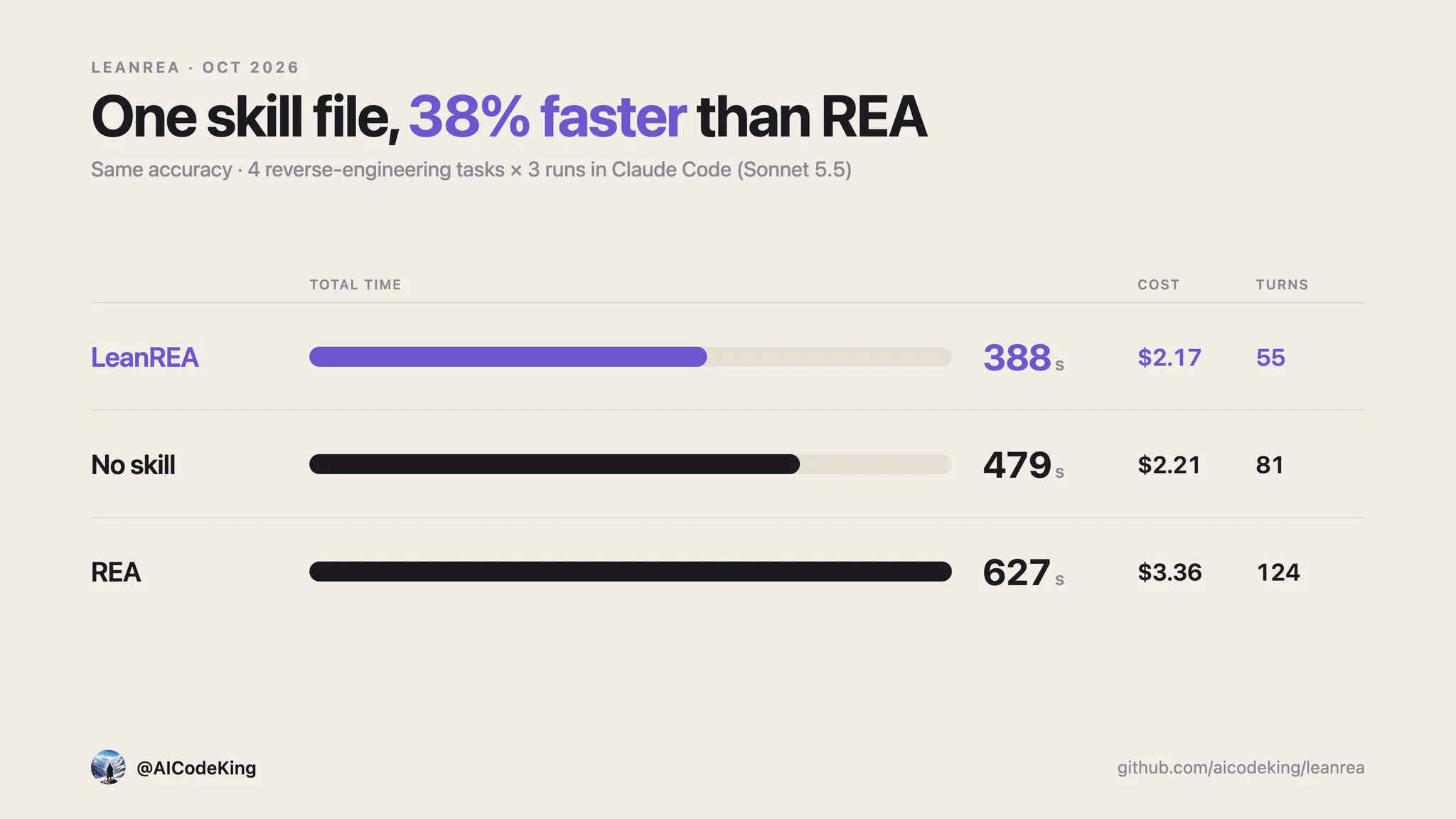
leanrea is an 8 KB skill file that tells a coding agent which plain CLI tools to use for reverse engineering, replacing REA, a 207-tool MCP server. In the author's test it ran 38% faster and 35% cheaper, scoring 74/75 against 75/75. The author lists caveats: 3 runs per task, one model, one machine, and Claude with no skill was already decent.
x.comthreadAdded 25 Oct 2026, published 23 Oct 2026  Reproducible Evaluation as the Substrate for Safe Prompt Compression in Production Agents
This paper presents an offline evaluation harness for a production merchant-facing conversational agent. It stays reproducible when live backend data changes and can be regenerated when it goes stale. Used as the fitness function for GEPA prompt optimization under a correctness gate against reward hacking, it shrinks the full prompt surface by 3.5-7.6% without losing held-out correctness, across three subject-model families.
 arxiv.orgpaperAdded 26 Oct 2026, published 22 Oct 2026
- Donating Agent Skills to the Agentic AI Foundation
Simon Willison's link post covers Anthropic's 22 October 2026 announcement that it is donating the Agent Skills standard to the Agentic AI Foundation (AAIF) under the Linux Foundation. Anthropic co-founded the AAIF with Block and OpenAI and earlier donated MCP to it. Willison notes he predicted this in December 2025 and found his old post by querying his blog through datasette-mcp in Claude.
simonwillison.netarticlePublished and added 22 Oct 2026 - Causal Chain of Thought: Mitigating Attention Leakage via Context Isolation
CausalCoT is an inference framework that splits a problem into a directed acyclic graph of atomic sub-questions and evaluates each node in an isolated context holding only its direct causal parents. This removes attention paths to non-parent content, so intermediate steps drive the answer rather than leaking from global context. It keeps benchmark accuracy competitive and raises causal sensitivity of reasoning steps by 12 points on average, up to 21, over the strongest baseline. The graph also allows test-time corrections that propagate downstream.
arxiv.orgpaperAdded 24 Oct 2026, published 22 Oct 2026 - SnailSploit/Claude-Red
claude-red is an MIT-licensed library of offensive security skills for the Claude Skills system, planned at about 130 skills across 23+ categories (web, Active Directory, cloud, exploit development, EDR evasion and others). Each skill is a SKILL.md file that loads on conversational triggers, so unused skills cost no context. It installs by git clone, sparse checkout per category, install.sh or pasting into a system prompt.
github.comrepoAdded 22 Oct 2026 - Sadra Majidi (@SadraMajidi04) on X
Impeccable is an open-source skill for AI coding agents that steers them away from generic UI output such as purple gradients and nested cards. It provides 24 commands (critique, audit, polish, typeset) and 61 detector rules that run without an LLM. It works with Claude Code, Cursor and Codex, and the repo is pbakaus/impeccable on GitHub. The source is a short tweet and gives no further detail.
x.comrepoAdded 23 Oct 2026, published 22 Oct 2026  Donating Agent Skills to the Agentic AI Foundation
Agent Skills is an open standard in which a skill is a folder with a SKILL.md file plus scripts and reference material. Anthropic is donating the name, logo, GitHub organization and agentskills.io domain to the Agentic AI Foundation under the Linux Foundation. Over 70 platforms have integrated it, with 1 million skills published and nearly 280 million installs. The proposed roadmap covers versioned releases, a proposal process and security guidance.
 anthropic.comarticleAdded 29 Oct 2026, published 22 Oct 2026
- Trail of Bits (@trailofbits) on X
Trail of Bits announces two open-source plugins, patching-bugs and regression-hunt, for AI coding agents that speed up bug patching. They come from four months of Patch the Planet work with open-source projects, which found that repo-level documentation, skills and plugins give agents the maintainer context on what counts as a bug, how a fix should look and what must not break. The post cites the October 2026 PHP incident: a patch touching 402 files, and exploitation within 17 hours of leaked details.
x.comarticleAdded 23 Oct 2026, published 21 Oct 2026 - Manish Kumar (@Manixh02) on X
Anatomy is an open-source agent skill that turns technical concepts into interactive visuals. Asked to explain a rate limiter or CDN cache, it builds a working model the user can explore. A tweet by Manixh02 says it works with Claude Code, Codex and other agents, and links to a GitHub repo under wheresryan22. The tweet gives no install steps or implementation details.
x.comthreadAdded 22 Oct 2026, published 21 Oct 2026  vlt 1.5.0 Adds Agent Skills Management
vlt 1.5.0 adds a `vlt skills` command that finds agent skills (SKILL.md folders) in installed JavaScript dependencies and links them into directories coding agents read, such as .agents/skills and .claude/skills. Selections are saved as allow-skills in vlt.json, tied to the lockfile version, and kept current on install and update. Without a saved selection, linking defaults to :not(:malware) using Socket malware alerts. pnpm 12.11.0 added similar linking.
 socket.devarticlePublished and added 21 Oct 2026
 How 3 Java Champions are using GitHub Copilot for increased productivity
Interviews with three Java Champions (Vlad Mihalcea, Patrick Baumgartner, Frank Delporte) on using GitHub Copilot in production and open source. Examples include a 900-slide Reveal.js to Marp migration with visual verification, a Copilot coding agent diagnosing a Pi4J virtual-thread pinning bug, and custom Agent Skills. Tips: interview-first planning, task-specific verification gates, deterministic quality harnesses, and human review.
 github.blogarticleAdded 29 Oct 2026, published 20 Oct 2026
 ALTK-Evolve: How learned memory tops the τ²-bench leaderboard on customer service tasks without a frontier model
ALTK-Evolve is an IBM Research method that distills an agent's own training-task trajectories into short behavioral guidelines appended to the system prompt, with no weight updates. On τ²-bench, a stock ReAct agent with gpt-4.1 reaches 67.5% Pass^4 on retail, and gpt-5.5 reaches 82% on airline. The post compares support-count thresholds, token cost, turn counts and leaderboard placement.
 huggingface.cowriteupPublished and added 20 Oct 2026
- better-isms/grcskills
grcskills is a library of 60 plain SKILL.md files in the Agent Skills format, each describing how an experienced practitioner does one piece of governance, risk and compliance work. Examples are scope statements, risk registers, audit prep, vendor review and incident handling. Every skill names where the agent must stop and hand the decision to a person. Installs are pinned to reviewed release tags and checked by a validator.
github.comrepoAdded 20 Oct 2026 - How Effectively Do Security Skills Guide Coding Agents in Vulnerability Detection in Linux Kernel?
The paper is a large-scale study of 37 security skills run through Claude Code with four LLMs on 100 real Linux kernel vulnerabilities, 14,800 runs in all. Only 24.4 percent of runs found the correct function and 15.7 percent classified the vulnerability correctly. It proposes SKILL-SIF, which evolves skills from failure patterns and raised fully correct detection on 100 unseen vulnerabilities from 2 to 16 percent.
arxiv.orgpaperAdded 21 Oct 2026, published 19 Oct 2026  Putting models to the secure coding test: Security rules
Datadog Security Labs tests whether Project CodeGuard v1.4.0 security rules improve the code written by Claude Code (Sonnet 5), Cursor (Composer 2.5) and Codex (GPT 5.5). Each model built the same document portal app once. Only GPT 5.5 closed the cross-user document IDOR and improved clearly. Sonnet 5 and Composer 2.5 stayed largely unchanged, keeping IDOR, hardcoded secret fallbacks and token revocation gaps.
securitylabs.datadoghq.comwriteupAdded 29 Oct 2026, published 19 Oct 2026- DietrichGebert/ponytail
Ponytail is a single skill prompt (skills/ponytail/SKILL.md, with a compact AGENTS.md) that makes coding agents write only the code a task needs, reusing existing components while keeping validation, error handling, security and accessibility. The author benchmarked it in Claude Code with Opus 5.5 over 39 tasks, 5 runs each, including a real FastAPI + React repo. They report -53% code, -41% time, -26% cost and -45% tokens, and 98% of risky logic shipping with a test versus 68% without. It adds /ponytail-review and /ponytail-audit commands, a Claude Code cost/token band with a local board, and installs through Claude Code and Codex plugin marketplaces or as a rules file for Cursor, Copilot, Gemini, OpenCode and others.
github.comrepoAdded 17 Oct 2026  Tree Appreciator
Simon Willison describes another game experiment, this time in the Claude iPhone app in chat mode rather than Claude Code. He prompted Claude Opus 5.5 Max to build a three.js game called "Tree appreciator" with two algorithmically generated trees and a mechanic based on appreciating their differences, and added "think hard about how to make sure it is both fun and beautiful". After about 3 hours 7 minutes of work it returned a spot-the-difference game with music, animation and achievements. He notes that simply telling Opus 5.5 to "make sure it is fun" works surprisingly well.
simonwillison.netarticleAdded 15 Oct 2026, published 14 Oct 2026- Quoting Geoffrey Huntley
Simon Willison quotes Geoffrey Huntley on keeping coding agents compliant with a project's conventions. Instead of updating AGENTS.md, which drifts, he adds a pre-commit hook that scans the git diff for direct calls to observability modules that bypass his diagnostics library. The hook fails the commit and injects a prompt telling the agent to use the library, which he says took compliance to ten out of ten.
simonwillison.netarticlePublished and added 13 Oct 2026  GitHub Copilot app for Beginners: How to teach Copilot about your codebase
Beginner-oriented GitHub blog guide to giving GitHub Copilot project context through four mechanisms: repository custom instructions (.github/copilot-instructions.md and path-specific .github/instructions files with applyTo), agent skills (SKILL.md folders under .github/skills), custom agents (.github/agents profiles), and MCP servers such as Playwright. It explains when to use each and how they combine, using examples like a quality-checks skill and an accessibility-review agent. Useful as a concrete reference for the repo layout Copilot reads, with a pointer to the community Awesome Copilot collection.
github.blogarticlePublished and added 12 Oct 2026 Context Engineering for Application Security | Endor Labs
Endor Labs whitepaper on using context engineering to make AI coding assistants produce secure code. It covers secure prompting (priming, decomposition, refinement with design-spec and test-first patterns), reusable system rules such as Cursor rules and the CSA R.A.I.L.G.U.A.R.D. framework, and external SAST/SCA tools wired in through MCP servers with a rule that triggers scans. It also covers the costs and risks: extra token use, models ignoring rules, untrusted community rules, and MCP server supply-chain threats. It cites figures such as 62% of AI-generated solutions containing flaws and a 77.5% reduction in weaknesses from recursive prompting.
 endorlabs.comarticlePublished and added 12 Oct 2026
- Cloudflare Changelog (@CFchangelog) on X
Cloudflare's changelog announces that its Cloudflare API MCP server now serves Cloudflare skills alongside its tools. A connected MCP client discovers them by calling `skills/list`. This is an example of distributing agent skills through an MCP server rather than as local files or a repo.
x.comarticlePublished and added 11 Oct 2026 - 0xMarioNawfal (@RoundtableSpace) on X
A tweet highlighting Prompts Chat (formerly Awesome ChatGPT Prompts), an open-source prompt library on GitHub that the post says has 167K+ stars. It works across ChatGPT, Claude, Gemini and other models. The post lists a CLI, an MCP server, a Claude Code plugin and self-hosting with custom branding and auth, all free. It is worth cataloguing as a pointer to a widely used prompt collection that now plugs into coding-agent and MCP workflows.
x.comthreadPublished and added 10 Oct 2026




Showing 30 of 72
Show more