- Show HN: Overtone – Transcribe, correct and cut captions for any screen shape
Overtone is a caption format (.overtone.json), a CLI and a video.js plugin that store each spoken word once and cut captions separately per screen shape (16:9, 9:16 or custom). The transcribe pipeline combines gpt-transcribe, Azure AI Speech and optional ElevenLabs Scribe, resolves disagreements with an LLM vote, and uses an LLM editor for corrections. A small public benchmark reports 5.3% word error rate and $0.023–0.025 per audio minute.
 github.comrepoAdded 30 Oct 2026, published 29 Oct 2026
 Glance: The Generator Is Its Own Reranker
Glance is a RAG method in which the generator also reranks. It adds a lightweight decision adapter and pointer head that score candidate passages from one shared prefill, so a single resident 9B backbone does generation and reranking. After 39 minutes of MS MARCO fine-tuning it reaches nDCG@10 of 0.741 on SciFact and 0.345 on NFCorpus, against 0.721 and 0.326 for bge-reranker-v2-m3. On 300 HotpotQA questions it improves answer F1 by 0.045 over cross-encoder-selected context. Evaluation covers two retrieval datasets, one QA dataset and one backbone family.
 arxiv.orgpaperAdded 31 Oct 2026, published 29 Oct 2026
- Retrieving from Your Own Mistakes: On-Policy Training of Embedding Models for Multi-Hop Retrieval-Augmented Generation
On-policy state training is a method for training chain embedding retrievers for multi-hop RAG on the states the encoder itself reaches, including those built on its own wrong retrievals. Each state is labeled with the earliest missing gold passage, other missing gold passages are masked, and updates are contrastive and mixed with teacher-forced states. It retrieves complete evidence more often than teacher-forced training and graph-based systems, and transfers to harder long-chain HotpotQA and 2WikiMultiHopQA variants the authors built.
arxiv.orgpaperAdded 31 Oct 2026, published 29 Oct 2026 - Decompose, Estimate, Select: Coverage-Aware Context Construction for Long-Form RAG
Decompose, Estimate, Select is a coverage-aware retrieval pipeline for long-form RAG. It splits a query into subquestions, ranks candidates with a coverage-trained bi-encoder, predicts a document-by-subquestion coverage matrix with a cross-encoder, and picks documents by greedy maximum-marginal coverage. On TREC RAG 2024, α-nDCG@10 rises from 0.625 to 0.702 (gold-nugget bound 0.718). A grounded self-feedback loop raises V_strict by 0.086 over two passes.
arxiv.orgpaperAdded 31 Oct 2026, published 29 Oct 2026 - TCC-RAG: Temporal Causal Chain-Guided RAG for Temporal Knowledge Graph Question Answering
TCC-RAG is a retrieval-augmented generation method for temporal knowledge graph question answering (TKGQA). It turns the temporal knowledge graph into a multi-view causal cue graph, builds a query-specific temporal causal chain to guide retrieval, and applies a causal evidence filter to the results. The authors report gains of 10.72% and 8.40% on two TKGQA benchmarks and 62.97% on multi-step temporal reasoning.
arxiv.orgpaperAdded 30 Oct 2026, published 28 Oct 2026  Early progress on accelerating drug development with Claude
Anthropic's life sciences update describes research partnerships with six drug developers (BigHat, Bristol Myers Squibb, Divergence Labs, Enveda, Generate Biomedicines, The Column Group) and its own Mithril Medicine programs. Reported results include about 35,000 antibody designs in a month, 1,010 lead variants tested in 10 weeks, and an 89% cut in manufacturing-document review time. Work is mostly preclinical.
 anthropic.comarticleAdded 28 Oct 2026, published 27 Oct 2026
- Statistical Detection of Positional Bias in LLM-Based Recommender Systems: Methodologies and Empirical Evidence
The paper proposes POB-ICM (contingency matrix with Chi-square independence testing) and POB-UNBP (a uniformity null model under permutation-based evaluation) to detect positional bias in top-1, single-turn LLM recommenders. On a RAG product-recommendation testbed with 2000 queries and 20 permutations each (40,000 instances), both methods reject positional independence in all evaluated models. Three metrics quantify the effect, and the bias persists across candidate-set size and temperature. Code is public.
arxiv.orgpaperAdded 30 Oct 2026, published 27 Oct 2026 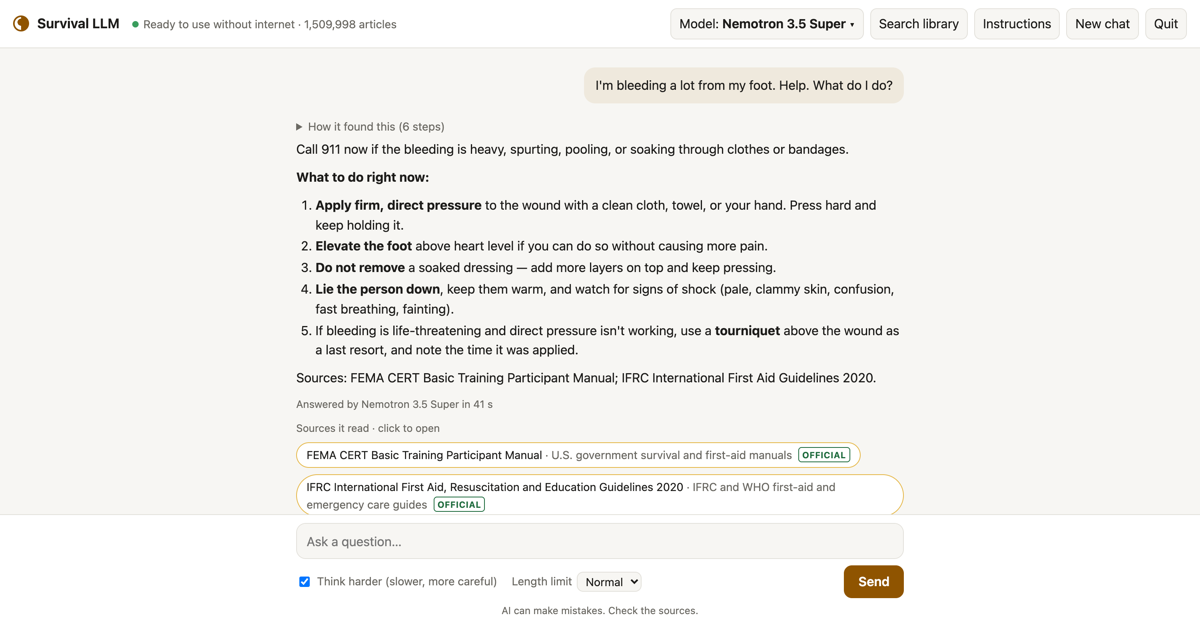 Survival LLM: AI assistant and emergency library that runs on your own computer
Survival LLM is a free, open-source desktop app for macOS (Apple Silicon) and 64-bit Windows that runs an AI model and an offline emergency library on the user's computer. It checks the machine's memory, downloads a fitting model, and answers from sources such as Wikipedia, WikiMed, Ready.gov and CDC guidance, citing each article. Users can add their own files; version 0.3.2 is dated October 2026.
 brangus.iotoolAdded 28 Oct 2026, published 27 Oct 2026
- When Is Additional Retrieval Worthwhile? A Cost-Aware Study of Evidence Gain and Answer Reliability in RAG
This paper studies a cost-aware, two-action RAG routing policy that chooses between dense retrieval plus reranking and a hybrid lexical-dense retriever, using a regularized linear model to predict per-question evidence gain. On 60 held-out QASPER articles (188 questions), it triggers hybrid retrieval on 24.5% of questions and matches always-hybrid Hit@10 (78.70%). Answers from 4-bit Qwen3-4B show no clear correctness or faithfulness gain, and the assessments are model-assisted.
arxiv.orgpaperAdded 28 Oct 2026, published 27 Oct 2026 - Tessera: Structure-Completed Evidence Units for Web Retrieval-Augmented Generation
Tessera is a training-free evidence delivery layer for web retrieval-augmented generation. It rebuilds retrieved pages' HTML into fine-grained evidence units, each completed with page title, section path and table headers, then packs the relevant units into the reader context at the same token budget. Tracing evidence over full English Wikipedia shows chunking loses table and infobox content. Tessera adds 5 to 6 accuracy points on three QA benchmarks and carries over to agentic search.
arxiv.orgpaperAdded 28 Oct 2026, published 27 Oct 2026 - p-DCIM: A 28nm Probabilistic SRAM DCIM based Ising Machine for Near-Memory Context Selection in LLM-RAG Pipeline
p-DCIM is a 28 nm SRAM digital compute-in-memory macro (0.16 mm2, 0.41 mW) that works as an Ising machine for RAG evidence selection. Selection is cast as a QUBO problem, and the same MAC datapath computes embedding similarities and annealing steps. Replacing LLM reranking with it gives a selection-energy estimate over six orders of magnitude lower and cuts total energy per query by 67%, with comparable token-level F1 on the evaluated examples.
arxiv.orgpaperAdded 28 Oct 2026, published 27 Oct 2026 - Show HN: Hob - Open-source, on device alternative to Claude Cowork and ChatGPT
Hob is an MIT-licensed desktop app from Frigade that runs open-weight models such as Gemma and gpt-oss locally on Mac, Windows and Linux. It picks the best open-weight model that fits the user's computer and sets it up. It is positioned as a free, private, offline alternative to Claude and ChatGPT for tasks like filling out PDFs and working through documents. The page gives no technical detail on its runtime.
github.comrepoAdded 27 Oct 2026, published 26 Oct 2026 - Reversible Pseudonymisation of Documents Sent to External LLMs: an Open Bilingual Benchmark and an Engine
This paper presents an open benchmark of five existing pseudonymisation tools and a regex baseline on Russian and UK English documents, plus an open engine built on the two strongest tools. On a held-out set of 1,000 synthetic documents per language, the best existing tools leave a whole value visible in 58 to 61% of documents. The engine does so in 0.2 to 0.3%. Russian name restoration reaches only 94.6%, below the 99% threshold. Real documents were not tested.
arxiv.orgpaperAdded 27 Oct 2026, published 25 Oct 2026 - HerHealthGPT: An Evidence-Grounded Conversational AI System for Women's Reproductive Health Copy title
HerHealthGPT is a conversational AI system for women's reproductive health that combines retrieval-augmented generation, context-aware clarification and source validation in a web interface. Evidence retrieval raises concern-category accuracy from 54.1% to 59.3% over fine-tuning alone on 540 messages from 90 cases. The clarification router reaches 85.6% recall and 86.2% specificity. In a 30-adult study, 83.3% preferred the retrieval-enabled version. The authors say clinical validation is still needed.
arxiv.orgpaperAdded 27 Oct 2026, published 24 Oct 2026 - DRILS: Dependency-based Requirement Change Impact Analysis Using LLMs
DRILS is an LLM-based agentic framework for requirements change impact analysis. It uses multiple agents to generate candidate impact sets, with an LLM-as-a-judge promoting diversity in selection. It adds RE-RAG, a tuned retrieval technique, and a requirement dependency graph as a knowledge source. On three curated datasets it reaches 87.1% recall, 76.3% precision and 81% F1 at lower cost than baselines. The authors release the datasets.
arxiv.orgpaperAdded 27 Oct 2026, published 24 Oct 2026 - Big Bull (@BIGBULLapp) on X
5ire is a desktop AI assistant and MCP client that connects to OpenAI, Anthropic, Google, Mistral, Grok, DeepSeek and Ollama from one window. It has a local knowledge base and tool calls over Model Context Protocol. The tools feature needs Python, Node and uv installed because it runs a local MCP server; without them it works only as a chat client.
 x.comthreadAdded 25 Oct 2026, published 24 Oct 2026
- TriageRAG: Failure-Aware Self-Training for Adapting Retrieval-Augmented Language Models to Specialized Domains
TriageRAG is a failure-aware self-training method for adapting retrieval-augmented LLMs to specialized domains using only an unlabeled corpus. It probes the student on self-generated questions with and without retrieved context, sorts them into known, solved, context-failure and retrieval-failure, and routes each to a matching training signal. With Qwen3-4B on 11 datasets it beats budget-matched SimRAG by 1.2-6.4 points and recovers closed-book accuracy where retrieval hurts.
arxiv.orgpaperAdded 27 Oct 2026, published 24 Oct 2026  LitPivot: Developing research ideas through dynamic contextualization within the literature landscape
LitPivot is a system from Ai2 and the University of Pennsylvania that helps researchers revise early research ideas when reading prior work changes their direction. It splits a proposal into problem, contribution and evaluation facets, groups papers from Asta Paper Finder per facet, and offers critiques with supporting excerpts and suggested rewrites. In a 17-researcher study, domain experts rated LitPivot ideas as better grounded in the literature than ideas made with a text editor and an AI chat tool.
 huggingface.coarticlePublished and added 23 Oct 2026
- Semantically Rich, Metrically Affect-Blind: A Geometric Blind Spot in Modern Text Embedders
Sentiment-Injected Sentence Embeddings (SISE) addresses a finding across eleven frozen text encoders (2021 to 2026): linear probes recover sentence polarity at up to 91.3% accuracy, but cosine similarity separates polarity by only 0.003-0.064. A small supervised-contrastive head (0.13M-0.69M parameters) trained on CPU raises retrieval MAP by up to 26 points, but the 128-d head loses 38-41 STS-B Spearman points. The paper also releases the Attribute Alignment Gap diagnostic.
arxiv.orgpaperAdded 26 Oct 2026, published 23 Oct 2026 - Build more responsive apps with the Decisions API
The Decisions API is an OpenAI endpoint, built on GPT-6 Luna, that answers bounded questions about text, images or native JSON inputs, up to 10x faster than Luna through the Responses API. It returns a probability (predicate), a choice or a score. It is generally available, accepts up to 400 questions per request, and costs $0.10 per million input tokens with no output charges.
 openai.comarticlePublished and added 22 Oct 2026
- How Ground Truth Shapes Retrieval Scores: Evidence-Aware Evaluation of a Retrieval-Augmented Generation System for Breast Lesions
This paper describes an evidence-aware retrieval evaluation protocol for a clinical RAG system over breast lesion management literature. Relevance is defined by evidence spans mapped to all containing chunks. A hybrid retriever (dense, BM25, cross-encoder reranking) with 384-token chunks and 20% overlap reached 0.94 Recall@3 on 18 queries. Expanding ground truth from 25 to 37 spans did not change rankings. The authors note the small set needs independent validation.
arxiv.orgpaperAdded 24 Oct 2026, published 22 Oct 2026 - From Structured Records to Patient Narratives: Preserving Clinical Alignment in LLM-Generated Health Summaries
This paper studies evidence-grounded health summarization for menstrual health monitoring. It combines structured evidence conditioning with RAG in a prompt-based constrained generation framework, and scores 4,500 summaries from three LLMs with NLI, atomic factuality metrics and readability measures. Grounding constraints improved uncertainty preservation and generally kept or improved faithfulness against retrieved evidence, while omission effects varied by model. Clinical alignment came with harder reading and more medical terminology.
arxiv.orgpaperAdded 24 Oct 2026, published 22 Oct 2026  You are the Team — Anekha Sokhal, Moshi
Latent Space interview with Anekha Sokhal, CEO of Moshi, recorded at AI Engineer New York. Moshi is a market-intelligence product for commodity and energy traders. It ingests structured and unstructured data, builds an ontology and graph, and pushes recommendations to each trader's book. She covers confidence scoring across divergent sources, an in-house vision-language model for messy PDFs, and build-versus-buy tradeoffs.
 latent.spacetalkAdded 23 Oct 2026, published 22 Oct 2026
 The Recommendation Engine for Commodity Traders — Anekha Sokhal, Moshi
Latent Space podcast episode recorded at AI Engineer New York, in which Moshi CEO Anekha Sokhal, a former JPMorgan energy derivatives trader, describes a recommendation engine for commodity traders. Moshi ingests structured and unstructured market data plus private user data, tags it into a graph ontology and pushes items relevant to a trader's book. She covers confidence scores across divergent sources, an in-house vision-language model for messy PDFs, and build versus buy.
latent.spacetalkPublished and added 22 Oct 2026- You are the Team — Anekha Sokhal, Moshi
Latent Space interview with Anekha Sokhal, CEO of Moshi, recorded at AI Engineer New York. Moshi is a recommendation engine for commodity and energy traders that ingests structured data, news, X posts, podcasts and private user documents into a graph. Topics include confidence scores for divergent sources, a self-built vision-language model for PDFs, build versus buy, and engineers told "you are the team".
latent.spacetalkPublished and added 22 Oct 2026 - Chunk Recomputation under Real Document Revisions: Measuring Update Cost and Retrieval Quality of Fixed, Recursive, and Content-Defined Chunking
Chunk Recomputation under Real Document Revisions measures how much text must be re-embedded after edits for three stateless chunkers (non-overlapping fixed-size, recursive paragraph-first, content-defined) on 120 pairs of adjacent Chinese and English Wikipedia revisions. Fixed-size recomputes 57-68% of the new-version workload, recursive 38-56%, content-defined 43-54%, while evidence recall at a 2048-token budget differs by under two points. The authors argue update cost should be reported alongside retrieval quality.
arxiv.orgpaperAdded 24 Oct 2026, published 22 Oct 2026 - OpenAI CLI
OpenAI CLI is OpenAI's official Go command-line client for the REST API. It lets users generate images, upload and download files, create and wait on batches, call the Responses API, and query admin usage endpoints from a terminal or shell script. It supports JSON, JSONL and YAML output, GJSON transforms, shell completion, and install via Homebrew, go install or release binaries.
github.comrepoAdded 23 Oct 2026, published 22 Oct 2026 - SpyTech Ai (@RizeOnline) on X
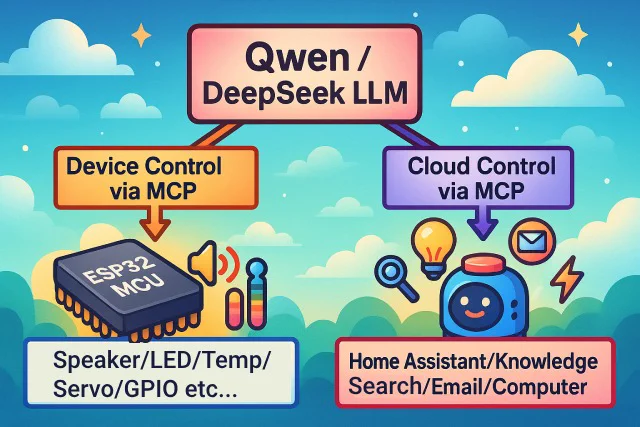
XiaoZhi ESP32 is an open-source, MIT-licensed firmware stack that turns ESP32 boards into MCP-based voice chatbots using models such as Qwen and DeepSeek. It streams Opus audio over WebSocket or MQTT + UDP through ASR, LLM and TTS, adds offline ESP-SR wake words, and uses device-side MCP to drive speakers, LEDs, servos and GPIO. It supports 138 board directories and builds with ESP-IDF 6.0.1 or newer.
x.comthreadAdded 23 Oct 2026, published 21 Oct 2026 - How we built ChatGPT’s novel ad stack for user trust and relevance
OpenAI's ChatGPT ad stack uses a custom post-trained LLM, the orchestrator, that makes tool calls for retrieval, filtering, scoring and auction nomination across stateful ad sessions. Ad selection runs in a separate service from answer generation, so ads cannot influence responses or delay them. The post covers ANN retrieval, a model-generated preamble, delivery versus impression, logging, and model-based evaluation.
openai.comarticlePublished and added 21 Oct 2026 - Protection Is Not One Event: A Survey of RAG Protection Research by Measured Endpoint
Protection Is Not One Event is a survey and human-coded evidence map of 118 RAG defense papers, grouped by measured endpoint into a seven-family taxonomy (kappa=0.867 across 32 annotators). It finds that only 17.8% of studies use content disclosure as their primary endpoint, and that most evaluations use general QA data and non-adaptive attacks. In a testbed on Qwen3-8B, an 8-gram guard cut copying to 0.0%, yet a three-query adaptive attacker still recovered 48.3% of hidden facts. Taxonomy, dataset, coding protocols and testbed are released.
arxiv.orgpaperAdded 24 Oct 2026, published 21 Oct 2026

Showing 30 of 109
Show more