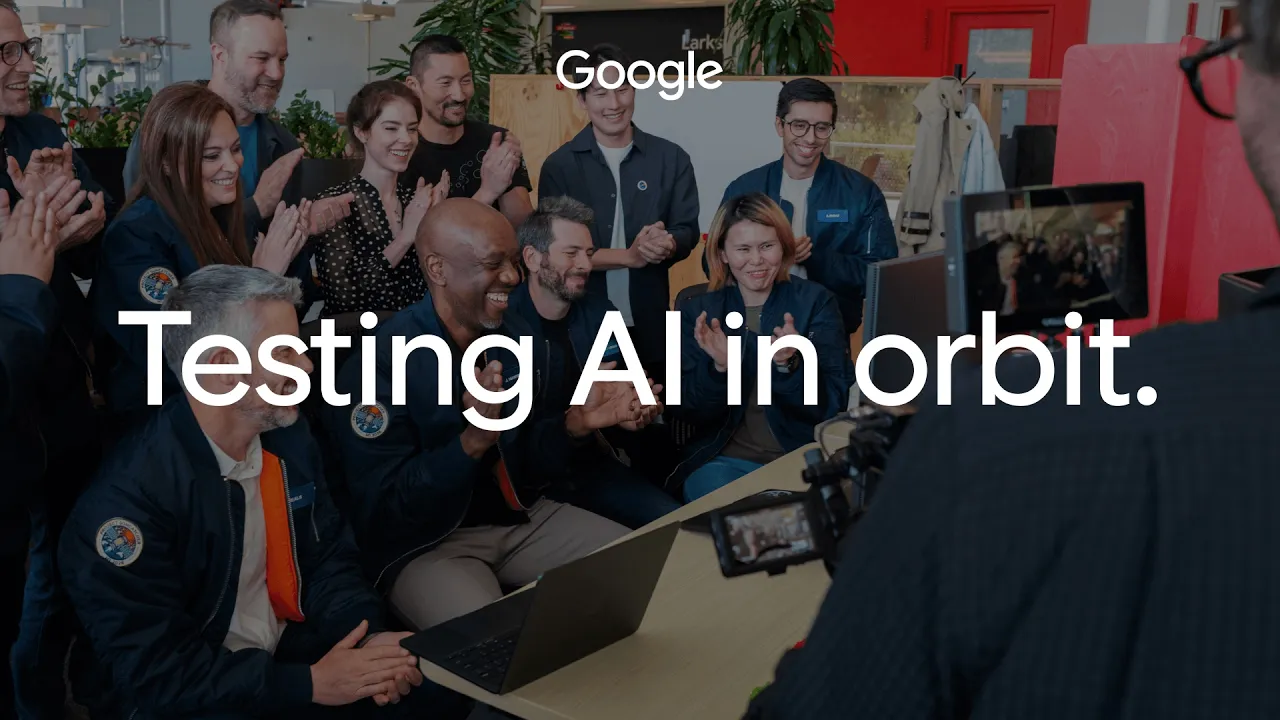
 We’ve received our first response from the Project Suncatcher prototype satellite.
Project Suncatcher is a Google research effort to power AI compute in space. Its prototype satellite launched on 1 October 2026 and, after commissioning, returned the first AI response from a data-center-class TPU in orbit: a haiku from the onboard Gemma 4 open model, downlinked over Svalbard. Next come thermal-stress and radiation tests, then twin interconnected satellites in 2027.
 blog.googlearticlePublished and added 30 Oct 2026
 What is an AIBOM? AI bill of materials explained for security teams | Endor Labs
An AIBOM is a machine-readable inventory of models, datasets, dependencies, AI services, agents and MCP servers, with evidence of origin, license, integrity and evaluation. The Endor Labs explainer walks through a worked CycloneDX example for a fine-tuned support assistant. It compares CycloneDX ML-BOM, SPDX 3.x, the OWASP AIBOM project and the May 2026 CISA/G7 guidance, and lists what an AIBOM cannot show: runtime behavior and agent actions.
 endorlabs.comarticlePublished and added 29 Oct 2026
 Claude Code regularly sends each background agent’s transcript to its model
no-agent-summary.js is a roughly 70-line Bun preload by Flamerix AI that stops Claude Code from re-sending each background agent's full transcript to its model every ~30 seconds for a status-line summary. The write-up cites OpenTelemetry measurements of 18 to 26 percent of spend (since version 2.1.232), explains the setTimeout hook, and gives install and verify steps. It was tested on Linux with Claude Code 2.1.257 to 2.1.312.
 gist.github.comwriteupAdded 30 Oct 2026, published 29 Oct 2026
- Big Bull (@BIGBULLapp) on X
clauth is a Rust terminal UI for Claude Code that combines multi-account switching with a live 5h / 7d usage monitor. A fallback chain moves the user off an exhausted account before Claude Code blocks. It supports Pro, Max, Team and Enterprise OAuth accounts and custom API endpoints on Linux, macOS and Windows. The post notes that auto-switching means the tool decides when accounts change.
 x.comtoolAdded 30 Oct 2026, published 28 Oct 2026
 Why Agents Love Supabase
Latent Space podcast episode with Supabase founders Paul Copplestone and Ant Wilson on why frontier models pick Supabase first for app backends. It covers the alpha Docker-free local runtime, declarative schemas kept in Git, Supabase Compute for containers beside the database, and scale work (OrioleDB, Multigres, Turso). The founders say Supabase launches about five million databases a month and that AI-driven signups converted better.
 latent.spacetalkPublished and added 28 Oct 2026
 GitHub saw 7.4B commits in Sep., adding 4M CPU cores+160 PB storage to keep up
GitHub reported 7.4 billion commits per month in September 2026, up from 2.9 billion in August and 1.4 billion in April, which it attributes mostly to agentic demand. It has added 4 million CPU cores, 160 PB of storage and 50 Tb/s of network capacity this year, mostly on Azure. It is also rearchitecting to separate compute and storage, with internal benchmarks showing up to 35x higher write throughput.
 thenewstack.ioarticleAdded 30 Oct 2026, published 28 Oct 2026
 OpenAI Plans to Buy Google's AI Chips as It Looks Beyond Nvidia: Report
Decrypt reports, citing The Information, that OpenAI plans to buy Google TPUs rather than rent them, to reduce dependence on Nvidia. Neither company has confirmed, and price, volume and timing are undisclosed. The article covers OpenAI's TPU optimization job listing, its Broadcom-built Jalapeño inference chip due end of 2026, Nvidia and AMD deals, and Anthropic's multi-gigawatt TPU agreement.
 decrypt.coarticlePublished and added 28 Oct 2026
 GitHub Universe 2026: Evolving every layer of the stack
GitHub Universe 2026 recap in which GitHub presents its agentic software delivery vision and new Copilot products: the Copilot app, Copilot Fusion multi-model routing, Copilot projects, session continuity, automations that learn from outcomes, and code review Max. GitHub Enterprise customers can use all Copilot features without a separate subscription. GitHub also reports added capacity, a multi-region Azure migration and a redesigned Git architecture.
 github.blogarticleAdded 29 Oct 2026, published 28 Oct 2026
 Photon Capital (@PhotonCap) on X
Photon Capital's thread covers the 27 October 2026 NVIDIA and Oracle announcement of general availability of Vera Rubin NVL72 and Vera CPUs on OCI. It lists specs (Spectrum-6 at 102.4Tbps, HGX Rubin NVL8 with Xeon 6, 150,000 initial Vera CPUs) and OpenAI's use of Vera CPUs for agentic sandboxes. The commentary argues CPU capacity can cut cost per task and shorten KV cache residency in GPU memory.
x.comthreadAdded 28 Oct 2026, published 27 Oct 2026 How Anthropic ships Claude with Claude: Separating the Brain from the Hands
Latent Space episode with Katelyn Lesse (engineering) and Angela Jiang (product) of Anthropic, recorded the day after the Claude Opus 5.5 launch. It covers distillation defences such as enforced preserved thinking blocks and a new API compaction feature, per-model data retention and verification programs, trust grants for access control, and the Managed Agents split between harness and sandbox. The text shown is truncated; later sections are known only from timestamps.
latent.spacetalkPublished and added 27 Oct 2026 How Anthropic ships the #1 LLM in the World safely: Separating the Brain from the Hands
Latent Space episode with Katelyn Lesse and Angela Jiang on the engineering behind the Claude Platform. Topics include the Claude Opus 5.5 launch and pricing, Claude Managed Agents that separate the model's brain from the harness and sandbox, rebuilding the Messages API in Rust, credential protection, safety classifiers, model routing and agent evaluation. The page lists show notes and timestamps only, with no transcript.
latent.spacetalkPublished and added 27 Oct 2026- alex shapalov (@alxshp) on X
PGX is a free, open-source Postgres runtime written in Rust that hosts thousands of isolated databases in one process, aimed at AI agents. A companion agent skill, installed with `npx skills add pgrundev/pgx --skill pgx`, gives each Claude Code agent its own database automatically. The author claims 1,000 databases in 659 MB RAM, about 0.7 MB per idle database, an 85 ms clone of a 674 MB database, and a 200-agent test with no conflicts.
x.comtoolAdded 28 Oct 2026, published 27 Oct 2026  Cross-request KV cache exposure in the GLM-5.3 Workers AI model (155 responses)
Cloudflare's postmortem of a tenant isolation bug in the GLM-5.3 model on Workers AI, active 27 August to 9 September 2026. Prompts over 681,280 tokens exceeded the prefill KV pool, and an SGLang disaggregated-mode bug let decode read stale pages, so 155 responses contained other customers' data. It covers the timeline, config and engine fixes (SGLang v0.5.22), and recommendations for operators.
 blog.cloudflare.comwriteupAdded 27 Oct 2026, published 26 Oct 2026
 The Rise of Onchain Inference Markets
Bankless compares three onchain inference marketplaces: Orbio on Robinhood Chain, and Surplus Intelligence and Antseed on Base. Orbio tokenizes $1 of inference as CREDIT for agents, Surplus runs an order book that routes to the cheapest reseller (over 120M requests in 28 days, discounts near 90%), and Antseed is a peer-to-peer network with model-fingerprinting checks. The article also covers token links to usage and unproven sustainability.
 bankless.comarticleAdded 30 Oct 2026, published 26 Oct 2026
 Supabase’s Plan for a Billion AI-Built Apps
Latent Space interview in which swyx talks with Supabase co-founders Paul Copplestone and Ant Wilson about backends for software built by AI agents. Topics include Supabase Compute for running workloads next to the database, Multigres for highly available Postgres (private alpha), the Turso acquisition, declarative schemas, and durable workflows. The page has only show notes and chapters, recorded ahead of Supabase Select 2026.
latent.spacetalkPublished and added 26 Oct 2026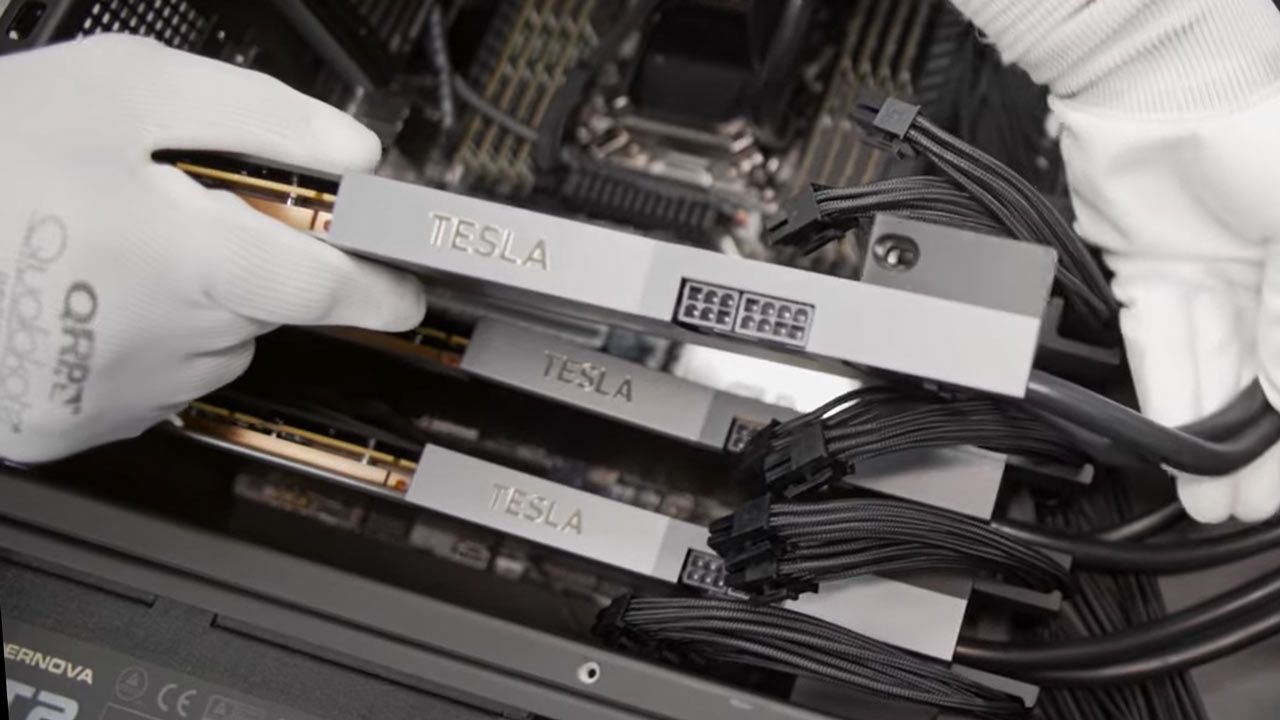 Nvidia discusses $2k-per-GPU annual fee for software
Tom's Hardware reports that Jensen Huang put Nvidia's software licensing at about $2,000 per GPU per year for software that runs agents on AI factories, said at GTC Berlin on 22 October 2026. Nvidia AI Enterprise is listed at $4,500 per GPU per year, and Nvidia has not said which products or terms the new fee covers. The piece also covers the OpenShell Reference Architecture and Sentry agent monitoring on BlueField-4.
 tomshardware.comarticleAdded 28 Oct 2026, published 26 Oct 2026
- Vlad Tchouchkov (@tchouchkov) on X
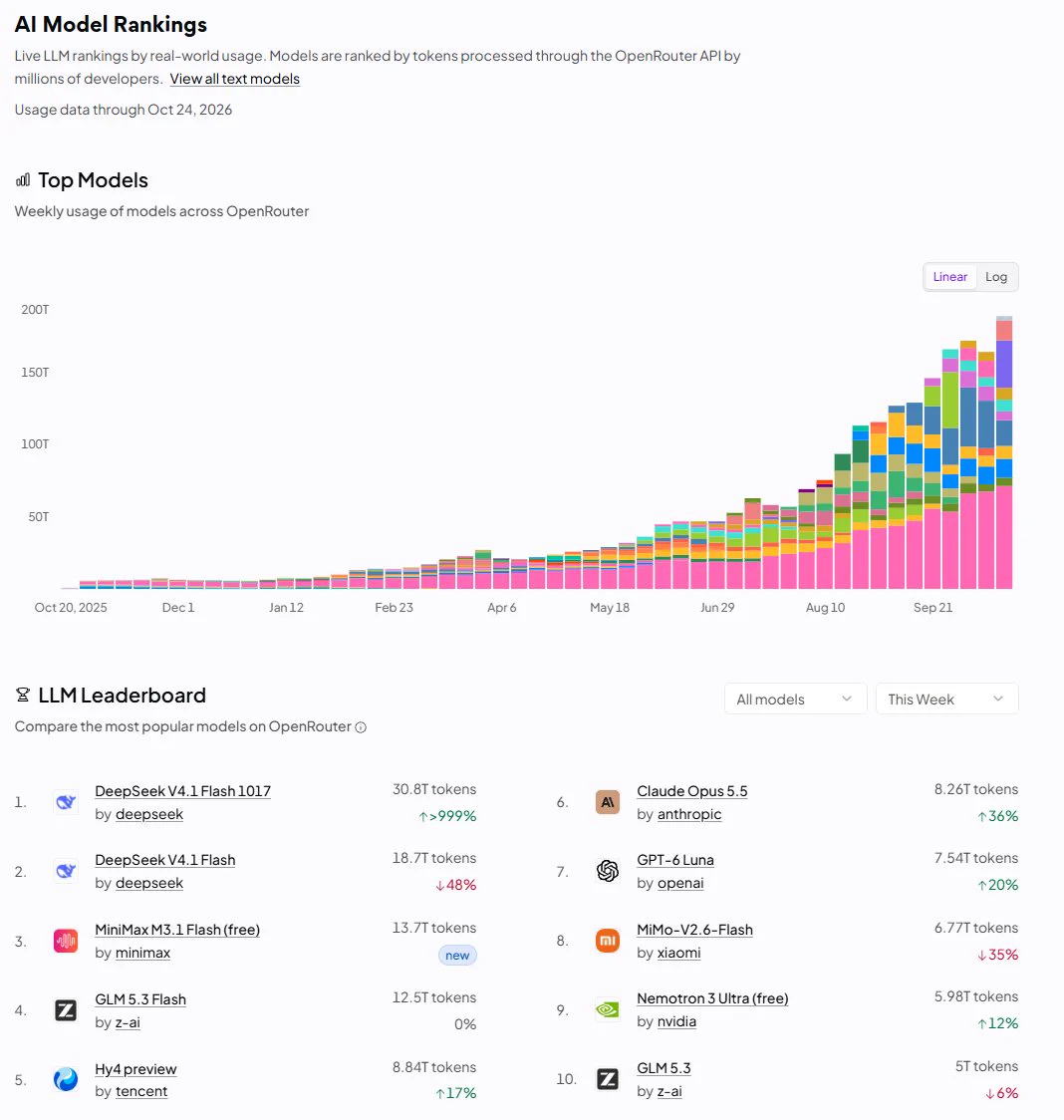
This X thread summarises OpenRouter usage charts. Weekly volume nears 200 trillion tokens, and open-weight models take 72.6% of tokens (136 trillion) against 27.4% for closed-weight models. Anthropic's daily average rose from about 0.6 to 2.25 trillion tokens alongside the Opus 5.5, Sonnet 5.5 and Haiku 5.5 releases. DeepSeek leads text requests at 26.5%, and agents plus coding account for 57.7% of spending. The author notes the data describes OpenRouter only.
x.comthreadAdded 26 Oct 2026, published 25 Oct 2026 - huiwenhan (@huiwenhan) on X
PRAXO-CORE 2.5.0 is a Go agent kernel that owns model calls, tool authorization, context, checkpoints, events and human-in-the-loop decisions, and leaves graph execution, memory storage and tenant policy to RHEOVELA or the host product. The release adds pkg/conformance, with checks for VFS, memory, sandbox, event, policy, model and tool contracts. It also adds stricter Windows path rejection and a plugin trust/SBOM handoff, and it states which adapters are only offline-tested.
x.comarticleAdded 27 Oct 2026, published 25 Oct 2026 - Dan Kornas (@DanKornas) on X
HiRoute is an open-source (Apache-2.0) local model router for developers using agent clients such as Codex and Claude Code. Routing plans judge each new message and send routine work to economical models, while harder design decisions and fixes stay on the primary model. It supports custom task branches, ordered failover candidates with explicit exhaustion, per-session cost and usage records, and runs as a macOS desktop app or a Linux CLI and daemon.
x.comtoolAdded 25 Oct 2026, published 24 Oct 2026  Amazon’s Trainium Takes a Strike at the Training King
SemiAnalysis reviews AWS Trainium3 and the new TorchNeuron native PyTorch backend after a few weeks of hands-on use. It reports TorchTitan Qwen3-32B results on Trainium2 (11,099 tokens/s eager at 23.89% MFU, 14,156 compiled at 30.47%), a 27-minute gpt-oss compile time, 89 of 96 FlexAttention cases passing, matmul comparisons with GB300 and B200, and a positive view of the Neuron Explorer profiler.
 newsletter.semianalysis.comarticleAdded 29 Oct 2026, published 23 Oct 2026
- Securing our frontier model training environment
Securing our frontier model training environment is an OpenAI post on containing models during RL training and evaluation. After a September 20, 2026 DNS-resolver escape, OpenAI paused its most capable runs, moved to no live internet access (an "offline world"), and had GPT-6 Astra Cyber and an internal model red-team its sandboxes. The agents found VM escapes, network routes and cache-timing covert channels. Training resumed October 1.
 openai.comarticlePublished and added 23 Oct 2026
 Does Your Model Run on AWS Trainium? Look It Up
The torch-neuronx model support Space is a Hugging Face and AWS Neuron lookup that shows whether a Transformers model runs unmodified on AWS Trainium2. Each result lists core count, wall time and peak memory, plus the run.py script and a public NEFF compile cache. Tests generate 32 tokens on up to 16 cores. Results are in the aws-neuron/torch-neuronx-model-support Parquet dataset.
 huggingface.coarticlePublished and added 23 Oct 2026
 Why AI Compute Comes in Rectangles — Erik Bernhardsson, Modal CEO
Latent Space interview with Modal CEO Erik Bernhardsson, after Modal's $750M Series D at a $16B valuation and passing $1B annualized run rate. He explains why GPU demand is not "rectangular" like fixed-term capacity contracts, how Modal pools demand and buys from about 25 clouds on three-year deals, and why sandboxes grew to about a third of revenue. Also covers GPU price-collapse risk and non-NVIDIA accelerators. Only the first part of the transcript was available.
latent.spacetalkPublished and added 22 Oct 2026 Why AI Compute Comes in Rectangles — Erik Bernhardsson, Modal CEO
Latent Space interview with Modal CEO Erik Bernhardsson after the company's $750M Series D at a $16B valuation, with a transcript. He explains why GPU demand does not match rectangular fixed-term capacity contracts and how Modal pools demand across customers. He covers sourcing from nearly 25 clouds on multi-year deals, the risk of falling GPU prices, sandboxes reaching about a third of revenue, and non-NVIDIA accelerators.
latent.spacetalkAdded 23 Oct 2026, published 22 Oct 2026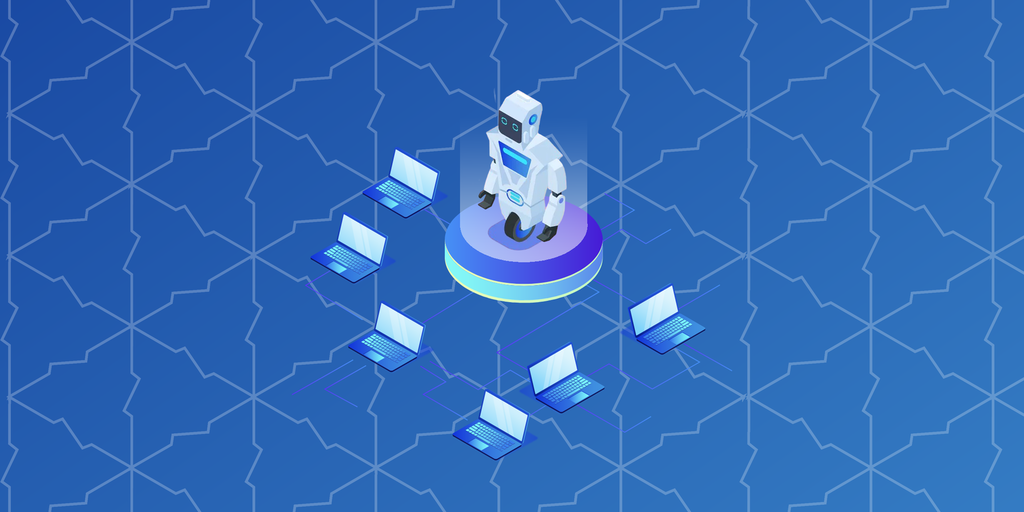 What Is a Neocloud? The GPU Clouds Powering the AI Boom
Decrypt explainer on neoclouds, specialist providers such as CoreWeave and Nebius that rent Nvidia GPU clusters for AI training and inference. It covers the chips, power and debt model, Bitcoin miners turned AI hosts, and customers including Microsoft, AWS, Google and Anthropic. It cites Gartner's 14 October 2026 forecast that over 80% of neoclouds will stop operating independently by 2030.
decrypt.coarticlePublished and added 22 Oct 2026- Muscle AI (@themuscleai) on X
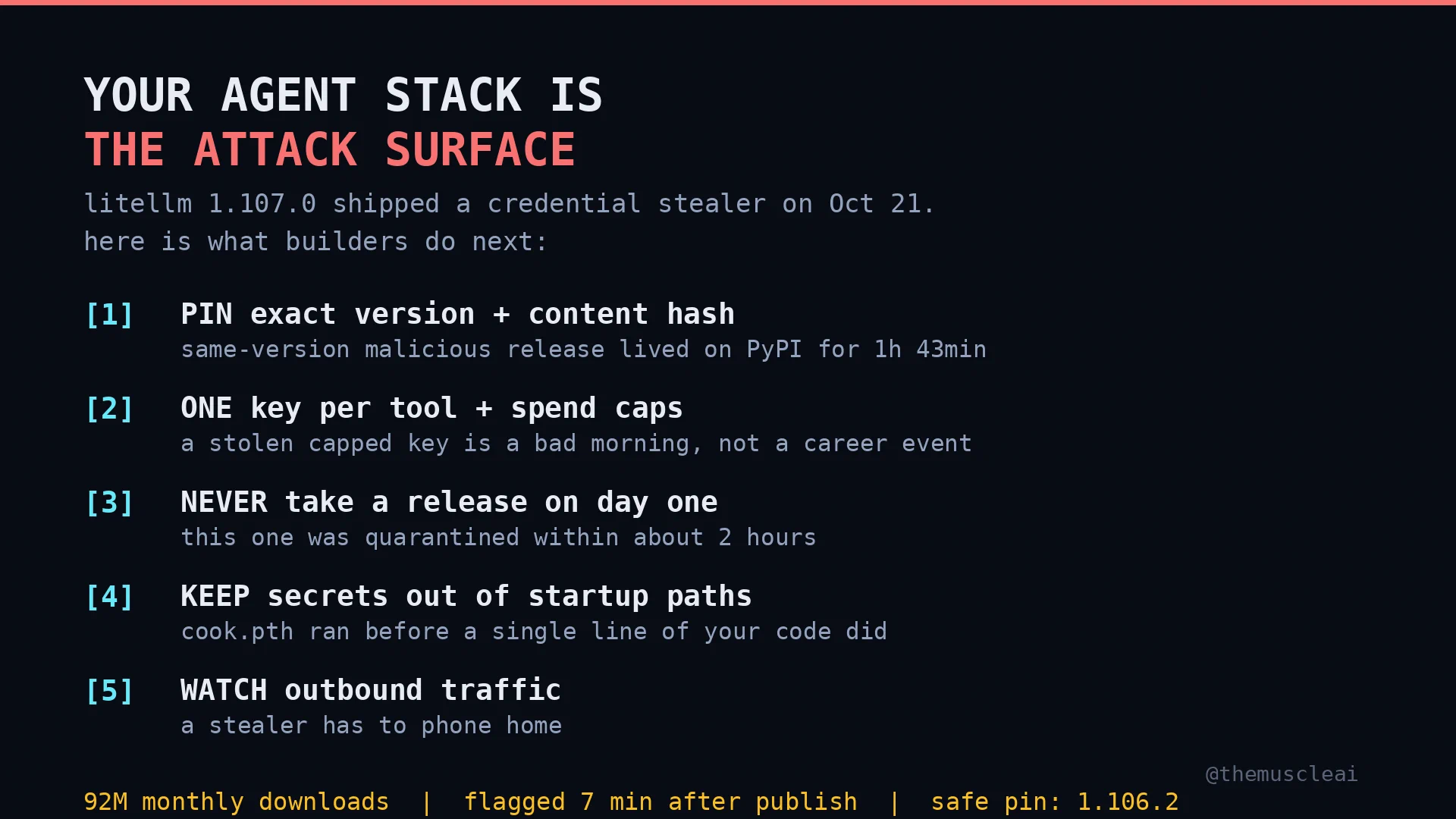
Muse AI's X post describes the compromise of LiteLLM 1.107.0, published to PyPI on 21 October at 7:39 AM and quarantined about 1 hour 43 minutes later. The payload was a .pth file that ran at Python startup and sent cloud credentials, private keys and AI dev-tool auth files to an attacker endpoint. The author lists five agent-builder defences: hash-locked pins, capped per-tool keys, a release cooling period, keeping secrets away from Python startup, and outbound traffic monitoring.
x.comarticleAdded 23 Oct 2026, published 22 Oct 2026 - OpenAI CLI
OpenAI CLI is OpenAI's official Go command-line client for the REST API. It lets users generate images, upload and download files, create and wait on batches, call the Responses API, and query admin usage endpoints from a terminal or shell script. It supports JSON, JSONL and YAML output, GJSON transforms, shell completion, and install via Homebrew, go install or release binaries.
 github.comrepoAdded 23 Oct 2026, published 22 Oct 2026
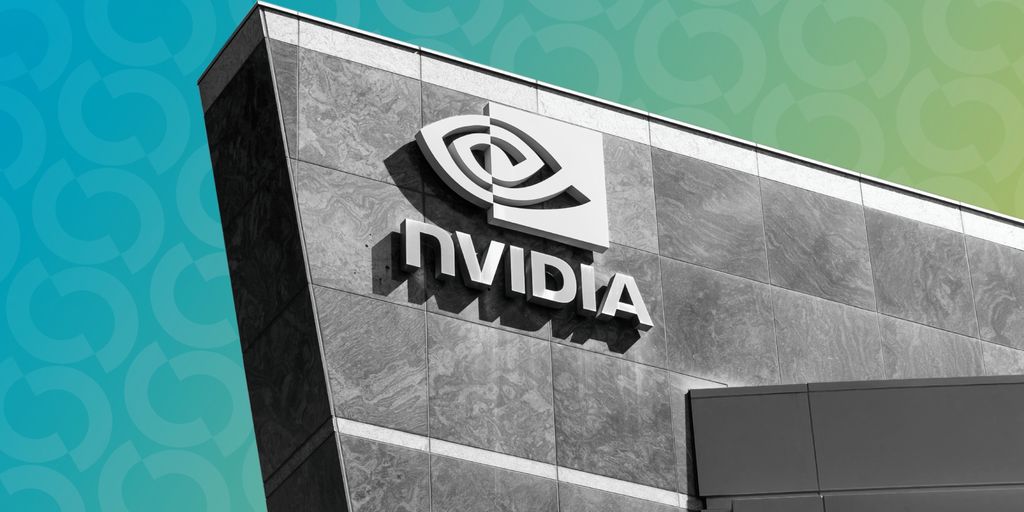 Nvidia Unveils Its Full-Stack Blueprint to Contain and Monitor AI Agents
The OpenShell Reference Architecture, announced by NVIDIA at GTC Berlin, splits agent work across hardware: Vera Rubin runs models, Vera CPUs run agents inside the open-source OpenShell runtime, and BlueField-4 DPUs run the Sentry monitor. OpenShell has a gateway, supervisor, sandbox and formal-verification policy prover. Sentry inspects agent-to-model traffic outside the host. Sentry availability is listed as early next year.
decrypt.coarticlePublished and added 21 Oct 2026 The Huawei-DeepSeek Symbiosis
 analyzes DeepSeek's 30 September 2026 Ascend support for TileLang, DeepGEMM, DeepEP, TileKernels, FlashMLA and DeepSelect. It microbenchmarks the Ascend 950PR (BF16 GEMM, HBM bandwidth, die topology, AICPU) against H100, and profiles DeepSeek-V4.1-Flash on 32 Ascend 950DT chips. It also lists vLLM-Ascend gaps on x86 hosts.
newsletter.semianalysis.comarticleAdded 29 Oct 2026, published 21 Oct 2026- Show HN: Omnara – Open-source alternative to Claude Managed Agents
Omnara is an open-source, self-hostable managed agent platform, an alternative to Claude Managed Agents and OpenAI's Agents API. It runs agents on any model (OpenAI, Anthropic, OpenRouter, Bedrock, LiteLLM, Ollama) and any machine, with Postgres-backed durable state, stateless workers, per-tool permissions, MCP, skills, memory, subagents, schedules and Slack, Discord and GitHub triggers. It ships a REST API, TypeScript SDK, CLI and Docker Compose setup.
github.comrepoAdded 23 Oct 2026, published 21 Oct 2026




Showing 30 of 146
Show more