 x.comthread
CuteGuy☣️ (@cutetoxicguy) on X
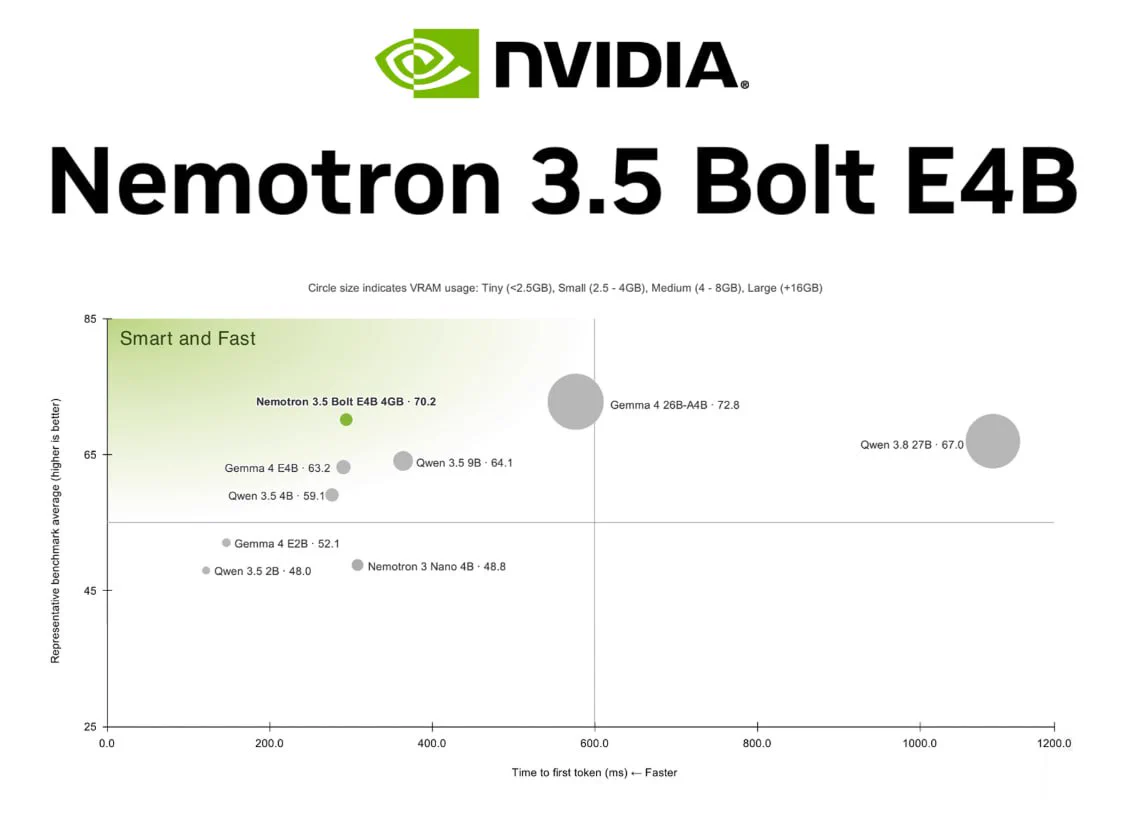
Nemotron 3.5 Bolt E4B is an NVIDIA open-weights model with 8B total and 4B active parameters, built on Gemma 4 E4B and post-trained with NeMo RL and NeMo Gym. It targets local agents in about 4GB of GPU memory, with 64K context, 35 languages, multi-step tool calling and configurable reasoning. NVIDIA's llama.cpp tests show 133.4 tokens/sec on an RTX 5070 and 15.5 on a Jetson Orin Nano. Benchmarks are NVIDIA's own.
What it claims
Nemotron 3.5 Bolt E4B is an NVIDIA open-weights model (8B total, 4B active parameters per token) for local agents in about 4GB of GPU memory. NVIDIA built it on Google's Gemma 4 E4B, unlike the larger Nemotron 3.5 Bolt 74B. It targets conversational AI, interactive game characters and embedded devices. Weights are released under OpenMDW 1.1, which permits commercial use. The source is a third-party X post by @cutetoxicguy restating NVIDIA's announcement, not NVIDIA's own page.
How it works
NVIDIA post-trained Gemma 4 E4B with NeMo RL and NeMo Gym, targeting instruction following, structured outputs, tool use and conversation. Reasoning is configurable: thinking can be turned on or off, reasoning tokens can be capped, and the model can switch to short conversational replies for voice assistants.
Inference can use DFlash speculative decoding. A separate draft model predicts several tokens, and Bolt verifies them in parallel. NVIDIA reports up to 21% higher throughput than Gemma 4's original MTP drafter. The post does not give the setting for that figure.
Evidence
NVIDIA ran the Q4_K_M quantized model in llama.cpp with about 3K input tokens and 50 output tokens:
- RTX 5070 (12GB): 133.4 tokens/sec, 548ms to first token, 3.5GB peak VRAM.
- Jetson Orin Nano (8GB): 15.5 tokens/sec, 5.8s to first token, 4.2GB peak memory.
NVIDIA's BF16 evaluations against Qwen3.5-4B show a split result:
- IHEval: 84.8 vs 60.6 (Bolt ahead).
- RoleBench: 67.0 vs 53.7 (Bolt ahead).
- Tau2-Bench: 55.1 vs 75.1 (Qwen ahead).
- RULER 64K: 87.0 vs 95.1 (Qwen ahead).
NVIDIA also reports about 40% higher average benchmark scores than Nemotron 3 Nano 4B, and up to 80% fewer output tokens in selected comparisons. The post does not list which benchmarks or comparisons.
Demos include a Minecraft blacksmith NPC that negotiates payment, checks recipes, crafts items and hands them to players. Another demo runs Bolt with Cosmos 3 Edge on a Jetson-powered Reachy Mini robot.
How to use it
GGUF and BF16 checkpoints are on Hugging Face (link truncated in the post, under huggingface.co/nvidia/). Supported runtimes are llama.cpp, Ollama, LM Studio, vLLM and SGLang. The memory figures above are for Q4_K_M. The post gives no run commands or exact model IDs.
Limits
All benchmarks are NVIDIA's own, not independent. The speed figures use a short 3K-token prompt and 50-token output; the post states that longer contexts raise memory use and latency, so the 64K window will not fit the quoted 3.5GB to 4.2GB. Qwen3.5-4B leads on Tau2-Bench, an agentic tool-use benchmark, by 20 points, and on RULER 64K long-context retrieval, which matters for multi-step agent workloads. Time to first token on Jetson Orin Nano is 5.8 seconds even at 3K input. Benchmarks were run in BF16, while the speed tests used Q4_K_M, so quantized accuracy is not reported.
Organisations named here
- NVIDIA
- Hugging Face
Technologies named here
- llama.cpp
- Nemotron 3.5 Bolt
- Ollama
- LM Studio
- vLLM
- SGLang
- Qwen3.5-4B
- NeMo Gym
- GGUF
- Gemma
- Nemotron
- Gemma 4
- Qwen3.5
- RULER
- Cosmos 3 Edge
- Gemma 4 E4B
- IHEval
- Jetson Orin Nano
- NeMo RL
- Nemotron 3.5 Bolt E4B
- Nemotron 3 Nano 4B
- Reachy Mini
- RoleBench
- Tau2-Bench
Standards and laws named here
- OpenMDW 1.1
Techniques named here
- Speculative decoding
- Reinforcement learning
- Quantization
- Tool calling
- Mixture of experts
Concepts named here
- Configurable reasoning
- Local agents on edge devices
- Mixture of active parameters
Related in models