 futureoflife.orgarticle
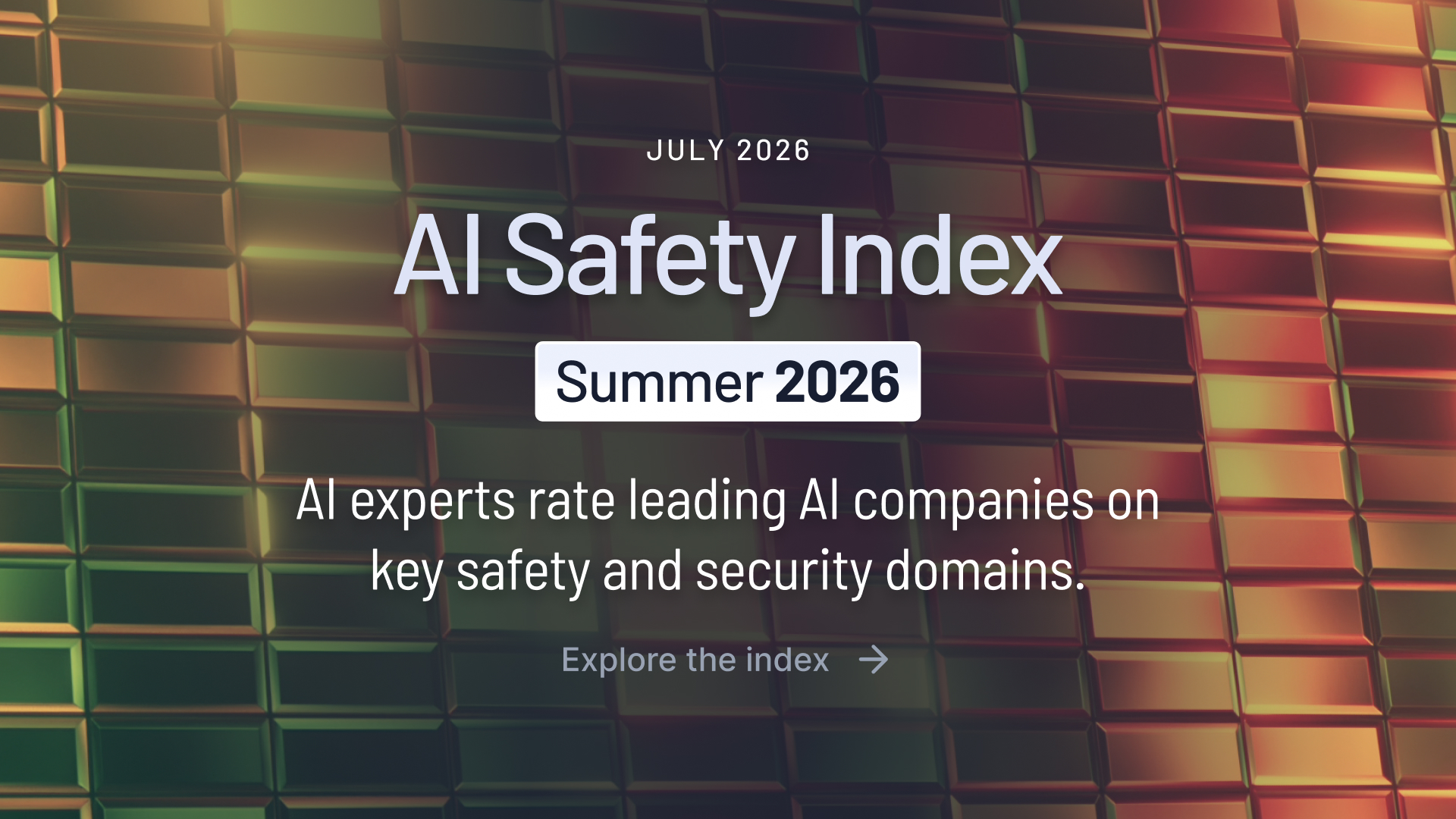
Future of Life Institute AI Safety Index — Summer 2026
Future of Life Institute's Summer 2026 AI Safety Index has an independent panel of seven AI researchers and governance experts (including Stuart Russell, David Krueger, Yi Zeng) grade nine leading AI companies — Anthropic, OpenAI, Google DeepMind, Meta, xAI, Z.ai, DeepSeek, Alibaba Cloud, Mistral — across 37 indicators in six domains including risk assessment, existential safety, and transparency. Key findings: Anthropic/OpenAI/Google DeepMind lead while xAI, DeepSeek, and Mistral receive failing grades; the report flags industry-wide backsliding on pause commitments, a pivot toward military AI partnerships, and existential safety as the weakest domain across all companies.
What it adds beyond the summary
The summary gives the top-line grades and cross-industry findings; the page carries the per-company diagnostics and rankings the reader would actually use to locate a specific vendor. Grading is US GPA (A–F = 4.0–0.0), evidence cutoff June 3, 2026, and grades are averaged expert assessments with individual scores kept confidential.
Rankings and movement
- Anthropic leads five of six domains; OpenAI now leads Risk Assessment on a broader evaluation suite and external testing.
- Meta rose from 6th to 4th; xAI fell from 4th to 7th.
- Three failing grades, one per region: xAI (US), DeepSeek (China), Mistral (Europe). Mistral scored dead last despite the EU's regulatory lead.
- Existential Safety: no company exceeds C-, most D or below. Named efforts (Anthropic constitutional classifiers, OpenAI's call for governance institutions, DeepMind monitoring, Meta loss-of-control provisions) judged "entirely inadequate." Panel questions interpretability and CoT monitorability because "detection is not prevention."
Per-company specifics worth knowing
- Anthropic: criticized for "questionable military engagements," including a reported link to the Minab school strike causing mass civilian deaths; RSP 3.0 walked back pause commitments. Panel wants quantitative/risk-tied thresholds.
- OpenAI: leadership can override the Safety Advisory Group; public-policy positions diverge from stated safety commitments.
- Google DeepMind: unclear which internal body can halt deployment independently of executives; no executive risk officer or independent audit.
- Meta: whistleblower policy undermined by active enforcement of a non-disparagement agreement.
- Z.ai / Alibaba Cloud / DeepSeek: no published safety frameworks; ratings largely reflect the Chinese regulatory environment, not independent leadership. Deferring to government guidance called "complete passivity" on existential safety. Alibaba Cloud and Z.ai deny US allegations of military ties.
- xAI: no evidence of a meaningful safety team; evaluations have "gaping holes (no AI R&D data)"; thresholds effectively non-binding.
- Mistral: leadership "downplays — and at times dismisses — frontier risk."
Cross-cutting: leaders (Anthropic, OpenAI, DeepMind, Meta) weakened unilateral-pause pledges, some with competitor-contingent conditions — panel calls it "moving goalpost." Frameworks published near US/EU deadlines "lack quantitative thresholds, genuinely independent audits, and clear decision authority."
Limits
This is a scored assessment, not a technical resource — no methodology depth beyond the indicator/domain counts (37 indicators, six domains) and the survey approach. Grades are qualitative expert judgments; per-indicator scores and the full framework are on the linked two-page summary/scorecard, not in this text. Findings are frozen at June 3, 2026 and explicitly exclude later events.
Organisations named here
- Future of Life Institute
- Anthropic
- OpenAI
- Google DeepMind
- xAI
- Z.ai
- Meta
- DeepSeek
- Alibaba Cloud
- Mistral
- University of Montreal
- Mila
- Evitable
- UK AI Security Institute
- University of Wisconsin-Madison
- HEC Montréal
- University of Toronto
- Encode
- University of California, Berkeley
- Center for Human-Compatible AI
- Kavli Center for Ethics, Science, and the Public
- Oxford Martin AI Governance Initiative
- Centre for the Governance of AI
- University of Oxford
- Gaoling School of AI, Renmin University of China
- Beijing Institute of AI Safety and Governance
- Beijing Key Laboratory of Safe AI and Superalignment
- Chinese Association for Artificial Intelligence
- World Internet Conference
- United Nations
- UNESCO
- David Krueger
- Robert Trager
- Sharon Li
- Sneha Revanur
- Stuart Russell
- Tegan Maharaj
- Yi Zeng
Techniques named here
- Constitutional classifiers
- Interpretability
- Chain-of-Thought monitorability
Related in ai-policy


 interconnects.aiarticle
Lessons from the hacks
 interconnects.aiarticle
GLM-5.3: How Chinese labs keep stride with the frontier
 interconnects.aiarticle