 latent.spacetalk
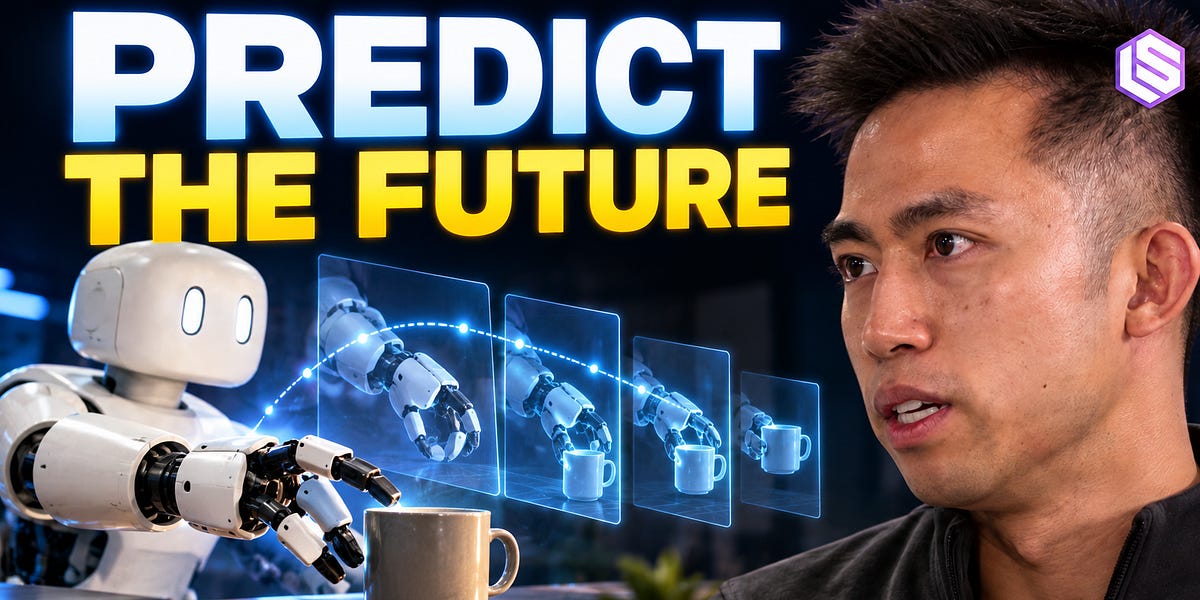
Dyna-2: General Purpose Physical Agents with Hour-Long Autonomy — Jason Ma, Dyna Robotics
Podcast interview with Jason Ma, co-founder and Chief Scientist of Dyna Robotics, on Dyna-2, a world-action model pre-trained on over one million hours of human egocentric video. The model predicts future video and uses it to guide robot actions, built on a diffusion transformer with flow matching. The discussion covers the robotics data bottleneck, adapting to new tasks from about 45 minutes of demonstrations, synthetic environments and self-generated training data, on-device inference and distillation, and Dyna's custom wheeled semi-humanoid hardware. The episode listing also covers commercial deployments (Din Tai Fung, Best Western), agentic harnesses for hour-long workflows, and world-action models versus VLAs, but the fetched text was truncated before those sections.
What it claims
Dyna Robotics says its world-action model, Dyna-2, pre-trained on more than one million hours of mostly human egocentric video, makes robots more dexterous and better at generalising than action-only policies. They claim scaling laws on human data across four orders of magnitude, but the page gives no curves. The headline production claim is a 99.4% success rate folding restaurant napkins for 24 hours straight, including recovering after the robot pulled over the whole stack. The follow-up release, Dyna-2.1, is a physical agent that runs a full laundry workflow (washer, dryer, folding). Ma says one full loop takes about an hour. Din Tai Fung is described as the largest scaled customer: robots fold thousands of napkins per day across multiple US locations, at what Ma calls human-parity speed. Din Tai Fung has signed a larger contract, and vegetable cutting is a candidate next task. Ma frames this as the line between pilots and multi-site deployment, and says he knows of no other general-purpose robot company that has crossed it.
How it works
- Inputs: several seconds of past camera video, joint-encoder readings (proprioception), and a language instruction.
- Outputs: future video, or a representation of it, generated first and then used to condition actions. Ma calls this "chain of thought" in physics space.
- Backbone: an encoder-only diffusion transformer trained with flow matching. Flow matching is used because the noise schedule needs less tuning, and actions can be re-planned in real time.
- Action space: about 100 continuous dimensions. The model predicts at 10–20 Hz, with roughly a 1–2 second lookahead. Past context is needed to resolve ambiguous states; a half-open microwave could be opening or closing.
- Data recipe: human egocentric video supplies a broad physical prior. A small amount of robot data covers the low-level dexterity that human video can't, because of the embodiment gap. The model's own generated video is being explored as self-produced training data, alongside frontier-model-generated simulation environments. Ma says GPT-6 is notably good at building these.
- Deployment: a smaller model is distilled for on-device inference, since network latency is unacceptable for control. Dyna runs its own inference stack.
- Long-horizon tasks: an agentic harness sits above the world-action model, handles high-level planning (for example, "washer done, move towels to the dryer now"), and composes skills. An SDK is planned but not yet available.
- Hardware: a wheeled semi-humanoid with a 4-DOF waist, built so torso motion in human video transfers to the robot. Body proportions are measured against real people for the same reason. LiDAR and cameras are off-the-shelf; actuators are being built in-house so the robot is easier to model.
The per-task adaptation loop:
flowchart LR
  A[Teleop demos<br/>tens of min to hours] --> B[Fine-tune base model]
  B --> C[Deploy on same setup]
  C --> D{Good enough?}
  D -- yes --> E[Ship]
  D -- "~70-80%" --> F[Score rollouts + collect targeted data]
  F --> B
Ma describes the scoring step as a robotics analogue of RLHF. The chopping task took 45 minutes of demonstrations. The new semi-humanoid had little robot data, and Ma credits fast task learning on it to the human-video pretraining.
Limits
- This is an interview. Apart from the 99.4%/24h figure, which comes without detail on how success was counted, the page gives no benchmarks, baselines or ablations, and no model size or training compute.
- No weights, licence, API or install path are mentioned. The model is proprietary as described.
- Ma's stated bottlenecks:
- Dexterous hands overheat; some need ice packs. Today's tasks use parallel-jaw grippers.
- Data is mostly vision plus joint state. Touch and sound are not captured, so some tasks may stay unsolvable however much data is added.
- Slow hardware evaluation throttles research progress.
- Human-to-robot transfer still requires robot-specific data.
- The fetched text is truncated at about the 50-minute mark of a 67-minute episode. The world-action-model versus VLA comparison, the rest of the deployment discussion, and the remaining sections are not covered here.
Organisations named here
- Dyna Robotics
- Latent Space
- NVIDIA
- Google DeepMind
- University of Pennsylvania
- Din Tai Fung
- Best Western
- Runway
- Scale AI
- Mercor
- Rosewood Hotel
- OpenAI
- Tesla
- Eureka
- Jason Ma
Technologies named here
- Dyna in-house inference stack
- Dyna-2
- LiDAR
- Dyna-2.1
- GPT-4
- gpt-oss-20b
- GPT-6 Astra
- AlphaGo
Techniques named here
- World action model
- Diffusion transformer
- Flow Matching
- Synthetic environments and self-generated training data
- Model distillation
- Robotics analogue of RLHF
Also named here
- diffusion model
- Transformer
Related in multimodal
 latent.spacearticle
[AINews] Pi 1.0, Pi Durable, and AIE NYC
 github.comrepo
Show HN: Made an open-source Lego AI generator


 simonwillison.nettool