 arcfu.comarticle
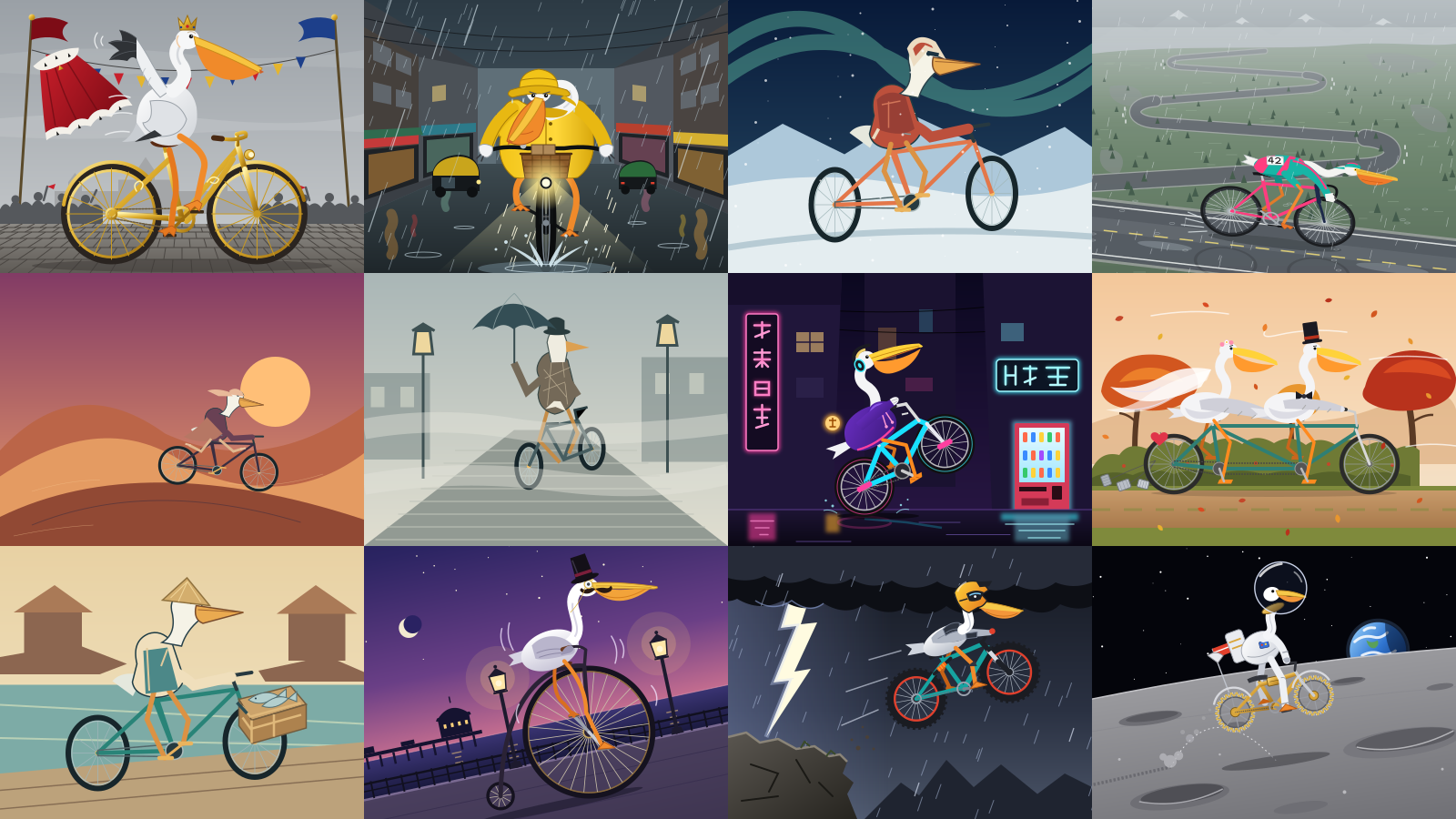
Why do LLM pelicans look like this?
Announces Design Creativity Bench, a benchmark of 80 open-ended UI design tasks, each adapted to two product domains and paired with human designer references. It evaluates 16 frontier models on Originality (how distinct a model's output is from other models' for the same brief), Creative Range (how much its design decisions change when the domain changes) and Appropriateness (how well the UI meets the brief's functional requirements). The best model, GPT-6 Astra, scores 65.5 against a human reference of 92.3. The leaderboard, methodology, arXiv paper, Hugging Face dataset and GitHub evaluation framework are published.
What it claims
Kombai, the publisher behind the Hugging Face dataset and GitHub organisation, presents Design Creativity Bench as evidence that frontier models trail human designers on creative UI decisions. The top model, GPT-6 Astra, scores 65.5 overall against a human reference of 92.3. The page frames this as a gap in creativity, not in functional correctness. It contrasts the benchmark with existing UI benchmarks, which it says score a single output-quality metric. This one splits scoring into Originality, Creative Range and Appropriateness.
How to use it
The page names three artifacts:
- Paper: https://arxiv.org/abs/2610.11539
- Dataset: https://huggingface.co/datasets/Kombai/design-creativity-bench
- Evaluation framework: https://github.com/kombai-io/design-creativity-bench/
The page describes the framework as "reproducible". It gives no install or run commands, no dataset licence, no file format and no judging setup.
Limits
- This is an announcement, not the methodology. The page does not say:
- how the three dimensions are scored or weighted into the overall number;
- what scale the 65.5 and 92.3 sit on;
- whether scoring uses human raters or a model judge;
- how the human reference was scored on Originality.
- Originality is relative to the evaluated set. It measures distance from the other models' outputs for the same brief. A model's score therefore depends on which 16 models were included, and it is not directly comparable if you add your own model.
- Only the top result is given. The page reports no other models' scores and no per-dimension breakdown. To see whether the gap comes from Originality, Range or Appropriateness, you need the leaderboard or the paper.
- The page and its title do not match. The page title ("Why do LLM pelicans look like this?") and URL slug (
the-emperor-pelican-has-no-clothes) suggest a different post, but the fetched text is the benchmark announcement. Check that the catalog entry points at the intended source before citing it.
Organisations named here
- Hugging Face
- arXiv
- OpenAI
- Kombai
- Design Creativity Bench
Technologies named here
- GPT-6 Astra
- Design Creativity Bench reproducible evaluation framework
- Hugging Face
- GitHub
Techniques named here
- Originality
- Creative Range
- Appropriateness
Related in evals




