 magazine.sebastianraschka.comarticle
Language Models for Text Classification: From Bag-of-Words to Jev
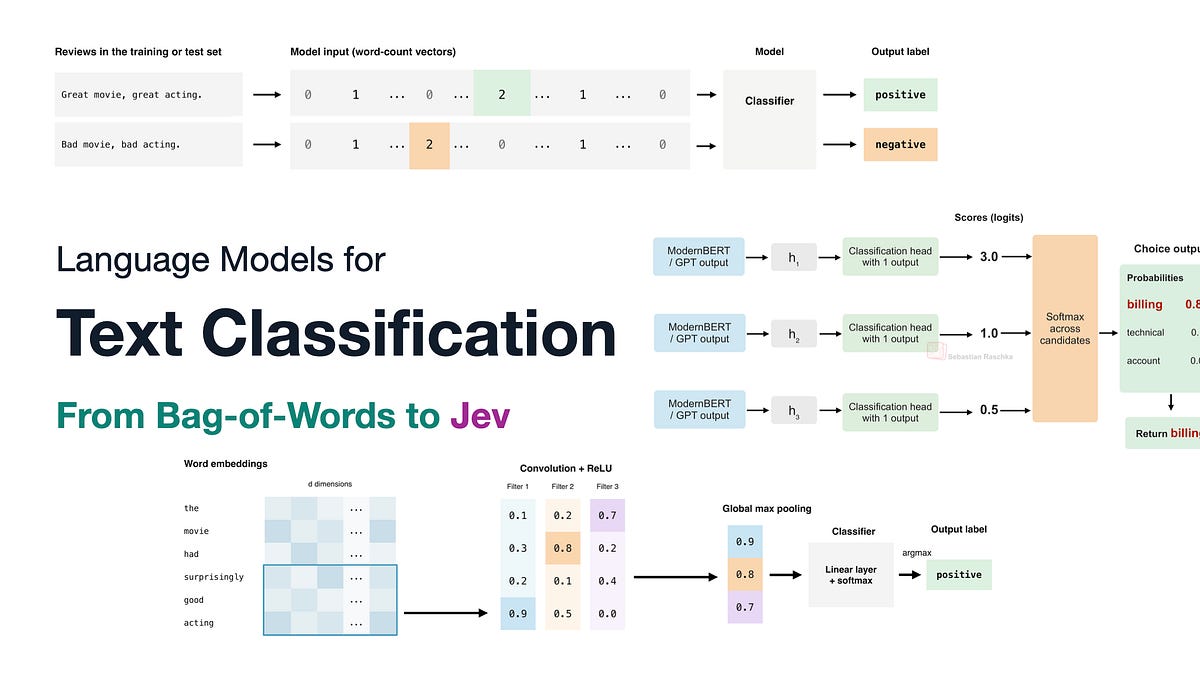
Sebastian Raschka surveys the history of text classification — bag-of-words with naive Bayes/logistic regression, RNNs and CNNs with word embeddings, then transformer approaches (BERT/ModernBERT, GPT-style decoder fine-tuning, T5 encoder-decoder) — before analyzing TypeSafe AI's new Jev model, a fast/cheap general-purpose classifier accessed via Choice/Noul/Score APIs. He benchmarks Jev against a fine-tuned ModernBERT on the IMDb sentiment dataset (Jev ~96.2-96.5% vs ModernBERT ~95%), explains how to retrofit a Jev-like classification head onto BERT/GPT models, and discusses probability calibration, including the RLCR (Reinforcement Learning with Calibration Rewards) technique from a 2025 paper that likely inspired Jev's proprietary "RLCD" training method.
What it claims
Raschka ran TypeSafe AI's proprietary Jev classifier (jev-1.13.0) on the full 25,000-review IMDb test set with no fine-tuning. It reached 96.47% accuracy via the Choice API for about $0.65 in roughly 22 minutes. That matches or slightly beats a fine-tuned ModernBERT (~95%), which needed 23 minutes of training. His argument is that Jev's value is breadth: the same model also plays Tetris in real time. Hand-rolled "Jev clones" match the API shape but not that breadth.
Evidence
All results below are on the IMDb test set (25,000 reviews):
| Approach | Accuracy | Cost / time |
|---|---|---|
| Jev Choice | 96.47% (24,117 correct) | 22m24s, 15,456,663 input tokens, $0.6492 |
| Jev Noul | 96.20% (24,050 correct) | 23m3s, 15,106,663 input tokens, $0.6345 |
| ModernBERT, fine-tuned | ~95% | 23 min fine-tune + 7 min eval on a DGX Spark; author expects 1–2% more with tuning |
| ULMFiT (2018) | 95.4% | — |
| GPT-2 124M with classification head | ~92% | — |
| Text CNN | 90.07% | — |
| Bag-of-words + logistic regression | 89.9% | — |
| LSTM from scratch | 85.66% | — |
| Contrastive Language Models (Jev-like clone) | 82.90% | fails Tetris test |
| Laya (Jev-like clone) | 92.33% | fails Tetris test, worse than CLM |
Calibration. The author trained ModernBERT on cross-entropy plus Brier loss. This gave only a "modest"/"very small" improvement over plain temperature scaling.
RLCR (2025 paper, Qwen2.5-7B), HotpotQA vs RLVR:
- Expected calibration error fell from 0.37 to 0.03.
- Accuracy was similar: 62.1% vs 63.0%.
- Across six other datasets, ECE fell from 0.46 to 0.21 and accuracy rose from 53.9% to 56.2%.
How it works
Jev's own architecture and RLCD training are not public. The author guesses it is a small ModernBERT-like model trained on fully synthetic, heavily curated data.
Retrofitting a Jev-like Choice API onto BERT, GPT or T5:
- Replace the N-class head with a single-output scoring head, s_i = wᵀh_i + b.
- For each candidate, feed the input text, the instructions and that candidate's description. Score each one with the same head.
- For h_i, use the [CLS] state for BERT-style models and the last non-padding token for GPT-style models (because of causal masking).
- Softmax across the candidate scores and train jointly with cross-entropy.
The number of options can change without changing the architecture.
flowchart LR
  T[Text + instructions] --> A[+ option A desc]
  T --> B[+ option B desc]
  T --> C[+ option C desc]
  A --> H[Shared 1-output head]
  B --> H
  C --> H
  H --> S[Softmax over N scores]
RLCR. The model emits, in order:
- Reasoning
- An answer
- An uncertainty analysis
- A confidence q
The reward is the correctness reward minus a Brier term (q − correct)². The page's examples:
- Wrong at 0.9 confidence → −0.81
- Wrong at 0.2 confidence → −0.04
- Right at 0.9 confidence → 0.99
How to use it
Endpoint: https://api.typesafe.ai/v1/systemone. There are three question types:
choice: one label from named criteria. Returnschoice,confidenceand per-classprobabilities. Note thatconfidencemeasures how concentrated the distribution is; it is not the winning class's probability.noul: a single "yes" probability. For multi-label tasks, ask one question per label; the probabilities need not sum to 1.score: a rubric level (e.g. 0/1/2).
curl -sS https://api.typesafe.ai/v1/systemone \
  -H "Authorization: Bearer $TYPESAFE_API_KEY" \
  -H "Content-Type: application/json" \
  -d '{
    "model": "jev-1.13.0",
    "state": "The acting was excellent and the story kept me engaged throughout. I would happily watch this movie again.",
    "questions": {
      "sentiment": {
        "type": "choice",
        "instructions": "What is the overall sentiment of this movie review?",
        "criteria": {
          "negative": "An overall unfavorable opinion of the movie",
          "positive": "An overall favorable opinion of the movie"
        }
      }
    }
  }'
OpenAI announced a comparable Decisions API at DevDay on 29 September 2026. It is in limited preview.
Limits
- Contamination unknown. It is not known whether IMDb was in Jev's training data.
- Non-deterministic runs. A second Choice run gave different numbers. The same text scored 1.0 via Choice but 0.98 via Noul.
- Weak spot reported. A reader reports Jev does poorly on non-English legal reviews. The author's suggested workaround is translating first.
- Fine-tuning still wins at the extremes. For high-volume, narrow tasks, a fine-tuned specialist should still be better, faster or cheaper.
- No open weights. Jev is proprietary, so privacy-sensitive use has no open equivalent of comparable breadth yet.
- RLCD link is a guess. The connection between RLCD and RLCR is the author's assumption.
Organisations named here
- TypeSafe AI
- OpenAI
- GPT-2
- HotpotQA
- IMDb
- Jev
- Sebastian Raschka
- TypeSafe
- ULMFiT
Technologies named here
- Jev API
- Jev
- GPT-5.6 Luna
- Word2Vec
- GPT-6 Luna
- GloVe
- GPT-6
- ModernBERT
- BERT
- GPT2
- Qwen3
- Kimi
- GLM
- DeepSeek
- DeepSeek V4.1 Flash
- T5
- Qwen-2.5-7B
- AlexNet
- ConvNeXt V2-H
- GPT
- CNN
- LSTM
- RNN
- Transformer
Techniques named here
- Bag-of-words
- TF-IDF
- N-grams
- Word embeddings
- Recurrent neural networks
- LSTM
- GRU
- State-space models
- Convolutional neural networks for text
- Global max pooling
- Transfer learning / fine-tuning
- Classification head
- Text-to-text classification
- Jev-like classification head
- Calibration
- Temperature scaling
- RLVR
- RLCR
- RLCD
- DPO
Also named here
- Attention Is All You Need
Related in models







