 latent.spacearticle
[AINews] Xiaomi MiMo-V2.6-Pro 1T-A42B: the new top Open Weights model, trained for $3M
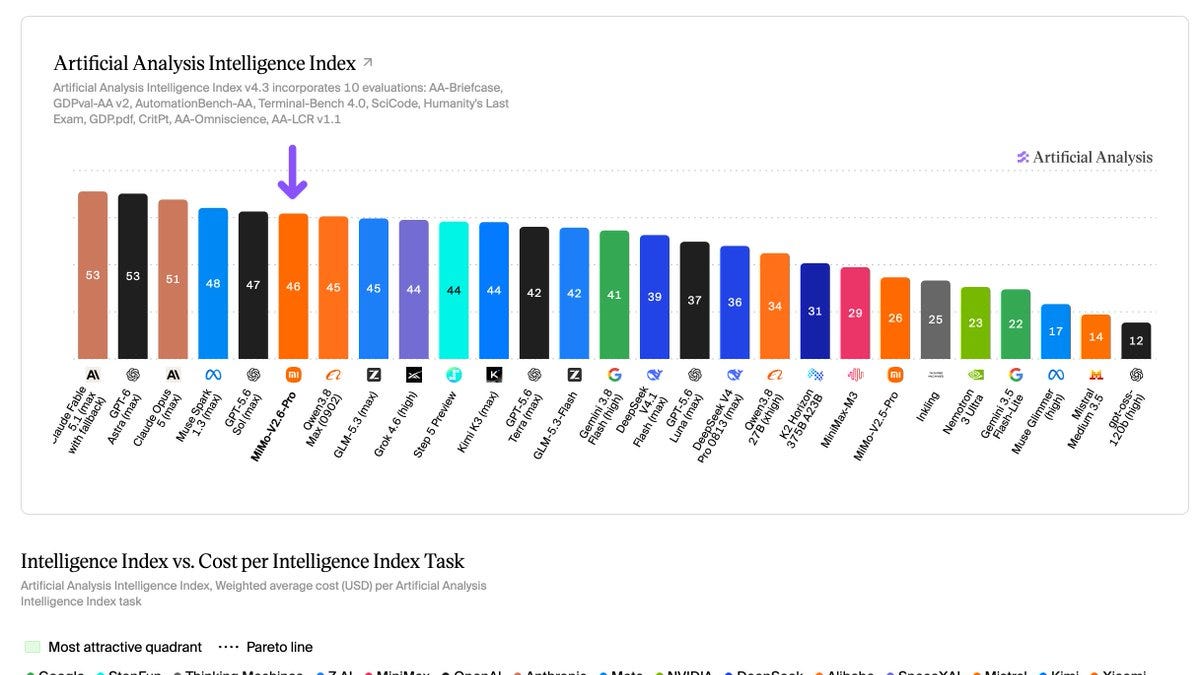
Latent Space's AINews digest covering the launch of Xiaomi's MiMo-V2.6 series (Pro, Flash, and Pro-UltraSpeed), a natively omnimodal 1.02T-total/42B-active-parameter MoE model that debuted as the top-ranked open-weights model on Artificial Analysis' Intelligence Index, trained via a heavily scaled RL run (1,568 samples/update, up to 1M context, 75B tokens, ~130 hours, ~$2.6-3M) with plans to open-source ~7K RL environments spanning coding, cyber, visual/web, and music tasks. The issue also rounds up Alibaba's Qwen-Image-2.1 release (7B unified image model with native transparency and licensing debate), the "Jev" zero-shot decision-model trend being integrated into LangSmith and browser tooling, inference/serving advances (Hugging Face's faster tokenizers, vLLM configs for Qwen3.8-2.4T on GB300, Tencent Hunyuan's 2.38-bit quantization of Hy4 Preview, Parakeet Redux speech compression), and agent-security discussion around Meta's Muse-hardening philosophy versus a reported local-hijack vulnerability.
What it claims
Xiaomi's MiMo-V2.6-Pro is a natively omnimodal MoE with 1.02T total and 42B active parameters. Artificial Analysis places it as the top open-weights model on its Intelligence Index, with a score of 46. It ships under the MIT license, together with a technical report, training code and RL environment code. Artificial Analysis lists API pricing at $0.435/M input and $0.87/M output tokens. The series has three variants:
- Pro: the most capable.
- Flash: positioned as the best intelligence/efficiency/cost balance.
- Pro-UltraSpeed: claimed to deliver up to 20x faster output "at the same quality."
The model and tech report shipped less than a week after the final RL run, which Xiaomi had published live.
How it works
The report frames the gains as scaling RL compute along three axes:
- Batch size and throughput. Training runs on a fully asynchronous architecture with 1,568 samples per update, up to 1M context, and 3.5–3.7B tokens per step.
- Task breadth. One multi-task suite covers coding, general agents, visual and cyber work. It is mixed across several harnesses so that gains in one capability carry over to the others.
- Grader compute. Rewards come from relative comparison within each group. This is meant to give long-horizon tasks more precise and diverse reward signals, and to push the model toward shorter paths and fewer tokens per task.
A separate environment/data-factory paper describes generating RL tasks from open repositories, with "agents in the loop" for robustness and anti-cheating. According to a team member, the stack runs on JAX + TPU, where scaling is "mostly a config change, not a code rewrite."
Evidence
- Intelligence Index: 46 on Artificial Analysis, ranked top among open-weights models.
- RL run cost: 130 hours, 75B tokens, about $2.6M, as cited by a third party (@zephyr_z9). The headline rounds this to $3M.
- Missing comparisons: the page gives no per-benchmark numbers and no comparison against closed models.
How to use it
Seven artifact groups are being released:
| Domain | What is released |
|---|---|
| Coding | Recipes, dataset loader, rewards |
| Cyber | ARVO vulnerability-reproduction environment and recipe |
| General / knowledge work | Environment, tools, recipe |
| Web development | Environment and grading |
| Music generation | Data prep and music scorer |
| Mini-harnesses | Composable agent configs |
| Shared adapters | "mimoagent" environment adapters |
The page gives no install commands or model repo IDs.
Limits
- RL datasets are incomplete. The page corrects its own "ALL of this tooling will be open sourced" line: the environment code and recipes are out, but the full 7K+ task datasets have not been released. If you plan to reproduce the RL run, the task data is the gap.
- Cost figures are unverified. They come from tweets, and the page itself hedges with "if these numbers hold up."
- The UltraSpeed claim is unsupported. "Same quality" comes with no evaluation.
Other items with adoption-relevant detail
- Qwen-Image-2.1 licence mismatch. Qwen's README and X post say generated outputs are not licensed "Materials," so users own their outputs. However, the Hugging Face LICENSE file still contains Section 2(b), which prohibits commercial use of the Materials. Commenters advise against client or commercial work until the file is updated.
- Hardware: one user ran the model in ComfyUI with int8 on a 16GB RTX 5060 Ti, peaking at about 15.2GB VRAM.
- Speedup: a KV-caching integration cut DiT time from 50.57s to 19.86s (2.55x) on a warmed A100, with moderate memory overhead.
- Hy4 Preview (770B) was packed into 214 GiB using mixed precision averaging about 2.38 bits/weight. It needs custom CUDA kernels in a patched llama.cpp.
- Parakeet Redux shrinks NVIDIA's speech model from 1.2GB to 178MB and runs at 113x realtime on CPU. It beats the base model on 25-language FLEURS and stays within 0.3 WER on English.
- Hugging Face tokenizers v1 RC claims up to 30x faster tokenization.
- Halo is a post-training framework that claims up to 2.8x throughput over stock TRL while keeping models in native HF format.
- vLLM on GB300 NVL72 published configs for Qwen3.8-2.4T, ranging from 5K total tok/s/GPU to 180 output tok/s/user. vLLM's NVDEC integration reports 2x+ video throughput on 8×H100.
- Jev cost data point: retagging about 2.3K papers took 83 seconds and cost $0.14, producing 579 high-confidence changes.
- Agent security: Meta's Muse hardening recipe is to assume prompt injection, keep real credentials away from the model, containerize tools, and put an independent gatekeeper on outbound calls. It is set against a reported local-hijack flaw in Muse.
Organisations named here
- Xiaomi
- Latent Space
- Artificial Analysis
- DeepSeek
- Hugging Face
- Tencent Hunyuan
- NVIDIA
- Meta
- Cognition
- GitHub
- LangChain
- OpenAI
- xAI
- Vals
- Eidon AI
- Polymarket
- DeepLearningAI
- Andrej Karpathy
- ARVO
- Devin
- Fuli Luo
- GitHub Copilot
- Jev
- LangSmith
- Nathan Lambert
- Patrick Wardle
- Sentry
- SGLang
- vLLM
Technologies named here
- tokenizers v1 RC
- MiMo-V2.6-Pro
- MiMo-V2.6-Flash
- Halo
- TRL
- MiMo-V2.6-Pro-UltraSpeed
- Kimi K3
- vLLM
- Qwen3.8 Max
- LangSmith
- LangSmith Gateway
- DeepSeek V4 Pro
- GLM-5.3
- SGLang
- Devin Cloud in Terminal / devin ssh
- Hy4 preview
- Atria Dawn
- GitHub Copilot desktop app
- Grok 4.7
- ComfyUI
- llama.cpp
- Grok 4.6
- Qwen3.8-2.4T
- Qwen-Image-2.1
- Parakeet Redux
- Opus 4.8
- SemIf
- Jev
- Hugging Face
- CUDA
- LangChain
- Model Context Protocol
- Docker
- Qwen
- Muse
- Mixture of Experts
Techniques named here
- RL compute scaling along three axes
- KV caching for image diffusion
- Mixed-precision quantization
- Multi-level hiCache
- Test-time compute scaling
Related in models






