 x.comthread
Granite0x Security Thread
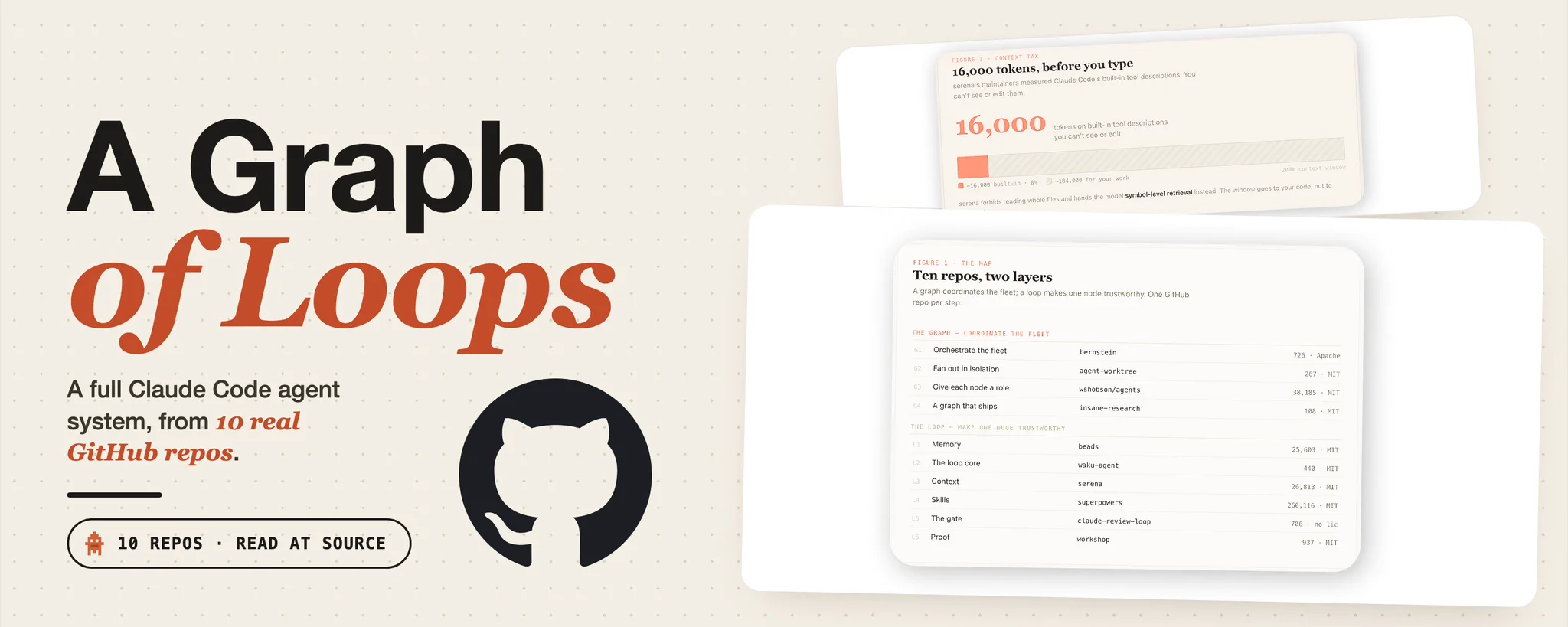
A Twitter/X thread that maps ten GitHub repos into a 'graph vs loop' framework for building trustworthy multi-agent coding systems: the graph layer covers task orchestration (bernstein's DAG scheduler), git-worktree isolation (agent-worktree), and specialist subagent roles (wshobson/agents), while the loop layer covers memory (beads), a minimal agent loop (waku-agent), token-efficient symbol-level context retrieval (serena), enforced skills/TDD (superpowers), a second-model review gate as a Stop hook (claude-review-loop), and trace-replay evals (raindrop-ai/workshop). Each repo entry includes concrete implementation details (file names, line counts, install commands) and a stated 'trap' or limitation, distinguishing substantive tools from surface-level pitches.
What it claims
The thread assembles a working Claude Code multi-agent system from ten specific GitHub repos, split into a "graph" layer (coordinate a fleet of agents) and a "loop" layer (make one agent trustworthy). The organizing claim: every node in the graph is an agent running a loop, so a graph built out of loops you can't trust is "a faster way to ship bugs across a fleet." Each repo entry gives star count, license, install command, and a stated trap. Star/license figures were pulled from the GitHub API the morning of posting.
The ten repos, with commands and traps
Graph layer:
- G1 bernstein (726★, Apache-2.0) — plain-Python DAG scheduler, zero model in the coordination loop; loads a task DAG, detects cycles, batches
[P]-marked tasks concurrently, runs each node in its own git worktree behind a lint/type/test gate.pip install bernstein && bernstein init && bernstein -g "Add rate limiting". Trap: heavy platform (1,765 Python files, own.sdd/workspace, bearer-token server); the DAG is hand-authored, not inferred. - G2 agent-worktree (267★, MIT) — git-worktree-per-agent CLI; dry-run merge that aborts and resets on conflict.
npm install -g agent-worktree, thenwt run -- claude. Trap: a primitive, not a scheduler. - G3 wshobson/agents (38,185★, MIT) — real Claude Code plugin marketplace: 203 specialist subagents across 94 plugins, tiered (Opus for 55 architecture/security/review roles, Haiku for ops).
/plugin marketplace add wshobson/agents. Trap: staffing all 203 burns your context window. - G4 fivetaku/insane-research (108★, MIT) — 7-phase research graph; Phase 3 fans out 3–5 sub-agents throttled to 2–3 concurrent (guard against >16-agent fan-out that trips "Server temporarily overloaded"); Phase 6 is a deterministic code gate (
scripts/validate_ledger.py) that alone writesverified_claims.json. Trap: skip validation and synthesis has nothing to cite.
Loop layer:
- L1 beads (25,603★, MIT) — graph-over-versioned-SQL replacement for markdown TODOs;
bd ready,bd remember,bd prime(~50 tokens); closed work decays to a 70%-smaller self-written stub.npm install -g @beads/bd. Trap:.beads/on iCloud/Dropbox corrupts the DB (error 522). - L2 waku-agent (440★, MIT) — the whole agent loop in
waku/loop/agent.py, ~95 lines; no done flag, bounded bymax_iterations(default 10). Trap: swallows tool errors into normal-looking output, so a silently-wrong tool reads as correct. - L3 serena (26,813★, MIT) — the repo reclaiming Claude Code's ~16,000 tokens of un-editable built-in tool descriptions; forbids Read/Edit for discovery and forces symbol-level retrieval over MCP.
uv tool install -p 3.13 serena-agent && serena setup claude-code. Trap: verifies nothing; strongest refactors need the paid JetBrains backend. - L4 superpowers (260,116★, MIT) — TDD methodology enforcing an "Iron Law" (no production code without a failing test); dormant skills cost ~100 words.
/plugin install superpowers@claude-plugins-official. Trap: persuasion, not a syscall — a model can fake seeing red. - L5 claude-review-loop (706★, no license) — a Stop hook returning
{"decision":"block"}to force an OpenAI Codex review (up to 4 parallel reviewers) before exit; fails open.npm i -g @openai/codex && claude plugin marketplace add hamelsmu/claude-review-loop && claude plugin install review-loop@hamel. Trap: no LICENSE file; only checks a review file exists, agent may skip findings. Alternative:npx cc-sdd@latest(3,581★, MIT). - L6 workshop (937★, MIT) — captures a run, replays the trace against edited code on a local daemon (port 5899), diffs tool calls until spans go green.
/instrument-agent. Trap: replay against a production handler can hit your real DB, billing, and email.
Shape
flowchart TD
  G1[bernstein: DAG scheduler] --> N
  G2[agent-worktree: isolation] --> N
  G3[wshobson/agents: roles] --> N
  N[each node = one agent] --> L
  subgraph L[the loop per node]
    L1[beads memory] --> L2[waku iterate] --> L3[serena context] --> L4[superpowers skills] --> L5{L5 gate: 2nd model}
    L5 -->|block| L2
    L5 -->|pass| L6[workshop proof]
  end
  G4[insane-research: whole shape in one plugin]
Limits
Star/license counts are point-in-time (day of posting). L5 (claude-review-loop) ships with no license, which may block commercial adoption. bernstein is a large, opinionated platform, not a drop-in. The thread is one practitioner's synthesis read from source, not benchmarked; it offers no comparative performance numbers, only the 16k-token figure and per-repo file/line counts.
Organisations named here
- OpenAI
- JetBrains
- anthropics
- sipyourdrink-ltd
- raindrop-ai
- bernstein
- Claude Code
- raindrop-ai/workshop
Technologies named here
- Opus
- bernstein
- agent-worktree
- Haiku
- Codex
- wshobson/agents
- insane-research
- beads
- waku-agent
- Serena
- Superpowers
- claude-review-loop
- workshop
- cc-sdd
- Claude Code
- MCP
- git worktree
- Model Context Protocol
- OpenAI Codex
Techniques named here
- Task DAG scheduling
- Git worktree isolation
- Specialist subagent roles
- Throttled fan-out
- Deterministic code gate for claims
- Dependency-graph memory with decay
- Minimal agent loop with iteration cap
- Symbol-level retrieval
- TDD Iron Law
- Stop hook review gate
- Trace replay evaluation
Related in coding-agents


