 latent.spacearticle
[AINews] Here are 6 Clones of Jev in 2 days
Latent Space's AINews digest covering the rapid open-source cloning of Jev, a non-generative 'discriminative decision model' positioned as a fast System-1 complement to LLMs for routing, escalation and tool-call decisions. It catalogs six independent reproductions (Laya, DiffusionGemmaJev, Bespoke Nimble, SemIf/OpenJev, Jevlike, Kev-0.5B) built on ModernBERT, diffusion, and Qwen3.5/Qwen2.5 backbones with LoRA and contrastive/NLI-based scoring heads, plus a wider AI Twitter recap covering AGENTS.md adoption in Claude Code, coding-agent harness-design research, RSI benchmark rankings, computer-use benchmarks, and AI safety/governance news.
What it claims
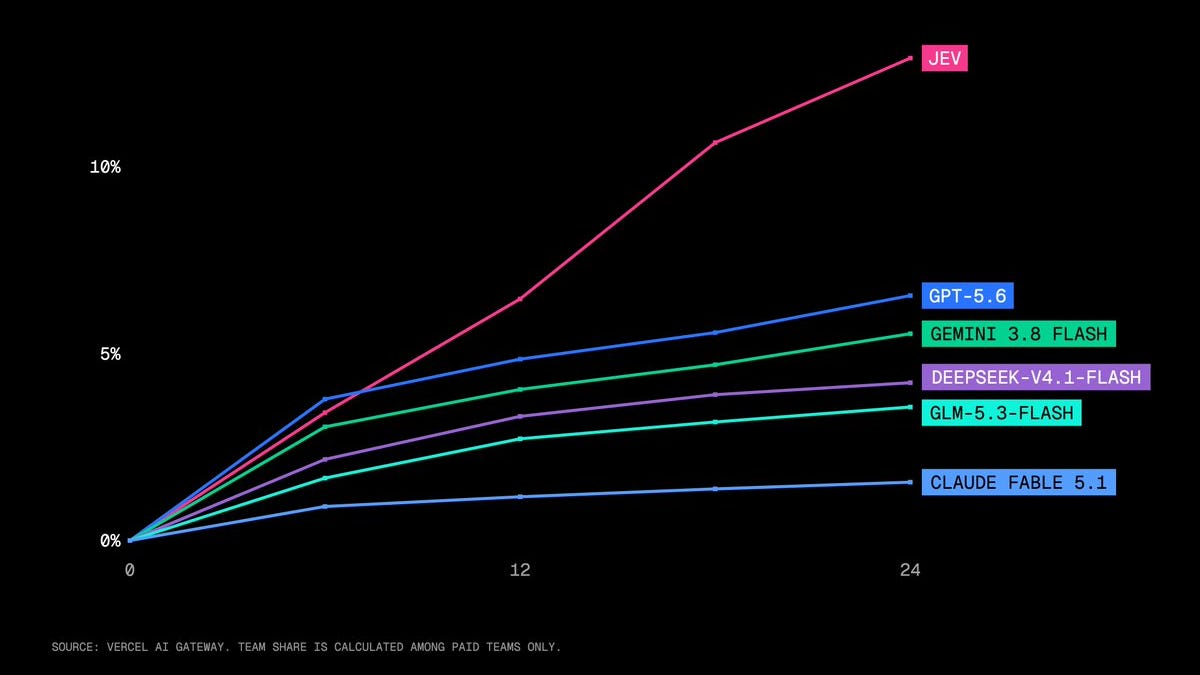
Jev, a closed, non-generative "decision model" that scores a set of candidate options instead of generating text, was reproduced six ways in two days. The issue's best guess at the underlying architecture is ModernBERT or diffusion. One reproduction, Bespoke Nimble, reports getting within 3 points of Jev on its own curated eval. Jev is now offered as an eval model in Braintrust at roughly 400x lower scoring cost than prior setups. The issue also notes that Jev's training data is acknowledged to be 100% synthetic, and that no standard benchmark exists for this class of model.
How it works
The six clones differ in backbone and in how they score options:
| Clone | Backbone / size | Scoring mechanism |
|---|---|---|
| Laya | ModernBERT-large, 421M params | Two added transformer layers score user-supplied options; PPO over sequence embeddings outputs turn-by-turn probabilities (0.0–1.0) |
| DiffusionGemmaJev | Diffusion model | Not detailed |
| Bespoke Nimble | Qwen3.5-9B, LoRA | Synthetic contrastive data curation plus constrained decoding |
| SemIf (fka OpenJev, on HF) | Qwen3.5 causal, 4B and 35B | Tiny three-class NLI classifier on the last token |
| Jevlike | 40K byte embedding | Option-attention: each candidate is a query over a shared context representation, then scored |
| Kev-0.5B | Qwen2.5-0.5B | LoRA adapter plus small readout head |
Evidence
- Bespoke Nimble: on Bespoke's own curated eval, base Qwen3.5-9B scored 66%, the fine-tune 90%, and Jev 93%. Latency is reported at about 100ms on an H100, and the model is usable locally.
- Kev-0.5B: runs on a MacBook Pro.
- DiffusionGemmaJev: described only as "pretty close on benchmarks," with no numbers.
- Braintrust: ~400x lower scoring cost when Jev is used as an eval model, compared with "prior setups." No further detail on the comparison is given.
How to use it
Jev itself is not open source. You can reach it through Braintrust as an eval model, through a Cline plugin that gives Jev a browser, or via the LangChain + Jev browser-use demos.
Among the clones, SemIf is on Hugging Face. Nimble and Kev are pitched for local use. The page gives no commands, licences or weight links.
The integrations practitioners highlighted were:
- routing
- citation selection
- escalation, for example classifying Box incident reports into escalation paths
- browser and computer-use control
Browser use was called the strongest application so far.
Limits
- No shared benchmark. Most comparisons, Nimble's included, are on self-curated evals, so the clone numbers are not comparable to each other. Many demos emphasized speed over quality.
- Uncalibrated confidence in Laya. Its confidence is entropy-based, not calibrated. That matters if your reason for adopting this class is the calibrated-probability use cases above. Laya's RLCD claim is flagged as made without justification.
- Synthetic data. Jev's training data is 100% synthetic, and the issue notes that this side is under-discussed.
Other recap items you can act on:
- Claude Code v2.1.277 reads AGENTS.md when no CLAUDE.md is present. This is toggleable in config.
- "Harness Tax" analysis: a minimal tool set of read, write, edit and bash reaches the Pareto frontier on coding-agent benchmarks.
- CUA-Bench covers 6 games, 3 of them private. All frontier models score below 20%.
- Turbo-dLLM is an open-source library for training diffusion LLMs. It reports a 2.48x speedup at 512K context and 7.59x at 1M context on 8x H100s.
Organisations named here
- OpenAI
- Anthropic
- Braintrust
- LangChain
- Cline
- Box
- Hugging Face
- Roboflow
- fal
- trycua
- Epoch AI Research
- SAIR Foundation
- ValsAI
- Accenture
- WSJ
- Transluce
- DeepSeek
- Latent Space
- Epoch AI
- AGENTS.md
- Claude Code
- CUA-Bench
- Jev
- Newsom
- Open Math Model
- SAIRfoundation
Technologies named here
- Braintrust
- Jev
- Cline
- Laya
- DiffusionGemmaJev
- LangChain
- Bespoke Nimble
- AGENTS.md
- SemIf
- Claude Code
- Jevlike
- Turbo-dLLM
- Kev-0.5B
- ProgramAsWeights
- Qwen3.5-9B
- ABC
- ABC-130K
- Qwen3.5
- Qwen2.5-0.5B
- Cua Bench
- GPT 5.6 Sol XHigh
- Auto Annotate
- GLM 5.3 Flash
- DeepSeek V4.1 Flash
- Opus
- Sonnet
- GLM-5.2
- Fable
- Astra
- Fable 5
- GPT-6 Astra
- Fable 5.1
- Grok Voice Transcribe 2.0
- H3 Max Lip Sync
- CUA-S1-FORMS
- ModernBERT
- Qwen3
- LoRA
- Hugging Face
- vLLM
- GRPO
- Qwen2.5
- Claude Fable 5.1
- GLM-5.3
- DeepSeek V4
Techniques named here
- PPO over sequence embeddings
- Contrastive data curation
- Constrained decoding
- Option-attention scoring
- Discriminative decision models as a 'System 1' layer
- Context-Sharded Block Parallelism
- Three-class NLI classifier on last token
Related in models






