 latent.spacearticle
[AINews] Jev: a “System One Model” that only decides/classifies/routes/scores — >100x faster, >200x cheaper than small frontier LLMs
This AINews/Latent Space daily digest (Sep 14–15, 2026) leads with TypeSafe's Jev, a non-autoregressive "System One Model" trained via RLCD (reinforcement learning from calibrated decisions) that skips free-form text generation entirely, instead outputting predefined structured decisions/classifications 20–200x faster and 40–400x cheaper than small frontier LLMs — positioned as a cheap calibrated inference engine for routing, judging, and classification rather than a general LLM replacement. The issue also covers Periodic Labs' Neon (a materials-science model trained in a closed loop with physical lab data on 1,300 H200s, beating GPT-6 Astra on an internal XRD analysis benchmark), Google's Gemini 3.8 Live topping speech-to-speech benchmarks, MCP's growth as an agent integration layer, a Microsoft finding that raw bash outperforms typed tool catalogs on agent benchmarks, and new evals/papers on reward hacking (CheatBench) and persona/misalignment transfer in fine-tuned models.
What it claims
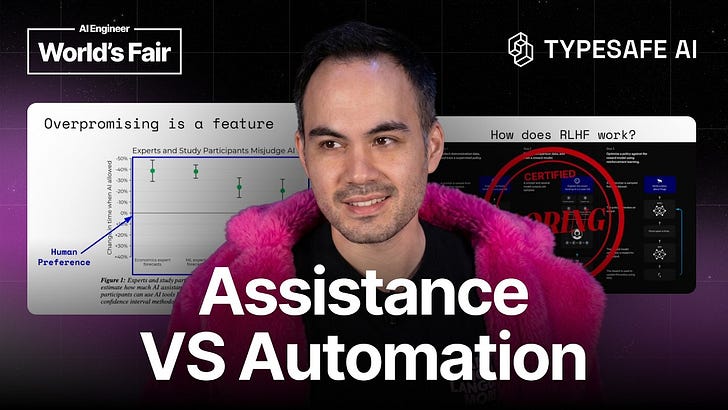
The issue leads with TypeSafe's Jev, a non-autoregressive model trained with RLCD ("reinforcement learning from calibrated decisions"). Jev outputs only predefined structured decisions. TypeSafe claims it is 20–200x faster and 40–400x cheaper than small frontier LLMs, and that output tokens are free. The team frames Jev as a "System One" complement to slower "System Two" LLMs. Dropping strings and chat buys three properties:
- parallel sampling
- "no hallucination"
- calibration
Beyond Jev, the digest carries numbers the summary leaves out. They are useful if you work on voice agents, agent harness design or AI-for-science.
Evidence
Jev. The page gives only the multiplier ranges above. It names no benchmark, baseline model or task setting, and there are no eval figures here. They live in TypeSafe's linked blog, evals and docs.
Periodic Labs' Neon
- It is a 1T-parameter XRD (X-ray diffraction) analysis expert.
- A community summary says it starts from Kimi K2.6. Another post says a Kimi 2.5/K2.x base.
- It was trained on 1,300 H200s using mid-training plus RL on months of proprietary lab data.
- On the internal FrontierXRD eval, success rose from 2.7% to 55.3%.
- It reportedly beats GPT-6 Astra and Claude Fable 5.1 on that eval at lower inference cost.
- Long scientific traces required work on long-context training efficiency.
Gemini 3.8 Live
| Measure | Gemini 3.8 Live Extended Thinking (High) | Comparison |
|---|---|---|
| Artificial Analysis speech-to-speech index | 82.6 | GPT-Live-1 Astra: 81.5 |
| Tau Voice | 68.6% | — |
| Input audio price | $3.50/hour | Standard 3.8 Live: $0.84/hour |
The standard model is cheaper and faster but "much weaker on agentic voice tasks". Both models support 97 languages and async tool calls while speaking. They are available via the Gemini API and AI Studio, with partner support in LiveKit, Pipecat, LangChain and Vercel.
Bash vs typed tools (Microsoft paper, via @dair_ai summary)
- Bash alone beat typed tool catalogs by 21.8–24.5 points on TheAgentCompany.
- It beat them by 4.8–7.4 points on APEX-Agents.
- It used fewer tokens in both cases.
- The recommendation: use bash when sandboxing is acceptable, and programmatic tool calling when compliance requires a fixed tool inventory.
Perplexity CobbleDB
- A DynamoDB replacement for search serving.
- Built by two engineers plus hundreds of persistent agents over two months.
- Median batch-read latency fell from 31.4 ms to 5.60 ms, and p99 from 123 ms to 24.2 ms.
- At least 20% cost savings versus DynamoDB.
Other items
- Devin now runs Mac VMs, which enables end-to-end iOS development. Its macOS, Windows and Linux infrastructure was rebuilt in Rust.
- Every LangChain Managed Deep Agent is now an MCP server.
- @jennjwang reports that API-based audit findings may not transfer to the ChatGPT, Claude and Gemini chatbot interfaces. This matters to anyone relying on API-only external review.
How to use it
For Jev, the community reading is to put it where an LLM currently acts as a classifier, judge or routing policy and free-text generation is overhead.
Several engineers (@eggie5, @dbreunig) map it onto DSPy-style signatures and typed predictions. In that view, expensive LLM calls compile into many small task-specific AI functions, and Jev fits that slot.
No install command, API shape, model size or licence appears on this page.
Limits
- Jev's scope. It cannot generate free-form text, code or reason, and it requires predefined output formats. @scaling01 suggests it is closer to a constrained or diffusion-like decision model, but TypeSafe does not confirm the architecture here.
- Jev's evidence. RLCD is named but not explained. The speed and cost ranges come without the tasks they were measured on, so check TypeSafe's evals before relying on them.
- Neon's evidence. FrontierXRD is Periodic's internal benchmark. The base-model and comparison details come from secondary posts, and the reported base model is inconsistent (K2.6 vs K2.5/K2.x).
- Secondary sourcing. The bash-vs-tools result reaches the page through a third-party summary, not the paper itself. The CobbleDB "hundreds of agents" framing is self-reported.
Organisations named here
- TypeSafe
- Hugging Face
- Periodic Labs
- LangChain
- Microsoft
- CAIS
- Perplexity
- Meta
- Latent Space
- APEX-Agents
- Artificial Analysis
- CheatBench
- Devin
- Diogo Almeida
- DynamoDB
- Jev
- Liam Fedus
- LiveKit
- Model Context Protocol
- Pipecat
- TheAgentCompany
- Vercel
Technologies named here
- LangChain
- Jev
- Gemini 3.8 Live
- MCP
- Gemini 3.8 Live Extended Thinking
- Devin
- Neon
- LiveKit
- Pipecat
- GPT-6 Astra
- Kimi 2.5/K2.x
- Vercel
- Kimi K2.6
- DSPy
- CobbleDB
- Claude Fable 5.1
- GPT-Live-1 Astra
- Model Context Protocol
- Gemini
- Rust
Techniques named here
- RLCD
- System One / System Two model split
- Lab-grounded RL for materials science
Related in models