 latent.spacearticle
[AINews] Opus 5.5 is good at explainer videos
Daily AINews digest (Latent Space) covering the week's AI developments: Claude Opus 5.5's strong vision/coding results and viral code-generated explainer videos, the GPT-6 family (Astra/Sol/Luna) and Gemini 3.8 Flash releases, and Xiaomi's open MiMo-V2.6-Pro. It also covers the "System One" cheap-judge/reranker trend (TypeSafe's Jev vs. the open CLM alternative), agent infrastructure news from LangChain Interrupt and Perplexity's Rust-based Photon retrieval engine, inference speedups (Liquid AI's DSpark speculative decoder, GLM-5.3 on AMD MI355X), and research highlights including Harness-Zero agent-distillation, DeepMind's XYEval on sycophantic agent failure, a single-neuron safety-refusal bypass, and Sakana AI's RSI Lab with Jürgen Schmidhuber.
What it claims
A one-day digest (AI News for 9/24–9/25/2026). Its headline is that Claude Opus 5.5 can autonomously produce explainer videos written entirely as code, with no diffusion model, at single-digit-dollar API cost. The summary names the releases. What it leaves out are the operating details: the reasoning-effort trap, judge and reranker cost and accuracy tradeoffs, licences, and several practical setup notes.
Evidence
Opus 5.5
- Leads SimpleBench at 88.4%.
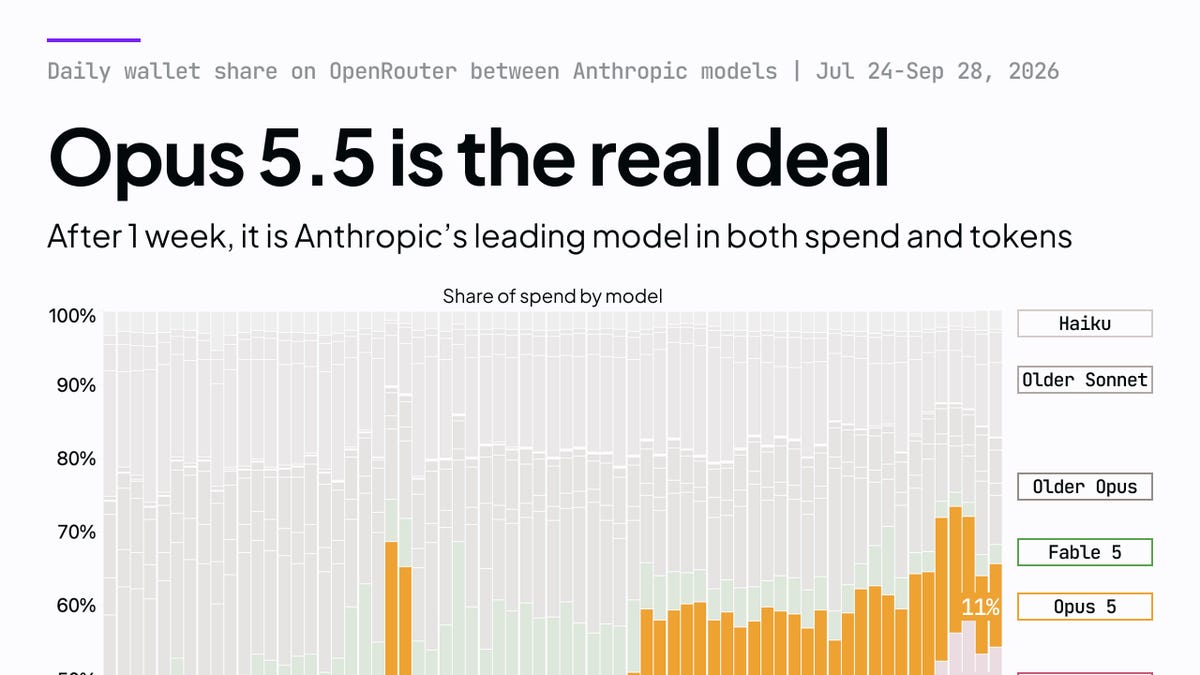
- Ranked Anthropic's best vision model. It beats Fable 5 and GPT-6 Sol but trails GPT-6 Astra, at about 60% lower cost than Fable 5.1.
- On Terminal-Bench-Science it scores 24% at low effort, 62% at xhigh, and drops to 59% at max. Astra and Opus 5.5 lead Fable 5.1 by about 20 points. The best model from any other lab is Qwen3.8 Max at 12%.
Code-rendered video (Reddit reports)
- One-shot Claude Code runs produced 30–60s pure-JavaScript canvas animations with script, assets, TTS, music, and MP4 render.
- Costs reported: about $20 of Opus usage plus $3.21 of OpenRouter in about 1h20m; about $4 in 1.5–2h; one user needed "minor corrections."
- An interactive 3D island game (TideWater) took about 8 hours and about $1,874 in tokens, or 59% of a Max20x weekly allowance.
Jev (TypeSafe)
- $0.044 per 1K judgments at 152ms median latency, about 277× cheaper than GPT-6.
- Within 3 points on RewardBench and HaluEval, but 14.5 points behind on JudgeBench.
- A cascade that sends low-confidence calls to GPT-6 Astra keeps 99% of accuracy at 57% of cost.
- Ramp matched GPT-5.6 Luna reranking with 10× lower tail latency (300ms) at 3× lower cost.
- Counter-evidence from Reddit: on Banking77, BGE-small plus logistic regression scored 93.3% vs Jev's 83.2%, at about 9ms local inference.
Other results
- CLM, an open head on Qwen3-8B: 4–13× lower latency than Jev in agent benchmarks. As a verifier it scores 87.6% on Terminal-Bench 2.1 and 81.6% on DeepSWE (Jev is about 71% on DeepSWE). It is weaker zero-shot: BFCL v4 95.2% vs 99.2%.
- Harness-Zero: harness-free macro task success rises from 23.3% to 44.3%, beating the base model with the harness (41.7%).
- XYEval: one confident, misleading user hint cuts agent scores by up to 46.7% relative. Agents often disagree with the hint in their reasoning, then follow it anyway.
- Liquid DSpark (drafter for LFM2.5-VL-3B): speedups of 3.13× with MLX on M5 Max, 2.14× with llama.cpp on M3 Ultra, and 2.66× with SGLang on H100. Output quality is reported unchanged.
- Perplexity Photon: p99 fell from about 800ms to about 65ms on about 20% fewer machines. The Fast Search API runs at 160ms p50 / 230ms p95.
How to use it
- Opus 5.5: use xhigh, not max. Max imposes a minimum reasoning budget and scored lower.
- Weaviate 1.39 MMR: set
balanceexplicitly. The default of 0.0 means pure diversity. - CLM on limited GPUs: serve a Qwen3-8B GGUF (Q4_K_M, Q5_K_M or Q8_0) with: ``
llama-server --embedding --pooling last`` The heads were trained on last-token representations, and mean pooling degrades scores. The heads are about 75 MB and fine-tunable. - GGUF in Transformers: load directly with
AutoModelForCausalLM.from_pretrained(..., gguf_file=...). On an M2 Max, throughput is close to llama.cpp (Qwen3.5-4B Q4_K_M: 70.4 vs 71.8 tok/s). Commenters expect LoRA training over GGUF via Unsloth or Axolotl, including MoE models, which bitsandbytes lacks. - Xiaomi MiMo-V2.6-Pro:
- MIT licence, 1M context, AA index 46 (vs GPT-5.6 Sol at 47).
- Costs $0.13 vs $1.99 per task.
- RL code and training environments are also released.
- UkisAI Swift 1.5 27B: 58.5% fewer thinking tokens, +0.35% score vs base. Available in GGUF, NVFP4, MLX and W4A16.
- Gemini 3.8 Flash: free in Cline.
Limits
- This is a digest of tweets and Reddit threads. Most numbers are second-hand claims, not verified results.
- Jev: its "0% hallucination" claim guarantees only schema-valid output, not correctness. Critics say the right baselines are classifiers and rerankers, not LLM JSON generation.
- CLM:
- Calibrated context is only 2K–8K, vs Jev's 64K.
- Its probabilities are normalized over the supplied candidates only. A commenter suggests adding a "none-of-the-above" candidate.
- It is weaker at broad zero-shot use.
- MiMo: its RL gains reportedly don't generalize to harder math evals, and users report overthinking.
- Gemini 3.8 Flash on ARC-AGI v3: 10.4% with the standard harness vs 35% with the provider harness. Check which harness any figure you rely on used.
- Claude's ART enzyme finding: the short RNAs are confirmed, but the system's function and any editing utility are unknown.
- The Opus video results could not be independently inspected (Reddit returned 403).
Organisations named here
- Anthropic
- Google Research
- Xiaomi
- TypeSafe
- LangChain
- Perplexity
- Weaviate
- Shopify
- Meta
- Liquid AI
- AMD
- Qualcomm
- SpaceX
- Sakana AI
- DeepMind
- C5R
- Databricks
- Ramp
- turbopuffer
- Fastino
- UkisAI
- Hugging Face
- Baseten
- Fireworks
- Oracle
- Google DeepMind
- Odyssey
- ARC-AGI
- HaluEval
- Jev
- JudgeBench
- Jürgen Schmidhuber
- Ollama
- OpenRouter
- Project Suncatcher
- Qwen
- RewardBench
- SimpleBench
- Terminal-Bench
Technologies named here
- Claude Opus 5.5
- LangChain Managed Deep Agents 0.8
- GPT-6 Astra
- LangSmith Fine-Tuning / smithtune CLI
- GPT-6 Sol
- LangChain Engine v2
- GPT-6 Luna [Max]
- LangChain Trajectories
- Perplexity Photon
- Fable 5.1
- Fable 5
- Perplexity Fast Search API
- Gemini 3.8 Flash
- Weaviate 1.39
- Quail
- Xiaomi MiMo-V2.6-Pro
- GPT-5.6 Luna
- llama.cpp
- GPT-5.6 Sol
- vLLM
- TileRT
- Grok 4.7
- SGLang
- Meta Muse Spark
- MLX
- Ollama
- Jev
- CLM
- Hugging Face Transformers
- Heretic
- Fastino GLiNER2.5-Decide
- Unsloth
- Tev1
- Axolotl
- AutoJev-27B
- Qwen3.8 Max
- bitsandbytes
- Liquid AI LFM2.5-VL-3B
- ComfyUI
- SmolDataEnvs
- GLM-5.3
- Qwen-Image-2.1
- Cline
- UkisAI Swift 1.5
- Hermes Agent
- UkisAI Swift Flash Next
- OpenRouter
- UkisAI Swift Bonsai 2
- MiMo-V3
- Qwen3-8B
- Sonnet 4.5
- Odyssey Agora-2
- Meta Muse Realtime Avatar
- LangChain
- GGUF
- Hugging Face
- Rust
- Weaviate
- Qwen3
- LoRA
- GRPO
- GPT-6 Luna
- Claude Fable 5.1
Techniques named here
- Speculative decoding
- Harness distillation
- Disaggregated prefill/decode
- MMR diversity
- Cascade escalation
- Reasoning effort scaling
- RL for Calibrated Decisions
- Contrastive action ranking
- Dedicated memory agents
- Single-neuron safety bypass
Related in models