 newsletter.pragmaticengineer.comarticle
Building Pi and Self-Modifying Systems
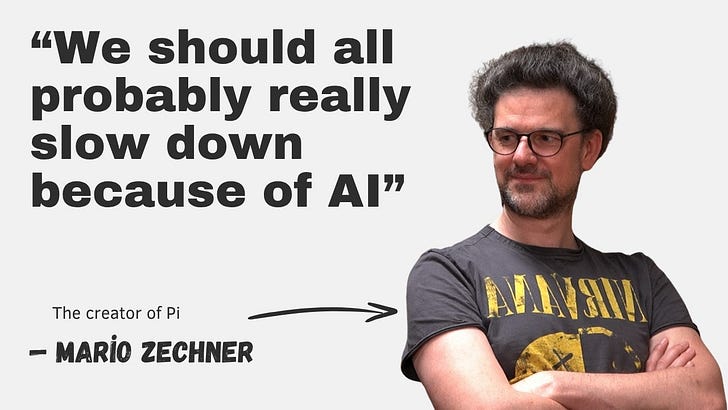
A Pragmatic Engineer Podcast episode/writeup featuring Mario Zechner (creator of Pi, a minimalist self-modifying AI coding agent that underlies Peter Steinberger's OpenClaw) and Armin Ronacher (creator of Flask). They discuss why Mario built Pi as a deliberately feature-minimal alternative to Claude Code after finding its rapid feature additions made it unpredictable, how Pi's self-modification lets users build bespoke task-specific harnesses, and broader risks of agentic coding including automation bias, declining code quality ("vibe slop"), and agents' inability to feel the "pain" that drives humans to refactor bad interfaces.
What it adds beyond the summary
This is a Pragmatic Engineer Podcast episode with Mario Zechner (Pi) and Armin Ronacher (Flask). The catalog summary already covers Pi's minimalism, its self-modification for bespoke harnesses, automation bias, "vibe slop," and agents' inability to feel refactoring "pain." The page's value past that is a set of concrete, opinionated findings from practice that the summary doesn't name.
- Grounded in 30+ teams. Armin's claim that code quality is "down everywhere" and serious projects ship "vibe slop" comes from talking with 30+ engineering teams — not a single anecdote. Named causes: PR review fatigue plus automation bias.
- A new organizational failure mode. Senior engineers historically contained complexity by saying "no." Now junior engineers and PMs push back with agent-scripted counterarguments, making it harder to reject bad ideas — so more pointless complexity reaches production. This is the most actionable observation and isn't in the summary.
- Friction is sometimes the point. Armin argues frictionless shipping can be harmful and names the friction worth keeping: multi-reviewer approvals on critical services, SLO-tiered gates, and migration checklists. The purpose is to make humans stop and think.
- Junior engineer > agent. Because juniors retain lessons and feel maintenance pain, they grow into senior judgment; agents don't, and keep extending bad structures indefinitely (their stated mechanism for accruing tech debt).
- Why Pi minimizes features. Concretely: Mario watched Claude Code's feature velocity multiply bugs and change behavior, and resolved to add as few features as possible to keep the harness stable and predictable.
The episode also touches MCPs vs. CLI (~1:16:40) and whether open source can absorb agent-generated code, but the page states no conclusions on either — only that they're discussed.
Pointers
- Pi: https://pi.dev · OpenClaw: https://openclaw.ai
- Armin's related writing referenced: "Agent Design Is Still Hard" (lucumr.pocoo.org/2025/11/21/agents-are-hard) and "The Final Bottleneck."
- Mario's essay "Thoughts on slowing the F down" (mariozechner.at/posts/2026-03-25...).
Limits
This is a discussion, not a study. The "code quality is down everywhere" finding is Armin's read of 30+ teams with no metrics, methodology, or named teams given on the page. There are no numbers, benchmarks, or reproducible procedures — the takeaways are practitioner judgment. If you want the reasoning rather than the headline, the transcript and timestamps are on the source page; the takeaways above are what the writeup itself establishes.
Organisations named here
- Armin Ronacher
- Claude Code
- Mario Zechner
- OpenClaw
- Peter Steinberger
- Pragmatic Engineer
Technologies named here
- pi
- OpenClaw
- Claude Code
- Flask
Techniques named here
- Self-modifying agent harness
Related in coding-agents


