 latent.spacearticle
[AINews] Claude Haiku 5.5 — better than GPT-6 Luna at the same pricing
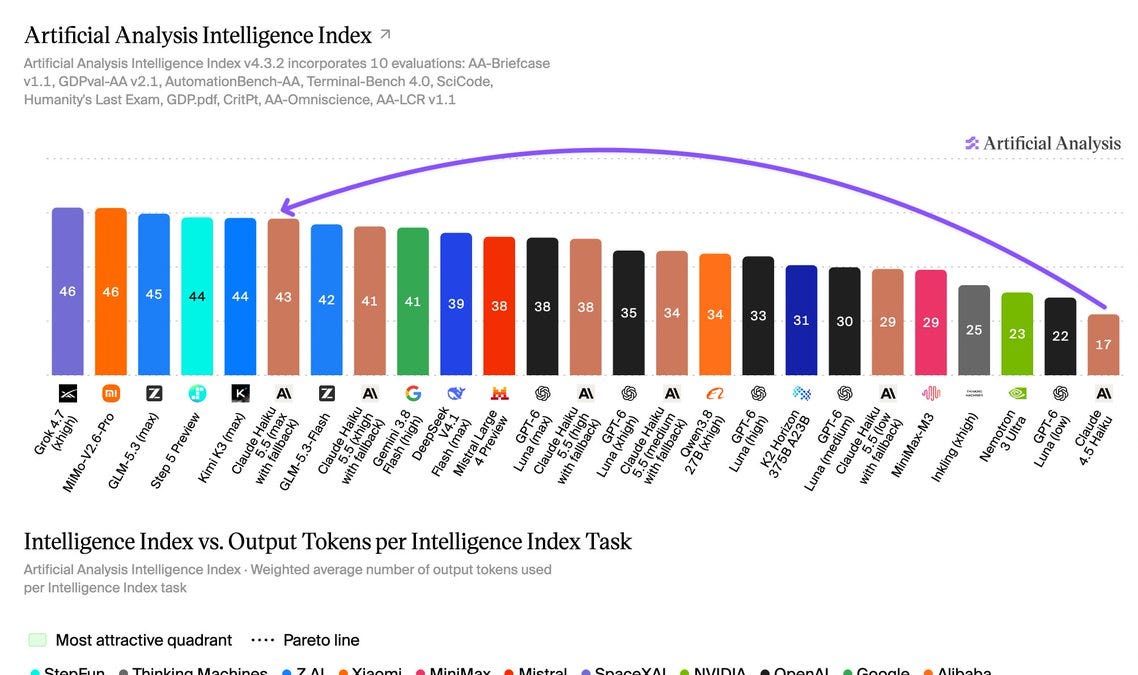
Latent Space's AINews recap covers Anthropic's launch of Claude Haiku 5.5, priced to match OpenAI's GPT-6 Luna and paired with a Sonnet 5.5 cache-read price cut and new Max/Team API credits. Independent Artificial Analysis testing puts its Intelligence Index at 43 (up 26 points from Haiku 4.5) and Terminal-Bench 4.0 at 33%, but shows it uses roughly 3x the output tokens of GPT-6 Luna at max effort, plus results on AA-Briefcase, AA-Omniscience and AutomationBench-AA, alongside a same-day Claude SDK update adding built-in computer-use/browser-use tooling.
What it claims
Claude Haiku 5.5 is Anthropic's first Haiku-tier update in about a year. It is positioned as a cheap subagent under Opus 5.5 or Sonnet 5.5, for summaries, compactions and database queries. Anthropic says it costs about 75% less to run than Haiku 4.5 on average. It is the first Haiku with effort settings and adaptive thinking. Context grows to 1M tokens, up from 200k. Input is text and image; output is text. Per a secondhand summary of Anthropic's figures, max output is roughly 12k tokens. It is live on the Claude Platform and in Claude Code.
How to use it
Pricing is tiered on prompt length, and long prompts cost 5x more:
| Prompt length | Input / output per 1M | Cache reads per 1M | 5-min cache writes per 1M |
|---|---|---|---|
| Under 100K | $0.10 / $0.50 | $0.01 | $0.125 |
| Over 100K | $0.50 / $2.50 | $0.05 | $0.625 |
Related changes the same day:
- Sonnet 5.5 cache reads were halved from $0.20 to $0.10 per 1M. Anthropic says this makes Sonnet about 20% cheaper on most long-running or agentic work.
- Monthly API credits now come with Max 5x ($100), Max 20x ($200) and Team (up to $500, pooled). They work on any model and in third-party harnesses.
- Claude SDK (Python and TypeScript) now runs the computer-use and browser-use action loop itself. It sends clicks and keystrokes to drivers from browser_use, Browserbase, E2B or Daytona.
Evidence
Artificial Analysis (independent) found:
- Token usage. At max effort it uses about 162k output tokens per Index task, versus about 50k for GPT-6 Luna at max. Going from xhigh to max effort buys +2 Index points for about 1.8x the tokens. At equal score it is still wordier: Haiku at high effort scores 38 using ~55k tokens, the same score Luna reaches at max with ~50k. The gap widens at lower effort settings.
- Intelligence Index comparisons. It scores 43, against GLM-5.3 Flash (42), Gemini 3.8 Flash (41), Kimi K3 (44) and Sonnet 5.5 at max (56).
- AA-Briefcase: 1578 Elo, ahead of Kimi K3 and GLM-5.3.
- Terminal-Bench 4.0: 33%. Gemini 3.8 Flash scores 20% and Luna 13%.
- AA-Omniscience:
| Model | Accuracy | Hallucination rate |
|---|---|---|
| Haiku 5.5 | 36% | 40% |
| Gemini 3.8 Flash | 55% | 55% |
| GPT-6 Luna | 44% | 77% |
Haiku recalls fewer facts but is more willing to say it doesn't know.
- AutomationBench-AA: 35%, versus 53–60% for Luna, Gemini 3.8 Flash and GLM-5.3 Flash.
Vendor and partner claims, not independently verified:
- Anthropic reports OSWorld rising from 15% to 72% and TerminalBench from 0% to 39%. The 39% conflicts with Artificial Analysis's independent 33%.
- Devin reports 58.4% on FrontierCode 1.1, ahead of Sonnet 5 at about one-eighth the cost per task.
- Cursor reports it is "10x less than Haiku 4.5" on shorter requests.
- GitHub Copilot says it matched Sonnet 5 on many coding tasks using fewer tokens and steps.
Document parsing on ParseBench (independent) costs about $1.2 per 1,000 pages. Overall it is close to Luna. It is good at tables and reading order, but weaker on charts, semantic formatting and bounding boxes.
Limits
- Real savings may be smaller than the sticker price. Heavy token use and the 5x price step above 100K tokens both cut into the discount, which matters most for long-context agent loops. The page suggests these two effects explain why Cursor's "10x" differs from Anthropic's "75%."
- Cost figures are provisional. Artificial Analysis does not yet model the price step above 100K tokens, and cost-per-task numbers are still to come.
- The AutomationBench score is depressed by a known bug. A pre-release safety bug causes over-refusal. Anthropic is working on a fix, and Artificial Analysis will re-run the eval.
- Factual recall is weaker than Gemini 3.8 Flash and Luna.
- Arena scores are still pending.
- Much of the evidence is anecdotal or vendor-sourced. This includes the pelican and Three.js single-prompt tests and the partner claims.
Organisations named here
- Anthropic
- OpenAI
- Artificial Analysis
- Cognition
- Cursor
- GitHub
- ThursdAI
- Latent Space
- AINews
- AutomationBench
- Claude Code
- DeepSeek-V4.1-Flash
- Devin
- FrontierCode
- GitHub Copilot
- GLM-5.3-Flash
- Simon Willison
- Terminal-Bench
Technologies named here
- Claude Code
- Claude Haiku 5.5
- Claude Platform
- Claude Haiku 4.5
- Claude SDK
- Claude Sonnet 5.5
- Browser Use
- Claude Opus 5.5
- Fable
- Browserbase
- E2B
- GPT-6 Luna
- Sol 6
- Daytona
- Cursor
- Astra
- GLM 5.3 Flash
- GitHub Copilot
- Gemini 3.8 Flash
- Devin
- Kimi K3
- OpenDocRouter
- Agent Arena / Code Arena
- DeepSeek V4.1 Flash
- Musespark-1.3
- Claude
- TypeScript
- GPT-6 Astra
- GPT-6 Sol
- Artificial Analysis Intelligence Index
- Muse
- Python
Techniques named here
- Effort settings / adaptive thinking
- Subagent pairing in multi-model harnesses
- Prompt caching
Related in models






