 simonwillison.netarticle
Claude Opus 5.5, GPT-6 Sol, GPT-6 Luna, and a new price war
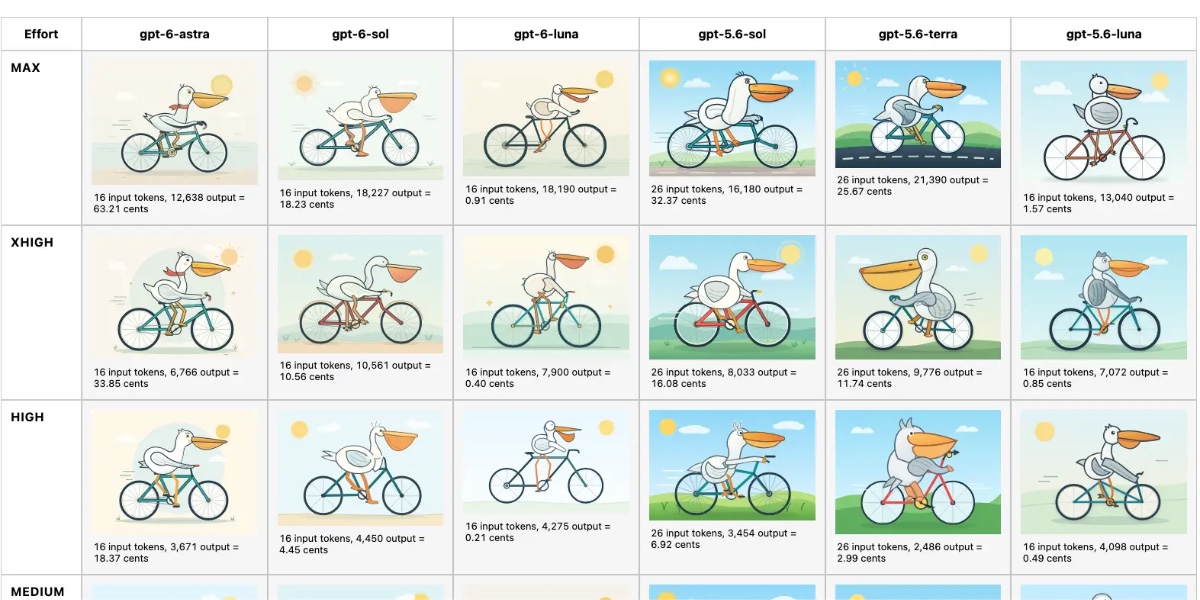
Simon Willison compares the pricing and behavior of newly released Claude Opus 5.5, OpenAI's GPT-6 Sol and GPT-6 Luna, and notes Grok 4.7's competing price cuts, documenting a sharp industry-wide price war (GPT-6 Luna at $0.10/$0.50 per million tokens, Opus 5.5 down 20% to $4/$20). He also reports a concrete failure mode: Claude Opus 5.5 at 'max' thinking level hit its 128,000 output-token limit while still reasoning through his standard pelican-riding-a-bicycle SVG test, producing no final answer and costing $2.56 per failed attempt.
What it claims
Beyond the headline prices, the page gives the context needed to choose between these models:
- GPT-6 Sol costs about half of GPT-5.6 Sol. Its input price now matches Grok 4.7's $2/M.
- GPT-5.6 Terra costs the same as GPT-6 Sol, which the author says removes any reason to use Terra.
- GPT-5.6 is getting more expensive. A 25% price increase is scheduled for November. The current GPT-5.6 prices are promotional.
- The top tier did not get cheaper. GPT-6 Astra and Claude Fable 5.1 are both $10/M input and $50/M output. The price war only affects the tier below them.
- Anthropic's small models are expensive by comparison. Haiku 4.5 is $1/$5, ten times GPT-6 Luna. Anthropic says Sonnet 5.5 and Haiku 5.5 are "coming soon."
Evidence
Cache pricing. Opus 5.5 cache-read prices fell 60%, a much larger cut than the 20% on headline rates. The author notes that in long agentic conversations, 90%+ of input tokens are billed at cached prices. For agent workloads, the effective saving is closer to 60% than 20%.
Price history. Opus 4.5 through Opus 5 all held at $5/$25, so the cut to $4/$20 is the first change in that line. Opus 5.5 now matches GPT-5.6 Sol's price, which OpenAI has since halved.
Luna in context. At $0.10/$0.50, GPT-6 Luna is undercut among OpenAI models only by the "far weaker":
- GPT-4.1 Nano: $0.10/$0.40
- GPT-5 Nano: $0.05/$0.40
Vendor claims for Opus 5.5 (Thariq Shihipar, unverified):
- clearer communication than Opus 5.0
- Fable 5.1-level intelligence
- token-efficient across every effort level
- better at Blender
The author's choices after testing:
- Default in Codex: GPT-6 Sol
- Default in Claude Code: Opus 5.5
- The agent.datasette.io demo now runs on GPT-6 Luna, which the author reports as fast and competent at SQL queries and at building HTML/JS for Datasette Apps.
Limits
Opus 5.5 at "max" thinking failed completely. Both attempts at the pelican SVG prompt hit the 128,000 output-token cap while still reasoning and returned no answer. Each attempt took nearly 20 minutes and cost $2.56. Points to note:
- The cap applies to all Claude models.
- The author's conclusion is that "max" is "effectively useless," and they would not trust it on real work either.
- The problem is specific to that setting. Fable 5.1 at "max" finished normally and drew the best pelican the author has seen from any Anthropic model.
- If you use top effort levels, cap your spend and timeouts per request.
Evidence is thin. These are first-day impressions built on a single SVG prompt. The author says cross-vendor pelican comparisons may not mean much. The test is mainly useful for comparing reasoning levels within one model family.
The page text is incomplete. The pricing table did not come through in the fetched text. GPT-6 Sol's output price is not stated, so check the vendor pricing pages before budgeting.
Organisations named here
- Anthropic
- OpenAI
- Claude Code
- Simon Willison
- Thariq Shihipar
Technologies named here
- Codex
- Grok 4.7
- MiMo v2.6 Flash/Pro
- Claude Code
- Datasette Agent
- Claude Opus 5.5
- Datasette Apps
- GPT-6 Sol
- GPT-6 Luna
- GPT-5.6 Luna
- GPT-5.6 Sol
- GPT-5.6 Terra
- GPT-4.1 Nano
- GPT-5 Nano
- Opus 5.0
- Opus 4.5
- Opus 4.6
- Opus 4.7
- Opus 4.8
- Opus 5
- GPT-6 Astra
- Claude Fable 5.1
- Sonnet 5.5
- Haiku 5.5
- Haiku 4.5
- Sonnet 5
- Opus 5.5
- Datasette
Techniques named here
- 'Max' thinking/effort level
- Cached token pricing
- Pelican SVG test
Related in models







