 latent.spacearticle
[AINews] Gemini 4 Argon: GDM’s answer to Astra/Fable, with 1M output
Latent Space's AINews digest for 9/29-9/30/2026 leads with Google DeepMind's Gemini 4 Argon, a frontier model in limited Fairwind Program cyber-defense/government preview claiming SOTA on 13 of 19 benchmarks and an industry-first 1M-token output via Long Decode Continuation, with detailed head-to-head evals against GPT-6 Astra, GPT-6.1 Sol and Claude Opus 5.5 from Artificial Analysis, Vals and Arena. It also covers other releases (Cohere Embed 5, Ideogram 4.5, GLM-5.3-Flash llama.cpp support, Solar Mini 4), research (Meta's Context Language Models, a Nature paper on superhuman Stratego AI), inference/systems news, and a safety section on hidden-reasoning-extraction attacks and GLM-5.3 cyber-capability risk.
What it claims
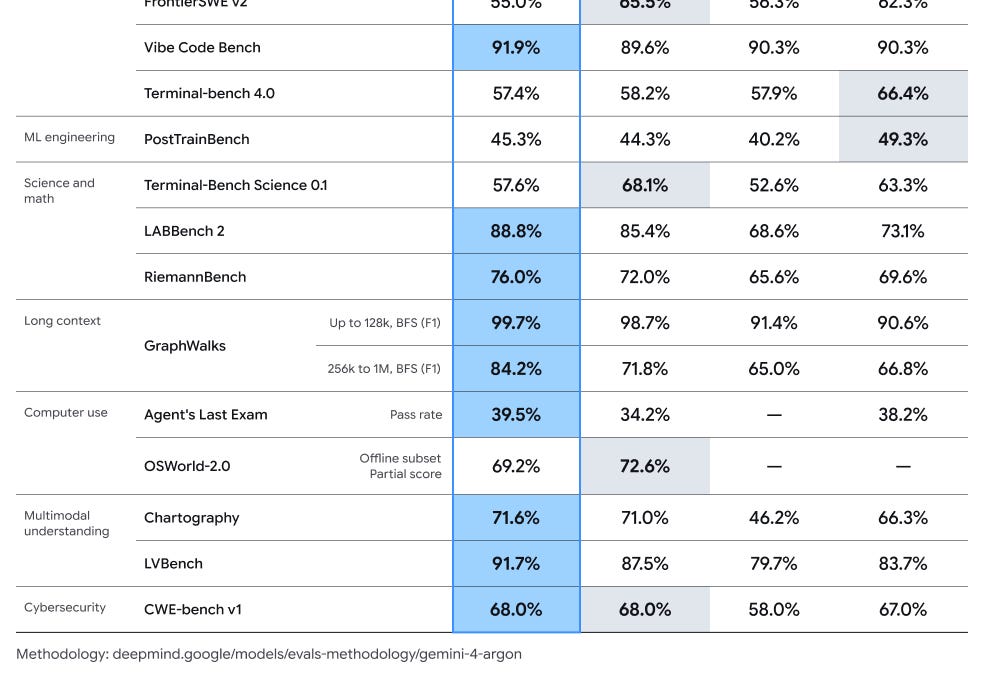
Google DeepMind's Gemini 4 Argon reaches the frontier tier on independent leaderboards, but it is not generally available. Access starts with government users and trusted cyber defenders in the Fairwind Program. Developers, enterprises and consumers get it only after Google refines its guardrails, with no date beyond "as soon as possible."
- Pricing: standard is $4/$20 per 1M input/output tokens. A 50% introductory discount brings that to $2/$10, with no end date. Cached input is discounted 95%.
- Output limit: the claimed 1M-token output limit is up from 64K.
How it works
The 1M output comes from Long Decode Continuation, an experimental API feature. It pauses a long response and resumes it across multiple calls. Without it, the limit is lower: Vals lists Argon's max output as 262K, and Artificial Analysis reached 1M only by using continuation. Plan for a multi-call pattern, not one giant response.
Evidence
Google's own figures:
- First on 13 of 19 published benchmarks against GPT-6 Astra and Claude Opus 5.5.
- DeepSWE: 77.9%, versus 74.2% (Opus 5.5) and 74.1% (Astra).
Artificial Analysis:
- Intelligence Index: 53, tied with Astra (53) and above GPT-6.1 Sol (52).
- Cost per task: $1.99 at discounted pricing versus $3.26 for Astra. At standard pricing it rises to $3.98, more than Astra.
- The cost advantage is entirely price. Argon averages 62K output tokens per task against Astra's 27K.
- AutomationBench-AA: #1 at 77.5%.
- Terminal Bench 4: 57%, behind Sonnet 5.5, Opus 5.5 and Astra.
- AA-Omniscience: hallucination rate 15% versus 51% for Astra, but accuracy 50% versus 63%. Argon abstains more rather than knowing more.
Vals:
- Vals Index: #1 at 68.9%, at an average $15.68 per task.
- Vibe Code Bench: 30 apps built perfectly, versus 25 for Opus 5 and 24 for Astra.
- Terminal-Bench 4.0: 57.6%, up from 19.0% for the previous Gemini.
- CyberBench proof-of-concept tasks: 70%.
- IOI 2024–2026: 100%.
- On Vals Index tasks it uses about a quarter of Sonnet 5.5's output tokens. This contrasts with the AA token-count finding above.
Arena:
- Text Arena: #1 at 1525.
- Code Arena WebDev: #8 at 1679.
- Agent Arena: #8 overall and #1 for steerability, on a preliminary 3K sessions.
Other:
- PostTrainBench: 45.3%, versus 21.99% for Gemini 3.1 Pro.
Internal deployments Google reports:
- Argon agents freed more than 300 TiB of data-center memory.
- They are migrating more than 800K lines of C/C++ kernel code to Rust.
- They replaced 32K lines of SIMD video-decoder code with safe Rust, making the existing Rust port 2.7x faster with identical output.
Comparison point if cost matters more than peak score: GPT-6.1 Sol costs $0.72 per task at max effort (Artificial Analysis) at $2/$10 pricing. It leads MathArena and is #3 on Code Arena WebDev at 1759. OpenAI's 300 tok/s "ultrafast" mode gave about 8x faster generation in one hands-on report, but only a 2–4x end-to-end agent speedup, because tool latency dominates. The tester exhausted a weekly limit in about 2 hours.
Limits
- Access: you cannot use Argon unless you are in Fairwind. Every number above is from preview access.
- Pricing: the discount has no announced end date. Budget against $4/$20, where Argon is more expensive per task than Astra on AA's measurement.
- Output length: 1M output depends on an experimental continuation feature. The single-call ceiling is 262K per Vals.
- Verbosity: token use differs by harness. AA shows 2.3x Astra's output tokens, while Vals shows low usage relative to Sonnet 5.5. Measure on your own workload.
- Disputed results:
- On Harvey's legal benchmark, Argon's reported 19.6% trails Muse Spark 1.2's listed 25.42%.
- Commentators raised possible preference-data benchmaxxing and objected to some figures, including DeepSWE.
- The Agent Arena ranking rests on a preliminary 3K sessions.
Other actionable items from the same issue:
- GLM-5.3-Flash in llama.cpp: support merged in llama.cpp PR #27773, covering the 320B hybrid text+vision model. Existing Unsloth quants use the architecture name
glm5next, while mainline expectsglm5-next, so mainline may fail to load them without a metadata fix. - GLM-5.3 cyber capability: Anthropic reports 50/410 end-to-end V8 exploits on ExploitBench, against 56/410 for Claude Mythos Preview. Simple jailbreaks reportedly succeed 64–100% of the time.
- Solar Mini 4 (35B total / 3B active, $0.10/$0.40): still costs about 5x GPT-6 Luna per task, because only 48% of its repeated context hits cache versus 99% for Luna.
- pplx-embed-v2-context-9b-preview: open on Hugging Face. On turbopuffer's private context-bench it beats voyage-context-4 by 14.4 points in answer recall@10, with 1 KB int8 vectors versus 8 KB.
- Cohere Embed 5: the Pro and Fast variants share an embedding space, so you can index with one and query with the other.
Organisations named here
- Google DeepMind
- OpenAI
- Anthropic
- Perplexity
- Cohere
- Ideogram
- Artificial Analysis
- Vals
- turbopuffer
- Runway
- Upstage
- Meta
- Cloudflare
- DeepSeek
- NVIDIA
- SemiAnalysis
- Cognition
- CoreWeave
- Factory
- Zhipu/Z.ai
- Hugging Face
- Apollo Research
- Harvey
- Leading the Future
- ggml-org
- Unsloth
- New York Times
- Flow
- Moonshot AI
- Latent Space
- AutomationBench
- CyberGym
- DeepSWE
- GLM-5.3-Flash
- MathArena
- Nathan Lambert
- Nature
- PostTrainBench
- Terminal-Bench
- Vera Rubin
Technologies named here
- Gemini 4 Argon
- Long Decode Continuation
- Dots
- Gemini 3.1 Pro
- Decisions API
- GPT-6 Astra
- Computer Use
- Claude Opus 5.5
- ChatGPT Sites
- GPT-6.1 Sol
- GPT-6 Sol
- MiniSGL
- GPT-6 Luna
- llama.cpp
- Cloudflare Containers
- Sonnet 5.5
- Opus 5
- AutoRouter
- DeepSeek Ascend toolkit
- pplx-embed-v2-context-9b-preview
- Cohere Embed 5
- TileLang
- SynthID Bio
- Ideogram 4.5
- Pangram
- Wan3.0
- Seedance 2.5
- DFlash
- AutoBenchmark
- MiniMax-H3
- Utopai X
- Ling-3.1-flash
- Praxis-1
- Solar Mini 4
- GLM-5.3
- GLM 5.3 Flash
- Claude Mythos Preview
- MiMo-V2.6-Pro
- Rust
- Hugging Face
- CUDA
- Triton
- GGUF
- Muse
- Fairwind Program
- SynthID
Techniques named here
- Long Decode Continuation
- Context Language Models
- Lookahead depth supervision
- Prefill-Decode disaggregation
- AI as compiler
- Abliteration
- Distillation defenses without later RL
Related in models