 latent.spacearticle
[AINews] OpenAI’s Patch the Planet program is 1 of 2 parties to discover PHP2Shell vulnerabilities in core PHP affecting 70% of the web, using GPT-5.6 Sol; coordinated response over 2 months
AINews issue for 20-21 October 2026. The top story covers PHP2Shell (CVE-2026-109618 and CVE-2026-109619), two PHP-engine memory-corruption bugs found separately by Calif researchers using GPT-5.6 Sol under OpenAI's Patch the Planet and by Wiz, followed by two months of coordinated remediation. It also covers the Flint coding MoE, DeepSeek's DeepInfer, TorchTPU, eval critiques and agent product launches. The text is truncated.
What it claims
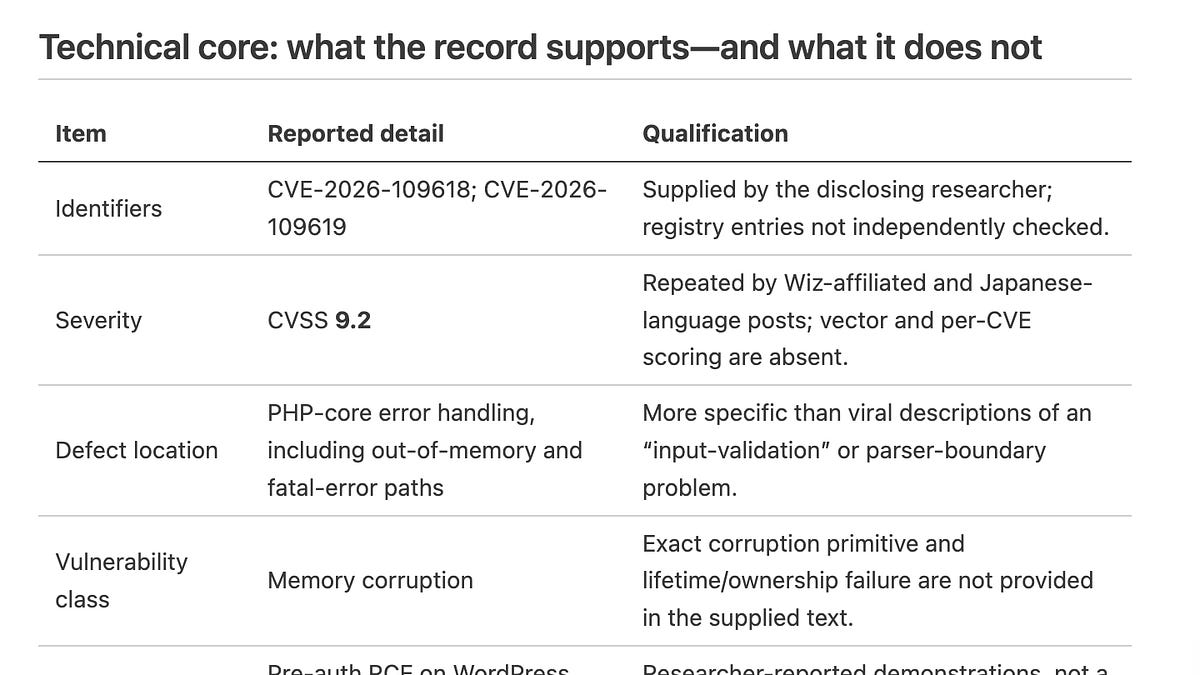
The AINews issue for 20-21 October 2026 reports that PHP2Shell (CVE-2026-109618 and CVE-2026-109619) sits in the PHP engine's own handling of out-of-memory conditions and fatal errors. It is not in any CMS plugin or application auth logic. Researchers report pre-authentication remote code execution against WordPress, Drupal and Joomla, plus "Heartbleed-style" remote memory disclosure against any PHP application. The patch was scheduled for 14:00 UTC on 21 October 2026 (23:00 JST). The issue says the fix needed a major PHP-engine change. Wiz's discovery account credits Gemini 4 Argon with discovery, exploit-chain development, detector creation and patch validation. The Calif account credits GPT-5.6 Sol.
How the response unfolded
- Cloudflare deployed WAF rules covering known exploit vectors before the patch. They are free for all customers, including the free tier. Its CTO called them a stopgap, said "early attacks" were already appearing, and told operators to patch.
- The NSA advised preparing to update immediately. It also advised taking systems offline if timely mitigation was not possible.
- Japan's prime minister urged operators to patch or disconnect.
- The Rundown reports that details leaked before the patch. What leaked, and when, is not established.
- OpenAI published a repository containing a Codex skill that guides operators through checking whether their sites are exposed.
A viral compilation claims about 1.5 million unpatched servers, attributed to Censys. It also lists shutdowns at Wikipedia, Archive.org, Asana, GOG and European government sites. The issue says none of these claims is corroborated in its sources.
How to use it
The issue gives this incident sequence, in order:
- Get the authoritative PHP and distribution advisories.
- Inventory exposed runtimes across hosting, containers, appliances and background workers.
- Apply temporary protections where justified.
- Deploy authenticated fixed packages.
- Restart or replace processes and verify the running build.
- Investigate exploitation separately.
Patching does not show that credentials or data were never exposed. Enabling 2FA does nothing against this unauthenticated engine bug. WAF coverage requires checking alternate ingress paths and origin exposure.
Other actionable items in the issue:
- Anthropic API version 2026-10-21. It removes
temperature,top_pandtop_kfrom the Messages API. New major SDKs default to this version, while 2023-06-01 remains supported. Review migration behaviour before upgrading SDKs. - Flint (Recursive). It is an Apache-2.0 coding MoE with 39.8B total and about 2.5B active parameters, 49 layers, 256 routed experts (6 per token) and 262K context. LM Studio says it needs about 24GB locally. A user measured 114-132 tokens/s on an M5 Max with int4 MLX. vLLM reports 500 tokens/s on one GB200 at 100K context using NVFP4. OpenRouter offers free launch access.
- DeepInfer (DeepSeek). This open-sourced production stack for DeepSeek-V4.1-Flash sizes speculative verification length from predicted draft acceptance and measured hardware throughput. Its reported prefill figure is 1.5M tokens/s per accelerator including cache hits, or 60K excluding them at a 96% hit rate. The $38 per accelerator-hour figure is revenue, not profit.
- TorchTPU. Google open-sourced it with SGLang and vLLM plugins. The vLLM plugin adds prefix caching, speculative decoding and disaggregated serving.
Evidence
All of the following are author or vendor claims:
| Item | Claim |
|---|---|
| Flint | 54.9% Terminal-Bench 2.1, 89.7% SWE-bench Pro v2, 74.2% SWE-bench Verified |
| JOLT (Perplexity/NVIDIA) | Matches GRPO on MATH with 6.5x fewer training tokens |
| EAGLE-4 | 3.59x over vanilla decoding on Qwen3.8-27B, vs 2.80x for DFlash 2. Gains shrink at higher concurrency, and the draft model is about 3 GB larger than DFlash2's |
| OO-Harness | AutomationBench rises from 61.6% to 77.4% with the same Gemini 3.5 Flash executor |
| Cohere Rerank 5 Context Focus | Up to 41% fewer tokens |
Limits
- No PHP Foundation advisory, fixed-version matrix, CVSS vector, distribution package ID or patch commit appears in the issue's sources. It cannot support an "upgrade to version X" instruction.
- OpenAI's claim that the models found the flaw before attackers is qualified "to our knowledge."
- The page text is truncated at 60,000 of 61,840 characters. The end of the Reddit recap is missing.
Organisations named here
- OpenAI
- Calif
- Wiz
- Google Cloud
- Cloudflare
- PHP Foundation
- NSA
- Anthropic
- SemiAnalysis
- JPCERT/CC
- Censys
- Recursive
- LM Studio
- vLLM
- OpenRouter
- Mirendil
- Perplexity
- NVIDIA
- DeepSeek
- SGLang
- Meta
- Lambda
- Artificial Analysis
- Cohere
- fal
- Kling
- Stripe
- Nous Research
- Kyutai
- Ornith AI
- Latent Space
- BBC
- Harvard
- AutomationBench
- DeepSeek-V4.1-Flash
- PHP2Shell
- SWE-bench Verified
- Terminal-Bench
CVEs named here
- CVE-2026-109618
- CVE-2026-109619
Technologies named here
- Codex skill for PHP2Shell exposure checking
- GPT-5.6 Sol
- Gemini 4 Argon
- Wiz Atlas
- Flint
- Cloudflare WAF mitigations
- Mirendil base model
- DeepInfer
- GPT-Rosalind
- TorchTPU
- Sonnet 5.5
- SGLang
- GPT-6 Astra
- vLLM
- LM Studio
- Opus 5.5
- Claude Duet
- OpenRouter
- NVIDIA DSX POD
- Rerank 5
- NVIDIA DSX MaxLPS
- Nemotron 3.5 Parse
- Kling 4.0
- InferenceX
- ParseBench
- Ornith-1.5-122B
- NeMo Automodel and NeMo RL
- Pocket TTS-small
- Anthropic Messages API version 2026-10-21
- EAGLE-4
- eagle-harness
- DeepSeek V4.1 Flash
- Qwen3.8-27B
- Eureka Machine
- Muse Spark Open
- Gemini 3.5 Flash
- Codex
- PyTorch
- MLX
- Cloudflare
- Daybreak
- Claude Opus 5.5
- Claude Sonnet 5.5
- Drupal
- Joomla
- Mixture of Experts
- PHP
- WordPress
Techniques named here
- Adaptive speculative verification length
- JOLT joint teacher-student training
- Calibrated draft-tree speculative decoding
- Evolved harnesses and interfaces
- Pocket TTS compression
- Context Focus
Related in models