 newsletter.semianalysis.comarticle
The Chinese AI Infrastructure Boom: Introducing the SemiAnalysis China Datacenter Model
SemiAnalysis previews its China Datacenter Model, which tracks more than 1,000 facilities across 60+ operators and puts China's fleet at over 24GW. The article covers the history of China's retail-first market, the Eastern Data, Western Compute policy moving builds inland, 12-month delivery of 100MW sites, and Alibaba, Tencent, Baidu and ByteDance capex. Tenant-by-tenant sections are paywalled.
What it claims
SemiAnalysis estimates China's operating datacenter fleet at over 24GW, built from 1,000+ facilities. That excludes about 20GW of dated pipeline and about 30GW of announced projects. Its global model puts the US at 56GW by end of 2026, APAC ex-China at about 15GW, EMEA at about 14GW and Latin America at about 2GW. SemiAnalysis says published estimates of China's capacity differ by 15x.
The article's main argument is that "China is empty" mixes up two markets. The headline utilization of about 50% comes from legacy retail racks in Tier-1 cities. About 90% of those facilities run below 2kW per rack, are 30-50% utilized, and are impractical to retrofit for H20 or Ascend servers. At one leading colocation operator, wholesale utilization is back above 70% on AI demand, while retail sits near 60%.
Demand and market structure
- Capex. ByteDance, Alibaba, Tencent and Baidu spent about $35B in 2024 and over $50B in 2025. They are on a trajectory to $100B in 2026. Alibaba, Tencent and Baidu reached $20B combined in 2Q26, more than double the prior year. All three posted negative free cash flow for the first time.
- ByteDance. It occupies about a fifth of delivered capacity in China and rents nearly all of it, so its tender calendar sets the order book for wholesale operators.
- GDS and VNET. They signed about 1.3GW of wholesale orders in 1H26 against under 10MW of retail. They captured only about a third of ByteDance and Alibaba orders in 2024 through 2026 YTD, so tracking the two listed landlords understates demand.
- State players. The three state carriers held 60-70% share historically and still own a third of capacity. Grid company capex for the 15th Five-Year Plan (2026-2030) exceeds $746B (¥5T).
- Pricing. Power-exclusive rates fell by half from about $80/kW/month. On its August 2026 earnings call, GDS management said digesting the price reset would take another 18 months.
- Overseas. Overseas leasing by Chinese hyperscalers is forecast to double from 2026 to 2029, to about 4GW. This excludes GPUs rented from Western clouds.
How the westward shift works
The binding control is the energy-consumption review filed with the local Development and Reform Commission. Any project above 10,000 tons of coal equivalent (above 10MW) cannot start construction without it. The offices that issue these quotas also implement the Eastern Data, Western Compute policy.
flowchart TD
  A[Land secured] --> B[Energy quota review]
  B -->|EDWC hub| C[Quota, land, tax incentives]
  B -->|Non-hub eastern metro| D[Quota withheld]
  D --> E[Build moves to hub]
  F[Low power price] --> G[Hub chosen within map]
  H[Fiber latency cut] --> G
  C --> G
Guangdong stopped issuing quotas in 2021-2022 and reopened only for Shaoguan. In mid-2023, Tencent's two Qingyuan campuses were each found running at 13-14x their approved scale. The grid was told to cap their power at the approved quota. Shaoguan's roughly $600M fiber build gives 1.3ms one-way latency to Guangzhou, 1.66ms to Shenzhen and under 3ms to Hong Kong. A hollow-core corridor planned from 2027 should cut latency about 30% more.
Inner Mongolia runs on the independent Mengxi grid and has power at about half the Tier-1 price. It is the default site for AI capacity. Its best campuses reach yield-on-cost similar to Johor developers. Chengdu and Chongqing lost the AI contest on power price. Shanxi sits outside the hub system but drew close to 2GW of commitments from ByteDance, Baidu and JD. ByteDance self-builds in Datong, Wuhu and Horinger/Ulanqab. It registered two Zhongwei entities in July 2026.
Speed and cost
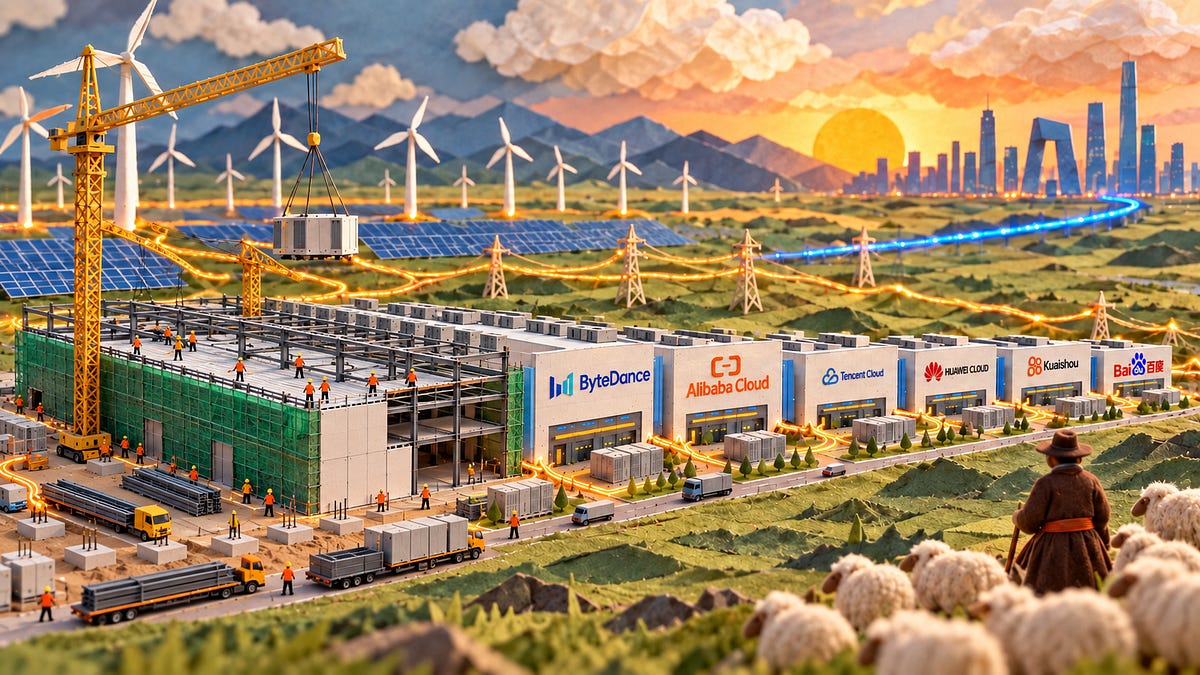
SemiAnalysis describes China as chip-gated, where the US is power-gated. A 100MW facility now takes about 12 months, down from about 18. Permitting takes 3-6 months, against 12-13 months in the US before 12-18 months of construction. Hyperscaler tenders require delivery in T+6 months, so developers pre-build shells at their own risk. GDS delivered a 152MW order in early 2025 within six months.
Alibaba's CUBE 5.0 takes 100 days from finished shell to server arrival: 30 days of factory production and site prep, 50 days of installation and 20 days of commissioning. Ground-break to commissioning is 7-9 months, and Alibaba credits it with a further cost cut of more than 10%. Full-container builds remain rare outside hyperscaler self-builds for two reasons. Site labor is cheap, and banks appraise container yards poorly as loan collateral.
The BOT model splits ownership. The hyperscaler owns the land and shell. The partner owns the M&E layer and recovers its capital over 8-10-year contracts. The pairings are Alibaba with AtHub, Tencent with Kehua Data, and Baidu with Aofei.
Limits
All capacity, share and order figures are SemiAnalysis model estimates, not disclosed data. ByteDance files no public accounts. The claim that costs are "a fraction" of US wholesale is not quantified on the public page. The maps and charts are not in the text. The per-tenant analysis of ByteDance, Alibaba, Tencent, Baidu and Huawei is paywalled. The full model, with quarterly delivery curves through 2032 and per-building tenant data, is sold through sales@semianalysis.com.
Organisations named here
- SemiAnalysis
- ByteDance
- Alibaba
- Alibaba Cloud
- Tencent
- Tencent Cloud
- Baidu
- Huawei
- Apple
- Moonshot
- DeepSeek
- Oracle
- Moonshot AI
- Aofei
- AtHub
- China Mobile
- China Telecom
- China Unicom
- Chindata
- GDS
- Guizhou-Cloud
- JD
- Kehua Data
- Kuaishou
- Mengxi grid
- National Development and Reform Commission (NDRC)
- NDRC
- Southern Grid
- State Grid
- VNET
Technologies named here
- GLM-5.3
- Kimi K3
- Doubao
- Seedance
- DeepSeek
- Ascend
- H20
- modular datacenter
Techniques named here
- Build-Operate-Transfer (BOT) datacenter structure
- Eastern Data, Western Compute (EDWC)
- Modular datacenter construction
- Speculative shell construction
Related in ai-infra
 github.comrepo
kerpopule/hermes-jev-skills

 huggingface.coarticle
Wire It, Run It, Deploy It: AI Workflows in Gradio