 jfrog.comtool
JFrog: Boost Enters Public Preview
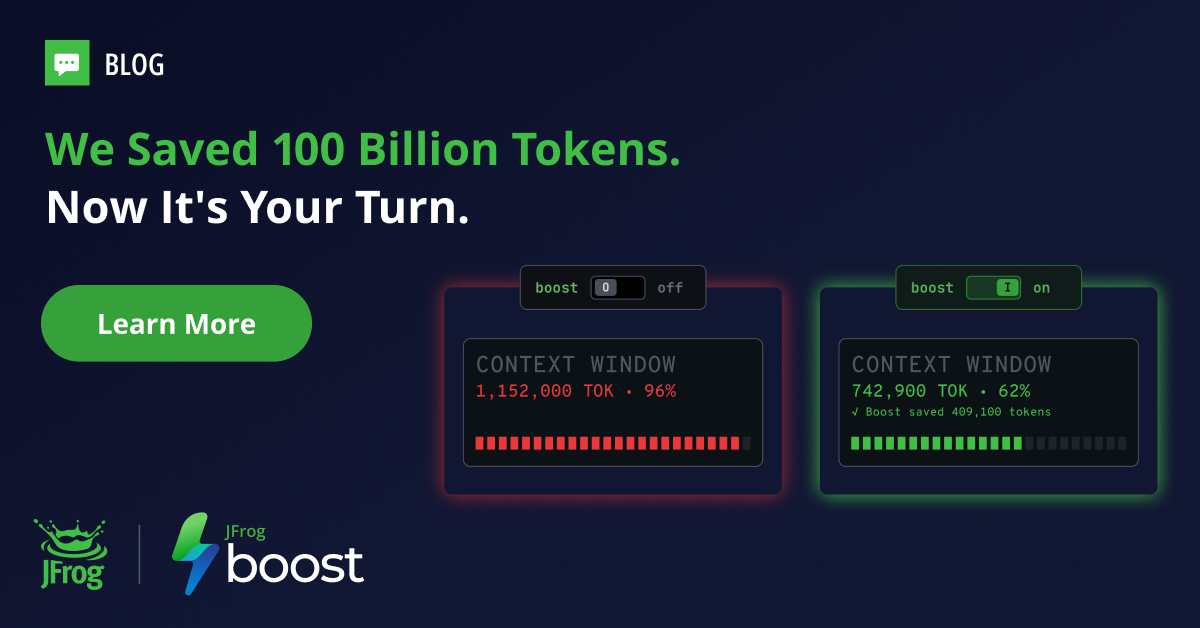
JFrog's Boost is a free CLI wrapper that intercepts coding-agent tool output such as test logs, grep results, and terminal output, stripping irrelevant content before it reaches the model while preserving full access via a retrieve command if needed. JFrog rolled it out to 1,000+ internal engineers using Cursor and Claude Code, reporting over 100 billion tokens saved and describing pitfalls: blanket permission-approval risk from wrapping every shell command, false-savings claims from tools that double-count filtering, and truncation-driven hallucination loops where aggressive context-cutting caused agents to repeatedly re-verify state.
What it claims
Boost is now in free public preview at boost.jfrog.com. The specific waste figures the summary omits: input context is ~70% of the total AI bill, and per JFrog's tracing over 90% of ingested tokens are read once and discarded. Individual Cursor bills hit >$700 for under 2,000 requests; single Claude Code sessions exceeded $1,700 — the pain that triggered the project.
How it works
Boost wraps agent shell commands with a boost prefix (boost ls -l, boost kubectl apply -f ...) and intercepts output before it reaches the model. Three named waste patterns, with the page's numbers:
- Test log avalanche: an agent was fed 847 lines of a pytest log when only the 9-line failure traceback mattered; the log-distiller shrinks such payloads by >80%.
- Blind grep/find: a
getUserquery returned 119 unordered matches (minified caches, docs, mocks) that the agent re-read every turn; Boost replaces this with an LSP-backed binary giving language-aware search. - Truncation hallucination loop: naive slicing caused agent amnesia — re-running the same
ls/catup to six times to re-verify state, burning more than it saved.
The shipped product is two capabilities rather than a blind filter:
boost skill— a minimal system prompt that tells the agent what Boost is and how to interact with the optimization layer, so it isn't silently manipulated.boost retrieve— fetches the full unedited output of the last command from session history when the agent needs filtered data back.
Evidence
Rolled out gradually across JFrog's 1,000+ engineer R&D org (Cursor and Claude Code), scaling from a few billion to over 100 billion tokens saved while agents stayed faster and more accurate. JFrog states it tracked boost retrieve frequency and per-technology context needs to guide trimming. These are self-reported internal figures with no external baseline.
Limits
- Self-reported vendor numbers from one organization; no independent benchmark.
- The
boost-prefix design created a real security flaw JFrog flagged: one "Always Allow" click onboost ls -lgrants blanket approval to everything includingboost rm -rf /— they say permission handling was reworked, but verify how before granting approvals. - Public preview, not GA.
- Telemetry claim to check: JFrog states it collects only high-level data (token counts, macro errors) and never sees, stores, or transmits code or conversations.
Organisations named here
- JFrog
- Boost
- Claude Code
- Cursor
Technologies named here
- Cursor
- Claude Code
- pytest
- Docker
- Boost
- boost retrieve
- boost skill
- grep
- log-distiller
- LSP-backed binary
Techniques named here
- Language Server Protocol-based code search
- Test log filtering
Concepts named here
- Blanket permission approval
- False savings
- Input context cost
- Truncation hallucination loop
Related in coding-agents


