 latent.spacearticle
How Anthropic’s Dynamic Workflows Coordinate Claude Agents
Latent Space report from an Anthropic workshop at AI Engineer New York 2026 on "dynamic workflows" (flows) in Claude Managed Agents. Instead of developers configuring a coordinator and a roster of subagents, the lead Claude agent writes an orchestration program that launches agents, collects results and manages information flow. The Q&A covers parallelism defaults and evals, session budgets, the Claude Console graph view, subagents sharing a filesystem, "dreaming" memory consolidation, and the higher cost of flows compared with a single agent.
What it claims
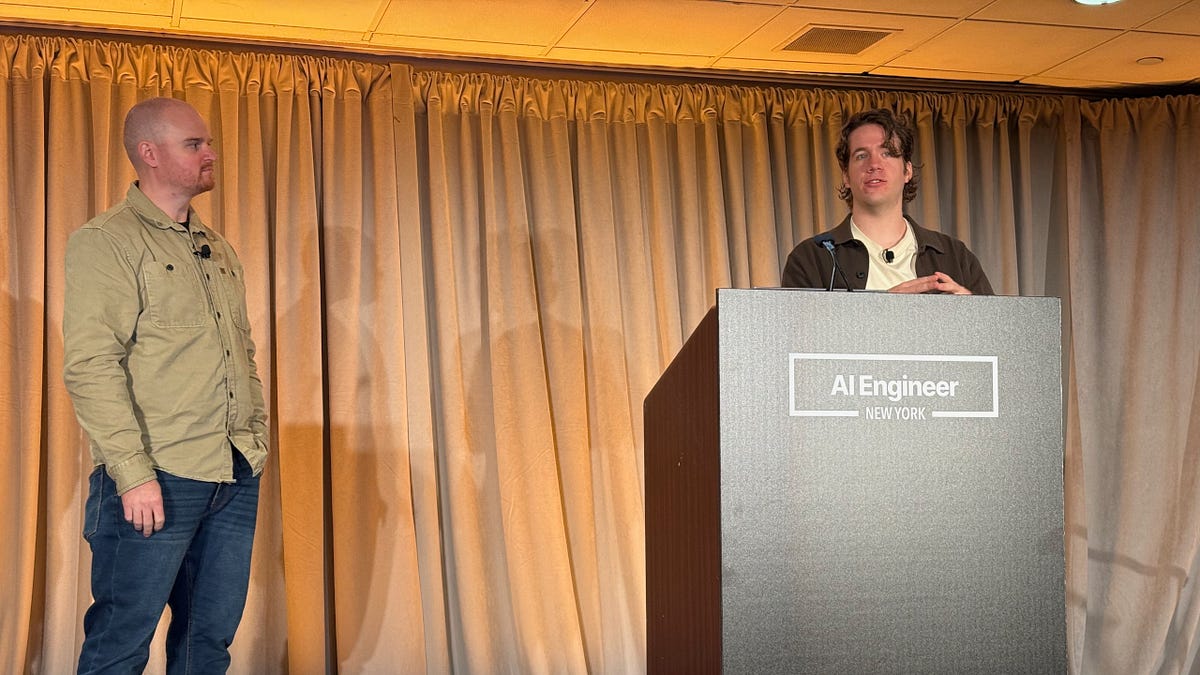
Anthropic presenters (CJ Avilla and Harrison Stall) described flows as a feature announced the Friday before the workshop. In a flow, the lead Claude agent picks its own multi-agent topology. The idea grew out of the "a harness for every task" concept in Claude Code. Flows are meant to run longer than a single agent or a fixed roster, and are pitched as "a way to throw test-time compute at hard problems." In a watchlist-scanner comparison, Avilla said flows cost "much more" than a single agent but were "much more effective at finding all of the details." No figures were given for either cost or effectiveness.
How it works
- The lead agent writes a plan.
- Claude writes an orchestration program from that plan. The program launches agents, collects their results and routes information between phases.
- You can still pass pre-configured specialist subagents in the agent config. Claude does not have to invent every role.
The demo was a stock watchlist scanner. A scan phase gave each ticker to its own agent, each with an isolated context. A review phase then examined the combined findings and produced a report.
flowchart LR
  L[Lead agent writes orchestration program] --> A1[Ticker agent]
  L --> A2[Ticker agent]
  L --> A3[Ticker agent]
  A1 --> FS[(Shared filesystem)]
  A2 --> FS
  A3 --> FS
  A1 --> R[Review phase]
  A2 --> R
  A3 --> R
  R --> Rep[Report]
How to use it
These points come from the Q&A and decide how you would configure a flow:
- Parallelism. The number of agents is governed by "evals and lower defaults." Ambitious tasks generally need you to explicitly ask for more parallelization. Don't expect wide fan-out by default.
- Budget. The model does not know its budget while it runs. Set a session budget yourself. Anthropic chose not to tell the model its budget, saying it could make agents "a little bit anxious."
- Inter-agent communication. Subagents share a filesystem and can exchange data through it. The API offers no way to tell one subagent to message another.
- Observability. The Claude Console graph view shows the payload the lead agent passed to each subagent, for every transition.
- Reducing repeat cost. You can ask Claude to review the costs it incurred, or use dreaming. Dreaming reads an existing memory store plus past session transcripts and writes a reorganized store: duplicates merged, stale or contradicted entries replaced, new insights surfaced.
Limits
- No self-improvement. A flow cannot revise itself between runs, for example by swapping out an inadequate scanning approach before the next scheduled run. The presenters suggested hill-climbing and dreaming as manual workarounds.
- Dreaming is a research preview.
- Cost. Flows cost substantially more than a single agent. The only comparison given was qualitative.
- Unproven at scale. The only demonstrated workload was the simple watchlist scan. Stall declined to give specifics on large scientific workloads.
- Source type. This is a conference report, not documentation. It gives no API shapes, config syntax or pricing.
Organisations named here
- Anthropic
- Union.ai
- OpenAI
- AI Engineer New York 2026
- Latent Space
- AWS Marketplace
- CJ Avilla
- Claude Code
- Harrison Stall
Technologies named here
- Dynamic workflows
- Claude
- Claude Managed Agents
- Claude Console
- Claude Code
- Dreaming
- Union.ai
Techniques named here
- Dynamic workflows / multi-agent orchestration
- Dreaming
- Hill-climbing
- Test-time compute via flows
Related in agents

