 latent.spacearticle
Building AI for Reliable Execution: Lessons From Industrial Robotics
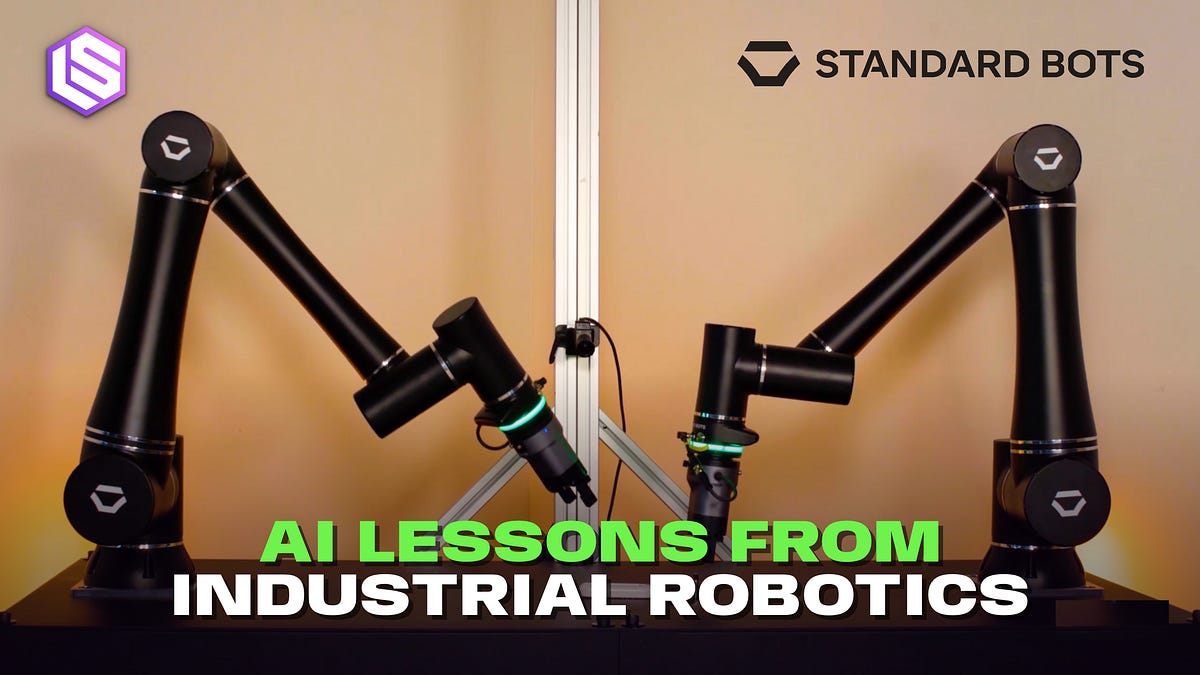
Latent Space interviews Standard Bots' CEO Evan Beard and Head of AI Leif Jentoft about the AI stack behind its industrial robot arms. A shared base model (low billions of parameters) is adapted per customer through demonstrations and fine-tuning. A zero-shot perception model, whose backbone is trained on over a billion images, handles machine tending, while conventional code handles motion and cell logic. Inference runs on-premises on edge GPUs that stream action chunks to low-level control. Failures and human corrections feed fleet learning except in air-gapped defense deployments, and the StandardOS APIs/SDKs let developers bring their own models such as NVIDIA Cosmos. The lesson is to keep the model's role narrow and use targeted, high-quality data to fix edge cases instead of chasing dataset size.
What it claims
Standard Bots' position is that industrial manipulation works when the learned model has a narrow job, the tasks are short-horizon, and edge cases are fixed with small amounts of targeted in-situ data rather than more data overall. Jentoft's concrete claim is that in-situ interventions "can fix an edge case with a few dozen examples." The company also argues that "no model today is truly hardware-agnostic." Because it builds the arm, end effector, control system and AI, it says it can co-optimize low-level control with higher-level policies. The article notes that Skild, which is pursuing cross-hardware generalization, would dispute this.
How it works
- Task scope: Tasks are deliberately short-horizon so they meet production cycle-time and reliability requirements. Any part of a workflow that doesn't need learned behavior is programmed conventionally.
- Training vs inference: Training runs in the cloud. Inference stays on-prem because most factories and warehouses lack reliable internet, and uptime decides whether customers accept the system.
- Sensing path: Wrist cameras and other sensors send raw pixels and signals over internal gigabit Ethernet to edge GPUs. The GPUs produce action chunks that stream to low-level control.
- Data sources: Simulation is used where possible, plus real demonstrations recorded with a handheld touch teaching device, plus failure signals and human corrections captured in production.
flowchart LR
  D[Deployed robot] --> F[Failures + human corrections]
  F --> Q{Air-gapped?}
  Q -- yes --> X[Data stays on site]
  Q -- no --> C[Cloud fleet training]
  C --> D
How to use it
StandardOS provides APIs and SDKs. Developers can use whichever parts of the stack they need, including their own models; NVIDIA Cosmos is the example given. The page does not show endpoints, SDK names, languages or pricing.
Limits
- Simulation gaps: Tasks involving liquids, suction or cutting flexible material are hard to reproduce in current simulators, so they depend on real-world data.
- Bring-your-own-model integration: Today this means writing your own integration code. Easier data collection, training and deployment are only planned.
- Air-gapped deployments: Many defense customers run air-gapped, and nothing flows back from those sites, so they get no fleet-learning benefit.
- Missing evidence: No benchmarks, success rates or cycle-time figures are given. The "few dozen examples" claim and the hardware-agnostic claim are company assertions in an interview, not measured results.
- Missing model details: Model details stop at "low billions of parameters" and a perception backbone trained on more than a billion images. No architecture, training data composition or weights are disclosed.
Organisations named here
- Standard Bots
- General Catalyst
- RoboStrategy
- NASA
- Amazon
- Lockheed Martin
- Figure
- 1X
- Applied Intuition
- Skild
- NVIDIA
- Latent Space
- Diogo Almeida
- Evan Beard
- Jev
- Leif Jentoft
Technologies named here
- Standard Bots shared base model
- StandardOS
- NVIDIA Cosmos
- edge GPUs
Techniques named here
- Fine-tuning and demonstration-based adaptation
- Hybrid learned and conventional programming
- On-premise edge inference with action chunks
- Fleet learning
- In-situ interventions
- Hardware–model co-optimization
- Teaching by handheld touch device demonstrations
Related in multimodal
 latent.spacearticle
[AINews] Pi 1.0, Pi Durable, and AIE NYC
 github.comrepo
Show HN: Made an open-source Lego AI generator


 simonwillison.nettool