 almostimplemented.github.iowriteup
Learning Jazz Pianist Style with Cross-Attention Conditioning
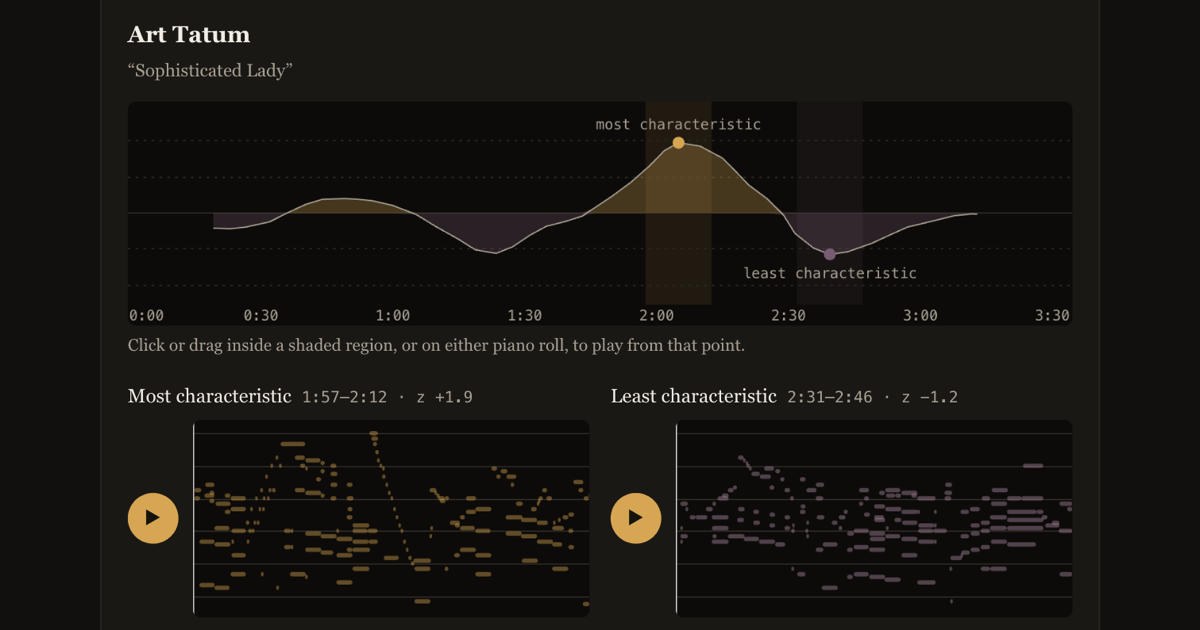
An ISMIR 2026 (Abu Dhabi) research project that fine-tunes Aria, a transformer pretrained on piano MIDI, on solo recordings from twelve jazz pianists in the PiJAMA dataset, adding a gated cross-attention layer that conditions generation on a learned per-pianist embedding. Because standard held-out perplexity is nearly blind to style (the next note is predictable regardless of pianist), the authors instead measure style transfer by sliding a pianist classifier over freely generated continuations: conditioned continuations are attributed to the intended pianist 70% of the time versus 37% unconditioned, and a classifier trained only on generated music identifies real recordings with 95% accuracy. The page is an interactive demo with audio examples, blindfold listening tests, and per-pianist results (e.g. 96% attribution for Hank Jones/Dick Hyman vs 29% for Cedar Walton), alongside a link to the full paper with ablations on mismatch conditioning and memorization checks.
What it claims
Fine-tuning Aria with a per-pianist cross-attention conditioning path makes freely generated piano continuations stay in a target jazz pianist's style. A sliding pianist classifier attributes conditioned continuations to the intended pianist 70% of the time, against 37% for the same model fine-tuned without conditioning. Chance is 8%. Held-out perplexity barely separates the two models, so the authors argue perplexity is the wrong yardstick for style.
How it works
- Base model: Aria (Bradshaw et al., ISMIR 2025), a 16-layer transformer pretrained on a large piano-MIDI corpus.
- Conditioning block: a cross-attention block is inserted into each of the last eight layers. The music attends to a learned embedding of four vectors per pianist.
- Gate: a learned gate scales each block's contribution. It is initialised at 0.1, so fine-tuning starts close to Aria's original behaviour and learns how much weight to give the embedding.
- Why cross-attention instead of a prompt prefix: the embedding is attended to at every step, so the conditioning does not fade over long generations the way a prefix does.
- Data: solo performances by 12 of the 30 pianists in PiJAMA. The recordings are automatic MIDI transcriptions of commercial recordings.
Evidence
- Generation setting: continuations are 4,096 tokens generated from 256-token prompts.
- Agreement metric: the classifier is applied in sliding windows of about 300 notes. Agreement is the share of windows attributed to the intended pianist.
- Headline result: agreement is 70% conditioned vs 37% unconditioned, while perplexity is nearly unchanged between the two.
- Evaluation classifier: 98.8% accuracy on held-out songs.
- Transfer check: a classifier trained only on generated music identifies real recordings with 95% accuracy. A from-scratch classifier, described in the paper, confirms this result.
- Memorization: continuations resemble their closest training performance less than real held-out performances do.
- Per-pianist spread: Hank Jones and Dick Hyman reach 96% agreement, Cedar Walton 29%.
- Not on this page: the paper covers further results, including the mismatch experiment (prompt from one pianist, conditioning on another).
Limits
- Pianist selection inflates results. The 12 pianists were picked as the ones a pretrained model already separates most easily out of PiJAMA's 30. Expect lower numbers on less distinctive players.
- The demo is cherry-picked. Each pianist's two scored takes are the best of eight candidates. The page reports how the remaining six did beneath them.
- Prompts come from training data. The memorization check addresses copying, but the prompts themselves are training recordings.
- Style is judged by a classifier, not by people. No human listening study was run; the authors name it as the next step. The classifier also has a known bias: many of its errors on generated music land on Dick Hyman, which may flatter Hyman's 96%.
- Input quality is limited. Training data are automatic transcriptions, so dynamics and pedalling are approximate.
- Output is MIDI only. Audio on the demo is a plain sampled-piano rendering in the browser.
- No adoption details. The page gives no code, weights, licence or compute figures for this work. It links only Aria's code and the paper.
Organisations named here
- International Society for Music Information Retrieval
- Art Tatum
- Cedar Walton
- Dick Hyman
- Erroll Garner
- Hank Jones
- ISMIR 2025
- ISMIR 2026
- Oscar Peterson
- PiJAMA
Technologies named here
- Aria
- MIDI
- Transformer
Techniques named here
- Gated cross-attention pianist conditioning
- Sliding pianist-classifier evaluation
- Mismatch experiment
- Synthetic-only classifier transfer check
Also named here
- Bradshaw et al.
Related in multimodal

 latent.spacearticle
[AINews] Pi 1.0, Pi Durable, and AIE NYC
 github.comrepo
Show HN: Made an open-source Lego AI generator


 simonwillison.nettool