 interconnects.aiarticle
Introducing our Artifacts Hub and Adoption Dashboard
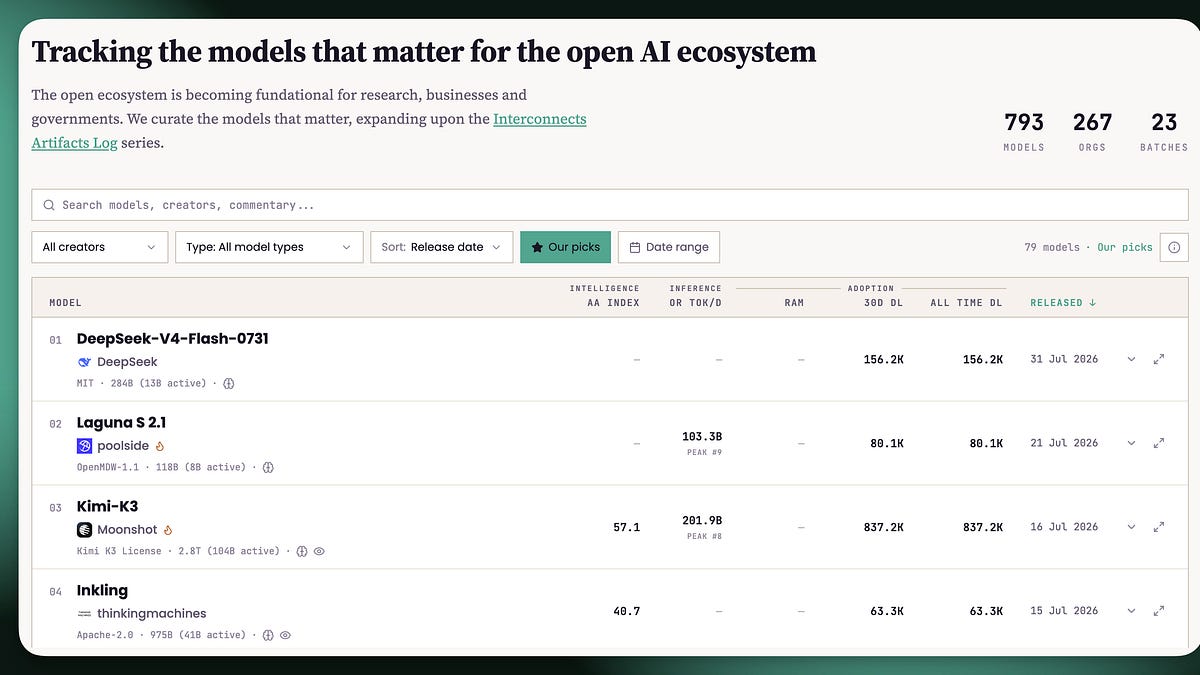
Interconnects announces two new free, continuously-updated resources for tracking the open-weights model ecosystem: the Artifacts Hub, which curates ~792 trending Hugging Face models with inference-token data from OpenRouter, intelligence scores from Artificial Analysis's Intelligence Index, and Interconnects' own relative adoption metric (RAM) and VAIL similarity index; and the Adoption Dashboard, a daily-updating view of download/derivative-model counts by geography and organization highlighting the US-China open-model gap. Both build on prior work from The ATOM Project and Interconnects' Artifacts Log round-ups, developed in collaboration with AI verification startup Project VAIL.
What it claims
Interconnects has launched two free, continuously updated data products on open-weights models. The Artifacts Hub covers 792 hand-selected models released in the last two years, spanning text-focused language models and multimodal generative models. The Adoption Dashboard updates daily with download and derivative-model counts by geography and organization. It replaces the US-vs-China adoption plot from The ATOM Project, which the authors say they only refreshed occasionally.
How it works
The 792 models are chosen in three stages:
- Interconnects tracks data for every model on Hugging Face.
- It analyzes a "core few thousand" LLMs. This list is public on GitHub and regularly updated, though the page does not give the link.
- It hand-selects a few hundred of those for the Hub.
For each model, the Hub combines:
- Artificial Analysis Intelligence Index: shows how far behind frontier intelligence the model was.
- Hugging Face and OpenRouter adoption: downloads and inference tokens, compared with similar models.
- Relative adoption metric (RAM): downloads normalized for model size and time since release. The authors present it as part of a method for judging adoption of large MoE models, where raw download counts mislead.
- VAIL similarity index: compares a model with models from related generations.
The page shows GLM-5.2 as an example entry.
How to use it
- Need a maintained, curated list of significant LLMs? The public GitHub list of the core few thousand LLMs is the most reusable piece. It is broader than the Hub's 792.
- Need raw download comparisons? Use RAM rather than raw counts when comparing models of different sizes or release dates.
- Want the curated data for your own product or research? The authors invite this at mail@interconnects.ai. The page names no API, export format or licence, so access terms come from that contact.
Limits
- Hand-picked coverage. The Hub is curated, not exhaustive, and the page gives no inclusion criteria beyond "the open models that matter."
- RAM is underspecified. It is described only as "time-size normalized downloads." No formula, baseline or validation is given.
- Unexplained metrics. The VAIL similarity index is not explained.
- Inherited bias. All scores come from third-party sources: Hugging Face, OpenRouter and Artificial Analysis. They carry those sources' coverage gaps. For example, models not served on OpenRouter will have no inference-token data.
- Funding. The Hub was built with support from Project VAIL, an AI verification startup that also supplies one of the metrics.
Organisations named here
- Hugging Face
- OpenRouter
- Artificial Analysis
- Project VAIL
- Interconnects
- DeepSeek-R1
- The ATOM Project
Technologies named here
- Kimi K3
- Artifacts Hub
- GLM-5.2
- Adoption Dashboard
- Artifacts Log
- DeepSeek R1
- Hugging Face
- OpenRouter
Techniques named here
- Relative Adoption Metric
- VAIL similarity index
- Intelligence Index
Related in models