 decrypt.coarticle
This AI Is Already Fooling People on Video Calls Into Thinking Its Human, Company Says
Decrypt reports on Tavus' Griffin, a "Human Interaction Model" built for real-time, full-duplex face-to-face video conversation (listening, watching and talking simultaneously rather than turn-by-turn). On Tavus' own unverified test, Griffin-Lite convinced 48% of 54 participants on a one-minute video call that they were talking to a human, versus 2.4% for Tavus' prior stitched three-model system, and it ranks first on NVIDIA's VideoFDB benchmark with a 3.83/5 generation score (vs. 2.80 for the next-best system and 3.92 for a human reference) and an average audio-to-video delay of 0.43s on H100 GPUs. The article notes the test isn't a classic Turing test, isn't independently verified, and contrasts it with a UC San Diego study where GPT-4.5 passed as human in text conversation 73% of the time, while flagging real-world misuse risk from deepfake video-call scams (e.g., BlueNoroff/Lazarus Group).
What it claims
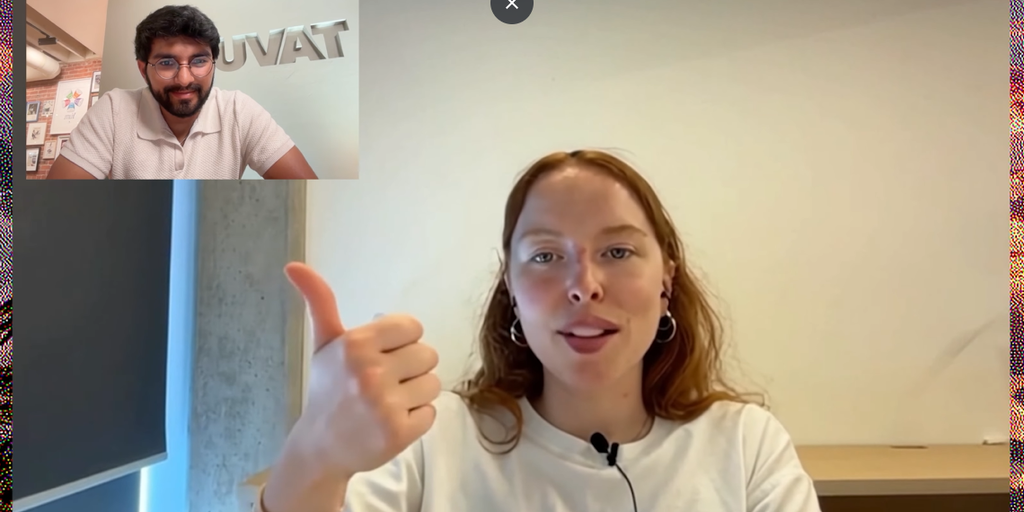
Tavus' Griffin is pitched as a "Human Interaction Model" for live face-to-face video conversation. It reads expressions and pauses as well as words, and it is full-duplex: it listens, watches and talks at the same time. The tested variant, Griffin-Lite, led 26 of 54 participants (48%) to believe they had talked to a real person after a one-minute call. Tavus' previous system convinced 1 of 41 (2.4%). Griffin-Lite also ranks first on NVIDIA's VideoFDB benchmark for live audio-video conversation.
How it works
The page gives almost no architecture. It only contrasts Griffin with the earlier system, which stitched together three separate models: one for visuals, one for dialogue and one for perception. Griffin is presented as a single interaction model in place of that pipeline. A Tavus demo shows it coaching a user through a Rubik's cube based on what it sees in his hands, and waiting when he goes quiet to think.
Evidence
- Human-belief test: Participants were recruited through what Tavus calls an independent research platform. They were told they would be matched with another person for a one-minute video call about what they were looking forward to this year. Only at the end were they asked whether it had crossed their mind that their partner might not be real. People who grew suspicious usually did so within 20 seconds.
- VideoFDB generation track (how natural and expressive the responses are): Griffin-Lite scored 3.83/5, the next-best system 2.80 and the human reference 3.92.
- VideoFDB perception track (whether the model understands what it sees and hears): Griffin-Lite scored 3.73, the strongest baseline 3.44 and the human reference 4.20. This track shows the largest remaining gap to humans.
- Tavus says NVIDIA ran the VideoFDB evaluation independently.
- Latency: Average audio-to-video delay is 0.43s on NVIDIA H100s, which Tavus says is half that of the next fastest method.
How to use it
You can't use it in production yet. Griffin-Lite is a research preview limited to select trusted testers, and it is not available to customers. Testers can request access through a form on the Tavus site. When Decrypt tried Tavus' generally available models, it found the results "disappointing", which suggests the reported quality does not carry over to what customers can use today. Tavus says it is working on disclosure features and with AI safety organizations before any public release.
Limits
- Not a Turing test. Participants were primed to expect a human and were never told a bot might be present. The 48% therefore measures failure to suspect, not the ability to tell a human from a bot when asked to.
- Unverified. All human-belief results come from Tavus' own research page. A community note on X flags that they are not independently verified and do not follow a standard protocol.
- Small and short. The samples are 54 and 41 people, each on a single one-minute call on a fixed topic. Longer or adversarial conversations were not tested. That matters because suspicion arose within about 20 seconds when it arose at all.
- Below human perception. Perception still trails the human reference by about 0.5 points on VideoFDB.
- Lite variant only. Every number is for Griffin-Lite. The page gives no results for the full Griffin.
- Misuse context. The article ties the capability to deepfake video-call intrusions attributed to BlueNoroff, a Lazarus Group subsidiary. It also cites spontaneous off-script questions, such as asking for government ID or the names of local restaurants, as a defense one company used against a suspected impostor.
Organisations named here
- Tavus
- NVIDIA
- UC San Diego
- OpenAI
- CRV
- Kraken
- Lazarus Group
- BlueNoroff
- Gonka
- Alan Turing
- David Liberman
- VideoFDB
Technologies named here
- Griffin
- Griffin-Lite
- Tavus' previous system
- GPT-4.5
- NVIDIA H100
Techniques named here
- Turing test
- Full-duplex interaction
Related in multimodal

 latent.spacearticle
[AINews] Pi 1.0, Pi Durable, and AIE NYC
 github.comrepo
Show HN: Made an open-source Lego AI generator


 simonwillison.nettool