 parsimony.lasu.devtool
Show HN: Parsimony – an open-source benchmark for how much code AI models add
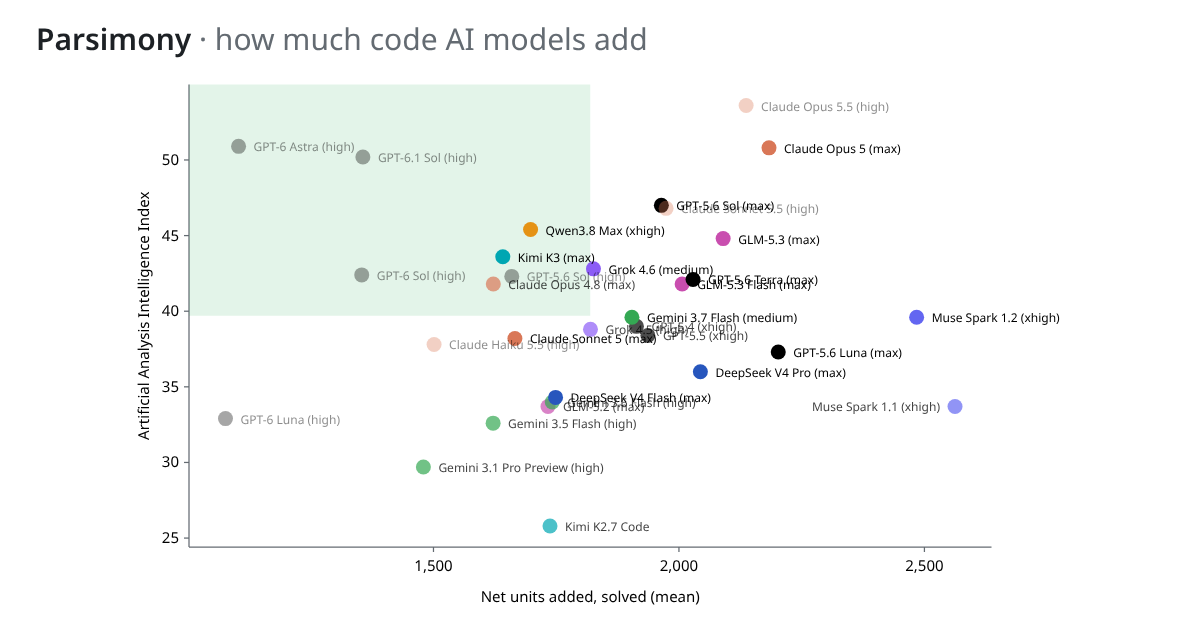
Parsimony is an open-source benchmark that ranks AI coding models by how much code their patches add. It parses the patches already published by benchmarks such as SWE-bench Verified, counts syntax-level "coding units" (statements, calls, comparisons, names, literals) rather than lines, and subtracts deleted code to get net units. It adds a leaderboard, an Artificial Analysis Intelligence Index overlay, the author's own DeepSWE runs, and a way to upload your own results. It matters because existing benchmarks score solve rate and cost but not code bloat, which makes codebases harder to maintain. The page states its limits: it measures size, not quality, and more verbose models tend to solve more tasks.
What it claims
Parsimony ranks AI coding models by mean net coding units added on the tasks they solved, lowest first. Net units = added − removed, where a unit is a syntax element (statement, call, comparison, name, literal), not a line. Packing code onto fewer lines therefore earns nothing. The page's example scores a 6-line loop that sets a flag above the one-line return any(value < 0 for value in values), though both return the same result.
How it works
- Take the patches a benchmark has already published. The main boards use SWE-bench Verified.
- Apply each patch to the task's code, then parse both versions of every changed file. Nothing is executed.
- Exclude tests, docs and generated files. Only Python is measured.
- Take pass/fail from SWE-bench's published results. Tests are not rerun.
Columns to read carefully:
- Rank metric: mean net units on solved tasks only.
- "Net units added (mean)": also includes failed attempts.
- "Measured": how many solved attempts could actually be parsed.
- Artificial Analysis Intelligence Index overlay: matched by model and reasoning effort. It does not affect rank.
Evidence
- Size correlates with solving. On boards with 26+ models, models that write more code also solve more tasks (Spearman 0.33–0.60). A low rank partly reflects lower capability, not only concision.
- The harness changes the count. The author's own runs are shown faded. They cover the first 3–10 DeepSWE Python tasks, with OpenAI models run through pi and Anthropic models through Claude Code, graded with each task's own tests. These runs are unverified and unranked. GPT-5.6 Sol was run both ways, and the author's run added 0.88× the code of its published run.
How to use it
To chart your own code-size numbers from another benchmark, download the example file from the page, fill in your results and open it in the page. You get the same chart and table. Processing is client-side ("the file stays in your browser"). The page links a format spec and sharing instructions, but the fetched text does not reproduce them.
Limits
- Units measure size, not readability or design. Smaller isn't always better.
- Python only. Test, doc and generated-file changes are not counted.
- Solve status is inherited from SWE-bench, not re-verified.
- All ranked models use the same agent, mini-SWE-agent. The page notes the agent still affects how much code gets written, so results may not transfer to Claude Code, pi or your own harness.
- The DeepSWE runs cover only 3–10 tasks each. Treat them as anecdotal.
- Some solved attempts may not be measurable. Check the "Measured" count before comparing models.
- The fetched text gives no source licence, repository link or install command, despite the "open-source" label.
Organisations named here
- OpenAI
- Anthropic
- Artificial Analysis
- Claude Code
- DeepSWE
- SWE-bench Verified
Technologies named here
- Parsimony
- GPT-5.6 Sol
- mini-SWE-agent
- pi
- Claude Code
- Artificial Analysis Intelligence Index
- Python
Techniques named here
- Coding-unit counting
Related in evals




