 x.comthread
rohonchain
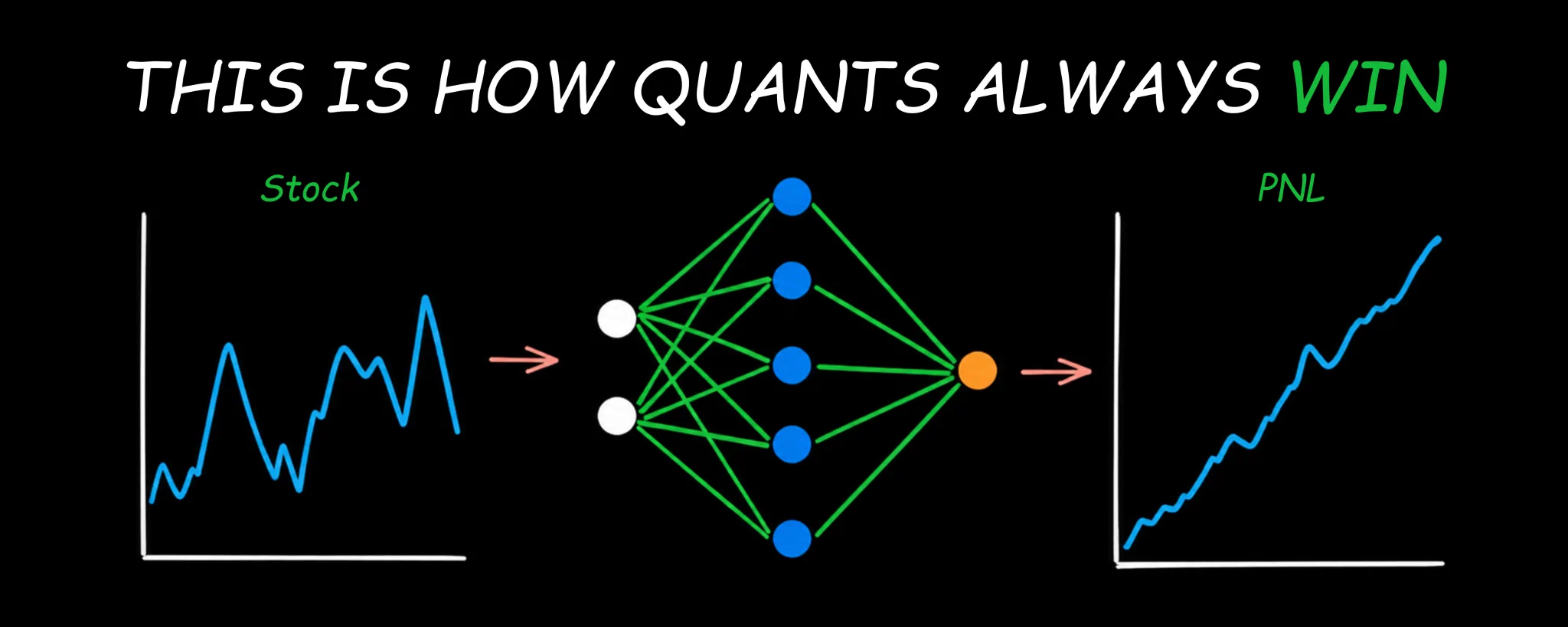
A detailed X thread walking through applying neural networks (specifically LSTMs) to quantitative trading signal generation, with full PyTorch implementation code. It covers why raw price prediction fails due to non-stationarity, how to engineer stationary features (log returns, volatility ratios, momentum, volume z-scores) validated via Augmented Dickey-Fuller tests, LSTM gating mechanics for sequential market data, rigorous train/validation/test splitting with early stopping, walk-forward validation, and Kelly-criterion position sizing.
What it claims
An X thread ("Roan"/rohonchain) that goes beyond the concepts the summary lists to give the concrete operating parameters and expected performance for an LSTM trading-signal pipeline. The framing insight it hammers: a network trained under MSE learns the conditional expectation E[Y|X], not a point prediction — the die-roll analogy is that it will output 3.5, a value the die can never land on. This is why price prediction fails: E[Y|X] is only meaningful if P(Y|X) is stationary, and price series are not.
Evidence and concrete numbers the summary omits
- Expected performance ceiling: a well-built model gets 52–57% directional accuracy; the thread's worked example is 54% with Sharpe > 1.0. It explicitly frames the edge as coming from consistency and scale, not signal magnitude — useful for setting expectations before you build.
- Target design: predict next-period direction (binary) or z-scored return, not raw price/return.
- LSTM hyperparameters given:
hidden_size=64,num_layers=2,dropout=0.2, output via sigmoid; lookback 10–20 trading days for daily, 24 periods (≈2 hours) for 5-min bars. - Training specifics: Adam,
BCELoss,ReduceLROnPlateau(patience 5, factor 0.5), early-stopping patience 10, and gradient clippingmax_norm=1.0(called out specifically to stop LSTM gradient explosion on long sequences). - Sizing rule: Kelly
f* = (p·b − q)/b, but use half Kelly for estimation error and never risk >2% of capital on one signal regardless of Kelly. - Drift monitoring (not in summary): track the Kolmogorov–Smirnov statistic between live and validation prediction distributions; retrain when KS > 0.1. Baseline for crypto/prediction markets: rolling 90-day training window, walk-forward re-eval every 30 days.
- Data sources named:
yfinancefor learning, Polygon.io for institutional tick/OHLCV.
Limits
- It is a marketing thread, not validated research. The hedge-fund claims (Two Sigma "10,000 signals," Renaissance "66% annually over 30 years," quant comp "$350k–650k") are unsourced motivation, not evidence about this specific code.
- The provided code is illustrative and incomplete:
walk_forward_validationhas a literal# train model heregap, andprepare_datamixes lookback-offset indexing in a way you must verify before trusting the split boundaries. - No backtest results, transaction costs, or slippage are shown — the 54%/Sharsteps>1.0 figures are stated targets, not a reproduced run. The thread ends on an engagement prompt ("drop your answer in the comments"), reinforcing that this is content marketing.
Worth reading for the hyperparameter defaults, the KS-drift retraining rule, and the Kelly/2%-cap discipline; do not treat the numbers as validated.
Organisations named here
- Two Sigma
- Citadel
- Renaissance Technologies
- Medallion Fund
Technologies named here
- Python
- PyTorch
- statsmodels
- yfinance
- Polygon.io
- scikit-learn
Techniques named here
- Stochastic gradient descent
- Universal approximation
- Stationarity feature engineering
- Recurrent Neural Network
- LSTM
- Early stopping
- Sequential train/validation/test split
- Walk-forward validation
- Gradient clipping
- Kelly criterion position sizing
- Kolmogorov-Smirnov drift monitoring
Related in training



