 twitter.comthread
Last night an AI agent performed brain surgery on a mouse
A thread by Gabriel Ocana-Santero describing an AI agent that chose a gene therapy vector, brain region and stereotaxic coordinates, then injected 250 nL into a mouse epilepsy model through a custom Arduino surgery rig. A licensed vet gated irreversible steps with fixed validators, hash-bound approval and a physical kill switch. Opus 5.5 refused on detecting biology, while Opus 5 completed a dry run and stopped before live surgery. The technical report is still to come.
What it claims
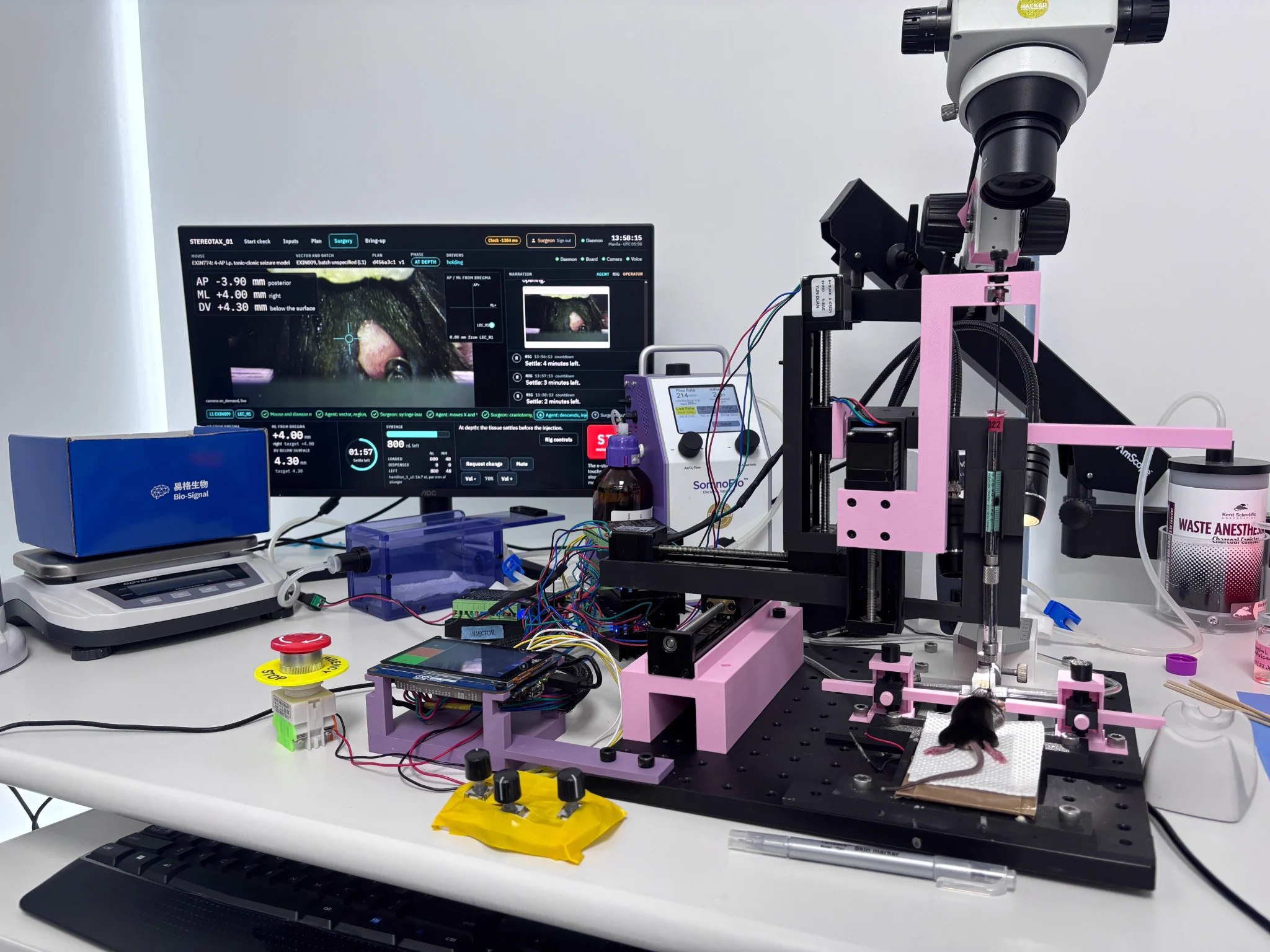
Gabriel Ocana-Santero describes an AI agent given a spreadsheet of 19 gene therapy vectors, a mouse epilepsy model, a motorized surgery rig with cameras, and one goal: reduce seizures. The agent chose the vector and the brain region. It derived stereotaxic coordinates from three papers, drove the arms into the brain and injected 250 nL. Ocana-Santero's point is that existing autonomous surgical robots execute operations a human chose, while this agent decided what to give and where.
How it works
- Therapy choice. The agent worked through the seizure mechanism in this model. It then proposed a therapy that increases GABA signalling, with a promoter restricting expression to GABAergic cells.
- Rig. The rig is custom-built on Arduino. Camera and motor functions are exposed to the agent through the lab's own interfaces, which are not described yet.
- Vision. The agent pulls camera frames whenever it wants and made 32 observations in the session. It watched the entry site for bleeding during injection.
- Division of labour. A human surgeon performed the craniotomy. The agent is not yet allowed to do that step, for safety reasons.
- Safety gates. A human approves every irreversible step. Fixed validators enforce hard limits, such as maximum injected volume. Approvals are hash-bound. A physical e-stop held by the vet cuts power to every motor.
Evidence
The thread reports one surgery on one mouse. It gives no seizure outcome, histology or survival data, so the only evidence is that the procedure was completed.
On model choice, Opus 5.5 refused as soon as it detected biology. Opus 5 ran the full dry run on water and graph paper, then stopped at the start of live surgery. It said: "The block isn't the rig and isn't the inputs. It's me." The thread does not say clearly which model performed the live surgery. It also teases a moment when the agent "refused to let me override it", but that post is truncated.
Limits
The author says the thread was written on the spot after 18 hours of work and promises a technical report later. Most posts in the captured page are cut off at "Show more", including the reasoning, observations, safety and conclusions sections. The interface code, validator thresholds, the vector chosen, the brain region and the coordinates are not given. The author says commercial surgical robots are better at the mechanics than this bench rig.
Technologies named here
- Opus 5.5
- Opus 5
- Claude Opus 5.5
- Arduino
Concepts named here
- Autonomous experimental decision-making
- Fixed validators
- Gabriel Ocana-Santero
- Hash-bound approval
- Human-in-the-loop gating
- Lab-in-the-loop
- Physical emergency stop
Related in agents

