 latent.spacearticle
Can Skills Learned in Games Transfer to Real-World Work?
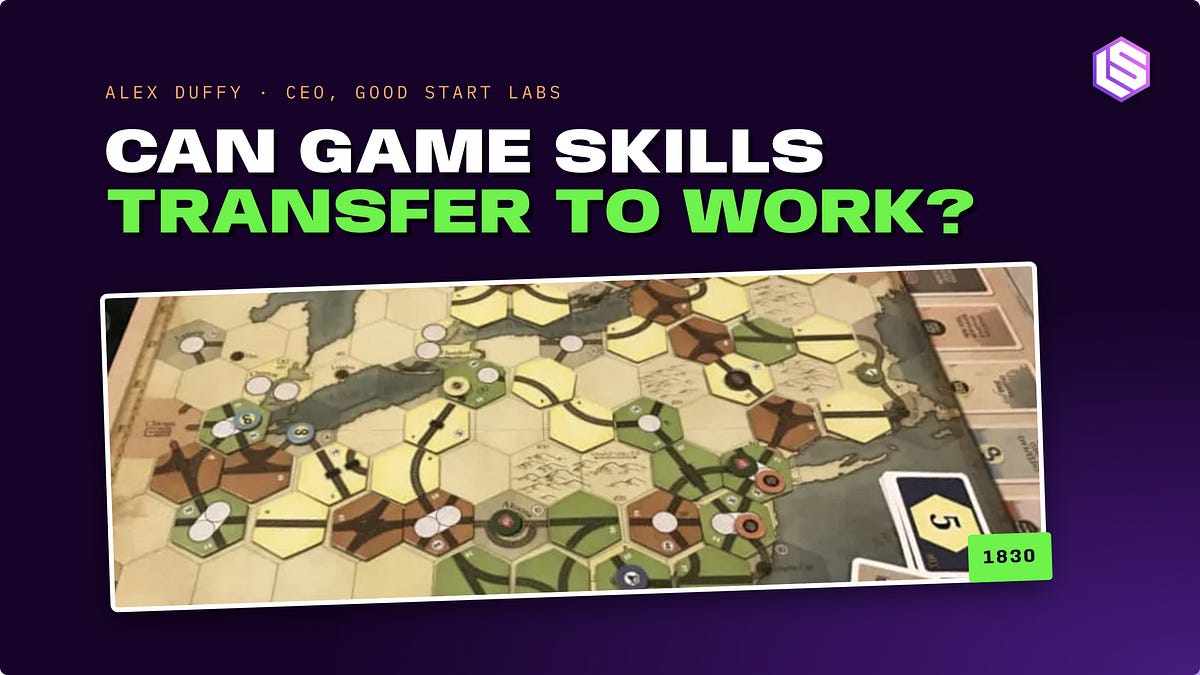
Interview with Good Start Labs co-founder Alex Duffy on training LLMs inside games like Diplomacy and 1830: The Game of Railroads and Robber Barons as reinforcement-learning environments with verifiable rewards. The company found that a multi-turn terminal-agent harness playing 1830 improved performance on the Finance-Agent benchmark, while single-turn Q&A training did not, suggesting that harness design — not just the game itself — determines whether in-game skills transfer to real-world agentic tasks like financial research and customer support.
What it claims
Good Start Labs trained a 30B model inside the board game 1830: The Game of Railroads and Robber Barons under two harness designs. Both designs improved their in-game objectives, but only the multi-turn terminal-agent design improved the Finance-Agent benchmark. The page reports no scores, deltas or baselines for either result. Duffy separately reports that fine-tuning on Diplomacy improved customer support and industrial operations benchmarks, and that "every environment we've built also improves tool use downstream." Neither claim comes with numbers.
How it works
The 1830 tasks are built to mirror a finance workflow:
- The model queries a database of past games.
- It writes the findings into an Excel file.
- It builds functions in that file and reasons over the data.
- It calculates the answer from those functions.
The game engine supplies the verifiable reward.
flowchart LR
  G[1830 game engine<br/>verifiable reward] --> A[Single-turn Q&A:<br/>state → next move]
  G --> B[Multi-turn terminal agent:<br/>tools, plan, adapt]
  A --> I[In-game gains]
  B --> I
  B --> F[Finance-Agent gains]
  A -.-x F
Two other levers are mentioned:
- Denser rewards. An expert model can provide stepwise rewards instead of a single sparse outcome reward.
- Presentation modality. Duffy says the same game shown as images, as natural text or as Python teaches different things.
COS-PLAY is a paper co-authored by Duffy and Marques with university researchers. In it, a decision agent acts with the help of a "learnable skill bank." A separate skill-bank agent reviews each trajectory and edits the bank, and the updated bank feeds into the next run.
Duffy argues that more capable models make the harness more important, not less. Their example is GPT-6 Astra, which "reports doing less chain-of-thought and jumps to answers." In their view, the harness is what forces a model to work a particular way, for example by computing with code rather than "in its head," so the result can be trusted.
How to use it
No code, weights or commands are released. Good Start Labs sells three things, mainly to frontier labs:
- Agent trajectories from game play, each recording what the agent observed, what it decided, the action it took and the outcome.
- Custom data from agents running live in publishers' games, anonymized and stripped of PII.
- Full end-to-end game environments, plus tasks that use the game engine as a reward source for problems other than winning.
The company is also merging its per-game expert models into a general "game intelligence" model. The pointer worth following is the COS-PLAY paper.
Limits
- No quantitative results. The page gives no Finance-Agent numbers, no baseline model, no training compute and no name for the 30B base model.
- Narrow transfer evidence. The 1830 task was deliberately designed to resemble finance work. The interviewer notes it is unclear whether transfer extends further, and Duffy concedes that how broadly and reliably skills transfer "remains an open question."
- Second-hand support. Duffy's broader backing for transfer comes from other sources: a Surge AI article reporting that office-work post-training improved coding, and DeepSeek R1.
- Unscored behavioural claims. Newer frontier models are said to diverge on betrayal, collaboration and theory of mind. That is stated, not measured on the page.
Organisations named here
- Good Start Labs
- Every
- General Catalyst
- Inovia
- OpenAI
- Surge AI
- DeepSeek
- Latent Space
- Wikipedia
- 1830: The Game of Railroads and Robber Barons
- Alex Duffy
- COS-PLAY
- DeepSeek-R1
- Diplomacy
- Finance-Agent
- Noam Brown
- Tyler Marques
Technologies named here
- o3
- Opus 4
- 30B model
- Claude Fable 5.1
- GPT-6 Astra
- DeepSeek R1
- Claude Opus 4.6
- Reinforcement Learning
Techniques named here
- Reinforcement learning environments
- Fine-tuning on game data
- Multi-turn terminal-agent training
- Learnable skill bank
- Environment-as-curriculum harness design
- Expert-model reward shaping
Related in training



