 CISA says max severity GitLab flaw now exploited in the wild
CVE-2026-97229 is a maximum-severity GitLab flaw in the CI/CD Regular Expression Compiler, caused by an integer overflow, that lets unauthenticated attackers run code via a crafted regular expression. CISA added it to the KEV Catalog and ordered federal agencies to patch under BOD 26-04. GitLab fixed it in CE/EE 19.4.2, 19.3.5 and 19.2.8, and Shadowserver tracks about 2,800 exposed CE instances.
 bleepingcomputer.comarticlePublished and added 30 Oct 2026🛡️ Security
 Max-Severity GitLab Vulnerability Exploited Against Alpine Linux
CVE-2026-97229 is a CVSS 10 code execution flaw in Onigmo, Ruby's regular expression engine, reachable through crafted CI/CD configuration in GitLab. Attackers used it against Alpine Linux's GitLab on 20 and 21 October 2026 and failed; Alpine rebuilt the instance and found no tampering with aports or packages. Self-managed installs with their own Ruby need Ruby 3.3.13, 3.4.12 or 4.0.9, not just GitLab 19.3.6. CISA added it to KEV.
 securityweek.comarticlePublished and added 30 Oct 2026🛡️ Security
- Making it easier for websites to express AI training preferences
OpenAI announces it will honor a common robots.txt signal, defined in the IETF draft draft-kelley-aipref-training-preference-signal, that lets site operators state whether content may be used for foundational generative AI training. The signal lets operators set one preference for several participating providers. OpenAI plans to implement it in the coming months, and its existing crawler controls stay in force.
 openai.comarticlePublished and added 30 Oct 2026🧠 AI
- Trail of Bits (@trailofbits) on X
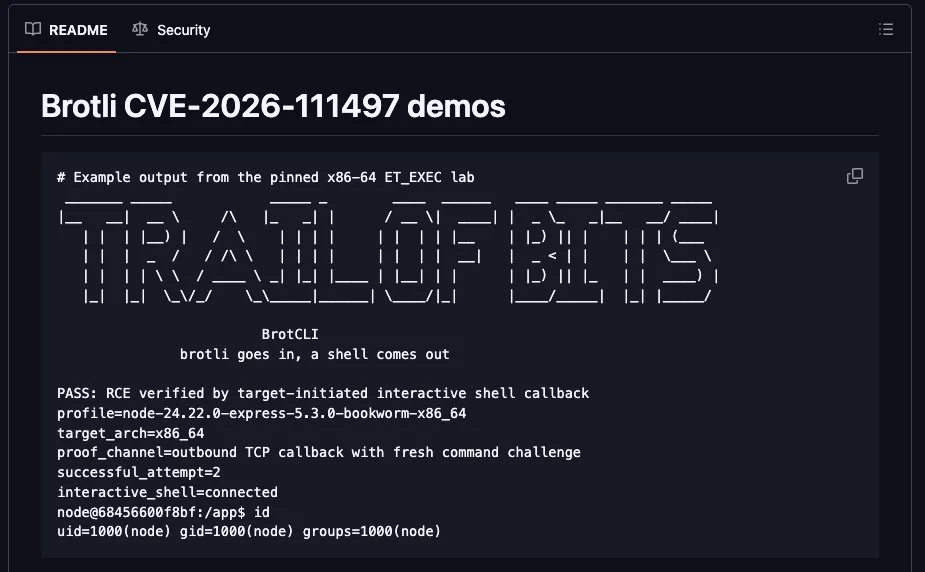
Trail of Bits post says it achieved remote code execution through a Brotli decoder bug in Linux lab setups: Node.js 24.22.0 with Express 5.3.0 via the standard JSON parser (x86-64 and ARM64), and Electron 41.10.7 (x86-64) with a custom decoding service. Exploitation needs a carefully matched setup and repeated attempts. A scanner by ToBScottA finds hidden copies of the decoder, including in stripped binaries.
 x.comthreadAdded 30 Oct 2026, published 28 Oct 2026🛡️ Security
 David Gutierrez | Eng (@david_x_ai) on X
Thread on a critical opencode bug disclosed by Pillar Security on Oct 19. On Windows and WSL, a remote MCP server could run code during OAuth sign-in, because the server-chosen authorization URL was put unescaped into a PowerShell command, so a PowerShell subexpression executed. opencode fixed it in 1.18.33 on Sep 28 as a browser-launch refactor with no advisory or CVE. MCP Inspector published an advisory for the same bug class, and its fix needs a major bump of the open package.
x.comthreadAdded 27 Oct 2026, published 25 Oct 2026🛡️ Security- lee1981 (@lee1981b) on X
CyberForge Weekly CVE Rundown #007 covers six CVEs from 19 to 24 October 2026: SiteGuard command injection (CVE-2026-106931), DB-GPT (CVE-2026-77932), Siemens Software Center DLL side-loading (CVE-2026-110936), Cisco Expressway (CVE-2026-76466), Node.js Brotli (CVE-2026-111497) and Arista VeloCloud (CVE-2026-114625). Each entry gives defender actions, fixed versions, exploitation status and primary-source links. Updated 25 October 2026 with CISA KEV and EPSS findings.
x.comarticleAdded 27 Oct 2026, published 25 Oct 2026🛡️ Security  Node2Shell: Node.js Brotli vulnerability allows remote code execution (CVE-2026-111497)
Node2Shell (CVE-2026-111497) is an out-of-bounds write in the Brotli decoder bundled with Node.js and Bun, triggered by malformed compressed input and rated high by Node.js, with possible remote code execution. Fixed in Node.js 22.23.4, 24.22.1 and 26.12.1 and Bun 1.4.4. The post covers exposure via Express 5, body-parser 2.x, fetch() and node:zlib, stopgaps, and a timeline with public proofs of concept on 22 October 2026.
 aikido.devadvisoryPublished and added 22 Oct 2026🛡️ Security
- Field Notes: Reconstructing an Attacker’s Workflow
Field note from dfir.ch on PowerShell scripts an attacker left on disk during an incident: a file-watching command runner using Invoke-Expression, a fake Windows credential prompt that validates passwords via Start-Process and logs them in cleartext, AD computer enumeration with WMI access testing, and SMB share discovery via NetShareEnum. It notes where script labels overstate what they prove and lists hunting strings for Event IDs 4104, 4103, 4688 and Sysmon 1.
 dfir.chwriteupAdded 24 Oct 2026, published 22 Oct 2026🛡️ Security
 Cisco Patches 34 Vulnerabilities Across Multiple Products
Cisco's October 21, 2026 patch batch fixes 34 vulnerabilities in Expressway Series, IOS XR, Snort 3 and Unified Communications products. The critical Expressway RCE (CVE-2026-76466) lets an attacker reach the database service and run commands as root; it is fixed in X15.5.20. Snort 3 fixes ship in 3.12.4.0 and several Cisco security products. Cisco knows of no exploitation in the wild.
securityweek.comarticlePublished and added 22 Oct 2026🛡️ Security- lee1981 (@lee1981b) on X
CyberForge CVE of the Day #084 analyses CVE-2026-76466, a CVSS 9.8 flaw in clustered Cisco Expressway-C and Expressway-E. Persistent database cookies and weak client-certificate validation allow root OS command execution over the network. The fix is X15.5.20 (X14 and earlier must migrate), with no workaround. It adds a per-peer SOC investigation trail, reachability checks and exposure status from CISA SSVC, KEV and EPSS.
x.comadvisoryAdded 24 Oct 2026, published 22 Oct 2026🛡️ Security  [Draft ERC] Swarm AI Framework — registry and charter model for purpose-bound agent swarms
Ethereum Magicians discussion of a draft ERC, the Swarm AI Framework. It proposes a registry and charter model in which accounts, including autonomous agents, form, bound, run and dissolve purpose-bound swarms. A hashed on-chain SwarmSpec (roles with eligibility modules, phases, decision authorities, fallback timers) is paired with an off-chain Swarm Pack charter. Two-sided signed admission (EIP-712 / ERC-1271), challenge and substitution, and minor versus material amendments are included. Phase posture is a coordinate: executed boundary and admission, plus declared payoff, topology and coordination terms from a write-once vocabulary. This lets cooperation, competition, tenders, debate, ensembles and pipelines be expressed. It integrates with ERC-8004 agent identity and ERC-8436 decision adapters. The reference implementation is a non-upgradeable registry with five eligibility modules and a task-tender adapter. The post asks reviewers specific design questions on vocabulary, amendment classes, roster snapshots and digest kinds.
 ethereum-magicians.orgthreadPublished and added 18 Oct 2026🧠 AI
 Rethinking Routing Exploration in Modern Mixture-of-Experts
The paper identifies an "exploration dilemma" in modern Mixture-of-Experts models. Shared experts reduce the variability of token representations, which makes routing less exploratory. Fine-grained expert segmentation enlarges the combinatorial routing space and so needs more exploration, which means its extra expressiveness may go unrealized. It proposes MirrorMoE, which shrinks the exploration space by suppressing unnecessary experts per token, and reports consistent gains across model scales.
 arxiv.orgpaperAdded 17 Oct 2026, published 15 Oct 2026🧠 AI
 Critical GitLab RCE Lets Unauthenticated Attackers Execute Code on Servers (CVE-2026-97229)
Orca Security analysis of CVE-2026-97229, a CVSS 10.0 flaw in GitLab CE/EE. An integer overflow (CWE-190) in the CI/CD regular expression compiler gives memory corruption and code execution as the git user. It is triggered by a crafted regex in .gitlab-ci.yml combined with a UTF-8 repository path, with no authentication needed on instances that allow public project creation or self-registration. Lists affected branches (19.2 before 19.2.8, 19.3 before 19.3.5, 19.4 before 19.4.2), the absence of a workaround, interim mitigations, and a Rapid7 PoC against GitLab CE 19.4.1 with ASLR on. Notes a prior max-severity GitLab bug (CVE-2026-85706) was probed in the wild within hours and later added to CISA KEV.
 orca.securityadvisoryPublished and added 14 Oct 2026🛡️ Security
- EmoGenie: Benchmarking and Evaluating Expressed and Evoked Emotion in T2I Generation with MLLMs
EmoGenie is a benchmark for emotions expressed and evoked by text-to-image outputs. It has 6,400 images from eight T2I models using 800 emotion-targeted prompts. It includes EmoGenie-QA (90,000 closed-set and 1,057 open-ended questions) and EmoGenie-Assess (13,175 mean opinion scores for valence, arousal, dominance and aesthetic quality). The authors also propose EmoProbe, which pairs emotion QA with response-aligned, dimension-specific regression heads. They report that it beats baselines on emotion QA and correlates better with human ratings. The work shows how reliably MLLMs interpret affect in generated images.
arxiv.orgpaperAdded 14 Oct 2026, published 13 Oct 2026🧠 AI - Claim Framing as a Driver of LLM Sycophancy
Systematic study of which framings of a user's claim trigger sycophancy in factual question answering, where every answer is objectively verifiable. Across 14 models and 42K questions, correct and incorrect user opinions are expressed through 21 framing types in 8 dimensions, and multiple opinion-driven behaviors are measured. All models are susceptible regardless of size; confidence of statement, attribution to whom, and framing as shared between user and model matter most, while expertise, authority and social pressure matter little. Larger models resist incorrect opinions better but are no better at recovering from their own errors, so the authors argue sycophancy evals must probe framing and measure more than a single flip rate.
arxiv.orgpaperAdded 14 Oct 2026, published 13 Oct 2026🧠 AI - lee1981 (@lee1981b) on X
CyberForge "CVE of the Day #076" covers CVE-2026-97229, a CVSS 10.0 integer overflow (CWE-190) in GitLab CE/EE's CI/CD regular expression compiler. It can lead to conditional unauthenticated code execution on the GitLab server. It lists the affected trains (19.2 before 19.2.8, 19.3 before 19.3.5, 19.4 before 19.4.2) and the 19.3.4 vs 19.3.5 Ona-regression discrepancy. It also gives six SOC checks: scoping, log preservation (Workhorse/Rails/Sidekiq, correlation_id), server-effect hunting, request-to-process correlation, upgrade and running-state verification. It notes that exploit details are unverified, no KEV listing exists and EPSS data is unavailable.
x.comadvisoryAdded 15 Oct 2026, published 13 Oct 2026🛡️ Security - Who Verifies the Verifier? Co-Evolving Inspectable Graders with Self-Improving Agents
Proposes making the verifier the evolving object in self-improving agent loops. The verifier is an inspectable expression over small, mostly deterministic drawback detectors, synthesized from clustered failures, gated at birth, and selected for agreement with a ten-item anchored reference set plus consensus over unlabeled outputs, never for the agent's score. On MBPP+ it gains +0.21 held-out agreement over the hand-authored seed and ends ahead of the bare LLM judge it contains. Removing the anchor guards collapses the verifier into an always-pass grader that still trains skills as well, so downstream task score cannot certify a self-evolved verifier. The paper's Double Ratchet pairs the verifier with a lifecycle-managed skill loop and retains 88-110% of the lift from ground truth or a rubric on code generation, enterprise text-to-SQL and reference-free report generation.
arxiv.orgpaperAdded 9 Oct 2026, published 8 Oct 2026🧠 AI  Trail of Bits (@trailofbits) on X
Trail of Bits' Circomspect, a static analyzer for Circom zero-knowledge circuits, had a false positive in its unconstrained-less-than check: compile-time constants fed into the LessThan template were wrongly flagged as unconstrained inputs. The merged PR fixes this so expressions resolvable at compile time are no longer reported, reducing noise for auditors hunting real under-constraint bugs in circuits.
x.comthreadAdded 8 Oct 2026, published 6 Oct 2026🛡️ Security AI systems could cover up misbehavior
METR describes a proof-of-concept client-side JavaScript injection in the Inspect evaluation transcript viewer. An unescaped MathJax \href expression lets an agent inject an SVG animate element with an onbegin handler and run its own JavaScript, so it could rewrite transcripts and the Download output. Meridian Labs patched it within one day. The post argues agent outputs and logging systems must be treated as untrusted and security-critical.
 metr.orgarticleAdded 29 Oct 2026, published 6 Oct 2026🛡️ Security
 Tavus Griffin: the first Human Interaction Model
Tavus introduces Griffin, a "Human Interaction Model" (HIM): a full-duplex, video-to-video system that unifies real-time perception, conversational decision-making, and expressive audiovisual generation into one model rather than a cascaded pipeline. It uses a Continuous Conversational Modeling engine that makes sub-second turn-taking and nonverbal-behavior decisions, paired with a streaming speech generator built on a new continuous audio codec (Tavec) and a distilled autoregressive video diffusion model that renders 720p video in 320ms chunks. In live one-minute video calls, Griffin-Lite was judged human by 48% of participants (versus 2.4% for Tavus's prior Phoenix-4.5 system) and topped NVIDIA's VideoFDB full-duplex conversation benchmark on both generation and perception tracks.
 tavus.ioarticleAdded 2 Oct 2026🧠 AI
- Towards Communication-Efficient Social Intelligence in Language Agents
This paper proposes Teacher-Assisted Communication Training (TACT), a method that improves social goal attainment in language agents while cutting communication cost. TACT uses an expression specialist to strip unnecessary detail from student-generated actions and a strategy specialist to propose alternative actions, then tests candidate revisions by sampling partner responses and distills the best-performing reference back into the student via on-policy distillation. Evaluated on SOTOPIA and AgentSense, TACT attains the highest Goal scores on the hardest scenarios while using far fewer target tokens than an SFT plus SDPO baseline, and reduces both tokens and interaction turns on AgentSense.
arxiv.orgpaperAdded 29 Sep 2026, published 28 Sep 2026🧠 AI - Chocapikk/CVE-2026-21858
A GitHub PoC chaining two n8n CVEs into unauthenticated RCE: CVE-2026-21858 abuses a Content-Type confusion in the Form Trigger/Respond-to-Webhook nodes to read arbitrary files (e.g. /proc/self/environ, the SQLite database, and the config file), from which the attacker derives the JWT secret from n8n's encryptionKey and forges an admin session cookie. That admin access is then used to create a workflow exploiting CVE-2025-68613, an expression-injection sandbox bypass (`this.process.mainModule.require`) that yields command execution, all demonstrated with a working Python exploit script and Docker lab against n8n 1.65.0. It notes the exploit was developed independently of a prior Cyera/Dor Attias write-up on a related n8n chain and details the specific vulnerable workflow pattern (file-upload form + binary Respond node) required for exploitation.
 github.comrepoAdded 26 Sep 2026🛡️ Security
- Environment Alignment and Redundant Record Formation in Imperfect-CNOT Quantum Darwinism
This paper studies redundant record formation in Quantum Darwinism using an imperfect-CNOT model with random Gaussian couplings and pure, noninteracting environment qubits. It identifies a single alignment parameter Λ governing conditional-state distinguishability without fields, explains nonmonotonic recording behavior via the geometry of conditional branch separation, and shows via exact expressions and numerical simulations (up to 24 environment qubits) how field disorder affects the reliability of environmental records. The work connects local information-acquisition geometry to the fragment sizes needed for robust classical objectivity to emerge from quantum systems.
arxiv.orgpaperAdded 22 Sep 2026, published 17 Sep 2026🧠 AI - vet (SafeDep)
vet is an open-source CLI (from SafeDep) that scans package manifests, SBOMs, container images, and source repos across npm, PyPI, Maven, Go, RubyGems, Cargo, and Packagist to surface vulnerabilities, malicious packages, and license/quality issues. It cuts through CVE noise by analyzing actual code-usage evidence, queries SafeDep Cloud's threat-intelligence database for real-time malware detection (e.g. flagged packages like express-cookie-parser, eslint-config-airbnb-compat), and lets teams enforce security/license/OpenSSF-Scorecard policies as CEL expressions in CI/CD via SARIF/JSON/Markdown reporting.
github.comrepoPublished and added 7 Sep 2026🛡️ Security - Towards Scaling Quantum Fine-Tuning of Foundational Time Series Models for Classification
This paper fine-tunes Amazon's Chronos time-series foundation model with a quantum circuit "head" for power-grid event classification on the PSML-5 benchmark, showing the quantum head outperforms a larger classical MLP by 1.7-2.0 points of balanced accuracy on identical inputs. The authors identify that scaling gains saturate due to data-intake bandwidth limits of a fixed-width quantum register, not circuit expressiveness, and introduce the "wing module" — a few-qubit sparse coupling circuit that feeds additional information into a fixed 12-qubit core, raising balanced accuracy from 83.6% (no wings) to 85.2% (two wings, 19 qubits total). Ablations confirm gains come specifically from added information bandwidth, not merely added qubits/parameters.
arxiv.orgpaperAdded 22 Sep 2026, published 4 Sep 2026🧠 AI  Orca Security: Critical Heap Buffer Overflow in NGINX Allows Unauthenticated RCE
Covers CVE-2026-42533, a heap buffer overflow (CWE-122) in the NGINX map directive's regex handling. It is triggered when a string expression references unnamed captures before the map output variable. Unauthenticated crafted HTTP requests can crash workers and may give RCE where ASLR is off or bypassed. It also covers two other F5-patched NGINX flaws: CVE-2026-60005 (uninitialized memory disclosure in ngx_http_slice_module) and CVE-2026-56434 (use-after-free in ngx_http_ssi_module with proxy_pass and proxy_buffering off). It lists affected NGINX Open Source (0.9.6–1.31.2), NGINX Plus, Ingress Controller, Gateway Fabric, App Protect WAF and Instance Manager versions. It gives fixed releases (1.31.3 / 1.30.4) and the named-capture workaround, and notes no public PoC or in-the-wild exploitation.
orca.securityadvisoryPublished and added 20 Jul 2026🛡️ Security- LocxZ/SecureSDLC-Lab
SecureSDLC-Lab pairs a minimal Node.js/Express/SQLite app with a GitHub Actions pipeline running Gitleaks (secret scanning), Semgrep (SAST), and Trivy (dependency, Docker image, and Kubernetes manifest scanning) plus OWASP ZAP (DAST) on every push and PR. It documents concrete remediations applied during the exercise: bcrypt password hashing, parameterized SQL queries, session-based auth with post-login session regeneration and HttpOnly cookies, RBAC for an admin page, Helmet security headers, env-based secrets, and a hardened Kubernetes deployment (non-root, readOnlyRootFilesystem, dropped capabilities, seccomp, resource limits) alongside a STRIDE threat model.
github.comrepoPublished and added 14 Jul 2026🛡️ Security  Snyk VulnBench JS 1.0: Can LLMs Find the Same Bugs Twice?
Snyk's VulnBench JS 1.0 report runs 300 repeated agentic security-review scans (10 JS/Express fixtures x 6 model configs x 5 repetitions) to measure whether LLMs like Claude Opus 4.6/4.7 and Claude Sonnet 4.6 find the same vulnerabilities twice, benchmarked against deterministic Snyk Code SAST reference findings. Key results: reference-matched LLM findings were highly repeatable (84.8% appeared in all 5 runs) while extra, non-reference LLM findings were unreliable (only 14% reproduced in all runs), the best LLM config (Opus 4.6 Medium) reached only 75.4% Snyk-reference F1 with a 24.6-point gap to SAST, and higher-cost models (Opus 4.7 Max) did not outperform cheaper ones despite 5.7x cost. The study argues LLM review and SAST catch different vulnerability classes (LLMs strong on injection/SSRF-type bugs, weak on path traversal/resource-limit enumeration) and should be combined rather than substituted.
 snyk.iowriteupAdded 3 Sep 2026, published 29 Jun 2026🛡️ Security
 Orca Security: Critical RCE in LiquidJS (CVE-2026-45618)
Orca Security details CVE-2026-45618, a CVSS 10.0 unauthenticated RCE in LiquidJS (Shopify's Liquid template engine for Node.js, 7.3M+ monthly npm downloads) affecting all versions prior to 10.26.0. Attackers craft a template expression using the valueOf filter (1|valueOf) to escape the sandbox, chain prototype manipulation to reach internal engine objects (parser, loader, filters), and ultimately invoke the JavaScript Function constructor for arbitrary command execution; a public PoC demonstrates file reads and execSync-based RCE, and CCB Belgium's national CERT has issued an advisory urging immediate patching.
orca.securityadvisoryPublished and added 2 Jun 2026🛡️ Security Bringing full YAML anchor support to zizmor
Trail of Bits worked with the zizmor maintainers to add full YAML anchor support to zizmor, the GitHub Actions static analyzer that catches misconfigurations like the one exploited in the March 2026 aquasecurity/trivy-action pull_request_target attack that led to a LiteLLM PyPI backdoor. They built a corpus of 41,253 workflows from 6,612 high-star repos, found zizmor crashed on 45 of them, and fixed four anchor-handling bugs plus unrelated deserialization and expression-evaluator issues, filing 20 issues and merging 15 PRs upstream.
 blog.trailofbits.comarticleAdded 5 Sep 2026, published 22 May 2026🛡️ Security
- Betterleaks
Betterleaks is a configurable secrets scanner built by the original Gitleaks author and team as its spiritual successor. It scans git history, local filesystems, GitHub/GitLab orgs, projects, PRs and MRs, Hugging Face repos, and S3-compatible buckets (including Cloudflare R2 and Common Crawl), and supports live credential validation via HTTP checks defined in its TOML config. Detection logic is expressed through prefilters and filters written in Expr (with legacy CEL compatibility), letting users tune regex matching, entropy thresholds, and multipart rule correlation for lower false positives.
github.comrepoPublished and added 10 May 2026🛡️ Security  GitHub Actions Security Pt 1: Attacks & Defenses | Wiz Blog
Part one of a Wiz Research series building a threat model for GitHub Actions, covering three core risk classes: dangerous triggers like pull_request_target enabling "Pwn Request" attacks, script/expression injection via unsanitized workflow inputs, and compromised third-party actions in the supply chain. It walks through real incidents including the Trivy supply-chain compromise via a pull_request_target misconfiguration, the Ultralytics PyPI cryptominer injection via branch-name script injection, and the tj-actions/changed-files compromise that hit 22,000 repos targeting Coinbase, with corresponding defenses such as avoiding pull_request_target, binding/sanitizing inputs, and pinning actions to commit SHAs.
 wiz.ioarticleAdded 5 Sep 2026, published 14 Apr 2026🛡️ Security
 Ni8mare and N8scape flaws among multiple critical vulnerabilities affecting n8n
Rapid7's ETR write-up on "Ni8mare," an exploit chain against n8n automation software anchored by CVE-2026-21858 (CVSS 10.0), an unauthenticated file read flaw triggered by improper content-type validation on custom webhook file-upload forms that lets an attacker overwrite internal JSON to read arbitrary files and forge admin session tokens. That access can be chained with four authenticated CVEs — CVE-2025-68613 (expression language injection RCE), CVE-2025-68668 (Pyodide Python node command execution), CVE-2025-68697 (legacy Code node file read/write), and CVE-2026-21877 (arbitrary file write RCE, CVSS 9.9) — for full remote code execution. Cyera and researcher Valentin Lobstein published separate technical analyses and PoCs on the same day; Rapid7 lists affected version ranges for each CVE and recommends upgrading self-hosted n8n to 1.121.0+.
 rapid7.comadvisoryAdded 26 Sep 2026, published 8 Jan 2026🛡️ Security
 Practical Temporal Proximity in KQL
A technical KQL deep-dive on detecting hands-on-keyboard attacker activity by correlating multiple suspicious process executions (route.exe, quser.exe, curl.exe, setspn.exe, klist.exe) within a time window on the same device. The author explains why bin()/bin_at() bucketing and Near-Real-Time (NRT) analytic rules are unreliable for temporal-proximity detections, then walks through using the row_window_session() window function with MaxDistanceFromFirst, MaxDistanceBetweenNeighbors, and a Restart expression to build accurate session-based correlation across DeviceProcessEvents in Microsoft Defender XDR.
 attackthesoc.comwriteupAdded 3 Sep 2026, published 15 Sep 2024🛡️ Security