 github.comrepo
Betterleaks
Betterleaks is a configurable secrets scanner built by the original Gitleaks author and team as its spiritual successor. It scans git history, local filesystems, GitHub/GitLab orgs, projects, PRs and MRs, Hugging Face repos, and S3-compatible buckets (including Cloudflare R2 and Common Crawl), and supports live credential validation via HTTP checks defined in its TOML config. Detection logic is expressed through prefilters and filters written in Expr (with legacy CEL compatibility), letting users tune regex matching, entropy thresholds, and multipart rule correlation for lower false positives.
What it is
Betterleaks, the secrets scanner from the Gitleaks maintainers. The summary covers its scan targets and engine; what it doesn't carry is the concrete config model and the evaluation order that determines when each stage runs — the part you need to actually write or tune rules.
How it works
Detection runs in stages, and where a check lives decides what data it can see:
- prefilter runs before any regex and can only read the
attributesmap (e.g.attributes["path"],attributes["git.author_name"]). Use it to bail out of expensive scans early — skip binaries,node_modules,vendor, orrenovate[bot]commits. - filter runs after a regex match, for every candidate, and additionally sees
finding["secret"]/finding["match"]. Filters exist at global and rule level. - validate runs after match-and-filter, async, and can make live calls (e.g.
http.gettoapi.github.com/user, checkingr.status == 200) returningvalid/invalid/validate.unknown(r).
Logic is written in Expr; older CEL configs are still accepted but new configs should use Expr. Multipart rules read sibling matches via components["rule-id"]?.secret ?? ""; primary named groups via finding["captures"].
flowchart LR
  A[resource / attributes] --> P{prefilter}
  P -->|match| X[skip, no scan]
  P -->|pass| R[regex match]
  R --> F{filter}
  F -->|match| D[drop finding]
  F -->|pass| V[validate: live API call]
  V --> Res[valid / invalid / unknown]
What to do
Standalone credential revalidation without running detection:
printf '%s\n' "$GITHUB_TOKEN" | betterleaks validate --rule-id github-patprintf '%s\n' "$GITHUB_TOKEN" | betterleaks validate --rule-id github-pat --simpleParallelize Git history scans:
betterleaks git /path/to/repo -v --source-workers=16Scope a GitHub/GitLab scan to specific surfaces with --include (e.g. issues,prs,actions,releases,gists).
Caveats
The page states a production recommendation directly: do not extend the upstream default config directly. Maintain your own config so your rule set stays stable across upgrades and you can review new upstream rules before adopting them. Note also that validate rules make outbound authenticated requests with the candidate secret — a deliberate side effect to weigh before enabling in CI.
Technologies named here
Techniques named here
- Secrets detection via regex and keyword matching
- Prefiltering
- Post-match filtering
- Credential validation
- Multipart rule correlation
Related in DevSecOps

 jfrog.comarticle
JFrog: The Governance Gap Between Your Policy and Your Pipeline
 stepsecurity.ioarticle
Dev Machine Guard Now Supports Windows - StepSecurity
 socket.devwriteup
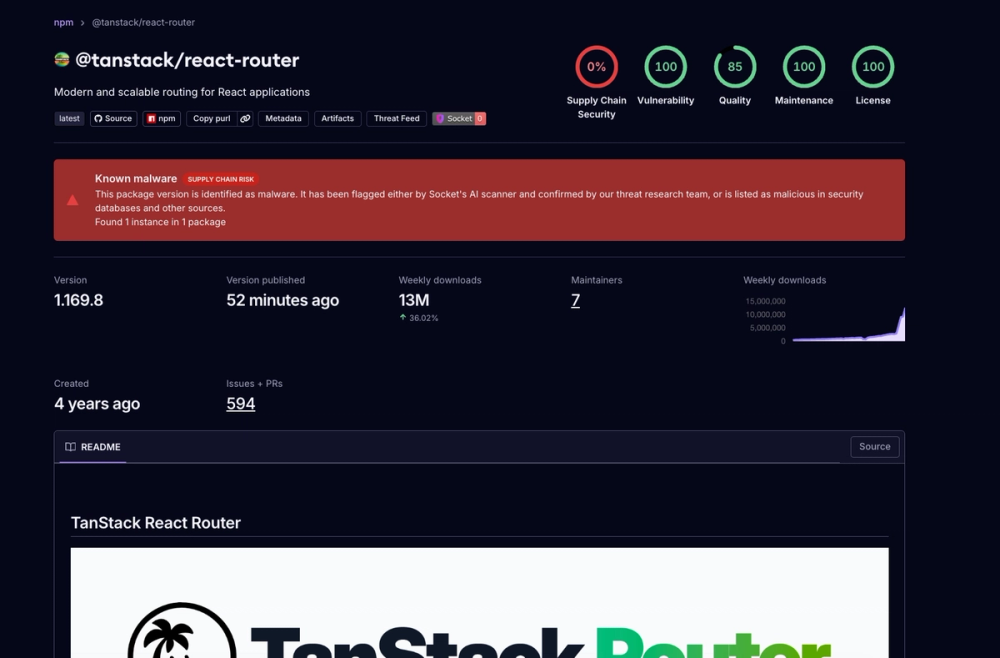
Socket: TanStack npm Packages Compromised
 securitylab.github.comadvisory