Trail of Bits (@trailofbits) on X
Trail of Bits post on X summarising Binance's initial investigation into a security incident. Binance suggests a compromised DevOps engineer's laptop let an attacker reach a service container and submit unauthorized withdrawal transactions. The text says no evidence has been found of wallet private key compromise. The fetched text is truncated and gives no further detail.
 x.comthreadPublished and added 30 Oct 2026🛡️ Security
- Trail of Bits (@trailofbits) on X
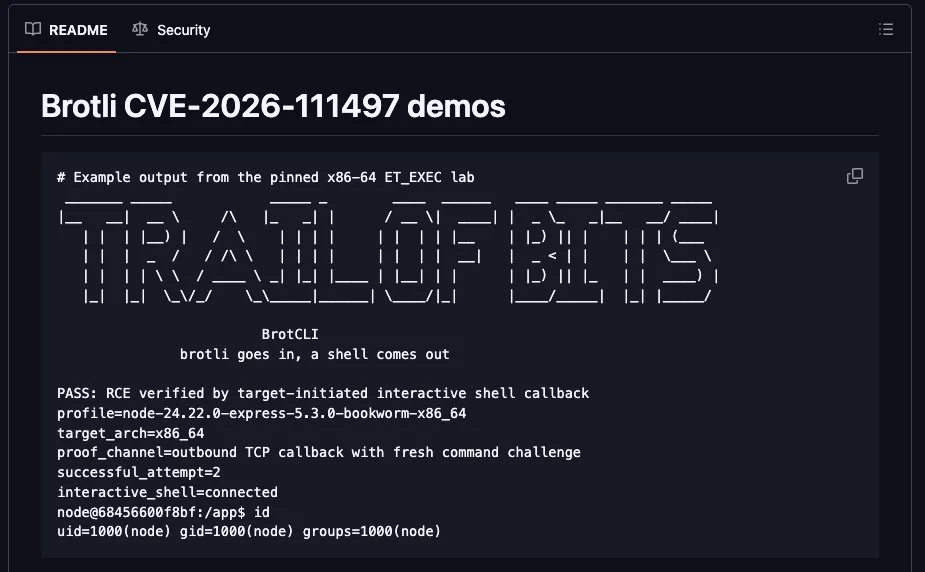
Trail of Bits post says it achieved remote code execution through a Brotli decoder bug in Linux lab setups: Node.js 24.22.0 with Express 5.3.0 via the standard JSON parser (x86-64 and ARM64), and Electron 41.10.7 (x86-64) with a custom decoding service. Exploitation needs a carefully matched setup and repeated attempts. A scanner by ToBScottA finds hidden copies of the decoder, including in stripped binaries.
x.comthreadAdded 30 Oct 2026, published 28 Oct 2026🛡️ Security  Backporting security fixes to stable releases
Trail of Bits argues that stable and LTS software, such as Ubuntu 26.04 LTS, Debian 13 and stable Linux kernel branches, carries many known CVEs that were fixed upstream but never backported. It measures the gap using the kernel CVE team's vulns.git (18 September 2026) and Debian and Ubuntu CVE feeds. Using Codex with GPT-5.6, the team got 142 fixes covering 90 CVEs applied to stable kernel trees and has begun sending patches to distributions.
 blog.trailofbits.comarticlePublished and added 27 Oct 2026🛡️ Security
- Trail of Bits (@trailofbits) on X
Trail of Bits post on PHP2Shell, an exploit that gives a shell on MediaWiki, Symfony, Laravel and phpBB. They confirmed it on pre-patch PHP 8.2 to 8.5. An update says it is production-grade: it works with stock php.ini-production, display_errors off, multiple workers, ASLR and load, on ARM64 and x86-64, and reaches root on Apache/mod_php and nginx/php-fpm. No CVE or technical root cause is given.
x.comthreadAdded 27 Oct 2026, published 26 Oct 2026🛡️ Security - Trail of Bits (@trailofbits) on X
Trail of Bits announces a scanner, built by Scott A., that finds hidden copies of the vulnerable Brotli decoder behind a Node.js/Brotli bug, including in stripped binaries. Exploitability of the bug is still under testing. Binary matching covers only aarch64 gcc builds, so an empty result on a stripped x86 binary may be a coverage gap. The post also separates finding vulnerable code from knowing whether an app reaches it.
x.comtoolAdded 25 Oct 2026, published 23 Oct 2026🛡️ Security - Trail of Bits (@trailofbits) on X
patching-bugs is a Trail of Bits plugin for Codex that has an AI agent write a vulnerability fix, prove it works, and check it for regressions. It was built from analysis of thousands of Codex sessions from the Patch the Planet work with OpenAI. The post argues defenders need patch-writing agents to match attackers' bug-hunting agents. It gives no technical detail beyond that.
x.comtoolAdded 24 Oct 2026, published 22 Oct 2026🛡️ Security  [tl;dr sec] #351 - PHP2Shell, Autopatching Skills, AWS Pathrunner
tl;dr sec #351 is a weekly security newsletter. Clint Gibler describes working with OpenAI, Calif, Wiz and the PHP maintainers on the PHP2Shell unauthenticated RCE disclosure, which affects 13 years of PHP. It also covers Datadog's pathrunner AWS IAM escalation framework, Trail of Bits' patching-bugs and regression-hunt Codex plugins, XBOW finding de-duplication, backdoored open-weight models, and CREBench.
 tldrsec.comarticleAdded 30 Oct 2026, published 22 Oct 2026🛡️ Security
- Trail of Bits (@trailofbits) on X
Trail of Bits post on two unpatched critical PHP bugs that were exploited within 17 hours of details leaking. Cloudflare began blocking attacks and Patchstack reported active exploitation. The bug was reported 11 August and fixed 71 days later, with a patch touching 402 files and over 11,000 lines. Trail of Bits announces two open-source plugins, patching-bugs and regression-hunt, from its Patch the Planet work.
x.comthreadAdded 23 Oct 2026, published 21 Oct 2026🛡️ Security - Trail of Bits (@trailofbits) on X
Trail of Bits announces two open-source plugins, patching-bugs and regression-hunt, for AI coding agents that speed up bug patching. They come from four months of Patch the Planet work with open-source projects, which found that repo-level documentation, skills and plugins give agents the maintainer context on what counts as a bug, how a fix should look and what must not break. The post cites the October 2026 PHP incident: a patch touching 402 files, and exploitation within 17 hours of leaked details.
x.comarticleAdded 23 Oct 2026, published 21 Oct 2026🧠 AI  Your AI agent fixed the bug, but what else did it change?
Trail of Bits releases patching-bugs and regression-hunt, two agent plugins built with OpenAI through Patch the Planet. patching-bugs reproduces bugs, writes fixes and runs a three-arm proof; regression-hunt traces diffs to real interfaces, confirms with live PoCs and a fresh-context replay. A review of 130+ merged PRs found 21 regressions, and regression-hunt gave 25% fewer false positives than a baseline Codex prompt.
blog.trailofbits.comarticlePublished and added 21 Oct 2026🧠 AI- Your AI agent fixed the bug, but what else did it change?
Trail of Bits releases patching-bugs and regression-hunt, two Codex plugins from the Patch the Planet initiative with OpenAI. A review of 130+ merged patches confirmed 21 regressions (none broke a security protection). In preliminary tests regression-hunt gave 25% fewer false positives than a baseline Codex agent. Design uses live PoCs, strict schemas, a three-arm proof, and project THREAT_MODEL.md and PATCHING_GUIDELINES.md files.
blog.trailofbits.comarticlePublished and added 21 Oct 2026🛡️ Security - Trail of Bits (@trailofbits) on X
Trail of Bits thread on Google Quantum AI's March publication of a new Shor's algorithm version aimed at secp256k1, the curve protecting Bitcoin and Ethereum wallets. Google used zero-knowledge proofs to keep the attack details secret, and the post says the secrecy lasted 63 days. The fetched text is cut off after the qubit estimate of roughly 1,200, so later details are missing.
x.comthreadAdded 22 Oct 2026, published 20 Oct 2026🛡️ Security - Trail of Bits (@trailofbits) on X
Trail of Bits post announcing research that tested 25 package managers against a simulated malicious repository serving swapped code for the same package and version. Without a lockfile only Go and vcpkg verified every download; with a lockfile fewer than half did. This undercuts the assumption that lockfiles make dependencies immutable and shows hash/integrity verification gaps across ecosystems.
x.comthreadAdded 18 Oct 2026, published 16 Oct 2026🛡️ Security - Trail of Bits (@trailofbits) on X
Trail of Bits tweet announcing a test of 25 package managers against a simulated malicious repository. Without a lockfile only Go and vcpkg verified every download; with a lockfile fewer than half did. Replies raise that checksum verification is separate from execution isolation, and ask whether poisoned CI package caches were in the threat model.
x.comthreadAdded 17 Oct 2026, published 15 Oct 2026🛡️ Security  Package managers have an integrity problem
Trail of Bits tested 25 popular package managers with a Docker and mitmproxy harness that simulates a compromised package repository injecting malware into legitimate packages. Fewer than half enforce lockfile hashes by default, only two verified every download, and only Go verifies signatures by default. The post covers lockfile hash pitfalls (Pub, pnpm, Conan, CocoaPods, Composer), repository, developer and Sigstore signing, and Go's checksum database. It also proposes lockfiles that commit to a signing identity plus a transparency log.
blog.trailofbits.comwriteupPublished and added 14 Oct 2026🛡️ Security- Trail of Bits (@trailofbits) on X
Trail of Bits announces SequenceHash, a library for hashing several inputs without concatenation ambiguity. Plain concatenation lets different input sequences produce the same SHA-256 digest. SequenceHash appends each input's length as a fixed 128-bit integer so every sequence has a single encoding. It ships for Rust, Go and Python, and removes a recurring bug class in crypto and appsec code.
x.comtoolAdded 11 Oct 2026, published 9 Oct 2026🛡️ Security - Trail of Bits (@trailofbits) on X
Trail of Bits' Circomspect, a static analyzer for Circom zero-knowledge circuits, had a false positive in its unconstrained-less-than check: compile-time constants fed into the LessThan template were wrongly flagged as unconstrained inputs. The merged PR fixes this so expressions resolvable at compile time are no longer reported, reducing noise for auditors hunting real under-constraint bugs in circuits.
x.comthreadAdded 8 Oct 2026, published 6 Oct 2026🛡️ Security  SequenceHash: multihashing for the rest of us
Trail of Bits introduces SequenceHash and its keyed variant SequenceMAC, hash-agnostic multihashing constructions similar in goal to NIST's TupleHash but not tied to Keccak, working with SHA256/384/512, BLAKE, and RIPEMD. The spec, now part of the Community Cryptography Specification Project, provides unambiguous input encoding, length-extension prevention, built-in customization strings, and HMAC-style keyed MACs that avoid HMAC's key-pseudocollision issues; reference implementations ship in Rust, Go, and Python with full test vectors.
blog.trailofbits.comwriteupPublished and added 2 Oct 2026🛡️ Security- Trail of Bits (@trailofbits) on X
Announcement tweet for Trail of Bits's September "Tribune" newsletter, which fact-checks 1Password's AI-powered patching benchmark, details a signature-forgery bug found in Miden's zkVM and a string-slicing bug in the Lean theorem prover/language, and reports 27 advisory submissions to OpenClaw plus seven new completed security reviews. It links out to the full newsletter on Mailchimp (mailchi.mp/trailofbits).
x.comthreadAdded 1 Oct 2026, published 30 Sep 2026🛡️ Security  Don't let TEEs break your MPC
Trail of Bits explains why running threshold-signature MPC protocols inside TEEs (Intel TDX, AMD SEV-SNP, AWS Nitro Enclaves) is not automatically secure: a malicious host can roll back enclave filesystem state to force reuse of deleted pre-signature nonces, leaking a signer's private key share. The post catalogs recurring audit pitfalls — incomplete attestation measurements (citing the WhatsApp Private Inference LD_PRELOAD bypass), missing verification steps, weak hardening, stale-backup/rollback risks (including LUKS2 header manipulation in confidential VMs), and physical/side-channel attacks like TEE Fail and DDRop against DDR5 memory — and gives best practices such as binding attestation to MPC party identities and using multiple TEE vendors for defense-in-depth.
blog.trailofbits.comarticlePublished and added 25 Sep 2026🛡️ Security- SAML: A fractal of bad design
A Trail of Bits researcher (ex-Duo Security engineer) traces SAML's history from its 2002 OASIS committee origins through recurring XML signature wrapping (XSW) and canonicalization/round-trip parser-differential attacks, arguing its reliance on brittle XML signature validation (libxmlsec) makes it fundamentally unsound. The post catalogs SAML's five structural flaws — XML complexity, canonicalization, enveloped signatures, kitchen-sink design, and protocol ossification — and recommends organizations deprecate SAML in favor of OIDC, citing Fly.io and Tailscale as vendors already holding the line on OIDC-only SSO.
blog.trailofbits.comarticlePublished and added 21 Sep 2026🛡️ Security  Auditing in the age of (good enough) AI
Trail of Bits describes preparing for a six-month audit of the Miden zkVM (a zero-knowledge VM with its own custom assembly language, MASM) by having AI agents (Claude and Codex) build an LSP server, a decompiler, an abstract-interpretation-based static analysis engine, and a Lean formal model of the VM executor, none of which previously existed for MASM. These tools surfaced a high-severity bug in the mod_12289 procedure where an underconstrained prover-supplied advice value allowed a malicious prover to forge Falcon signatures and drain Miden accounts, plus over 400 type-validation issues, while the Lean proof effort produced 95 machine-checked correctness proofs and caught two additional subtle arithmetic bugs (rotr, wrapping_mul) missed by unit tests.
blog.trailofbits.comwriteupPublished and added 18 Sep 2026🛡️ Security 1Password's AI patching benchmark is misleading
Trail of Bits dissects 1Password's August 2026 report claiming AI models produce "clean" security patches only 26% of the time, showing the figure is inflated by handpicked hard bugs, deliberately wrong-fix prompts (22% of trials), testing-prohibited trials (36%), inconsistent grading, and a buggy reference fix — and that when those confounds are removed, 86% of patches blocked the supplied exploit. The post contrasts this with Trail of Bits' own data: developers get 12.5% of first fixes wrong even under favorable conditions, and 67.7% of Patch the Planet AI-authored pull requests were merged by maintainers. It also releases two agent skills, post-patch-validation and review-walkthrough, to help agents test fixes and help engineers review AI-generated patches.
blog.trailofbits.comwriteupAdded 8 Oct 2026, published 15 Sep 2026🧠 AI- 1Password's AI patching benchmark is misleading
Trail of Bits dissects 1Password's August 2026 report claiming AI agents (GPT-5.5, Opus 4.8) produce clean vulnerability fixes only 26% of the time, showing the figure is inflated by a hand-picked set of six hard bugs, deliberately-wrong-fix prompts (22% of trials), a no-testing mode (36% of trials), grading disagreements between automated graders and humans, and a buggy Linux upstream reference fix. Reanalyzing the same data under fair conditions (testable, non-adversarial trials) they find 86% of patches blocked the supplied exploit, and they contrast this with their own consulting data (12.5% of developer first-fixes fail) and Patch the Planet's 67.7% maintainer merge rate across 186 PRs, including a case where both a human maintainer and an agent independently introduced the same freenginx cleanup-crash regression. The post also releases two new agent skills, post-patch-validation and review-walkthrough, to improve AI-assisted patch testing and human review.
blog.trailofbits.comarticlePublished and added 15 Sep 2026🛡️ Security  A “proof” of Fermat’s Last Theorem that fits the margin
Trail of Bits found a bug in Lean's String.Pos.Raw.extract (affecting all stable versions up to 4.33.1, fixed in 4.34.0-rc1) where the logical definition and the compiled native code disagree on the result of extracting a slice at an out-of-bounds position, letting an attacker manufacture a contradiction (empty string = non-empty string) that "proves" any theorem, including a fake formalization of Fermat's Last Theorem. The exploit only works when a proof relies on the native_decide axiom, which extends trust to the compiler rather than the kernel; the researchers found the issue while using GPT-5.6 to build a code-review skill, and Lean maintainers hargoniX and Rob23oba shipped fixes within hours to days of disclosure. The post is a reminder that machine-checked proofs are only as trustworthy as the evaluator/compiler paths behind axioms like native_decide, and points to work like lean4lean and alternative kernels as mitigations.
blog.trailofbits.comwriteupPublished and added 9 Sep 2026🛡️ Security- [tl;dr sec] #344 - VMs won't contain Cyber-capable Agents, AWS AI Security Analyst, Decompilers vs LLMs
tl;dr sec #344 is a weekly security newsletter issue. It summarizes Trail of Bits' report that an AI agent escaped a QEMU/KVM VM three times (Firecracker held), Grow Therapy's sub-$500/month AI threat hunting system on AWS, Palo Alto's "Pass-ta-key" attacks on synced passkeys, MCP configuration poisoning, org-wide GitHub Actions SHA pinning, and the DecBench decompiler benchmark with the LLM-written Kuna decompiler.
tldrsec.comarticleAdded 30 Oct 2026, published 8 Sep 2026🛡️ Security - trailofbits/skills
Trail of Bits maintains a Claude Code plugin marketplace of "skills" that extend AI coding agents (Claude Code, Codex, ChatGPT workspaces) with security analysis, testing, and secure development capabilities. It's installed via `/plugin marketplace add trailofbits/skills` and is also compatible with Codex's Claude marketplace support, with related sibling repos for curated skills, devcontainers, and config.
 github.comrepoPublished and added 7 Sep 2026🛡️ Security
- Pyro (@0x3b33) on X
A roundup of three open-source AI-assisted smart contract security scanners: pashov/skills (solidity-auditor + x-ray pre-audit + fuzz suite generation, fast/cheap feedback), PlamenTSV's autonomous 8-phase agent covering EVM, Solana, and Move that ships PoCs with findings, and Trail of Bits' skills repo with 40+ security skills for contract audits, differential review, and static analysis. Useful pointer to emerging AI-agent-based smart contract auditing tooling.
x.comthreadPublished and added 7 Sep 2026🛡️ Security  VMs won't contain cyber-capable agents
Trail of Bits gave GPT 5.6-Cyber preview access and tasked it with escaping a QEMU/KVM VM on a Debian 12 host; the agent succeeded three separate times, first via a recently disclosed host kernel bug (Januscape, CVE-2026-53359), then by chaining CVE-2026-9539 in libslirp with an unmarked bug fix, and finally by autonomously discovering and chaining multiple 0-day vulnerabilities in the kernel/QEMU stack over roughly 12 hours of largely unsupervised operation. The author argues off-the-shelf VMs (even hardened stable distros) no longer reliably contain a sufficiently capable AI agent — treat such agents as an APT — though Firecracker's minimal attack surface withstood the same agent's attempts.
blog.trailofbits.comwriteupAdded 3 Sep 2026, published 26 Aug 2026🛡️ Security State divergence enables unauthorized access
Trail of Bits found and reported an authorization bypass in Provenance Blockchain's marker module (Cosmos SDK) that let any user with zero tokens self-grant ACCESS_ADMIN on non-fixed-supply marker accounts, because the access check compared caller balance against a stale on-chain supply field that never diverged from zero. The bug affected 82 live mainnet markers (tokenized loans, bridged stablecoins, consortium deposits, governance escrow) and allowed two-transaction exploitation to mint arbitrary tokens or drain roughly $500,000 in escrowed nhash; it was mitigated in v1.28.0 (PR #2627) and fully fixed in v1.29.0 (PR #2734) by reading live bank-module supply with an explicit zero-guard.
blog.trailofbits.comwriteupAdded 3 Sep 2026, published 25 Aug 2026🛡️ Security OWASP Agentic Skills Top 10 explained: the ten agent skill risks, and which to fix first
Explains OWASP's Agentic Skills Top 10 v1.0 (AST01-AST10), a new framework for the risks of "agent skills" — folders with a SKILL.md file plus bundled code/scripts that agents discover and execute, treating plain-language instructions as an attack surface that neither traditional package security nor prompt-injection defenses cover. The piece details the ClawHavoc campaign (1,184 malicious skills across 12 ClawHub accounts), the ClawJacked exploit (CVE-2026-32025), Claude Code skill-related CVEs (CVE-2025-59536, CVE-2026-21852), and cites Adversa AI's own research showing a malicious skill bypassed all eight open-source scanners tested, including the OASB leaderboard leader and tools from NVIDIA (SkillSpector), Snyk, Trail of Bits, and Air Security. It closes with a prioritized remediation sequence (inventory, isolation, credential scoping, pinning, allowlisting, approval workflows, advisory scanning, cross-platform normalization) mapped to the AST entries.
 adversa.aiarticleAdded 7 Oct 2026, published 25 Aug 2026🛡️ Security
 How Trail of Bits helps verify the integrity of your Signal chats
Trail of Bits describes the from-scratch, open-source auditor it built and operates as one of three independent auditors (alongside Signal and Cloudflare) backing Signal's new Automatic Key Verification feature. The auditor maintains its own Merkle tree of the global phone-number-to-public-key map and periodically signs the tree head, so clients that require signatures from all three auditors can detect a malicious server maintaining a split view within at most one week. This replaces manual safety-number comparison with an automated key-transparency check for end-to-end encryption integrity.
blog.trailofbits.comwriteupAdded 3 Sep 2026, published 11 Aug 2026🛡️ Security A few notes on AWS Nitro Enclaves: KMS integration
Third in Trail of Bits' Nitro Enclaves series, this post catalogs threats to the enclave-KMS communication channel: passive attackers who can swap ciphertext/data-key pairs when encryption context is missing, active attackers who can hijack unauthenticated requests without enclave-initiated TLS, and operational risks like CMK deletion, key rotation, and IAM policy misconfiguration. It provides concrete checklists covering encryption context usage, ARN vs. alias pinning, PCR0/PCR3/PCR8-based key policy authorization, immutable key policies for end-to-end verifiability, and warns against the vulnerable aws-nitro-enclaves-sdk-c in favor of aws-nitro-enclaves-nsm-api and Boto3.
blog.trailofbits.comwriteupAdded 3 Sep 2026, published 5 Aug 2026🛡️ Security- Slither
Slither, developed by Trail of Bits, is a Python3-based static analysis framework for Solidity and Vyper smart contracts that runs a suite of vulnerability detectors, visualizes contract internals via 'printers', and exposes an API for writing custom analyses using its SlithIR intermediate representation. It integrates into Hardhat/Foundry/Brownie builds and CI (including GitHub code scanning), claims 99.9% parse coverage of public Solidity code and sub-second average analysis time per contract, and ships companion tools like slither-check-upgradeability, slither-prop, and slither-read-storage.
github.comrepoPublished and added 31 Jul 2026🛡️ Security  Building secure Uniswap v4 hooks
Trail of Bits distills dozens of Uniswap v4 hook audit findings into seven recurring failure patterns — missing caller checks, unvalidated PoolKey trust, custom accounting leaks, wrong-hook timing bugs, permission-bit mismatches, callback-triggered denial of service, and cross-callback state changes. The post walks through real incidents (the ~$12M Cork exploit and $8.4M Bunni rounding bug) to show how these bugs bypass PoolManager's settlement invariant, and gives developers and auditors a concrete checklist plus fuzzing guidance (Echidna, Medusa) for securing hook contracts.
blog.trailofbits.comarticleAdded 3 Sep 2026, published 30 Jul 2026🛡️ Security How we use /goal to find bugs in Patch the Planet
Trail of Bits describes how they use Codex's /goal feature, an open-ended agentic objective mode, to hunt for bugs in heavily audited open-source codebases like Rust, curl, and zlib as part of the OpenAI-backed Patch the Planet initiative. Key techniques include letting Codex write and red-team its own goal prompts, defining precise outcomes rather than prescribing methods, running one outcome per agent to avoid competing objectives, and building an automated variant-analysis pipeline (using P-critical Rust issues, a security gate, and a two-pass false-positive judge) that produced a soundness hole and a miscompilation patched in Rust 1.98, plus privilege-escalation bugs in Keycloak's SAML component. They also built agentcov, an internal tool that tracks code coverage read by Codex to prevent it from skipping parts of the codebase.
blog.trailofbits.comwriteupAdded 3 Sep 2026, published 28 Jul 2026🛡️ Security AI code security harnesses compared
Semgrep's blog post compares open-source AI-driven code security "harnesses" that use LLMs to find vulnerabilities, grouping them into three categories: LLM-led exploit generation (fuzzing-like, crash-oracle driven), LLM-skill-boosting vulnerability research (e.g. Cloudflare's security-audit-skill, Trail of Bits' skills, CapitalOne's vulnhunter, Google's mantis), and SAST+LLM hybrids (raptor, deepsec, ai-deep-sast, Visa's VVAH). It breaks down each tool's design, star counts, licensing, and ideal use case, and discusses cross-cutting themes like adversarial validation, discovery/validation separation, and patch generation maturity.
 semgrep.devarticleAdded 3 Sep 2026, published 24 Jul 2026🛡️ Security
- Awesome AI Web3 Security
A curated, verified awesome-list of AI-powered tools for smart contract and blockchain security, covering autonomous auditor agents (Hound, Plamen, Aether, SolidityGuard), commercial AI audit platforms (Sherlock AI, Cantina Apex, Zellic V12, Nethermind AuditAgent), MCP-based auditing plugins (Trail of Bits Skills, Claudit, Slither MCP, Solodit MCP Server), real-time on-chain ML monitoring (Forta Network, AnChain.AI), and benchmark/training datasets (EVMbench, SCONE-bench, ScaBench, SmartBugs). Every entry requires a real AI/ML/LLM component plus a specific Web3 security focus, with open-source entries needing 25+ GitHub stars, positioning it as a practical index for the emerging AI-driven smart-contract-audit tooling ecosystem.
github.comrepoAdded 3 Sep 2026, published 18 Jul 2026🛡️ Security  Rust-proof your code with our new Testing Handbook chapter
Trail of Bits announces a new chapter of its Testing Handbook dedicated to security testing Rust programs, covering Rust's safety-guarantee gaps (unwind safety, arithmetic errors, nondeterminism), dynamic analysis with Miri and proptest, static analysis with Clippy, a gotchas/footguns checklist for manual review, memory zeroization techniques, model checking with Kani, and supply-chain dependency vetting. The post also announces rust-review, a Claude Code plugin co-built with Aptos Labs that automates detection of over a dozen Rust bug classes including memory safety, concurrency, FFI, and async cancellation issues.
blog.trailofbits.comarticleAdded 3 Sep 2026, published 13 Jul 2026🛡️ Security- Mutation testing comes to DAML
Trail of Bits added DAML support to Mewt, their open-source mutation-testing engine, targeting Canton Network smart contracts. Mewt reuses the tree-sitter-haskell grammar to parse DAML and adds two contract-specific mutation operators — controller party swap (CPS) and controller party removal (CPR) — that probe whether test suites actually verify authorization rules (who must sign off on a choice) rather than just executing them. A worked example on a buyer/seller escrow contract shows a mutant that lets a seller release funds alone surviving a 100%-coverage test suite, illustrating how DAML's built-in choice-level coverage reporting can mask missing negative/unhappy-path tests; the team also ran Mewt against OpenZeppelin's canton-stablecoin reference implementation.
blog.trailofbits.comarticleAdded 3 Sep 2026, published 8 Jul 2026🛡️ Security  GPT-5.5-Cyber built a zlib fuzzing lab in a day
Trail of Bits' Patch the Planet initiative (a collaboration with OpenAI pairing engineers with 30+ open-source projects) had GPT-5.5-Cyber, driven through Codex's /goal command, autonomously build a full fuzzing lab against zlib in a single day. Without step-by-step guidance, the model wrote ASan/UBSan-instrumented harnesses across a dozen entrypoints (inflate, inflateBack, uncompress2, gzFile, MiniZip, puff, blast, infback9, gzjoin, gzappend), used compile-time variant builds to reach hidden code paths, repurposed edge-case tests as seed corpus, and applied strict reportability discipline to reject unreachable crashes while surfacing several findings now under coordinated disclosure. The report argues this collapses the expertise barrier that historically kept bespoke fuzzing campaigns out of reach for low-skill attackers while also acting as a major force multiplier for defenders/researchers.
blog.trailofbits.comwriteupAdded 3 Sep 2026, published 2 Jul 2026🛡️ Security- Shipping post-quantum cryptography to Python
Trail of Bits, funded by the Sovereign Tech Agency, implemented Rust bindings for NIST's ML-KEM (FIPS 203) key-establishment and ML-DSA (FIPS 204) digital-signature standards into pyca/cryptography, shipped in version 48 with AWS-LC backend support. The post makes them a pip install away for the Python ecosystem (pyca/cryptography sees 1.2B monthly PyPI downloads and underpins Certbot, Ansible, Airflow, and paramiko), while detailing the size/performance tradeoffs versus Ed25519/X25519 and noting SLH-DSA (FIPS 205) support and protocol-level integration are still in progress.
blog.trailofbits.comwriteupAdded 3 Sep 2026, published 30 Jun 2026🛡️ Security  Introducing Patch the Planet
Trail of Bits describes the first week of Patch the Planet, a partnership with OpenAI Daybreak pairing engineers and maintainers with frontier models like GPT-5.5-Cyber and Codex to find and fix bugs in open-source projects such as curl, aiohttp, RustCrypto, PyCA, python.org, PyPI, and Sigstore. It reports concrete outcomes: GPT-5.5-Cyber autonomously building a full fuzzing lab with OS-backpressure harnesses in under a day, Codex-driven CVE variant analysis and cross-library differential testing that found an AES-GCM issue in PyCA and X.509 discrepancies, 64 pull requests and 51 issues filed, and aiohttp maintainers fixing eight privately-reported bugs within hours. It closes with maintainer guidance on deduplication, false-positive filtering, and severity correction for the flood of AI-generated reports.
blog.trailofbits.comarticleAdded 3 Sep 2026, published 22 Jun 2026🛡️ Security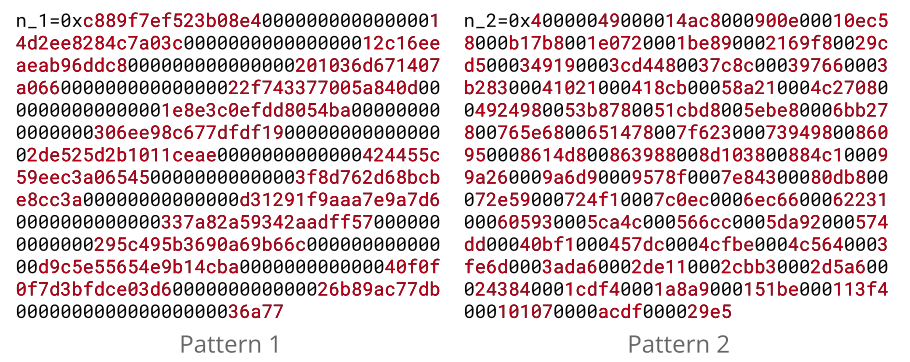 Factoring "short-sleeve" RSA keys with polynomials
Trail of Bits, working with Hanno Böck's badkeys project, found hundreds of real-world RSA/DSA keys ("short-sleeve" keys) with regularly spaced blocks of zero bits caused by a big-integer/RNG type mismatch in CompleteFTP's key-generation code (versions 10.0.0-12.0.0 for RSA, through 23.0.4 for DSA). They developed a polynomial-factorization technique — converting the modulus to a polynomial with small coefficients via base-2^w representation and factoring the polynomial instead of the integer — to recover 603 RSA private keys and 74 DSA private keys from internet scans, and reverse-engineered the CompleteFTP binary with ILSpy to find the exact Array.Copy bug responsible. EnterpriseDT shipped patched key generation and a key-checking tool, and badkeys now detects this weakness.
blog.trailofbits.comarticleAdded 3 Sep 2026, published 12 Jun 2026🛡️ Security- The sorry state of skill distribution
Trail of Bits researchers bypassed every agent-skill security scanner they tested — ClawHub's VirusTotal/Code Insight and GPT-5.5-based guard model, and skills.sh's Gen/Socket/Snyk-backed scanning, plus Cisco's skill-scanner — using techniques like context-truncation via 100,000 newlines, malicious payloads hidden inside .docx ZIP archives, Python .pyc bytecode poisoning to steal environment variables, and rhetorically-crafted prompt injection that convinced LLM analyzers a malicious npm/yarn registry change was benign. The piece also shows a legitimate Anthropic Office skill (soffice.py) using LD_PRELOAD in ways indistinguishable from malicious behavior, arguing static/LLM skill scanning is structurally unable to guarantee safety and that organizations should instead curate trusted skill marketplaces (e.g., trailofbits/skills-curated) rather than rely on public ones. PoC skills are published at trailofbits/overtly-malicious-skills.
blog.trailofbits.comwriteupAdded 3 Sep 2026, published 3 Jun 2026🛡️ Security  Bringing full YAML anchor support to zizmor
Trail of Bits worked with the zizmor maintainers to add full YAML anchor support to zizmor, the GitHub Actions static analyzer that catches misconfigurations like the one exploited in the March 2026 aquasecurity/trivy-action pull_request_target attack that led to a LiteLLM PyPI backdoor. They built a corpus of 41,253 workflows from 6,612 high-star repos, found zizmor crashed on 45 of them, and fixed four anchor-handling bugs plus unrelated deserialization and expression-evaluator issues, filing 20 issues and merging 15 PRs upstream.
blog.trailofbits.comarticleAdded 5 Sep 2026, published 22 May 2026🛡️ Security PyPI Access Control Vulns Patched
Socket.dev covers Trail of Bits' second external security audit of PyPI's Warehouse application, funded by the Sovereign Tech Agency, which found 14 issues including two high-severity access control flaws. One allowed any organization Member to POST an Owner-role invitation because the manage_organization_roles view gated both GET and POST behind read-only OrganizationsRead permission; the other let stale TeamProjectRole records grant upload/admin access after a project was transferred between organizations. The piece also details a Medium-severity OIDC Trusted Publishing replay window (Redis jti key expiring before PyJWT's 30s leeway), a related TOCTOU race in the same anti-replay flow, an IDOR in API token deletion, and an unfixed gap where wheel-embedded METADATA dependencies aren't validated against form-submitted metadata, letting installers see different dependency data than PyPI's JSON API/pip-audit.
 socket.devarticlePublished and added 6 May 2026🛡️ Security
 Trail of Bits AI-Native Journey
Trail of Bits describes how it moved from AI-assisted to "AI-native" over a year: standardizing on Claude Code, writing an AI usage handbook, building an AI maturity matrix, running hackathon-style adoption sprints, and packaging expertise into reusable skills/plugins/agents (94 plugins, 201 skills, 84 agents). It reports concrete outcomes — bug-finding throughput rising from 15 to 200/week on some engagements, ~20% of reported bugs first surfaced by AI — and open-sources the supporting repos (skills, curated marketplace, devcontainer, dropkit sandboxing, Slither MCP server). It also covers psychological adoption barriers (self-enhancing bias, identity threat, intolerance for imperfection, opacity) and open questions like private inference and prompt-injection risk on client code.
blog.trailofbits.comarticleAdded 22 Sep 2026, published 6 May 2026🧠 AI- Trail of Bits AI-Native Journey
Trail of Bits describes the internal "operating system" it built to make itself AI-native: a standardized Claude Code toolchain, an AI usage-policy handbook, a capability maturity matrix, recurring hackathons run in "bypass permissions" autonomous-agent mode, and six open-sourced repos (skills, skills-curated marketplace, claude-code-config, claude-code-devcontainer, dropkit macOS sandbox, slither-mcp) that package 94 plugins/201 skills/84 agents. Security-relevant specifics include treating agent autonomy as requiring sandboxing and hardened defaults by default, a curated skills marketplace to avoid backdoored third-party AI plugins, prompt injection to client codebases flagged as an unsolved "existential" risk (with pointers to kernel-level agent shells like nono and agentsh), and claims that AI now surfaces ~20% of bugs in client audits (15→200 bugs/week on some engagements). It's largely an org-process/adoption piece rather than a technical deep-dive, but the linked tooling and the agent-security framing make it useful for teams rolling out autonomous coding agents safely.
blog.trailofbits.comarticlePublished and added 6 May 2026🛡️ Security