 Inside a malicious Claude Code-branded extension and its persistent SSH backdoor
Microsoft Threat Intelligence analyzes a tampered anthropic.claude-code extension (versions 2.1.312 and 2.1.313) served on the Cursor marketplace on 29 October 2026. The injected JavaScript loader adds an SSH key labeled svc-telemetry, opens a reverse SSH tunnel and sets up persistence on macOS, Linux and Windows. The post gives cleanup steps, IOCs and Defender XDR hunting queries. VS Code Marketplace and npm were not affected.
 microsoft.comwriteupPublished and added 31 Oct 2026
 Trojanized Claude Code Extension Plants an SSH Backdoor
Analysis of a trojanized anthropic.claude-code 2.1.313 extension (darwin-arm64), found on Open VSX, with a 66-line loader prepended to extension.js. It adds an svc-telemetry key to authorized_keys, opens a reverse SSH tunnel to 134.209.82.225, sets persistence (LaunchAgent, cron, scheduled task) and sends host recon over HTTP port 8099. Includes IOCs, hashes and response steps; no further payload download was found.
 opensourcemalware.comwriteupPublished and added 30 Oct 2026
 Backdoor in Claude Code for VS Code extension on the Cursor Marketplace
Phorion analyzes a backdoor injected into versions 2.1.312 and 2.1.313 of the official Claude Code for VS Code extension on the Cursor Marketplace. An IIFE prepended to extension.js plants an SSH key, opens a reverse SSH tunnel to 134.209.82[.]225, persists via a fake com.apple.sysmond LaunchAgent and beacons host recon. A macOS systemsetup check bug usually stops SSH from being enabled. The post lists detections and remediation.
 phorion.iowriteupAdded 31 Oct 2026, published 30 Oct 2026
 Earliest Known PolinRider Malware Found in 2025 npm Packages
OpenSourceMalware traces nine itsa-* npm package versions published on 4 May 2025 from a hijacked maintainer account to the PolinRider campaign, eight months before documented victims. It decodes the EtherHiding chain (BNB Smart Chain and Ethereum calldata, JADESNOW, INVISIBLEFERRET bootstrapper, Socket.IO RAT, Python stealer) and links the 2025 sample to 2026 force-push infections. It lists IOCs, hashes, a timeline and hunting guidance.
opensourcemalware.comwriteupPublished and added 30 Oct 2026- rikugan: LLM reverse-engineering agent for IDA Pro and Binary Ninja
Rikugan is an open-source reverse-engineering agent that runs inside IDA Pro 9.0+ and Binary Ninja, with its own agent loop instead of an MCP server. It has 60+ tools (decompiler, xrefs, strings, types, IL/microcode), parallel subagent exploration, an experimental /modify natural-language patching command and an experimental Binary Ninja deobfuscation skill for control flow flattening and opaque predicates. It supports Claude, Gemini, MiniMax, Kimi, OpenAI-compatible endpoints and Ollama.
 github.comrepoAdded 30 Oct 2026
 Hackers exploit Cisco SD-WAN flaw to deploy custom KeyDrift malware
UAT-11473, a newly tracked APT cluster, exploits CVE-2026-20127, a max-severity authentication bypass in Cisco Catalyst SD-WAN Controllers (patched February 2026), to deploy the KeyDrift malware framework. KeyDrift's PolyFlame runs inside vdaemon processes, and LittleFilch hooks SSL_read to extract AES-256 IPsec keying material, saved to /var/tmp/vdaemon.bin and sent over UDP. Targets include space, defense and policy organizations. Talos sees overlap with Volt Typhoon's Silent Train network but makes no definitive link.
 bleepingcomputer.comarticleAdded 30 Oct 2026, published 29 Oct 2026
 Cisco SD-WAN Zero-Day Exploitation Tied to Volt Typhoon’s ‘Silent Train’ Network
Cisco Talos reported that UAT-11473 exploited CVE-2026-20127 (CVSS 10, Cisco SD-WAN peering authentication bypass) to deploy KeyDrift, a framework with PolyFlame (backdoor, relay C2) and LittleFilch (key harvesting) modules. Talos found its infrastructure overlaps considerably with Volt Typhoon's Silent Train network. Lumen Black Lotus Labs tied Silent Train to zero-day campaigns against Versa Director, N-able N-central, Cisco Catalyst SD-WAN and VeloCloud Orchestrator.
 securityweek.comarticlePublished and added 29 Oct 2026
 NIK C2: The new AI-enabled command-and-control framework
NIK C2 is a newly observed C2 framework with a Go-based 64-bit Windows implant that embeds an OpenAI Chat Completions client (ai_generate command), falling back to the victim's OPENAI_API_KEY. Talos details its 52+ commands, AES-256-GCM over WebSocket with HTTP fallback, credential, wallet and keystroke theft, screen-lock ransomware, AMSI bypass and anti-debug. It also lists a live C2 at 87.120.196[.]120 and total-sitevv[.]lol.
 blog.talosintelligence.comwriteupPublished and added 29 Oct 2026
 Inside KeyDrift: Analyzing historical UAT-11473 activity on Cisco SD-WAN
KeyDrift is a custom malware framework used by UAT-11473, which exploited CVE-2026-20127 in Cisco SD-WAN Catalyst Controller to gain access. Talos analyzes PolyFlame (memory-resident vdaemon injection, recvfrom hook, TinyShell-style backdoor, intermediate C2) and LittleFilch (SSL_read hook that extracts and RSA-encrypts keying material). It reports infrastructure overlap with Volt Typhoon's Silent Train, plus patch guidance and Snort SIDs.
blog.talosintelligence.comwriteupPublished and added 28 Oct 2026- Hakimi Eiqbal (@hakimieiqbal) on X
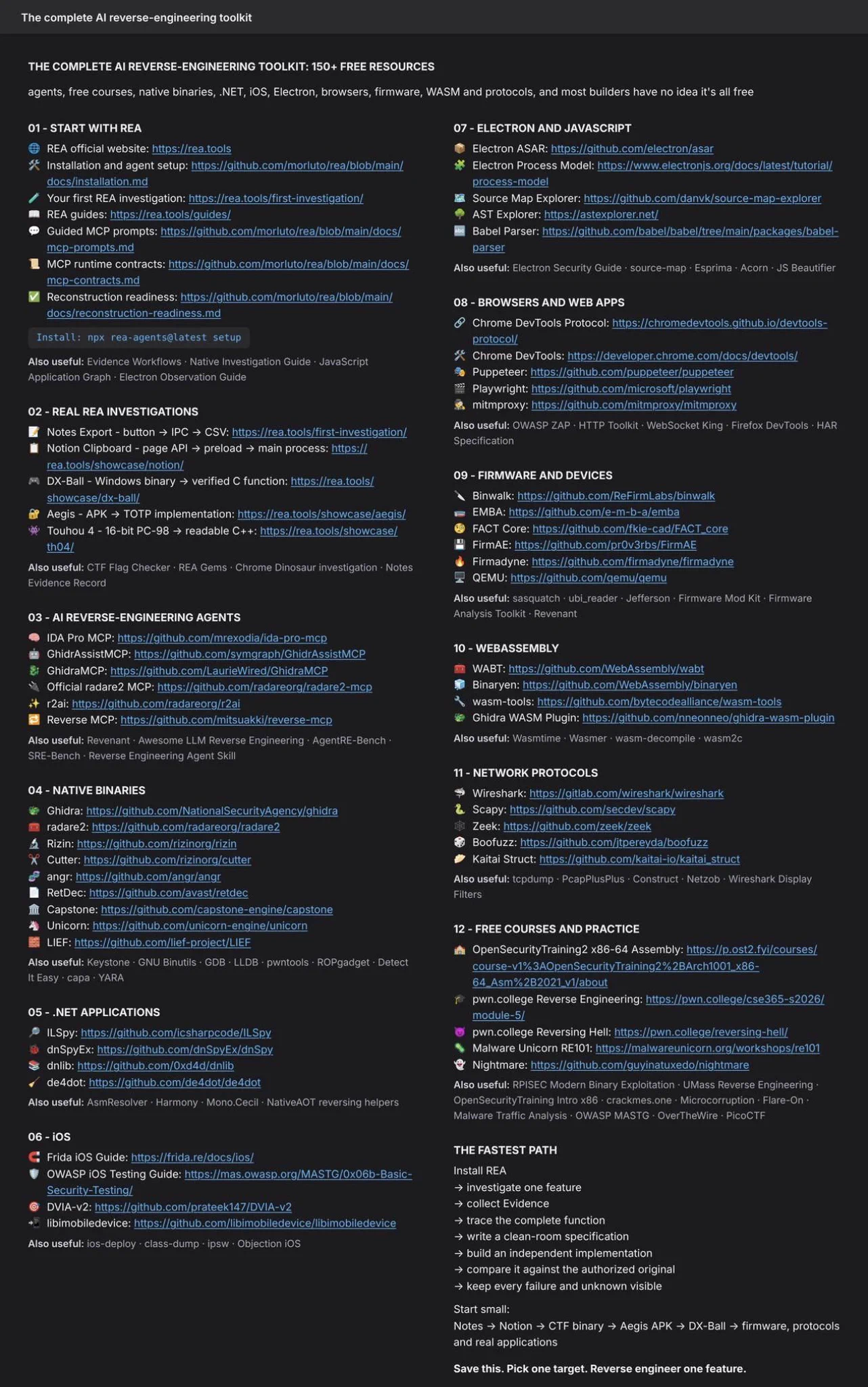
A practical reverse-engineering map by hakimieiqbal on X that picks tools by target: native binaries, .NET, Electron, iOS, firmware, WebAssembly and network protocols. It introduces REA (morluto/rea), which connects coding agents to RE tools, and lists MCP bridges for IDA Pro, Ghidra and radare2. It adds an evidence-first workflow and free courses such as pwn.college and OpenSecurityTraining2.
 x.comthreadAdded 29 Oct 2026, published 28 Oct 2026
 Malicious Firefox Extensions Impersonate Phantom, Jupiter, and Bitget to Steal Wallet Secrets
Socket analysis of three malicious Firefox add-ons impersonating Phantom, Jupiter and Bitget wallets, using Unicode homoglyph names. They steal seed phrases and private keys and send them to brand-named subdomains of bonto[.]io. The Phantom fake adds a runtime loader that fetches and evals a second stage, and bundles a drainer backend with Telegram forwarding. Includes IOCs, hashes and wallet addresses.
 socket.devwriteupPublished and added 27 Oct 2026
 Cheap AI-Assisted Reverse Engineering and What It Will Do
"Cheap AI-Assisted Reverse Engineering and What It Will Do" is an October 2026 arXiv paper (Computers and Society) arguing that generative AI strains the law of reverse engineering. AI systems can identify hardware components, extract firmware, decompile object code and clone apps, which removes the cost barrier that laws rely on. The authors map these practices onto trade secret, copyright, anti-circumvention, computer misuse and contract law, and sketch possible legal responses with their trade-offs.
 arxiv.orgpaperAdded 28 Oct 2026, published 26 Oct 2026
- Zex Alpha (@kryptozex) on X
Post about the "Steal My Bitcoin" bounty, a 0.025 BTC (about $2,025) prize that was swept early Monday, about 90 minutes after researcher @killa published a full exploit on GitHub. The exploit is a heap exploit written for the target's PHP build. It leaks memory addresses through session cookies and forces PHP cleanup to run the flag binary. The first solve looked like a failure because the pulled key did not control the advertised address, a planting mistake the creator admitted by email.
x.comthreadPublished and added 26 Oct 2026 - Dan Kornas (@DanKornas) on X
jshook is an open-source (AGPL-3.0) search-first reverse-engineering workspace for AI agents, exposed over MCP. It drives Chromium or Camoufox through CDP, captures WebSocket traffic, offers HTTP, GraphQL and Burp Suite helpers, deobfuscates JavaScript, rebuilds source maps and disassembles WebAssembly. Tool profiles start small and expand to workflow or full sets; hot-reload plugins and declarative workflows extend it.
x.comtoolAdded 28 Oct 2026, published 25 Oct 2026 - VulDec: Vulnerability Detection in Binaries via Neural Decompilation
VulDec is an arXiv paper (October 2026) presenting a dataset of real-world Assembly-C function pairs with CWE labels across multiple architectures, plus an end-to-end framework that uses neural decompilation for binary vulnerability detection. Tuned LLM decompilers reach about 56% Edit Similarity and 43% BLEU-4. Tuned LLM detectors reach macro F1 of 0.61 on a realistic test set with a 3% vulnerability rate.
arxiv.orgpaperAdded 28 Oct 2026, published 24 Oct 2026 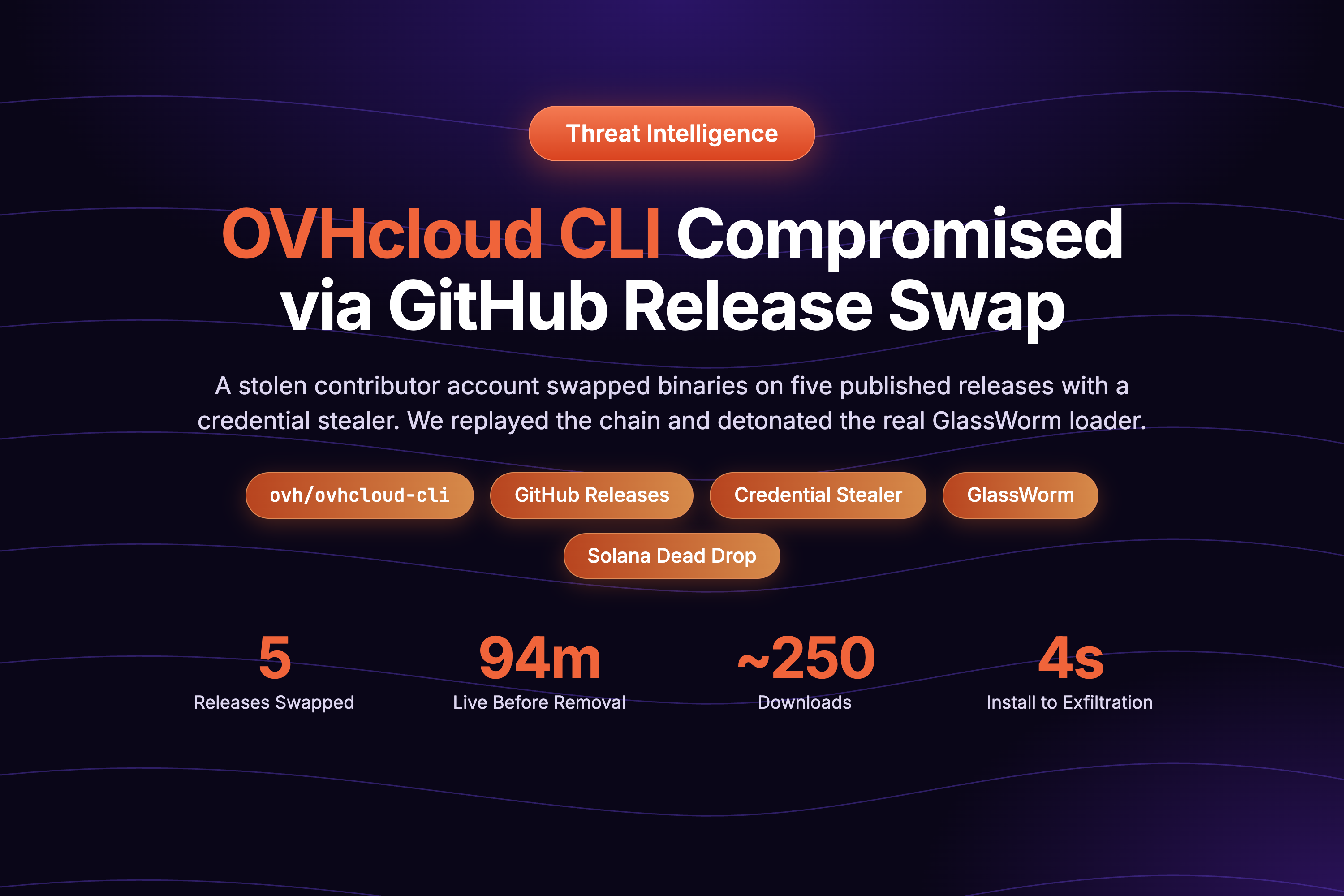 OVHcloud CLI Compromised via GitHub Release Swap: Detonating the Real GlassWorm Loader and What We Found
Analysis of the 19 October 2026 swap of binaries on five ovh/ovhcloud-cli GitHub releases (v0.11.0 to v0.15.0), live 94 minutes. StepSecurity rebuilt the attacker's binary, detonated the recovered GlassWorm preinstall.js loader against a controlled Solana dead drop, and found install.sh never exposed arm64 Linux, Homebrew was safe, and `ovhcloud version` showing "undefined" identifies the swapped build. Includes IOCs and recovery steps.
 stepsecurity.iowriteupPublished and added 24 Oct 2026
- Trail of Bits (@trailofbits) on X
Trail of Bits announces a scanner, built by Scott A., that finds hidden copies of the vulnerable Brotli decoder behind a Node.js/Brotli bug, including in stripped binaries. Exploitability of the bug is still under testing. Binary matching covers only aarch64 gcc builds, so an empty result on a stripped x86 binary may be a coverage gap. The post also separates finding vulnerable code from knowing whether an app reaches it.
x.comtoolAdded 25 Oct 2026, published 23 Oct 2026 - Yash Patil (@yvshpvtil) on X
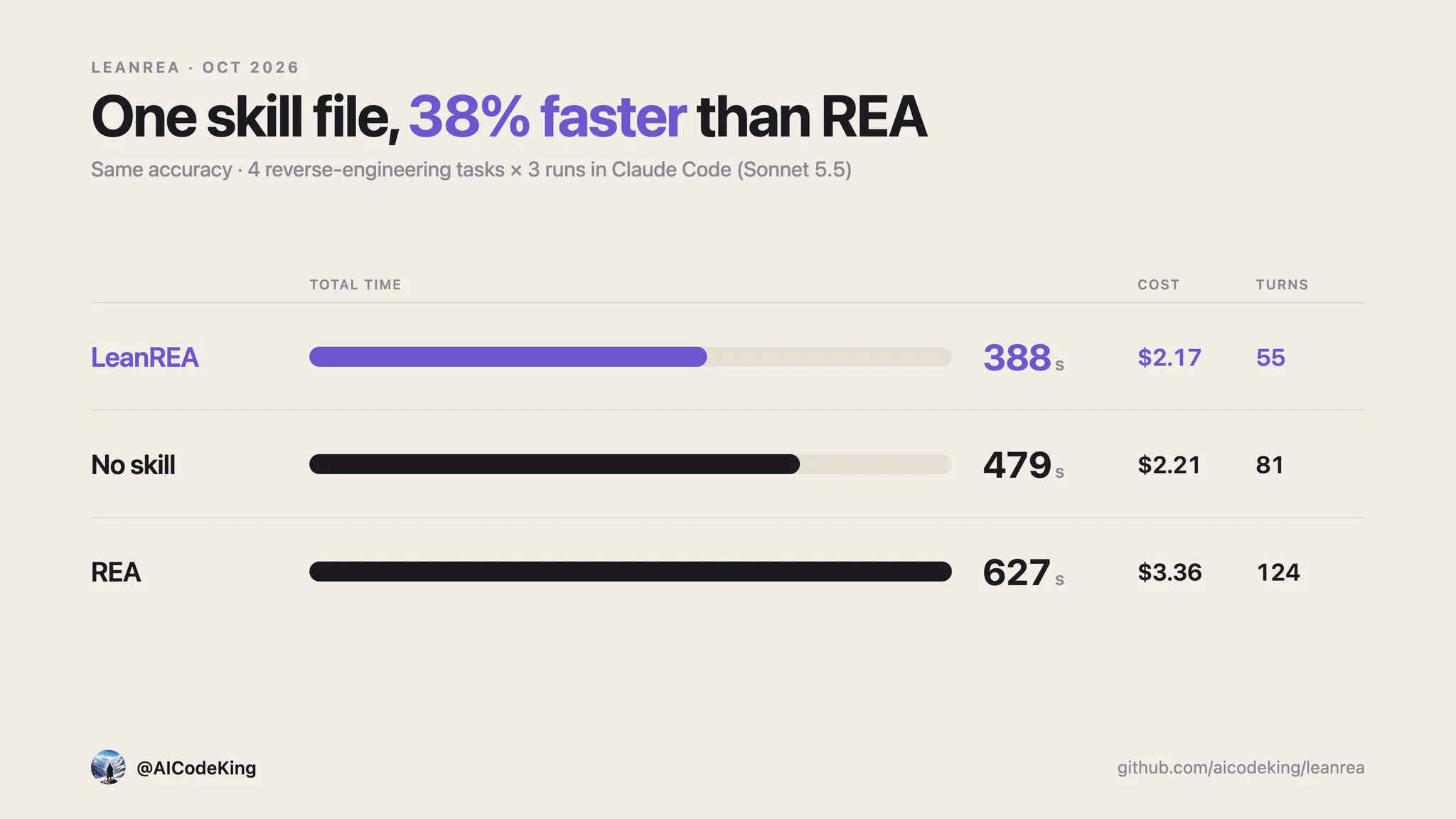
leanrea is an 8 KB skill file that tells a coding agent which plain CLI tools to use for reverse engineering, replacing the 207-tool REA MCP server. The author's test reports 38% faster, 35% cheaper, and a score of 74/75 against REA's 75/75. Caveats listed: 3 runs per task, one model, one machine, and Claude with no skill already performed decently. Replies question whether the lost point was a task where structured tool output beat parsing CLI text.
x.comthreadAdded 25 Oct 2026, published 23 Oct 2026  In Other News: Tor Exit Relays Hijacked, Banks Spot Rogue AI Agents, Self-Rebuilding macOS Ransomware
SecurityWeek's weekly roundup covers Heartbreaker, a Rust macOS ransomware that recompiles itself to change its hash, and 333 Tor exit relays running Ebury that redirected SSH logins to harvest passwords. It also covers APT28 Hookedge attacks on a NATO shipbuilder, the Railway and PingCAP breaches, ISO/IEC 27090 for AI threats, and US banks blocking unsanctioned AI agents.
securityweek.comarticlePublished and added 23 Oct 2026- x86rc/unthemidator
Unthemidator is an automated unpacker for binaries protected with Themida, Code Virtualizer and WinLicense (v3.0 to v3.2.6.0, experimental v4.0). It works without executing the target, handles x86 and x64 exe, dll and sys files, decrypts imports, restores the IAT, rebuilds the PE and identifies VM versions and entry points. It does not devirtualize or unmutate code. Releases cover Windows x64 and macOS Apple Silicon.
github.comrepoAdded 27 Oct 2026, published 23 Oct 2026  LiteLLM 1.107.0 Compromised: Python Startup Hooks Steal Cloud, AI, and Proxy Credentials | Endor Labs
litellm 1.107.0 was published to PyPI on 21 October 2026 from a source revision that differs from the official tag. One line in the Maturin config (data = "cook") installs cook.pth, cook.py and sitecustomize.py, which run on every Python start. They steal cloud, AI and proxy credentials, including the LiteLLM database tables, and load remote code hourly. The post gives IOCs, a five-step response plan and hardening advice.
 endorlabs.comwriteupPublished and added 21 Oct 2026
 litellm 1.107.0 Compromised on PyPI: Backdoored Wheels Drop a Credential Stealer and an Hourly Remote Code Loader
litellm 1.107.0 was published to PyPI on 21 October 2026 with all seven wheels backdoored through an injected `data = "cook"` maturin build line. The wheels drop cook.pth, cook.py and sitecustomize.py, which run on every Python start. They install a "privcollect" credential stealer (browser, SSH, cloud, AI coding tool and LiteLLM proxy database secrets, sent to litellm.dev) and an hourly GitHub dead-drop remote code loader. The post gives IOCs, detection commands and recovery steps.
stepsecurity.iowriteupPublished and added 21 Oct 2026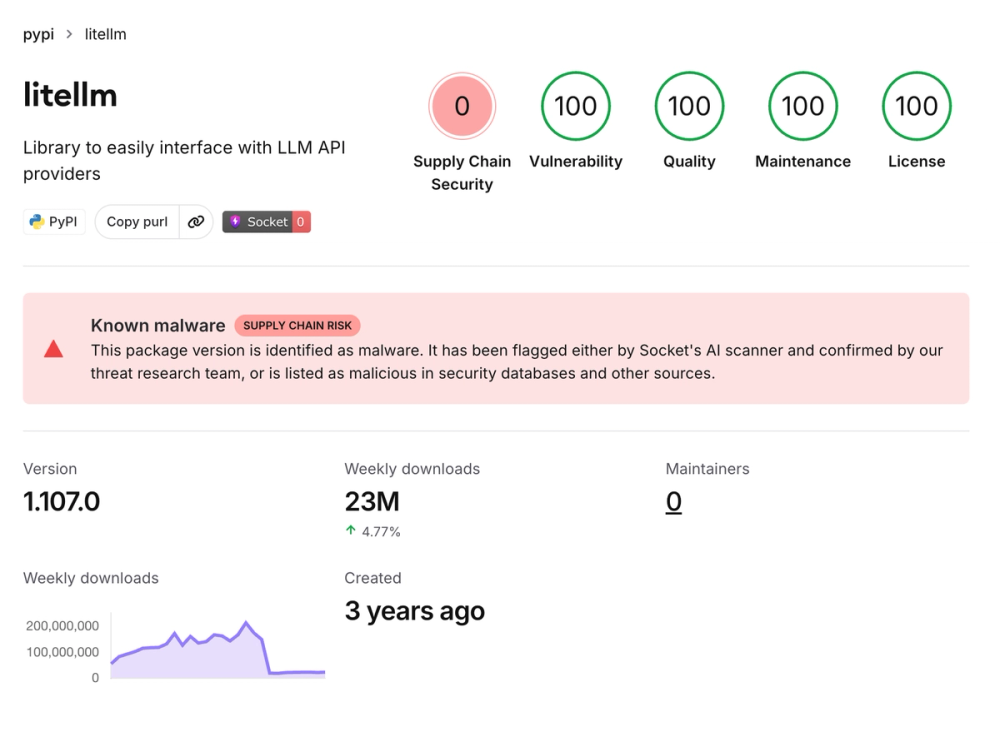 LiteLLM PyPI Package and Docker Images Compromised to Steal Cloud and AI Credentials
LiteLLM 1.107.0 on PyPI and GHCR images shipped Python startup hooks (cook.pth, sitecustomize.py) that steal cloud, SSH, browser and AI-tool credentials, including LiteLLM proxy database credentials. Image build provenance recorded a lookalike Berri-AI/litellm source repository. The post decodes the payload, encrypted exfiltration and GitHub-driven remote loader, and lists containment steps, MITRE ATT&CK mappings and IOCs.
socket.devwriteupPublished and added 21 Oct 2026 LiteLLM 1.107.0 PyPI Wheel Contains a Credential Stealer and Persistent Python Backdoor
LiteLLM 1.107.0 macOS x86-64 PyPI wheel analyzed by OpenSourceMalware contains three injected files (cook.pth, cook.py, sitecustomize.py) that run on every Python start. The payload, called privcollect, steals browser, SSH, cloud, CI/CD and AI-tool credentials, then uploads an AES/RSA-encrypted bundle to www.litellm.dev/healthcheck. A forked loader also fetches domain.txt from GitHub and executes /codepy hourly. The post lists IOCs, hashes and remediation steps.
opensourcemalware.comwriteupPublished and added 21 Oct 2026- Amazon-Themed ClickFix Campaign Serves Up Finger-Licking Malware
Huntress analysis of an Amazon-themed ClickFix campaign that used a Google sponsored result, a fake Amazon login on Google Sites and a fake CAPTCHA to make victims run the Windows finger utility. The .plan script drives IronPython, a Cyrillic-substituted Base64 Python loader, Doina, a Node.js stage, Lumma Stealer via sRDI, and a pirated NetSupport RMM. It lists C2 domains and gives detection tips (aclk/gclid markers, blocking the Run dialog).
 huntress.comwriteupPublished and added 21 Oct 2026
- Cyber Detective💙💛 (@cyb_detective) on X
Python Cybersecurity Libraries is a curated GitHub list by Yogsec, shared in a post by cyb_detective. It groups Python libraries by task: network analysis, penetration testing, threat intelligence, reverse engineering and malware analysis, forensics and investigation, web application security, CTF, and machine learning for security. The tweet shows only the category names, not the individual libraries.
x.comrepoAdded 24 Oct 2026, published 21 Oct 2026  From JavaScript to Renderer Code Execution: Three V8 Vulnerabilities and Two v8CTF Flags | depthfirst
Depth First Security's write-up describes three V8 bugs found using its dfs-large1 research tooling: CVE-2026-78938, a type confusion in Promise.prototype.finally that lets an internal helper be constructed and return a primitive; CVE-2026-79236, a TurboFan load-elimination bug that keeps a stale property-array pointer after object migration; and a shared WebAssembly memory sandbox escape (issue 546253900) caused by mismatched backing-store registration during serialization. It walks through turning each memory bug into addrof/fakeobj primitives, chaining either with the sandbox escape to reclaim a freed V8 isolate via a WebSocket allocation, and pivoting through a CFI-constrained ROP chain to achieve Chrome renderer code execution, earning two v8CTF flags. Fixes landed between August 20 and 25, 2026.
 depthfirst.comwriteupAdded 29 Oct 2026, published 20 Oct 2026
- ☣ KitPloit - Hacker Tools (@KitPloit) on X
DidierStevensSuite is a collection of Python scripts for malware analysis, file format parsing, hashing and forensic triage. It includes utilities for analysing PDF and OLE documents and for XOR-obfuscated data. The post is a short KitPloit announcement that links to the repository and gives no usage detail.
x.comrepoAdded 21 Oct 2026, published 20 Oct 2026 - Huda (@AlAssaf_H) on X
Source-level review of x64dbg-MCP, GhidraMCP and IDA Pro MCP security, dated October 2026. It covers GHSA-4478-h5jv-647m (missing authentication, 0.0.0.0 bind) and GHSA-jgj3-97w2-9v9r (Content-Length integer overflow before the token check, causing a DoS panic), and compares tags 1.0, v1.1 and v1.2. It separates network reachability, tool authority and semantic influence from hostile binaries. No new exploit is claimed.
x.comarticleAdded 21 Oct 2026, published 19 Oct 2026 - Panos Gkatziroulis 🦄 (@ipurple) on X
Malvex (JoasASantos/Malvex) is an AI-driven malware analysis framework that integrates more than 30 analysis tools, a web REPL and an MCP server. Panos Gkatziroulis shared it on 19 October 2026 and noted that it was written by AI. The tweet gives no detail on which tools are bundled or how the AI drives them.
x.comrepoAdded 22 Oct 2026, published 19 Oct 2026





Showing 30 of 239
Show more