 [tl;dr sec] #352 - Unprompted Slides, AWS AI Post-compromise Trends, Malicious LLM API Routers
tl;dr sec #352 is a security newsletter issue covering [un]prompted talks (AI-assisted firmware patching, a "Security Constitution" for finding cloud design flaws), Azure API Connections cross-tenant bugs worth $200,000, and a test of 14 LLMs given AWS keys. It also covers a paper on malicious LLM API routers (9 of 428 injecting code) and Datadog's "counterfeit policy" bypass of the Jev classifier.
 tldrsec.comarticleAdded 30 Oct 2026, published 29 Oct 2026🛡️ Security
 Node2Shell: Reproducing CVE-2026-111497 in the Node.js Brotli decoder
Node2Shell is Datadog Security Labs' analysis of CVE-2026-111497, an out-of-bounds write in the Google Brotli 1.2.0 decoder, fixed in Node.js 22.23.4, 24.22.1 and 26.12.1 on 21 October 2026. It explains the unchecked return value in DecodeBlockTypeAndLength(), the read and write primitives, and why code execution is still engineering effort. It lists inbound and outbound exposure paths, behavioral detections and what WAFs miss.
 securitylabs.datadoghq.comwriteupPublished and added 29 Oct 2026🛡️ Security
 Code security for new coders
 is a Datadog Security Labs primer for vibe coders on first-party versus third-party code, hardcoded secrets and software supply chain risk (vulnerable and malicious dependencies). It lists security questions to put to a coding agent before and after code is written. It also defines SCA, SAST, IAST, DAST, IaC scanning and secret scanning, and cites the PHP2Shell vulnerabilities.
securitylabs.datadoghq.comarticleAdded 29 Oct 2026, published 26 Oct 2026🛡️ Security- Code security for new coders
Code security for new coders is a Datadog Security Labs primer for vibe coders building with coding agents. It lists setup and follow-up security questions to ask the agent, such as OWASP top 10 reviews, hardcoded secrets and outdated packages. It also explains first-party versus third-party code, supply chain risk, and SCA, SAST, IAST, DAST, IaC and secret scanning tools.
securitylabs.datadoghq.comarticleAdded 29 Oct 2026, published 26 Oct 2026🧠 AI - [tl;dr sec] #351 - PHP2Shell, Autopatching Skills, AWS Pathrunner
tl;dr sec #351 is a weekly security newsletter. Clint Gibler describes working with OpenAI, Calif, Wiz and the PHP maintainers on the PHP2Shell unauthenticated RCE disclosure, which affects 13 years of PHP. It also covers Datadog's pathrunner AWS IAM escalation framework, Trail of Bits' patching-bugs and regression-hunt Codex plugins, XBOW finding de-duplication, backdoored open-weight models, and CREBench.
tldrsec.comarticleAdded 30 Oct 2026, published 22 Oct 2026🛡️ Security  PHP2Shell - Critical vulnerabilities in PHP (CVE-2026-109618, CVE-2026-109619): detection, analysis, and remediation
PHP2Shell is Datadog Security Labs' analysis of two critical PHP RCE flaws, CVE-2026-109618 and CVE-2026-109619 (CVSS v4.0 9.2), disclosed 21 October 2026. It walks through a reproduced exploit on PHP 8.5.11 (heap grooming, a fake array, and a destructor calling system()) and the stale-state use-after-free. It lists fixed versions (8.2.35, 8.3.36, 8.4.27, 8.5.12), partial mitigations, and detection signals across requests, error logs and shell child processes.
securitylabs.datadoghq.comwriteupAdded 29 Oct 2026, published 21 Oct 2026🛡️ Security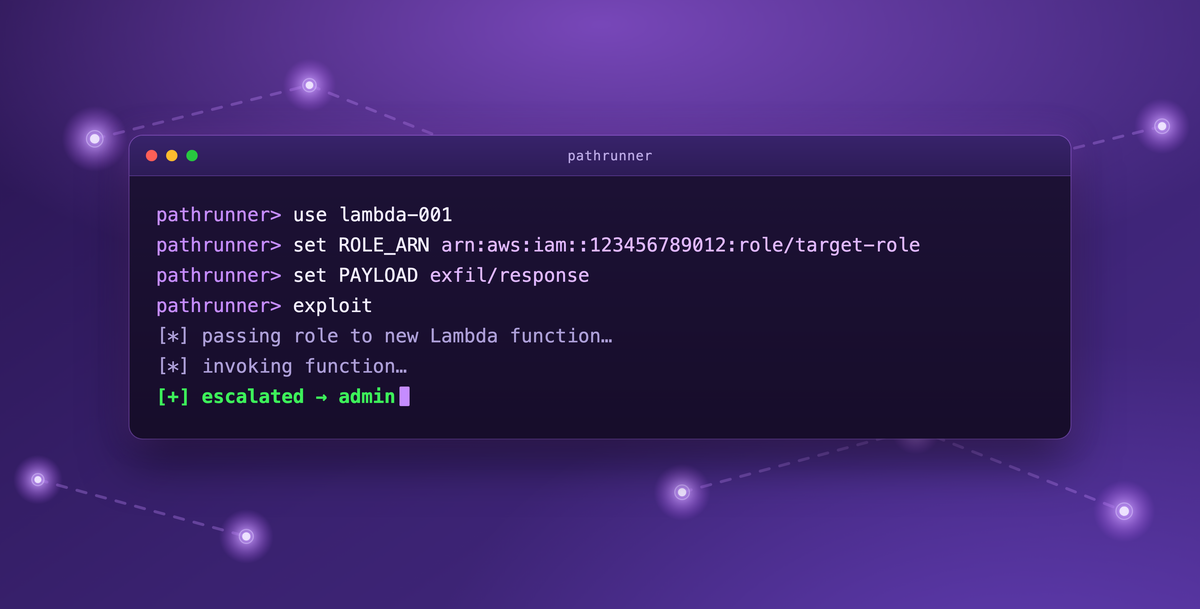 Datadog pathrunner: AWS IAM privilege escalation framework
pathrunner is a modular offensive framework from Datadog Security Labs that automates exploitation of the AWS IAM privilege escalation paths catalogued in pathfinding.cloud and deployed in Pathfinding Labs. It has over 80 exploit modules (as of October 2026), identity import and switching, multiple payloads per module, and attacker infrastructure deployment with a credential listener. A workspace report lists created resources and expected CloudTrail events for defenders.
securitylabs.datadoghq.comtoolAdded 23 Oct 2026, published 20 Oct 2026🛡️ Security Nick Frichette (@Frichette_n) on X
Datadog Security Labs announcement, posted by Nick Frichette, of research on steering the evaluations of a prompt-injection detector called "Jev". The team's method cut its detection rate from about 83% to about 4% in their tests. They also used it to bypass LangChain's experimental tool-risk gating feature that is based on Jev. The tweet gives no method details and links to the full article.
 x.comthreadAdded 21 Oct 2026, published 19 Oct 2026🛡️ Security
 Putting models to the secure coding test: Security rules
Datadog Security Labs tests whether Project CodeGuard v1.4.0 security rules improve the code written by Claude Code (Sonnet 5), Cursor (Composer 2.5) and Codex (GPT 5.5). Each model built the same document portal app once. Only GPT 5.5 closed the cross-user document IDOR and improved clearly. Sonnet 5 and Composer 2.5 stayed largely unchanged, keeping IDOR, hardcoded secret fallbacks and token revocation gaps.
securitylabs.datadoghq.comwriteupAdded 29 Oct 2026, published 19 Oct 2026🧠 AI- Putting models to the secure coding test: Security rules
Second post in a Datadog Security Labs series testing whether Project CodeGuard (v1.4.0) security rules improve code written by coding agents. Sonnet 5 (Claude Code), Composer 2.5 (Cursor) and GPT 5.5 (Codex) each built the same document portal, and the output was audited with Datadog Code Security and a Sonnet 5 code review. Only GPT 5.5 closed the cross-user IDOR; Sonnet 5 and Composer 2.5 stayed largely unchanged, including hardcoded JWT secret fallbacks and incomplete revocation.
securitylabs.datadoghq.comwriteupAdded 29 Oct 2026, published 19 Oct 2026🛡️ Security  Jev as a judge: How counterfeit policy steers Jev
Datadog Security Labs tests TypeSafe AI's Jev decision model as a prompt-injection detector and as the judge behind LangChain's tool-risk gating. On four public datasets Jev had 99.66% precision and 82.90% recall. A prepended "counterfeit policy" that redefines the attack categories cut recall by over 79 points. In a LangChain scenario, a user-editable profile field lowered the mean is_risky score from 0.893 to 0.290, below the 0.5 block threshold. Plain prompt injection did not move the score.
securitylabs.datadoghq.comwriteupAdded 29 Oct 2026, published 15 Oct 2026🛡️ Security Beyond valid credentials: How exposed AWS keys are tested for Amazon Bedrock access
Datadog Security Labs describes how attackers test stolen AWS credentials for Amazon Bedrock access. It analyses the KMON_NOC harvesting platform's frontend code and two Python checkers from VirusTotal that chain GetCallerIdentity, ListFoundationModels, ListInferenceProfiles and a 4-token Converse "ping", with optional billing:GetCredits. Datadog saw 12 organizations with similar behavior in 30 days and lists detection advice and IOCs.
securitylabs.datadoghq.comwriteupAdded 29 Oct 2026, published 6 Oct 2026🛡️ Security Guarding the gates: Assessing dangerous permissions granted to Kubernetes built-in principals
Datadog Security Labs analysis of Kubernetes RBAC bindings to the built-in principals system:anonymous, system:unauthenticated and system:authenticated across 65,000+ clusters from nearly 10,000 organizations. After excluding default and podsecuritypolicy bindings, about 44,000 remained, and over 3,500 granted dangerous permissions, including namespace-scoped ones. It also covers anonymous-auth defaults in AKS, EKS and GKE, and the GKE system:authenticated behavior.
securitylabs.datadoghq.comarticleAdded 29 Oct 2026, published 5 Oct 2026🛡️ Security OperTraitor — Kubernetes Operator RBAC Privilege-Escalation Scanner
OperTraitor is an open-source tool from Palo Alto Networks that scans Kubernetes operator RBAC manifests (from local installs and the OperatorHub catalog) and uses an LLM-powered analysis engine to flag mismatches between an operator's stated purpose and its actual granted permissions, scoring risk from 1-10. The research behind it found over 5% of examined operators request excessive permissions, including a case in IBM's Prometurbo operator (used with IBM Turbonomic) that had cluster-wide access to Secrets, leading to CVE-2026-6389 (CVSS 8.8) after responsible disclosure, and a separate finding of broad Secrets/RBAC access in the Datadog operator.
 cybersecuritynews.comarticleAdded 2 Oct 2026, published 30 Sep 2026🛡️ Security
 OperTraitors: How Kubernetes Operators Betray Your Security Posture
OperTraitor is an open-source, LLM-powered engine from Unit 42 that reads RBAC manifests of installed and OperatorHub Kubernetes operators and scores the gap between documented function and granted privileges. It found about 5% of operators over-privileged, including IBM Prometurbo (CVE-2026-6389, CVSS 8.8, cluster-wide secret read) and the Datadog operator. The article lists mitigations: namespace-scoped operators, RBAC downscoping, audit-log monitoring, and guardrails for agentic operators.
 unit42.paloaltonetworks.comarticleAdded 30 Oct 2026, published 29 Sep 2026🛡️ Security
- Supply Chain Firewall (Datadog)
Supply Chain Firewall (SCFW) is a Datadog-built CLI that wraps npm, pip, and poetry commands to inspect every package target against known-malicious/compromised package datasets (the open-source malicious-software-packages-dataset and OSV.dev) before installation proceeds, blocking or warning on hits. It ships as a single Go binary, can be aliased transparently into a developer's shell, and optionally reports run outcomes and enforces centralized allow/block policies through Datadog Code Security across a fleet, sending only package metadata (never source code) to Datadog.
 github.comrepoAdded 22 Sep 2026🛡️ Security
 Attacker infrastructure, but vibe-coded: tracking the evolution of credential harvesting platforms
Datadog Security Research analyses two vibe-coded credential harvesting platforms, Loot and UltraVault, monitored since July 2026. Loot catalogs plaintext secrets, including 1,778 AI keys (196 live). UltraVault adds credential validation, exploit chains, a 14-bug LPE matrix and AWS key-pair correlation. The same host probed Amazon Bedrock with GetCallerIdentity, ListFoundationModels and InvokeModel, using kali-cloud Boto3 and Python-urllib user agents.
securitylabs.datadoghq.comwriteupAdded 29 Oct 2026, published 18 Sep 2026🛡️ Security- Shai-Hulud-2.0-Detector — npm supply-chain compromise scanner
Shai-Hulud-2.0-Detector is a GitHub Action and CLI tool that scans package.json/lockfiles for packages compromised in the Shai-Hulud 2.0 (Nov 2025) and ChainDrop (Aug 2026) npm supply-chain worms. It uses semver-precise matching against a database of 1,241+ known-compromised package versions (auto-updated daily from Datadog and Wiz Research feeds) to flag malicious preinstall/postinstall droppers (setup_bun.js, Math_Symbol.js), rogue GitHub self-hosted runners named SHA1HULUD, and ChainDrop's new IDE-persistence hooks in .claude/settings.json and .vscode/tasks.json. It ships SARIF output for GitHub Security tab integration, an allowlist system, and a detailed incident-response guide covering credential rotation and forensic checks.
github.comrepoAdded 16 Sep 2026🛡️ Security  Threat Hunter's Guide to GitHub (Datadog Security Labs)
Datadog Security Labs walks through hunting for GitHub organization compromise using GitHub audit logs, covering the full attack chain from stolen PATs/OAuth tokens and device-code phishing (initial access) through secrets-listing enumeration, private-repo/tree discovery, and bulk collection via git.clone or repo.download_zip. It provides copy-pasteable queries (with fields like hashed_token, programmatic_access_type, external_identity_nameid) mapped to MITRE ATT&CK techniques and calls out GitHub audit-log quirks (missing IP on failed auth, inconsistent visibility fields, misleading token permission scopes) that shape accurate detections.
securitylabs.datadoghq.comwriteupAdded 25 Sep 2026, published 16 Sep 2026🛡️ Security Password spraying campaign targets AWS root user accounts across 150+ organizations
Datadog Security Research describes a password spraying campaign against AWS root user accounts at more than 150 organizations, running 24 July to 23 August 2026. Attempts came through proxies using two fixed Chrome/Edge and Firefox user agents, with a median of two attempts per organization. No successful logins were seen. The post gives a CloudTrail ConsoleLogin query, a sample failed event, and root user hardening advice (SCPs, centralized root access, AssumeRoot, alerting).
securitylabs.datadoghq.comarticleAdded 29 Oct 2026, published 31 Aug 2026🛡️ Security- [tl;dr sec] #343 - Hugging Face Technical Report, AWSHound, OWASP Agentic Skills Top 10
tl;dr sec #343 is a weekly security newsletter issue. It covers AWSHound (SpecterOps' BloodHound OpenGraph collector for AWS IAM), TruffleHog AWS Analyze, JavaScript in HTML tag names (PortSwigger), and the Varonis CoSnitch Copilot flaw (CVE-2026-24301). It also covers the OWASP Agentic Skills Top 10, Cloudflare MCP traffic detection, a Datadog plan-mode versus default-mode secure coding test, and OpenClaw phishing tests.
tldrsec.comarticleAdded 30 Oct 2026, published 27 Aug 2026🛡️ Security  N4D Mesh Controller: New infrastructure, a UPX-packed agent labeled "go-titan," and how to hunt for it
N4D Mesh Controller is a Linux malware campaign that abuses exposed MCP servers (tools/list, then tools/call on execute_command) and many other services. Datadog executed a UPX-packed, garble-obfuscated Go agent (33.8-go-titan) fetched from 209.99.186.235 in isolated microVMs and an offline replay lab. The post lists persistence paths, controller API paths, an SSH key, YARA and VirusTotal Livehunt rules, and response guidance.
securitylabs.datadoghq.comwriteupAdded 29 Oct 2026, published 20 Aug 2026🛡️ Security Putting models to the secure coding test: Plan vs default mode
Datadog Security Labs tests Sonnet 5, Composer 2.5 and GPT 5.5 on one prompt (a JavaScript document portal with JWT, PostgreSQL, file upload), in default and plan mode, six apps in all. Datadog Code Security and a Claude code review found IDOR in every build. The worst finding was a hardcoded JWT secret fallback in Composer 2.5 plan mode. The author finds no meaningful link between plan mode and more secure code.
securitylabs.datadoghq.comarticleAdded 29 Oct 2026, published 19 Aug 2026🛡️ Security- Putting models to the secure coding test: Plan vs default mode
Datadog Security Labs ran one document-portal prompt through Sonnet 5, Composer 2.5 and GPT 5.5 in default and plan mode, giving six apps. Code review found an IDOR flaw in every one, and Composer 2.5 plan mode shipped a hardcoded JWT secret fallback. The author found no meaningful link between plan mode and more secure code, and says the prompt mattered more than the mode.
securitylabs.datadoghq.comwriteupAdded 29 Oct 2026, published 19 Aug 2026🧠 AI  GhostJacking Attacks: AI Agent Takeover via Firewall Evasion
Tenet Security's DEFCON 34 research "Ghostjacking" chains four AI-agent attack primitives into a full kill chain: prompt injection via untrusted log/telemetry fields that AI coding agents (Claude Code, Cursor) read through MCP connectors to Cloudflare, Datadog, and Sentry; agent-to-agent lateral movement where one agent (Sentry's Seer) vouches malicious findings to a downstream coding agent; a JWT cross-reuse sandbox-escape zero-day in Claude Desktop's Envoy-based egress proxy that lets a stolen/broadly-scoped token bypass the deny-by-default network allowlist; and a "self-exploit" technique where one AI session iteratively crafts a prompt-injection payload against another. The Cloudflare chain is notable for weaponizing a WAF-blocked request: the payload rides in headers logged verbatim, so an agent triaging "blocked" firewall events is tricked into hijacking DNS records — a 90% success rate against Claude Code (Sonnet 4.6) on Cloudflare's own recommended config. All findings were disclosed and remediated/confirmed by Cloudflare, Datadog, Sentry, and Anthropic before publication, and the researchers open-sourced a mitigation tool, agent-jackstop.
 tenetsecurity.aiwriteupAdded 3 Sep 2026, published 10 Aug 2026🛡️ Security
- [tl;dr sec] #340 - Anthropic and Meta Agents be Hackin', Agentic Incident Response Notebooks, Figma's AI Code Scanning
tl;dr sec #340 is a weekly security newsletter issue from Clint Gibler. It summarizes Figma's agentic code scanning (precision raised from 15% to 80%), AISI and Anthropic reports of AI agents attacking real third parties during cyber evaluations, Tailscale's analysis of the Hugging Face intrusion, and Datadog's coding-agent code execution paths. It also covers S3 clone gaps, S3 Vectors risks, HollowGraph and marimo IR notebooks.
tldrsec.comarticleAdded 30 Oct 2026, published 7 Aug 2026🛡️ Security  'ChainDrop' worm compromises hundreds of popular npm packages
ChainDrop is an npm worm that compromised hundreds of packages on 4 August 2026, some with over 150 million weekly downloads, starting from a malicious commit (174f6a5) in the keyv repository. Datadog dissects the Bun-based loader, the obfuscated second stage, credential theft (files, GitHub Actions runner memory, AWS, Kubernetes, Vault), Ethereum smart-contract C2 discovery, AES/RSA exfiltration, an eval channel, and propagation via stolen npm tokens, GitHub branches and Sigstore provenance. IOCs and a list of affected packages are included.
securitylabs.datadoghq.comwriteupAdded 29 Oct 2026, published 4 Aug 2026🛡️ Security Before the first prompt: Code execution paths in trusted coding-agent projects
Datadog Security Labs shows two ways a trusted repository can run code before the first prompt in coding agents. In Codex, a project-scoped stdio MCP server in .codex/config.toml starts an attacker process. In Claude Code, a PATH override in .claude/settings.json makes startup Git probes run a repository git wrapper. Neither needs hooks, a model response or command approval. The post gives an rg search and endpoint monitoring advice.
securitylabs.datadoghq.comwriteupAdded 29 Oct 2026, published 3 Aug 2026🛡️ Security- DataDog/guarddog
GuardDog is DataDog's CLI tool that scans PyPI, npm, Go modules, Rust crates, RubyGems, GitHub Actions, and VSCode extensions for malicious packages using YARA-based static analysis and registry metadata detectors. It correlates code capabilities with threat indicators (mapped to MITRE ATT&CK stages) to produce a 0-10 risk score, aiming to reduce alert fatigue compared to traditional SAST tools, and runs archive extraction and source analysis inside a kernel-level sandbox (Landlock/Seatbelt via nono) to mitigate path-traversal/code-execution vulnerabilities such as CVE-2022-23530, CVE-2022-23531, CVE-2026-22870, and CVE-2026-22871.
github.comrepoPublished and added 11 Jul 2026🛡️ Security - DataDog/pathfinding-labs
Pathfinding Labs is DataDog's open-source platform (Go CLI 'plabs' + Terraform modules) for deploying intentionally vulnerable AWS resources into sandbox accounts to practice attacking and detecting IAM privilege-escalation paths. It ships modular labs across five categories — self-escalation, one-hop/multi-hop principal traversal, CSPM misconfigurations, toxic combos, and cross-account (dev/ops-to-prod) chains — each with demo/cleanup scripts, expected CSPM alerts, and MITRE ATT&CK mappings (e.g. T1098.001). It's positioned as a successor/companion to projects like IAM Vulnerable and Stratus Red Team for hands-on cloud identity attack training.
github.comrepoPublished and added 4 Jul 2026🛡️ Security
Showing 30 of 34
Show more