- Hackers hijack a dozen DeFi websites, all registered with Name.com, and steal about $138,000
Twelve DeFi websites, including Flap, Kintsu, Pickle Finance and Origami Finance, were hijacked on 30 October 2026 and served the Step Drainer kit. All 12 domains use Name.com as registrar, and 10 were suspended. The Block traced about $138,000 stolen to three EVM wallets, excluding Solana and Aptos losses. Kintsu and Origami blame Vercel. Projects say their onchain contracts were untouched.
 theblock.coarticlePublished and added 31 Oct 2026🛡️ Security
 How the Binance hack happened on-chain on Ethereum
Protos analysis of how the Binance hack played out on Ethereum. The attacker deployed a sweeper contract and sent 50 EIP-7702 authorizations for the Binance 14 hot wallet, signed with its key and using varied nonces to match the wallet's changing count. Other wallets and EVM chains used plain transfers. Binance later removed the delegation, and about $2.4 billion in funds was frozen or blacklisted.
 protos.comarticlePublished and added 30 Oct 2026🛡️ Security
 Rekt - Initia - Rekt
Rekt News post-mortem of the 23 October 2026 Initia exploit. A MoveVM script-caching bug let an attacker credit unbacked WETH, iUSD, AUSD0 and USDC without raising total supply, and bridges paid out about $2.73 million (1.4 million AUSD, 105 ETH, 1.08 million USDC). It includes 0xCanzi's local replay of a stale cached verification, the on-chain laundering timeline, and the Foundation's backing-restoration pledge.
 rekt.newsarticleAdded 29 Oct 2026🛡️ Security
 Lean verification of EIP-7002: system-call success and FIFO requests
Lean 4 proofs about the 504-byte EIP-7002 withdrawal-request contract on Ethereum, checked against the Jaune EVM semantics for Prague, Osaka, BPO1 and BPO2. The end-of-block system call always succeeds, using at most 210,000 gas. Requests leave in FIFO order. The post also gives counterexamples: code at the system address drains the queue, and the bytecode's 256-bit fee can undercut the EIP's fee.
 ethresear.chwriteupPublished and added 26 Oct 2026🛡️ Security
- Jetwani Avinash (@jetwaniavinash) on X
Announcement of jevmem, an open-source MIT plugin that gives Claude Code, Cursor and Codex persistent project memory. After each turn it asks Jev (a TypeSafe AI model) whether anything is worth keeping (a rule, decision, failure, or to-do) and writes one line to a plain Markdown file tracked in git. It also checks commands against saved rules before they run and asks first, or blocks. Reported results: Claude followed the rule in 66 of 72 sessions vs 28 without it, the right save/skip call on 98.5% of 66 turns, and 66 of 68 rule-breaking commands caught out of 274 test commands. Listed in Anthropic's Claude plugin directory and on the MCP Registry.
 x.comthreadPublished and added 10 Oct 2026🧠 AI
 Trust minimized transaction simulation using state proofs
An ethresear.ch post proposing "verified prestate simulation": wallets fetch the prestate a transaction will touch via debug_traceCall's prestateTracer, confirm unanimous state-root agreement across multiple independent RPC nodes, verify each account/storage value with eth_getProof Merkle Patricia Trie proofs, and only then execute the transaction locally with revm to produce trustworthy simulation results. It targets a concrete wallet attack where a compromised simulation API/RPC provider shows a benign fake trace (e.g. "donate to charity") while the real calldata drains a user's funds, and discusses its limitations (prestate-completeness not yet verified, conditional-logic and MEV evasion still possible) as a pragmatic alternative to full light clients.
ethresear.chwriteupPublished and added 1 Oct 2026🛡️ Security Solidity 0.8.37 Release Announcement
Official release notes for Solidity v0.8.37 detailing three bug-bounty-reported compiler bugs: memory `delete` on a bytes-array element zeroing a full 32-byte word instead of one byte (corrupting adjacent memory, evmasm pipeline, up to v0.8.36); a stack-to-memory spill-slot collision under mutual recursion in the IR pipeline (`--via-ir`, v0.7.2–v0.8.36) that silently overwrites live variables; and named custom-error arguments in `require(...)` being ABI-encoded in call-site order rather than declaration order, so revert data misrepresents error values (v0.8.36 introduced but only affects revert data). Also covers two non-security miscompilations (uninitialized packed function pointers, checked/unchecked constant reuse), a new SSA-CFG stack shuffler, Amsterdam EVM's SLOTNUM opcode support, and removal/deprecation of LSP mode, Generic Solidity, and several EVM version pragmas.
 soliditylang.orgadvisoryAdded 29 Sep 2026🛡️ Security
 Bitget Hacked for $351.6M
Bitget disclosed a $351.6M hot-wallet breach in which attackers did not compromise private keys but instead breached a core wallet backend and spoofed transaction data to trick Bitget's own authorization process into approving transfers. Attackers quickly converted most stolen EVM assets into 67,982 ETH (~$183M) and also took ~103M XRP to move into harder-to-freeze native assets, while Bitget's CEO and independent researcher Specter linked the attack to North Korea via VPN IP overlap and onchain infrastructure tied to the earlier AFX exploit attributed to TraderTraitor.
 bankless.comarticleAdded 8 Oct 2026, published 25 Sep 2026🛡️ Security
- Formal Verification of Execution and Consensus Clients
A reply on the Ethereum Research forum (ethresear.ch) responding to @pcaversaccio's call for formally verifying hard-fork changes in Ethereum execution and consensus clients before mainnet activation. It surveys current formal-verification efforts (Etheorem/SizzLean in Lean 4 for consensus/SSZ, Verifereum in HOL4 for the EVM), argues for prioritizing high-leverage surfaces like SSZ, state transition, fork-choice and core EVM semantics, and pushes for stronger verification tooling in Rust (Aeneas/Verus/hax) as an incremental path to reducing the trusted computing base of client software.
ethresear.chthreadAdded 29 Sep 2026, published 25 Sep 2026🛡️ Security - Memory Byte Array Element Delete Clears Whole Word Bug
The Solidity team disclosed a code-generator bug (reported by Shaheen Fazim via the Ethereum Foundation bug bounty program) where `delete b[i]` on a bytes/string element located in memory incorrectly writes a full 32-byte zero word instead of a single byte, corrupting up to 31 subsequent bytes — either later elements of the same array or, for elements near the array's end, adjacent memory allocations like other variables. The bug affects only the default evmasm pipeline (not the IR pipeline via --via-ir) in all versions up to and including 0.8.36, is fixed in 0.8.37, and the equivalent assignment `b[i] = 0` is unaffected and serves as a workaround. A Sourcify scan of ~870,000 verified compilations found the triggering pattern in only two functions, neither actually exploitable in practice.
soliditylang.orgadvisoryAdded 29 Sep 2026, published 10 Sep 2026🛡️ Security - Solidity 0.8.37 Release Announcement
Solidity 0.8.37 release notes disclosing three EF bug-bounty-reported compiler bugs with security implications: deleting an element of a memory bytes array (or converted string) zeroed the full 32-byte word instead of one byte, corrupting adjacent data in the evmasm pipeline (all versions ≤0.8.36); a stack-to-memory spill-slot collision in mutually recursive functions under --via-ir silently overwrote live variables (0.7.2–0.8.36); and require() with a custom error using named arguments encoded parameters in call-site rather than declaration order, producing structurally valid but semantically wrong revert data. The release also adds two non-security miscompilation fixes, an experimental planning-based stack shuffler for the SSA CFG backend, support for the Amsterdam EVM's SLOTNUM opcode (EIP-7843), and removes/deprecates several experimental features.
soliditylang.orgadvisoryAdded 29 Sep 2026, published 10 Sep 2026🛡️ Security - PlamenTSV/plamen
Plamen is an open-source Python orchestrator that drives 18-100 Claude Code or OpenAI Codex CLI agents across 40+ phases to autonomously audit smart contracts (EVM/Solidity, Solana/Anchor, Aptos Move, Sui Move, Soroban, DAML/Canton) and L1 node-client infrastructure (Go/Rust consensus, p2p, mempool code), producing a severity-tiered AUDIT_REPORT.md with verified proof-of-concept exploits for each finding. It integrates MCP servers for Slither, ChromaDB and Solodit, ingests vulnerability corpora from Solodit, DeFiHackLabs and Immunefi to ground findings, and runs a PTY-supervised worker-pool architecture with checkpoint/resume, artifact-based completion gating, and a dedicated L1 mode with consensus-invariant and network-surface depth agents.
 github.comrepoPublished and added 7 Sep 2026🛡️ Security
- Pyro (@0x3b33) on X
A roundup of three open-source AI-assisted smart contract security scanners: pashov/skills (solidity-auditor + x-ray pre-audit + fuzz suite generation, fast/cheap feedback), PlamenTSV's autonomous 8-phase agent covering EVM, Solana, and Move that ships PoCs with findings, and Trail of Bits' skills repo with 40+ security skills for contract audits, differential review, and static analysis. Useful pointer to emerging AI-agent-based smart contract auditing tooling.
x.comthreadPublished and added 7 Sep 2026🛡️ Security - SKANF
SKANF is a static and symbolic analysis tool that finds asset-management vulnerabilities in closed-source or obfuscated EVM smart contracts by fetching deployed bytecode from a JSON-RPC endpoint and locating attacker-reachable sensitive external calls (e.g. ERC-20 transfer/transferFrom/approve on tokens like USDT or WBTC). Beyond detection, it includes an exploit-generation phase that symbolically synthesizes calldata satisfying a verified vulnerability's preconditions and replays it against a forked EVM to confirm real balance changes. It builds on custom forks of the greed symbolic execution engine and the Gigahorse decompiler, and accompanies the ACM CCS 2026 paper "Insecurity Through Obscurity: Veiled Vulnerabilities in Closed-Source Contracts."
github.comrepoPublished and added 21 Aug 2026🛡️ Security - EVMBench Leaderboard
EVMBench Leaderboard aggregates self-reported vendor results on OpenAI's EVMBench, a benchmark of 117 ground-truth vulnerabilities drawn from 40 real Code4rena smart-contract audit contests. It defines a canonical evaluation protocol requiring the unmodified openai/frontier-evals task runner and the complete, unfiltered audit repository, comparing agents like Nethermind AuditAgent and Guardix by recall against the full ground-truth finding set.
 testmachine.aiotherAdded 3 Sep 2026, published 31 Jul 2026🛡️ Security
- Web3 Security Tools Hub
A curated GitHub repo cataloging AI tools for smart-contract security auditing, split into free/open-source and paid/closed-source categories and organized by chain/language: Solidity/EVM, Rust/Solana, Move/Sui, ZK/Circom, and multi-language tools. Maintained by pashov, it's meant as a directory for finding AI-assisted auditing tooling rather than a single tool itself.
github.comrepoAdded 3 Sep 2026, published 31 Jul 2026🛡️ Security  Solidus: Formally Verifying a Compiler Using Automated Research
Paradigm introduces Solidus, a project to build a formally verified Solidity-to-EVM compiler written in Lean, aimed at eliminating compiler-bug vulnerabilities like the one behind a $50M+ smart contract hack in July 2023. The already-verified Yul-to-EVM backend (built on a modified fork of Nethermind's Yul/EVM semantics, comparable to Powdr's yul-compiler) was produced almost entirely through ~1,700 hours of agentic "automated research" using Codex, GPT-5.6, Harmonic's Aristotle prover, and Claude Fable 5, with no human writing code. Two public challenges are launched: "Spec Hunt" to find divergences between the new solidity-lean formal semantics and real Solidity behavior (via Foundry-based PoCs reviewed by an AI agent), and a compiler-optimization challenge requiring submissions to shrink bytecode size while preserving the existing correctness proof.
 paradigm.xyzarticleAdded 4 Oct 2026, published 24 Jul 2026🛡️ Security
- Solidus: Formally Verifying a Compiler Using Automated Research
Paradigm describes Solidus, a project to build a formally verified Solidity compiler in Lean, built almost entirely via autonomous AI agent research loops (Codex running GPT-5.6 for ~1,700 hours, plus Harmonic's Aristotle proof assistant and Claude Fable 5) with no human writing or reading code. The piece details the verified Yul-to-EVM backend, a new formal semantics for Solidity, the engineering/proof tradeoffs that still required human judgment (spec drift, proof architecture choices), and two public 'Solidus challenges' (Spec Hunt and Compiler Optimization) inviting contributors to extend the work, with AI agents reviewing submissions. It's a concrete case study of long-horizon agentic research combined with formal verification (Lean) as a mechanism for trustless collaboration and optimization.
paradigm.xyzarticleAdded 4 Oct 2026, published 24 Jul 2026🧠 AI - BountyForge
BountyForge is a Claude Code skill that spins up 8 specialized agents in parallel to hunt for vulnerabilities across web/API, smart contracts (EVM, Move, Solana, TRON), infrastructure, and supply-chain targets, then deduplicates and runs findings through a four-gate validation pipeline (Refutation, Reachability, Trigger, Impact) before CVSS-scoring them into submission-ready HackerOne/Bugcrowd/Intigriti/Immunefi reports. It orchestrates local tools (nmap, ffuf, sqlmap, amass, ZAP, Burp Suite) when Claude Code execution is enabled, integrates with a companion `bug-bounty-intelligence-mcp` MCP server for Solidity scanning via "Al-Mizaan v3" 7-gate deep validation, and also offers a paid Firecracker-microVM cloud version at bountyforge.xyz.
github.comrepoPublished and added 22 Jul 2026🛡️ Security - Awesome AI Web3 Security
A curated, verified awesome-list of AI-powered tools for smart contract and blockchain security, covering autonomous auditor agents (Hound, Plamen, Aether, SolidityGuard), commercial AI audit platforms (Sherlock AI, Cantina Apex, Zellic V12, Nethermind AuditAgent), MCP-based auditing plugins (Trail of Bits Skills, Claudit, Slither MCP, Solodit MCP Server), real-time on-chain ML monitoring (Forta Network, AnChain.AI), and benchmark/training datasets (EVMbench, SCONE-bench, ScaBench, SmartBugs). Every entry requires a real AI/ML/LLM component plus a specific Web3 security focus, with open-source entries needing 25+ GitHub stars, positioning it as a practical index for the emerging AI-driven smart-contract-audit tooling ecosystem.
github.comrepoAdded 3 Sep 2026, published 18 Jul 2026🛡️ Security - EVM Hack PoC
A public GitHub repository aggregating proof-of-concept exploit archives for EVM (Ethereum Virtual Machine) smart contract hacks, generated from the companion evm-hack-registry dataset and meant to be consumed by the evm-hack-analyzer tool. It's positioned as raw material for blockchain security research, education, and building automated PoC-analysis tooling rather than a single vulnerability writeup.
github.comrepoAdded 3 Sep 2026, published 18 Jul 2026🛡️ Security - EVM Hack Analyzer
EVM Hack Analyzer is a static, backend-free, in-browser debugger that forks chain state at a historical transaction, replays it in an in-browser EVM (@ethereumjs/vm), pulls verified Solidity sources from Etherscan, and produces a pc-to-source-line map so researchers can step through a real exploit opcode-by-opcode or line-by-line. It supports both native replay of a historical tx hash and loading pre-built scripted exploit ZIPs from the companion evm-hack-poc dataset (mirroring DeFiHackLabs and crypto.training/hacks), letting users annotate the vulnerable line and exploit steps, then export/share a self-contained PoC via ZIP or IPFS. It's aimed at smart-contract vulnerability research and community-sourced exploit PoC archiving, entirely client-side with no server or persistent backend required.
github.comrepoAdded 3 Sep 2026, published 18 Jul 2026🛡️ Security - Inside the RaaS Ecosystem: Operators, Affiliates & Attack Tradecraft | Huntress
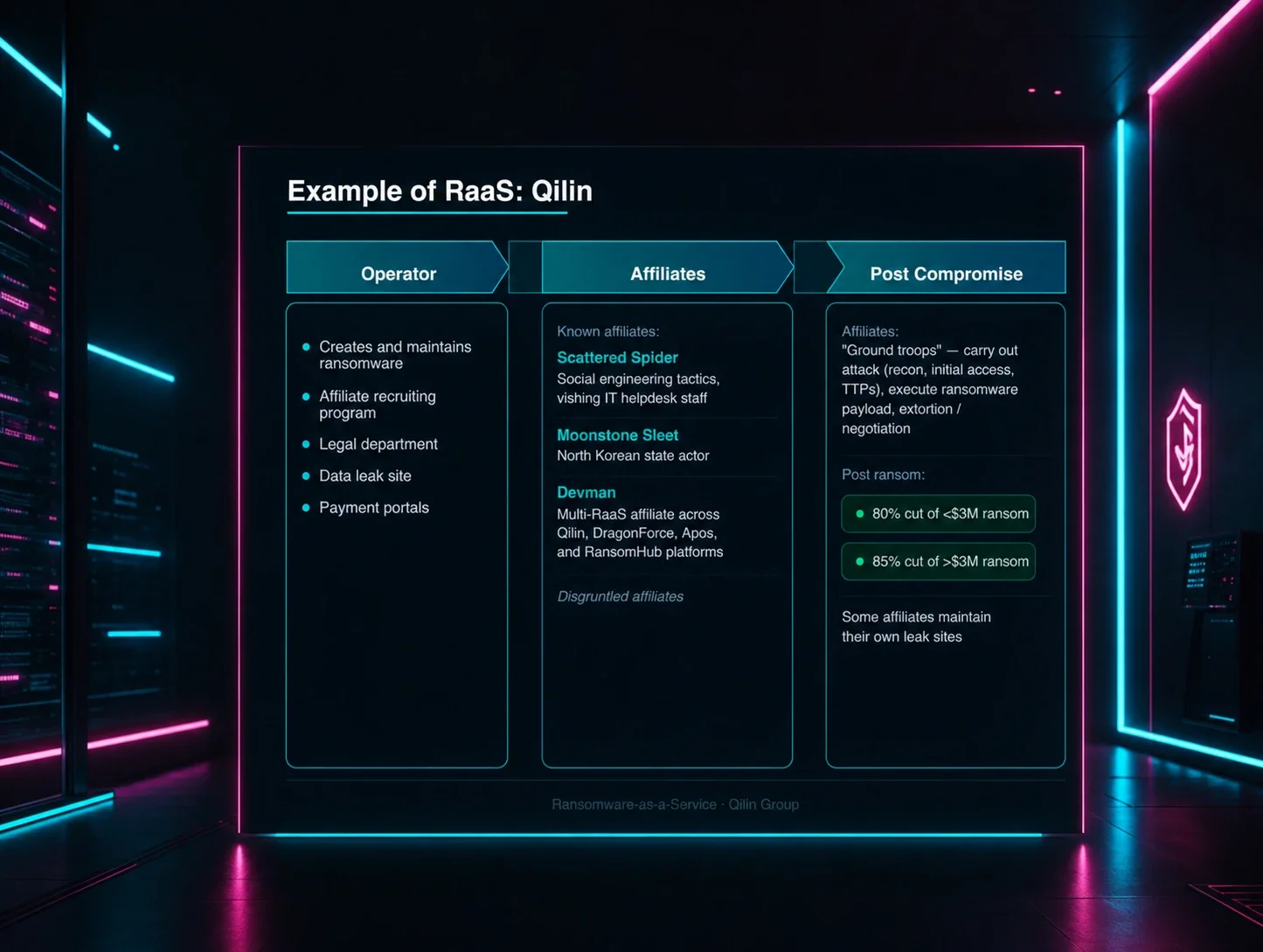
Huntress breaks down the ransomware-as-a-service (RaaS) ecosystem, explaining how operators (e.g., Qilin) provide the malware and infrastructure while diverse affiliates (Scattered Spider, Moonstone Sleet, Devman) handle intrusion, meaning the same ransomware brand can involve very different attack chains. It details real-world tradecraft: initial access via RDP abuse, vulnerable edge appliances like SonicWall VPNs (preceding Akira deployment), and rogue RMM tools (ScreenConnect, TeamViewer, Bomgar), plus persistence via hidden user accounts and RMMs like AnyDesk/Chrome Remote Desktop, defense evasion via EDR/AV killers and BYOVD, and exfiltration using 7-Zip, MegaSync, RClone, S5cmd, and finger.exe.
 huntress.comwriteupAdded 3 Sep 2026, published 20 May 2026🛡️ Security
 Training State of the Art Vulnerability Discovery Agents through Reinforcement Learning | depthfirst
dfs-mini1 is a vulnerability detection agent from depthfirst, built by reinforcement learning on gpt-oss-120b with a shell-only harness. Trained in Kubernetes sandboxes on audits that do not overlap EVMBench, using a 32k context with learned summarization, it reaches state of the art on EVMBench Detect at pass@8 at 10-30x lower cost than frontier models. It also transfers to an internal CVE benchmark, but reports more false positives.
 depthfirst.comwriteupAdded 30 Oct 2026, published 31 Mar 2026🧠 AI
- Training State of the Art Vulnerability Discovery Agents through Reinforcement Learning | depthfirst
dfs-mini1 is a vulnerability detection agent from depthfirst, built on gpt-oss-120b and post-trained with reinforcement learning on thousands of Kubernetes sandboxes of historical smart contract audits. On OpenAI's EVMBench Detect it reaches state of the art at pass@8, at 10-30x lower total cost than frontier models. The post covers 32k context with summarization-based compaction, a shell-only toolset that discourages Slither, transfer to an internal CVE benchmark, and a rise in false positives.
depthfirst.comarticleAdded 29 Oct 2026, published 31 Mar 2026🛡️ Security  Azure Virtual Machine Execution Techniques
Details five ways to execute code on an Azure VM beyond RDP/SSH: the Run Command agent, Custom Script Extension, Desired State Configuration (DSC) extension abuse, VM Application Definitions, and Hybrid Worker Groups — all running as SYSTEM/root by default. For each technique the author gives the exact PowerShell/Az cmdlets (including PowerZure's Invoke-AzureRunProgram and Invoke-AzureVMCustomScriptExtension), on-disk artifact paths, and the specific Azure Activity Log events (e.g. 'Run Command on Virtual machine', 'Create or Update Virtual Machine Extension') defenders should correlate on.
 hausec.comwriteupAdded 3 Sep 2026, published 4 May 2022🛡️ Security
 PowerZure 2.1 Update
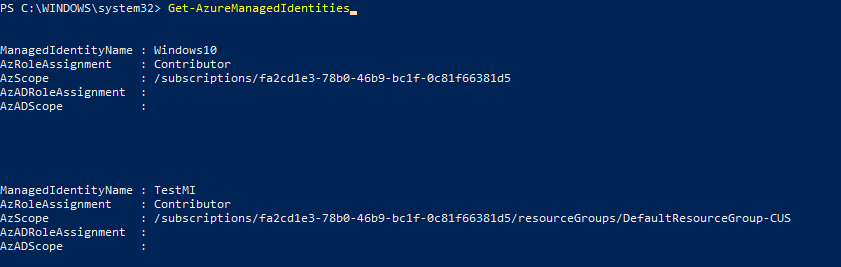
Release notes for PowerZure 2.1, a PowerShell Azure exploitation toolkit, detailing new offensive functions including Invoke-AzureVMUserDataAgent/Command which abuse the VM userData property for log-free command execution, and Invoke-AzureMIBackdoor which exposes the IMDS REST API externally via portproxying to steal Managed Identity JWTs without authentication. Also adds Get-AzureManagedIdentities and Get-AzurePIMAssignment for enumeration, plus several bug fixes to existing cmdlets.
hausec.comarticleAdded 3 Sep 2026, published 21 Dec 2021🛡️ Security Abusing and Detecting Alternative Data Channel Command Execution on Azure Virtual Machines
Hausec details a covert command execution technique on Azure VMs abusing the userData property of the Instance Metadata Service (IMDS): an attacker with VM write privileges uses Invoke-AzVMRunCommand once to deploy a PowerShell "agent" that polls IMDS for base64-encoded commands, executes them, and exfiltrates results back via the Azure REST API using a smuggled access token — enabling repeat command execution without further RunCommand calls. The technique is implemented in PowerZure via Invoke-AzureVMUserDataCommand and Invoke-AzureVMUserDataAgent, and the post includes detection guidance covering artifact locations, Activity log alerts on Invoke-AzVMRunCommand, and PowerShell logging.
hausec.comwriteupAdded 3 Sep 2026, published 3 Dec 2021🛡️ Security