 hausec.comarticle
PowerZure 2.1 Update
Release notes for PowerZure 2.1, a PowerShell Azure exploitation toolkit, detailing new offensive functions including Invoke-AzureVMUserDataAgent/Command which abuse the VM userData property for log-free command execution, and Invoke-AzureMIBackdoor which exposes the IMDS REST API externally via portproxying to steal Managed Identity JWTs without authentication. Also adds Get-AzureManagedIdentities and Get-AzurePIMAssignment for enumeration, plus several bug fixes to existing cmdlets.
What it is
Release notes for PowerZure 2.1, a PowerShell Azure exploitation toolkit. The summary already names the four offensive/enumeration functions; what follows is the operational detail an engineer needs to reason about detection and privilege — which the summary omits.
How it works — the details that matter for detection
Two of the new techniques are marketed on the same property: they leave no entry in the Azure Event Log.
- userData command execution (
Invoke-AzureVMUserDataAgent/-Command): theuserDataVM property is writable by any principal with VM write and readable by any principal with VM read. The agent is a Scheduled Task on the VM that pollsuserDatavia IMDS, executes any command it finds, and writes output back intouserDatafor the reader to collect. The channel is the VM property itself, not a network callback. Invoke-AzureMIBackdoor: exposes the internally-only IMDS REST API to the internet via portproxy, letting anyone unauthenticated request a Managed Identity JWT. The crucial operational detail the summary drops: by default it portproxies over 3389 (RDP), which breaks RDP on the VM until the rule is removed. The-NoRDPflag instead opens a custom port in the NSG firewall — but that NSG change does generate logs. So the stealthy default is self-signaling (RDP outage); the flexible option trades away the stealth.
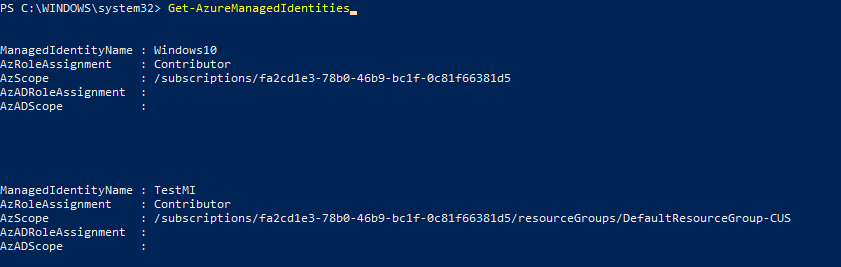
Get-AzureManagedIdentities identifies MIs by enumerating service principals and matching application URIs containing identity.azure.net, then maps each to its role.
Preconditions
- userData technique: attacker needs VM write to plant/command, VM read to collect output.
- MIBackdoor: a Managed Identity configured on the VM (no JWT to steal otherwise); ability to set a portproxy rule on the host.
What to look for (defender takeaways)
- The "no logs" claim is scoped to Azure Event Log — host-level artifacts remain: a Scheduled Task polling IMDS, and abnormal
userDatawrites/reads. Alert onuserDataproperty modifications, which have no legitimate high-frequency use. - For MIBackdoor: an unexpected RDP outage on a VM, or a portproxy rule forwarding to 169.254.169.254, is the tell for the default mode; NSG rule additions opening a new port are the tell for
-NoRDP.
Caveats (stated on the page)
Invoke-AzureCustomScriptExtensionis currently only a wrapper — the file-less execution it promises is blocked pending an Azure REST API bug fix.Get-AzurePIMAssignmentgathers AzureRM assignments only; the AzureAD/PIM path is broken because the underlying Graph API returns 401 for any user.
Organisations named here
- IMDS
- Managed Identity
- PIM
Technologies named here
- Azure Virtual Machines
- PowerZure
- Az module
- Azure Managed Identities
- Azure Service Principals
- AzureAD cmdlet
- Azure PIM
- Azure Network Security Group firewall
- PowerShell
- Azure
Techniques named here
- Get-AzureManagedIdentities
- Invoke-AzureCustomScriptExtension
- Get-AzurePIMAssignment
- Invoke-AzureVMUserDataAgent / Invoke-AzureVMUserDataCommand
- Invoke-AzureMIBackdoor
Related in Offensive Security

 huntress.comwriteup
AI-Coded Malware | Analyzing Vibe-Coded AD Enumeration | Huntress
 github.comrepo
YesWeHack Claude Kit
 huntress.comwriteup
Inside an Oracle Database SQL Injection Attack | Huntress
 huntress.comwriteup