 huntress.comwriteup
Inside the RaaS Ecosystem: Operators, Affiliates & Attack Tradecraft | Huntress
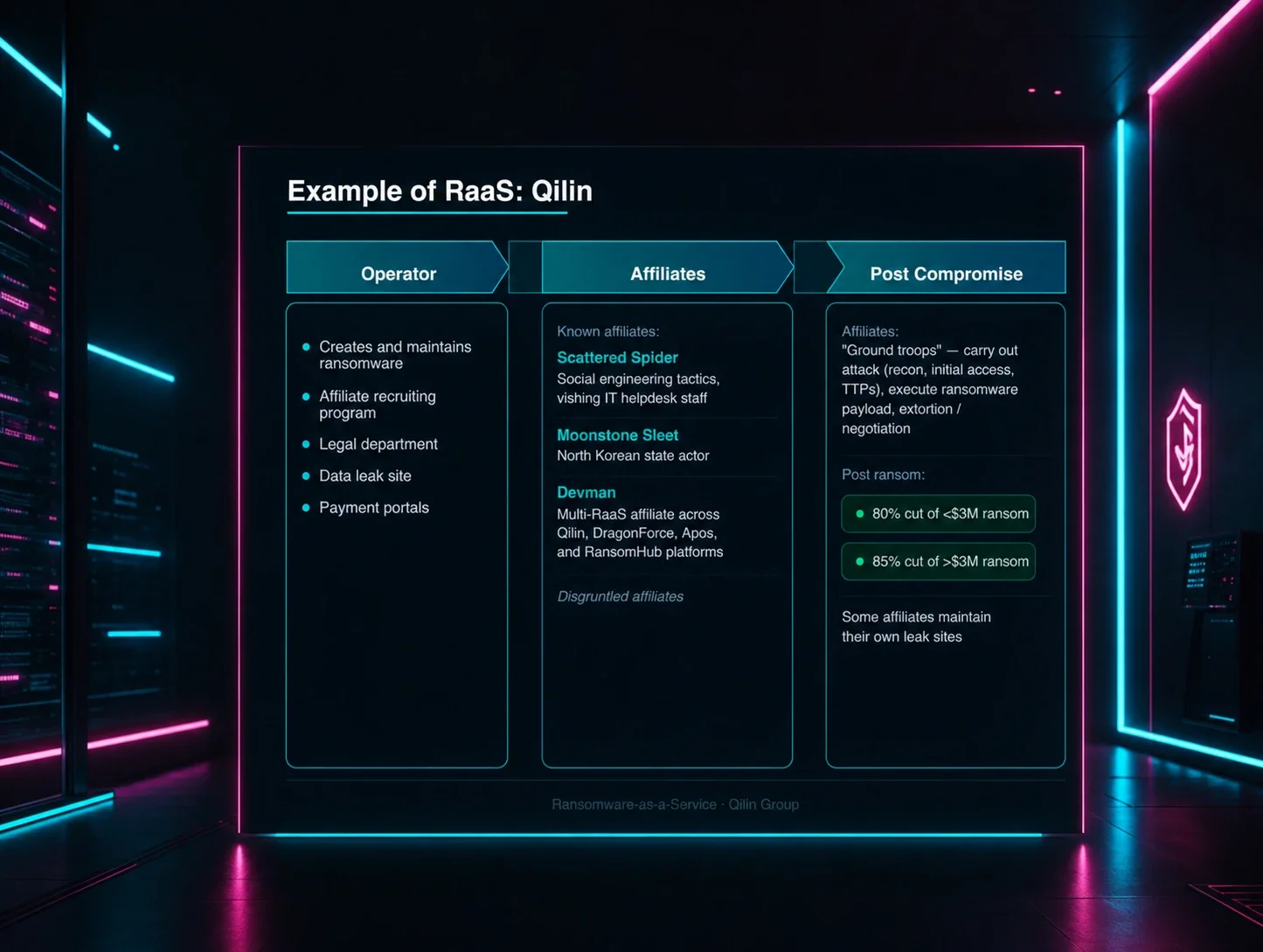
Huntress breaks down the ransomware-as-a-service (RaaS) ecosystem, explaining how operators (e.g., Qilin) provide the malware and infrastructure while diverse affiliates (Scattered Spider, Moonstone Sleet, Devman) handle intrusion, meaning the same ransomware brand can involve very different attack chains. It details real-world tradecraft: initial access via RDP abuse, vulnerable edge appliances like SonicWall VPNs (preceding Akira deployment), and rogue RMM tools (ScreenConnect, TeamViewer, Bomgar), plus persistence via hidden user accounts and RMMs like AnyDesk/Chrome Remote Desktop, defense evasion via EDR/AV killers and BYOVD, and exfiltration using 7-Zip, MegaSync, RClone, S5cmd, and finger.exe.
What it is
A Huntress Tradecraft Tuesday write-up (Harlan Carvey, Lindsey O'Donnell-Welch) arguing that the ransomware payload name is a poor predictor of intrusion behavior, because RaaS splits work between operators (who maintain the variant, leak sites, payment portals, negotiation, even legal support) and affiliates (who do recon, initial access, hands-on-keyboard, theft, and encryption). The summary already lists the tradecraft; what it does not carry is the two named incidents and the defensive posture the page recommends.
The MSP amplification pattern
The item worth acting on: a single compromised RMM instance in an MSP-centric environment can hit many downstream victims at once. On April 14, a ransomware campaign reached multiple organizations through a compromised Bomgar remote support environment belonging to a dental software company whose software was installed across dozens of organizations. Separately, a March incident showed actors using Chrome Remote Desktop and AnyDesk for post-compromise persistence.
What to do
The page's recommendations:
- Maintain an asset inventory
- Reduce your attack surface
- Deploy monitoring broadly
- If already compromised, investigate the incident without making assumptions based on branding alone
The operational point behind the last one: the payload name does not tell you the access path, persistence mechanisms, or which controls failed. If you scope an incident by the ransom-note brand and miss the real intrusion path, the same foothold stays available for a return attack — possibly under a different ransomware banner.
Caveats
- The page states EDR/AV killers are "often noisy," so aggressive defense-evasion is not silent — a detection opportunity, not a dead end.
- Attribution is explicitly called "messy": Huntress notes it is usually the affiliate, not the operator, that dictates tradecraft, so intel keyed to an operator name may not describe your actual attacker.
flowchart TD
    B[Ransom note / file extension brand] -->|does NOT reveal| P[Access path, persistence, failed controls]
    A1[Phishing / help-desk scam] --> INT[Intrusion]
    A2[Exposed RDP] --> INT
    A3[Rogue RMM eg Bomgar] --> INT
    INT --> ENC[Same brand deployed]
    A3 -.MSP: one instance.-> MANY[Dozens of downstream victims]
    P -->|scope by brand only| MISS[Real foothold missed]
    MISS --> RET[Return attack, possibly new banner]
The through-line: branding is the least reliable signal in a ransomware case, and the affiliate model is why. Scope on evidence, not on the note.
Technologies named here
- SonicWall VPNs
- ScreenConnect
- Remote Desktop Protocol
- TeamViewer
- Bomgar
- SMB protocol
- Chrome Remote Desktop
- Microsoft SQL Server
- AnyDesk
- Bomgar remote support environment
- Microsoft Defender
- EDR/AV killer tools
- 7-Zip
- MEGASync
- RClone
- s5cmd
- finger.exe
- SonicWall
Techniques named here
- Initial access via weak/compromised RDP credentials
- Initial access via vulnerable edge appliances
- Initial access via rogue RMMs
- Persistence via new user account creation
- Persistence via RMM installation
- Defense evasion via Defender exclusions
- Defense evasion via EDR/AV killers and BYOVD
- Data staging via archive compression
- Data exfiltration via cloud storage and CLI tools
Threat actors named here
- Akira
- Qilin
- LockBit
- Scattered Spider
- Moonstone Sleet
- Devman
Related in Threat Intel
 huntress.comwriteup
Reverse Engineering the Six Stages of MacSync Stealer and RAT
 huntress.comwriteup
AI-Coded Malware | Analyzing Vibe-Coded AD Enumeration | Huntress

 blog.talosintelligence.comtool
Introducing CAIRN: Frontier tracking for AI-integrated malware (Cisco Talos)
 huntress.comwriteup