 huntress.comwriteup
Determined Attacker Uploads Malicious Webshells to Parks and Rec Management Platform Servers
Huntress details a four-act intrusion against a shared parks-and-recreation management platform running on IIS, where an attacker first tried noisy unauthenticated exploits (IIS 8.3 tilde enumeration, WebDAV verb abuse, upload-handler bypasses) before simply registering a member account and uploading .aspx webshells via a member-file upload feature across three servers. The attacker enumerated hosts, extracted web.config/connection strings, hunted for cardholder data (Fortis/MXMerchant webhook logs, CVV/card-number strings), then escalated to timestomping, re-deploying known-filename webshells, and finally injecting an AI-generated PowerShell/JS dropper into a trojanized jQuery file to turn site visitors' browsers into WebRTC/WebSocket C2 clients (ririmochii/bubuneeko Cloudflare Workers infrastructure). Includes a zh-CN PowerShell user-agent string used for attribution and full command/IOC listings useful for detection engineering.
What it is
Concrete IOCs and detection artifacts from the Huntress writeup (incident date 2026-09-10) that the catalog summary names but does not reproduce. The entry already establishes the four-act narrative and TTPs; what follows is the material a detection engineer actually needs to act.
Preconditions / Affected
A shared recreation-management platform on IIS where the member file-upload feature writes to /documents/MemberFiles/ and does not block .aspx execution. The attacker registered a legitimate member account, so this is an authenticated-but-unprivileged path — login brute force, IIS 8.3 tilde enumeration, and WebDAV verb abuse all failed first. Upload filenames follow <accountID>_<memberID>_<guid>.<ext>, which let Huntress pivot from a shell filename back to the registering account.
What to do
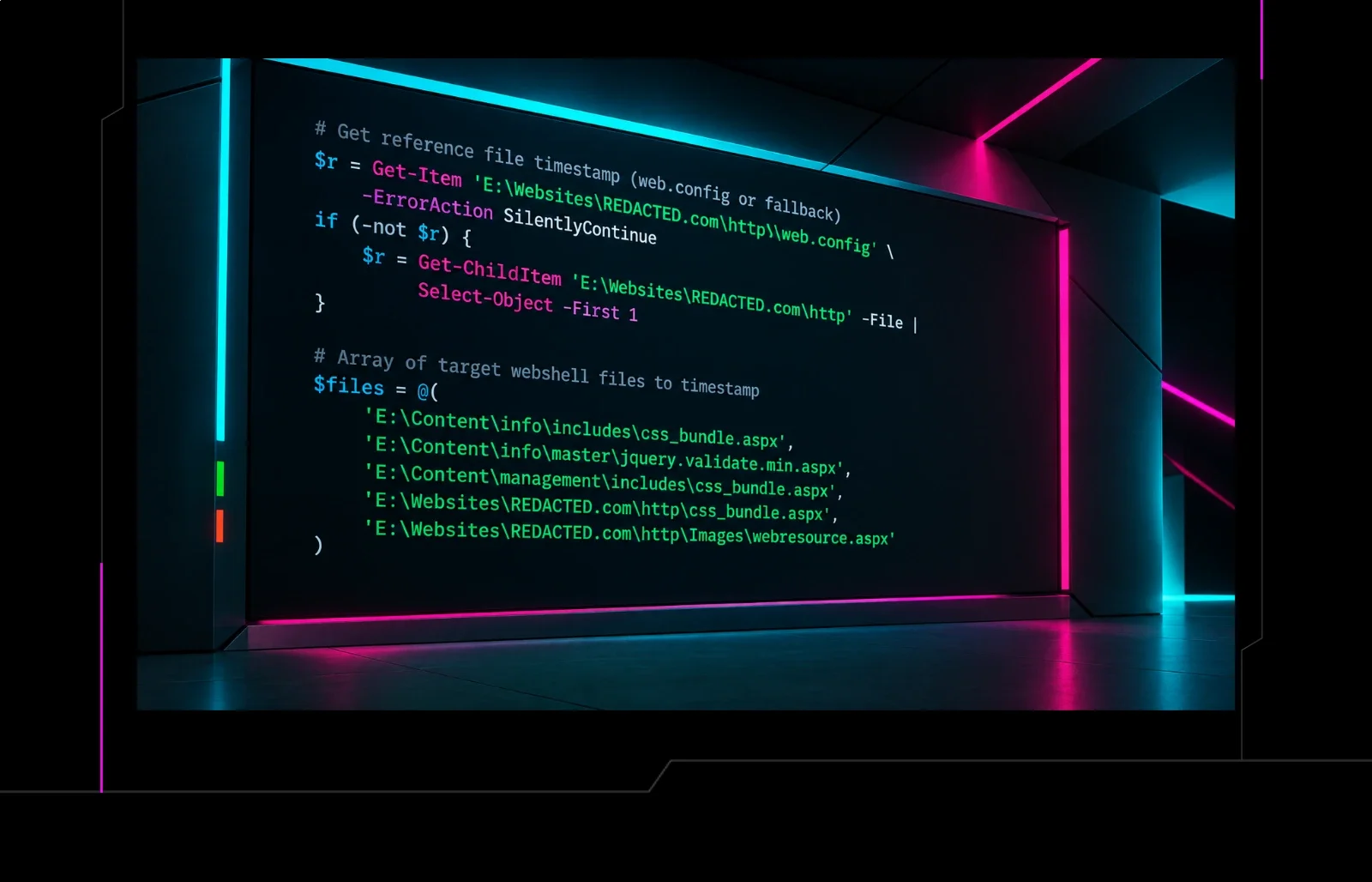
Webshell filenames — these were copied/masqueraded as legitimate assets across web roots, so hunt for .aspx where these names should only be .js/.css:
css_bundle.aspxjquery.validate.min.aspx(also writtenquery.validate.min.aspxin the post)webresource.aspx
Act-4 dropper artifacts in C:\Windows\Temp (staged Base64-first, then decoded):
plant_ccrtc_mousewheel.ps1.b64 / .ps1   (deep recursive scanner)
plant_ccrtc_fast.ps1.ps1.b64   / .ps1   (shallow, EDR-evading variant)
ccrtc_sdk_init.js.b64          / .js
The planter appends an obfuscated dropper into the legitimate jQuery file jquery.mousewheel-3.0.6.pack.js (loaded by /auth/default.aspx), uses an idempotency guard function named _0x9d66 to avoid double-writes, then timestomps the file back to its original UTC times. Grep served jQuery assets for _0x9d66 and for the AI-generated comment strings left in the scripts, e.g. # Fast plant: candidate paths only, no drive recurse. Run ON web host. and # append only - do not rewrite head/structure.
C2 infrastructure (Cloudflare Workers) — block/alert:
hxxps://chat.ririmochii[.]workers[.]dev/core[.]js
hxxps://fk.bubuneeko[.]workers[.]dev/_cf/rel
hxxps://fk.bubuneeko[.]workers[.]dev/_cf/ice
wss://fk.bubuneeko[.]workers[.]dev/_cf/soc
The trojanized jQuery turns any browser hitting /auth/default.aspx into a WebRTC/WebSocket C2 client that receives eval() frames and harvests credentials in real time.
Attribution/hunting string — the PowerShell user agent carrying a Simplified-Chinese locale:
Mozilla/5.0+(Windows+NT;+Windows+NT+10.0;+zh-CN)+WindowsPowerShell/5.1.22621.1037Behavioral detection: w3wp.exe spawning cmd.exe/powershell.exe is the backbone of every act. High-signal child commands include appcmd.exe list sites|vdirs|app, findstr sweeps for connectionString/CVV/CardNumber/Fortis/AuthorizeNet across E:\Content\..., and reads of _fortis\Webhooks\*.txt / mxmerchant payment directories.
Caveats
The locale string is the sole attribution basis ("most likely based in China") — a user-agent is trivially forgeable. The payment-module persistence drop in Act 3 (css_bundle.aspx into mxmerchant/fortis folders) failed, and the Act-4 webshell re-tasking failed because the files were already remediated — so those paths are hunting ground, not confirmed footholds. Server paths (E:\Content, E:\Websites) and the 12345_67890_ filename prefixes are environment-specific.
Organisations named here
- bubuneeko[.]workers[.]dev
- ririmochii[.]workers[.]dev
- WebDAV write verbs
Technologies named here
- Shared recreation management software platform
- Upload.ashx / FileUpload.ashx
- appcmd.exe
- Microsoft IIS
- Fortis
- PowerShell / WebAdministration module
- MX Merchant
- sqlcmd
- findstr
- wmic / tasklist
- plant_ccrtc_mousewheel.ps1
- plant_ccrtc_fast.ps1
- ccrtc_sdk_init.js
- core.js
- IIS
- PowerShell
- Windows
- .NET
- Cloudflare Workers
- Huntress
Techniques named here
- Brute forcing login pages
- IIS 8.3 tilde enumeration
- WebDAV write verb abuse
- Upload-handler parser bypass
- Forced browsing
- NTFS Alternate Data Streams abuse
- Case flipping
- Malicious file upload via legitimate account registration
- Web shell deployment
- System and network enumeration
- IIS configuration enumeration
- Credential and connection string harvesting
- Cardholder data search
- Database access with stolen credentials
- File masquerading
- Timestomping
- Browser-based C2 via WebRTC/WebSocket
- Base64 encoding of payloads for staging
Threat actors named here
- Unnamed threat actor
Related in Threat Intel
 huntress.comwriteup
Reverse Engineering the Six Stages of MacSync Stealer and RAT
 huntress.comwriteup
AI-Coded Malware | Analyzing Vibe-Coded AD Enumeration | Huntress

 blog.talosintelligence.comtool
Introducing CAIRN: Frontier tracking for AI-integrated malware (Cisco Talos)
 huntress.comwriteup