- CISA Adds Two Known Exploited Vulnerabilities to Catalog
CISA added two Ivanti Connect Secure vulnerabilities to its Known Exploited Vulnerabilities (KEV) Catalog on 30 October 2026, citing evidence of active exploitation: CVE-2026-111357 (missing authentication for a critical function) and CVE-2026-118527 (generation of predictable numbers or identifiers). The alert restates BOD 26-04, which requires federal civilian agencies to remediate KEV-listed flaws on exposed assets and check for prior compromise. It also links the KEV nomination form.
 cisa.govadvisoryPublished and added 30 Oct 2026
 GPT-Rosalind-6 System Card Addendum
 is OpenAI's safety documentation for a life-sciences model that shares weights with GPT-6 Astra. It rates the model High in Biological and Chemical and Critical in Cybersecurity under the Preparedness Framework. It reports biology evaluations, trusted-access controls, biosecurity refusal pass rates, a historical cyber jailbreak regression (14.3% task success), and sabotage and monitor-evasion results.
 deploymentsafety.openai.compaperPublished and added 30 Oct 2026
 VulnCheck - Outpace Adversaries
VulnCheck's vulnerability disclosure policy, last revised March 2026, sets a 120 day deadline for vendors to patch or publish an advisory, after which VulnCheck publishes an uncoordinated third-party advisory. The deadline drops to 7 days if exploitation in the wild is found. Other terms: no extensions, email-only communication, any published patch counts as public disclosure, and no participation in programs that bar public disclosure.
 vulncheck.comotherAdded 29 Oct 2026
 SAIL Framework: A Practical Guide for AI Security
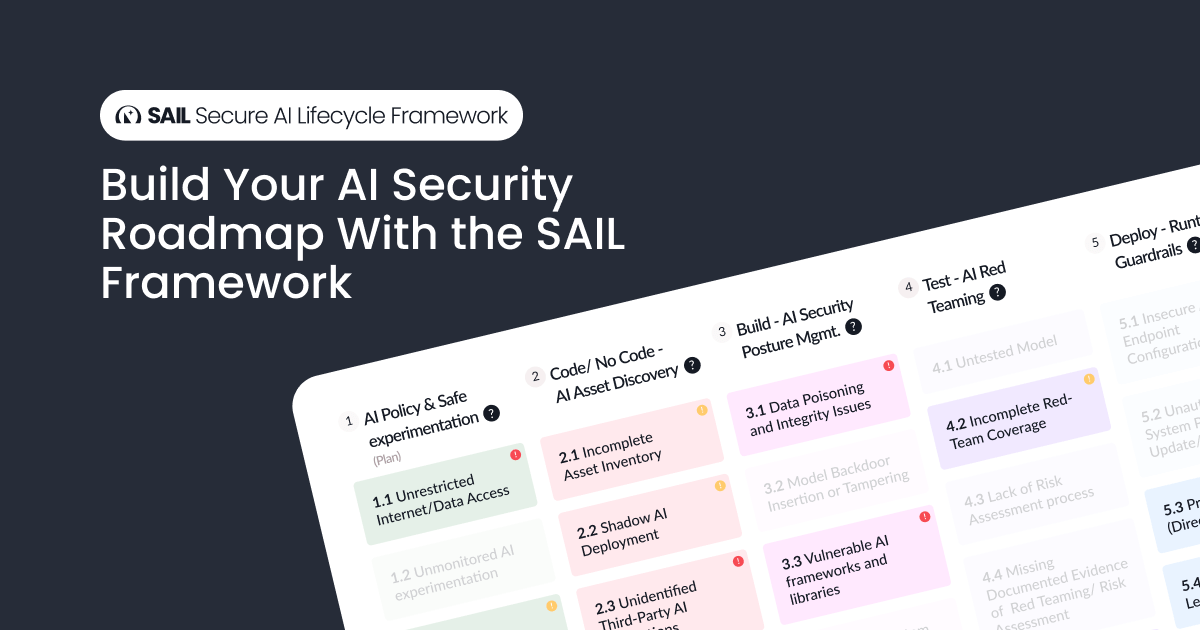
The SAIL Framework from Pillar Security is a seven-phase, lifecycle-oriented method for securing AI systems. The phases are AI policy and safe experimentation, AI asset discovery, AI security posture management, AI red teaming, runtime guardrails, sandboxed execution for agents and MCP servers, and AI activity tracing. It argues for a "Shift Up" approach that protects the business logic AI controls, and it is meant to sit on top of existing standards.
 pillar.securityarticleAdded 29 Oct 2026
 PCI DSS and Mobile Apps: A Simple Guide | Oversecured Blog
Guide to PCI DSS v4.0.1 scope for mobile apps, with a mapping of common Android and iOS finding types to the requirements they break (Req 2, 3, 4, 6, 7). It covers which app behaviors bring an app into scope and gives three anonymized cases: cleartext HTTP in a vendor native library, hardcoded keys in a third-party SDK, and an implicit Intent leaking data. It argues for testing the shipped binary and keeping a current component inventory.
 oversecured.comarticleAdded 29 Oct 2026
- CISA Adds Two Known Exploited Vulnerabilities to Catalog
CISA alert of 29 October 2026 adding two vulnerabilities to the Known Exploited Vulnerabilities catalog on evidence of active exploitation: CVE-2026-97229, an integer overflow in GitLab CE/EE, and CVE-2026-76418, a NULL pointer dereference from an unchecked return value in Cisco Secure Firewall ASA and FTD. It restates BOD 26-04 remediation duties for federal civilian agencies and links the KEV nomination form.
cisa.govadvisoryPublished and added 29 Oct 2026  What is an AIBOM? AI bill of materials explained for security teams | Endor Labs
AIBOM explainer from Endor Labs: an AI bill of materials is a machine-readable inventory of models, datasets, dependencies, AI services, agents and MCP servers, with origin, license and integrity evidence. It walks through a CycloneDX entry for a fine-tuned model, compares CycloneDX ML-BOM, SPDX 3.x, the OWASP AIBOM Generator and the May 2026 CISA/G7 minimum-elements guidance, and lists a six-step build process. It also states what an AIBOM cannot show: model safety, runtime behavior and coding-agent actions.
 endorlabs.comarticlePublished and added 29 Oct 2026
- CISO Security Program Management 2026
Security Posture Management is a web tool that maps 30 CISO-accountable security topics across the five NIST Cybersecurity Framework functions. It tracks current maturity, KPIs, risks and audit findings per topic. It also records target maturity, target dates, accountable owners and review dates, flagging topics unreviewed for 6 months as due and 12 months as overdue. Initiatives link to topics and risks with owner, budget, dates and expected maturity uplift.
 spm.threat-modeling.comtoolAdded 29 Oct 2026
- CISA Adds Two Known Exploited Vulnerabilities to Catalog
CISA alert of 28 October 2026 adding two vulnerabilities to the Known Exploited Vulnerabilities Catalog on evidence of active exploitation: CVE-2026-41709 (Broadcom VMware ESX insufficient logging) and CVE-2026-46300 (Linux kernel missing variable initialization). It restates BOD 26-04, which requires federal civilian agencies to prioritize fast remediation of KEV CVEs on exposed assets and to check for prior compromise. It also links the KEV nomination form.
cisa.govadvisoryAdded 29 Oct 2026, published 28 Oct 2026  Nobody Trusts the Security Questionnaire. We Rely on It Anyway.
The article argues that security questionnaires are self-reported assertions, not evidence, yet still gate deals and serve as due-diligence records. It cites Verizon's 2025 DBIR (third-party breaches doubled from 15% to 30%), IBM's 2025 report (about $4.9 million per supply-chain breach), the Target PCI case, and the October 2025 NYDFS industry letter. It recommends outside-in observation and on-demand evidence.
 securityweek.comarticlePublished and added 28 Oct 2026
 ADLC compliance: Mapping agentic development to NIST SSDF, OWASP, and the EU AI Act | Endor Labs
ADLC compliance guide from Endor Labs that maps agentic development to NIST SSDF (SP 800-218 v1.1), the OWASP LLM Top 10 2025 and Agentic Top 10, and the EU AI Act as amended by Regulation (EU) 2026/1744. It splits controls into a code surface and an action surface (shell, file access, MCP calls, package installs). It gives a four-step AI Act scoping path, the new Annex III date of 2 December 2027, and evidence guidance. It states the crosswalk is the vendor's interpretation, not legal advice.
endorlabs.comarticlePublished and added 28 Oct 2026 The ADLC maturity model: 5 stages of agentic development security | Endor Labs
The ADLC maturity model is a proposed five-stage framework from Endor Labs for scoring security controls over coding agents, from unmanaged experimentation to continuous verification. Each stage has requirements on two tracks, agent actions (shell commands, MCP calls, package installs) and agent output (code, dependencies, secrets). It sets stage 3 at deterministic hooks that block actions, gives evidence-based assessment questions, and lists traps such as relying on prompt-level rules.
endorlabs.comarticlePublished and added 28 Oct 2026- CISA Adds Two Known Exploited Vulnerabilities to Catalog
CISA alert of 27 October 2026 adding two vulnerabilities to the Known Exploited Vulnerabilities (KEV) Catalog on evidence of active exploitation: CVE-2026-48356, an unrestricted upload of a dangerous file type in Adobe Commerce and Magento, and CVE-2026-111497, an unchecked return value in Google Brotli. It restates BOD 26-04, which makes federal civilian agencies prioritise KEV flaws on exposed assets and check for prior compromise. No technical detail or IOCs are given.
cisa.govadvisoryAdded 29 Oct 2026, published 27 Oct 2026 - CISA Adds Two Known Exploited Vulnerabilities to Catalog
CISA added two PHP vulnerabilities to its Known Exploited Vulnerabilities Catalog on 26 October 2026: CVE-2026-109618 (memory corruption) and CVE-2026-109619 (stale internal request state). It also updated its PHP alert on critical vulnerabilities requiring immediate patching. The alert restates BOD 26-04, which requires federal civilian agencies to prioritize fast remediation of KEV CVEs on exposed assets and to check for prior compromise.
cisa.govadvisoryAdded 29 Oct 2026, published 26 Oct 2026  Cheap AI-Assisted Reverse Engineering and What It Will Do
"Cheap AI-Assisted Reverse Engineering and What It Will Do" is an October 2026 arXiv paper (Computers and Society) arguing that generative AI strains the law of reverse engineering. AI systems can identify hardware components, extract firmware, decompile object code and clone apps, which removes the cost barrier that laws rely on. The authors map these practices onto trade secret, copyright, anti-circumvention, computer misuse and contract law, and sketch possible legal responses with their trade-offs.
 arxiv.orgpaperAdded 28 Oct 2026, published 26 Oct 2026
- CISA Publishes Significant Updates to ScubaGear and ScubaGoggles
ScubaGear v2.0 and ScubaGoggles v1.1.0 are CISA's updated SCuBA assessment tools for Microsoft 365 and Google Workspace secure configuration baselines. ScubaGear now uses direct REST API calls, adds Power BI coverage, a consolidated Security Suite baseline and app severity scoring. ScubaGoggles adds a GUI, Policy API integration and Gemini controls. The release supports BOD 25-01 compliance.
cisa.govarticleAdded 29 Oct 2026, published 26 Oct 2026  Revisiting AES Key Wrap: Forgery Bounds, Structural Observations, and Recommendations for the Revision of NIST SP 800-38F
Revisiting AES Key Wrap is an ePrint paper (2026/2636) by John Preuß Mattsson, expanded from technical comments to NIST on the SP 800-38F revision. It shows the stated forgery probabilities ignore adaptive attacks and gives corrected bounds for KW, KWP and TKW. It also shows KW lacks beyond-birthday-bound security, since a forgery leaks a plaintext prefix and an encryption-only distinguisher exists.
 eprint.iacr.orgpaperAdded 26 Oct 2026, published 25 Oct 2026
- The Policies of Programming Language Ecosystems: A "Qualitative" Analysis
The Policies of Programming Language Ecosystems is an October 2026 arXiv paper (cs.SE) that compares the policies of eight programming language ecosystems, including CRAN for R, across 38 policy categories. Three authors coded the policies with moderate agreement. Malware, intellectual property and content removal are covered everywhere, while package size limits, metric manipulation, typosquatting and binary uploads diverge.
arxiv.orgpaperAdded 28 Oct 2026, published 25 Oct 2026  Sweden's Government Offices Block ChatGPT and Claude, Keep Microsoft Copilot
Sweden's Government Offices will block ChatGPT and Claude on staff computers from 26 October 2026 and leave Microsoft Copilot as the only approved AI tool, citing information security. Digitalisation director Mikael Wettercrantz said unvetted AI use had involved sensitive inputs and poorly handled outputs. The Tax Agency and National Board of Institutional Care have similar bans, and the European Parliament disabled AI features in February 2026. Whether Copilot has Claude models enabled is unconfirmed.
 decrypt.coarticlePublished and added 24 Oct 2026
 Bringing post-quantum cryptography to geographically fenced key management
Cloudflare's post-quantum GeoKey Manager, in closed beta for the Data Localization Suite, wraps customer private keys so only edge servers in an allowed region can unwrap them. It uses regional 256-bit root keys, derived application-specific HPKE key pairs (RFC 9180) with hybrid ML-KEM-768 and X25519, TPM-backed server authorization, kernel keyring storage, fail-closed checks, and soft and hard rotation. General availability is planned for Q1 2027.
 blog.cloudflare.comarticleAdded 29 Oct 2026, published 23 Oct 2026
 Bitcoin Core Rewrites Its Security Policy for a World Where AI Finds Bugs in One Prompt
Bitcoin Core merged a security policy update in October 2026 that adds an "easily discoverable" label for vulnerabilities findable with a simple LLM query. Such bugs get a fix backported to all maintained releases and a new version shipped fast with an advisory, instead of a long embargo. Antoine Poinsot of Chaincode Labs proposed the change after a spike in reports. The article also recaps the Bitcoin Red Team and AI-found Lightning and wallet bugs.
decrypt.coarticlePublished and added 23 Oct 2026 PHP2Shell: What This Week Tells Us About the Web We Built
PHP2Shell is the name for two unauthenticated remote code execution flaws, CVE-2026-109618 and CVE-2026-109619 (CVSS v4 9.2), in the PHP engine back to version 5.4. The post covers the leaked October 2026 embargo, AI-assisted exploit building by Calif and others, patch availability by PHP version, and a 72-hour and quarterly response plan covering inventory, patching, secret rotation and edge virtual patching. It ends with a short Orca product section.
 orca.securityarticlePublished and added 23 Oct 2026
- ENISA Technical Advisory for Software Bill of Materials
ENISA Technical Advisory for Software Bill of Materials (October 2026, TLP:CLEAR) is non-mandatory guidance for organisations, especially SMEs, starting SBOM adoption. It covers SBOM data models (CycloneDX, SPDX), a mapping of BSI TR-03183-2 fields to CISA minimum elements, lifecycle and CI/CD integration, an SBOM threat model, and security recommendations. It supports Cyber Resilience Act obligations but is not a legal interpretation.
 enisa.europa.euadvisoryAdded 23 Oct 2026
- ENISA Technical Advisory for Software Bill of Materials
ENISA Technical Advisory for Software Bill of Materials is practical guidance on SBOM adoption for organizations, especially micro, small and medium enterprises and open-source stewards. It sets out an SBOM implementation architecture and data flows across a defined lifecycle, an indicative SBOM threat model with targeted risks, and measures for the SBOM ecosystem. It aligns with the ENISA Secure by Design and Default Playbook and supports Cyber Resilience Act compliance.
enisa.europa.euadvisoryAdded 23 Oct 2026  Localizing compliance at scale: achieving South Korea’s ISMS certification
Cloudflare's account of obtaining South Korea's ISMS-P certification after a ten-day KISA audit of 80 controls and a preparation period of about a year and a half. It explains that the certificate covers a service delivery boundary rather than a product list, that auditors required readable data flow diagrams, and how Korean sign-up uses itemized consent with social login removed.
blog.cloudflare.comarticleAdded 29 Oct 2026, published 22 Oct 2026 AI Model Risk Depends on What the Model Can Reach
Snyk's State of Agentic AI Adoption Volume III scores models against 29 attacker goals (0 to 1,000) and matches them to AI-BOM scan data from 1,693 environments. 74.5% reference a model scoring 500+ on some goal and 49.2% one scoring 750+. Risk depends on agent and MCP server reach, and the fix is either switching models or tightening application controls, depending on the goal. Only 37.5% of model occurrences have a score.
 snyk.ioarticlePublished and added 21 Oct 2026
 US Agencies Detail Incident Response Practices for Rogue AI Agents
SecurityWeek summarizes the NIST, NSA and CISA report "Key Practices for Incident Readiness and Response in Super Intelligence Training and Evaluation". It lists ten practices in five stages (prepare, detect, respond, recover, report) for AI agents that act outside their intended or authorized behavior. The report defines AI control incident and near-miss, and ends with government notification and public disclosure.
securityweek.comarticlePublished and added 20 Oct 2026 970,000 Medi-Cal Members Affected by Paradigm Healthcare Data Breach
Paradigm Healthcare Services, a Medi-Cal billing processor, told HHS that a breach affected more than 970,000 people. Attackers accessed its network between October 8 and 15, 2025, and exposed names, dates of birth, gender and Medi-Cal member IDs. The article also covers breaches at law firm Tarter Krinsky & Drogin (196,000 people) and Ridgeway Pharmacy (258,000). No threat actor or intrusion method is named.
securityweek.comarticlePublished and added 20 Oct 2026- SCF Controls Platform — open source
SCF Controls Platform is free, open-source (AGPL-3.0) GRC software built on the Secure Controls Framework. It covers the 1,451-control SCF catalog with 354+ framework mappings, L0–L5 evidence maturity scoring, a risk register linked to controls, and audit workspaces. It self-hosts via Docker Compose or a Helm chart for Kubernetes, and is independent of ComplianceForge, which publishes the SCF.
 scfcontrolsplatform.comtoolAdded 20 Oct 2026
- KNOX: Hardware-assisted Regulatory Sandbox for Generative Models
KNOX is a regulatory sandbox for generative models built by running AI agent workloads inside TEEs. It derives an attested policy manifest (applicable regulations, expected tool calls, permitted system calls) from the user prompt, and an attested reference monitor allows an action only if it matches. Actions and verdicts go into an attested execution graph that regulators can verify. The paper reports detection of prompt-injection deviations and under 1% overhead.
arxiv.orgpaperAdded 22 Oct 2026, published 20 Oct 2026
Showing 30 of 147
Show more