 latent.spacewriteup
Foundries vs Navigators: Lowering the Cost of Science
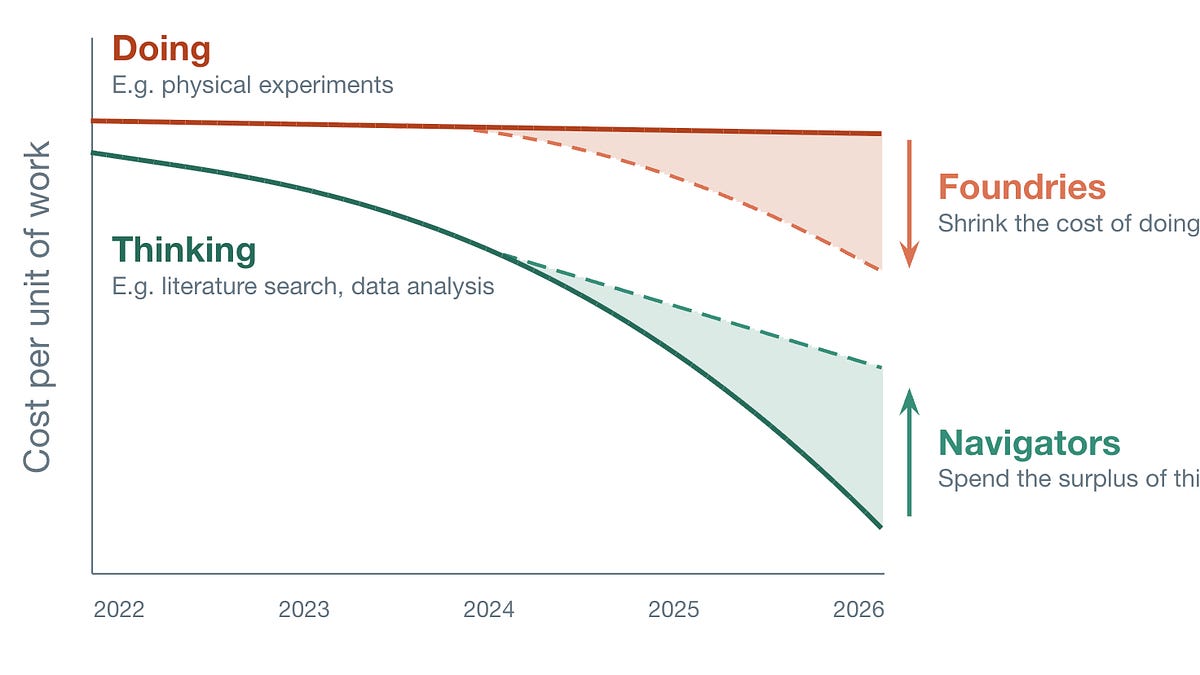
A guest post on Latent Space by Endura Therapeutics CEO Adrian Sanborn arguing biotech companies are adapting to AI in two distinct ways: foundries such as Xaira, NewLimit and Insitro that industrialize experimental data generation, versus navigators that use LLMs to speed up the ordinary work of running a company through faster bespoke data analysis, in-house dashboards replacing commercial lab software, and fleets of LLM research agents. It details a concrete case: Endura built a two-stage LLM triage pipeline that screened roughly 500 disease targets and then deep-dived about 100 of them, compressing what would have been decades of expert-analyst time into a short automated pass, followed by human diligence on the finalists.
What it claims
LLM agents let a small biotech do expert-depth target diligence across about 500 candidates, where a team would normally evaluate about five. The author's estimates of the human-time equivalent are about one person-year of reading for the first pass and "closer to a century of expert time" for the second. The post also makes two operational claims:
- Re-adapting analysis code to a changed experimental protocol is now "an afternoon's work."
- An in-house lab data portal now takes about one day to implement, where it was previously licensed commercial software "for six figures."
These are the author's estimates from their own company. No measured comparison is given.
How it works
The triage pipeline is the one reusable procedure on the page.
flowchart TD
  A[~500 disease targets] --> B[Pass 1: ~3-page report each]
  B --> C{Prevalent enough? Unmet by existing drugs? Lowering target relieves disease?}
  C -- no --> X[Dropped: missed opportunity at worst]
  C -- yes --> D[Pass 2: ~30-page report on ~100]
  D --> E[Check against primary sources]
E --> F[Full human diligence on selected programs]- Pass 1 generates the equivalent of a three-page report on each of about 500 targets. It filters on three questions: - Is the disease prevalent enough to justify the effort? - Is the problem already addressed by existing drugs? - Would lowering the target protein actually relieve the disease?
- Pass 2 produces the equivalent of about thirty pages on each of the roughly 100 survivors, covering disease biology and the competitive landscape. - The key design choice is that the prompts are written to act as "a skeptical expert rather than a summarizer." They must name the programs that failed, say why each failed, and state what would have to be true for Endura to succeed where those programs did not. - The stated rationale is that clearly good targets are crowded. A defensible position needs a specific disease and a specific reason the drug beats existing approaches.
- Verification: pass-2 output is checked against primary sources. Selected programs then get conventional full human diligence.
Endura needed this breadth because its sequencing readout returns candidate drugs across hundreds of diseases in one experiment, so it had no pre-chosen therapeutic area.
On internal tools, implementation takes a day, but deciding what the portal should show "can take weeks." The author treats that design discussion as the valuable part, because it forces the team to name which comparisons drive its decisions.
Limits
- Errors in pass 1. Some reports contained errors. The author accepts this only because a pass-1 error costs a missed opportunity rather than time spent chasing a bad idea. That reasoning does not cover pass 2, which is why pass 2 is verified.
- No outcome data. Model names, prompts, agent framework, cost and accuracy are not given. Nothing shows whether the chosen targets are any good.
- In-house portals. They are less polished and have no vendor support. Larger organizations with validation requirements and contractual obligations "will still struggle" to adopt them.
- Reproducibility. On-demand generated analysis has a reproducibility problem the author calls "unresolved." Code assembled for one question has weaker provenance than a versioned pipeline.
- Format. This is an opinion and experience piece from one early-stage startup. The author argues that legacy-free startups are where these gains come fastest.
Organisations named here
- Anthropic
- Endura Therapeutics
- Xaira
- NewLimit
- Octant
- Tahoe
- Insitro
- Eikon
- Noetik
- Lila
- Periodic Labs
- Atomic AI
- Roche
- Edison Scientific
- Metsera
- Stanford
- Latent Space
- Adrian Sanborn
- Roger Kornberg
Techniques named here
- Skeptical-expert prompting
Related in ai-policy



 futureoflife.orgarticle
Future of Life Institute AI Safety Index — Summer 2026

 interconnects.aiarticle
Lessons from the hacks
 interconnects.aiarticle