 newsletter.semianalysis.comarticle
The Datacenter Backlash Goes Bipartisan: Next Week's Midterms and the 2028 Buildout
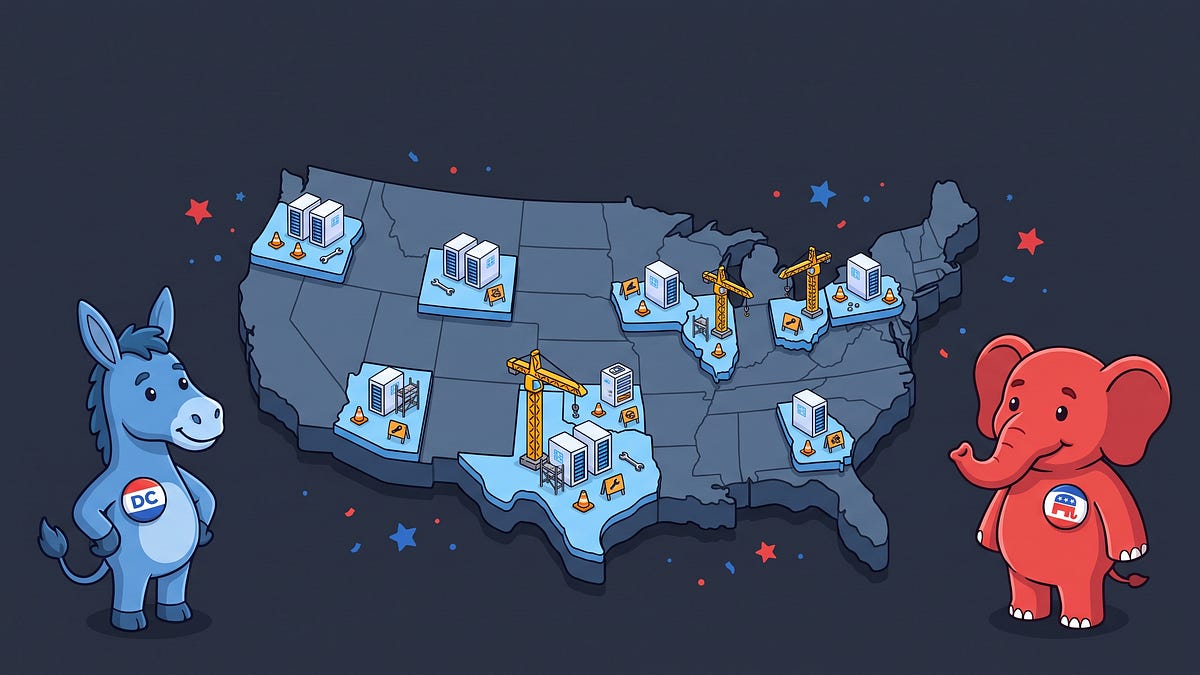
SemiAnalysis analysis of how the November 2026 US midterms could affect datacenter buildout. About 75% of the 33.8 GW due in 2027 across the top 20 states is already under construction, but 43.5 GW of 2028 additions sit in 13 states with pending approvals. The biggest risk is a prolonged Texas TCEQ permit freeze. Texas holds close to 30% of 2028 GW, and nine of 20 nominees back a pause.
What it claims
SemiAnalysis argues that the 3 November 2026 US elections put the 2028 datacenter pipeline at risk, not the 2027 one. Its model has 62.2 GW of US net additions in 2028, most not yet under construction. Exposure depends on who wins. If every pro-pause candidate won, about 30 GW of planned 2028 capacity would sit in states with a moratorium candidate in office. If the less restrictive candidates won, exposure would fall to 5.7 GW, mostly because Ohio and Oregon have pause supporters on both sides. SemiAnalysis still holds to its forecast of a global +50 GW year in 2027, published 16 October 2026.
How it works
The analysis covers the 13 states with the largest 2028 net additions. Virginia and Mississippi are excluded because they have no state elections in November. For each state it asks three questions: can the vote change governors, legislatures or elected utility commissions; how far apart are the candidates on policy; and how much unstarted capacity still needs an affected approval.
States fall into three tiers:
- Tier 1 (>2 GW unstarted): Texas, Ohio and Arizona have restrictive candidates on both sides. Georgia has a toss-up governor's race and a Public Service Commission majority on the ballot.
- Tier 2 (1.5 to 2 GW): new restrictions need a change in control, through Pennsylvania's Senate race or a Democratic win in Oklahoma's governor race.
- Tier 3 (<1.5 GW): Illinois, Oregon and Iowa are likely to tighten policy whoever wins.
Indiana, Missouri, Wyoming and West Virginia are left out because their governments are expected to stay aligned with datacenter development.
The piece separates pauses from conditions. A pause blocks any project that still needs an approval the state has stopped issuing. Conditions raise cost but leave a route to approval. The conditions most candidates back are making datacenters pay their own grid costs (15 candidates), ending tax breaks (12) and limiting or reporting water use (11).
Evidence
- Texas timeline: TCEQ froze permits on 21 September 2026, on top of an ERCOT interconnection-queue audit that began 3 August. ERCOT plans to file its report on 10 December, which does not by itself reopen permits. Challenger Gina Hinojosa (D) would keep a moratorium until legislation passes. The 2027 session runs 12 January to 31 May, so the freeze would last about eight months, or close to a year if approvals wait for new rules. That is five to nine months longer than a December restart.
- Oregon: the state-land freeze was extended to air and water-discharge permits on 9 October 2026 and runs through 1 July 2027.
- Race ratings as of 30 October: from Cook Political Report, Multistate and The New York Times. The conditions-only candidate is favored in Texas, Oklahoma, Pennsylvania and Iowa. Georgia is a toss-up.
- Tax lever: SemiAnalysis says equipment sales-tax exemptions are potentially worth billions of dollars per GW.
- Prior baseline: in September, SemiAnalysis estimated that only 1.5 GW of about 20 GW under local restrictions faced delay.
Limits
The analysis takes candidate positions at face value. Actual slippage depends on whether pledges become policy and which permit each project still lacks. Local approvals are out of scope.
Six current and former employees of Amazon, Microsoft and Google told SemiAnalysis that hyperscalers can absorb higher costs. The authors note that money does not speed up permits or transmission. Company-level exposure is only available to paying Datacenter Model subscribers. The fetched text ends partway through the state tiers, so the per-state detail is missing.
Organisations named here
- SemiAnalysis
- Amazon Web Services
- Amazon
- Microsoft
- The New York Times
- AWS
- Abdul El-Sayed
- Cook Political Report
- Electric Reliability Council of Texas (ERCOT)
- ERCOT
- Georgia Public Service Commission
- Gina Hinojosa
- Greg Abbott
- Josh Tolbert
- Linn County Board of Supervisors
- Mike Rogers
- Multistate
- Ohio Power Siting Board
- Pam Marsh
- PJM Interconnection
- QTS
- Rex Meyer
- Texas Commission on Environmental Quality
- Texas Water Development Board
- Tina Kotek
Concepts named here
- Conditions-only versus pause candidates
- Datacenter equipment sales-tax exemption
- Datacenter moratorium
- Datacenter pipeline exposure by construction stage
Related in ai-policy


 futureoflife.orgarticle
Future of Life Institute AI Safety Index — Summer 2026

 interconnects.aiarticle
Lessons from the hacks
 interconnects.aiarticle