 huntress.comwriteup
Device Code Phishing Keeps Evolving. Here’s What to Watch For
Huntress details a second 2026 wave of device code phishing against Microsoft 365, this time abusing VPS reseller BL Networks (BitLaunch/BLNWX, AS399629) after an earlier wave tied to Railway and the EvilTokens phishing-as-a-service kit. Huntress observed 533 malicious events and 113 successful logins from a single BL Networks IP in April, spreading across multiple IPs and subnets by May, with 26 critical incidents across 23 identities logged in July, and argues defenders must stop trusting infrastructure reputation and instead hunt for anomalous device-code sign-in clusters and revoke tokens quickly. It ties the activity to the broader legitimate-cloud-plus-legitimate-Microsoft-auth-page attack pattern also seen with Railway, EvilTokens, and Kali365.
What it is
A Huntress threat report on a 2026 device code phishing campaign against Microsoft 365 abusing VPS reseller BL Networks (BitLaunch/BLNWX, AS399629, active since ~2017). It follows an earlier Railway-hosted wave attributed to the EvilTokens phishing-as-a-service kit, and is possibly Kali365-aligned. The report's real contribution beyond a list of IOCs is a detection philosophy and a concrete internal threshold for classifying infrastructure as hostile.
How it works
Device code phishing evades classic detection because the victim authenticates through Microsoft's own legitimate sign-in flow — MFA can still complete, and no password is directly phished. The attacker then operates or replays the resulting Microsoft 365 tokens. Because logins arrive from a provider (BL Networks) that also sells legitimate hosting, downstream commercial controls that lean on infrastructure/ASN reputation don't flag the traffic, giving attackers a window to extract value.
What to do
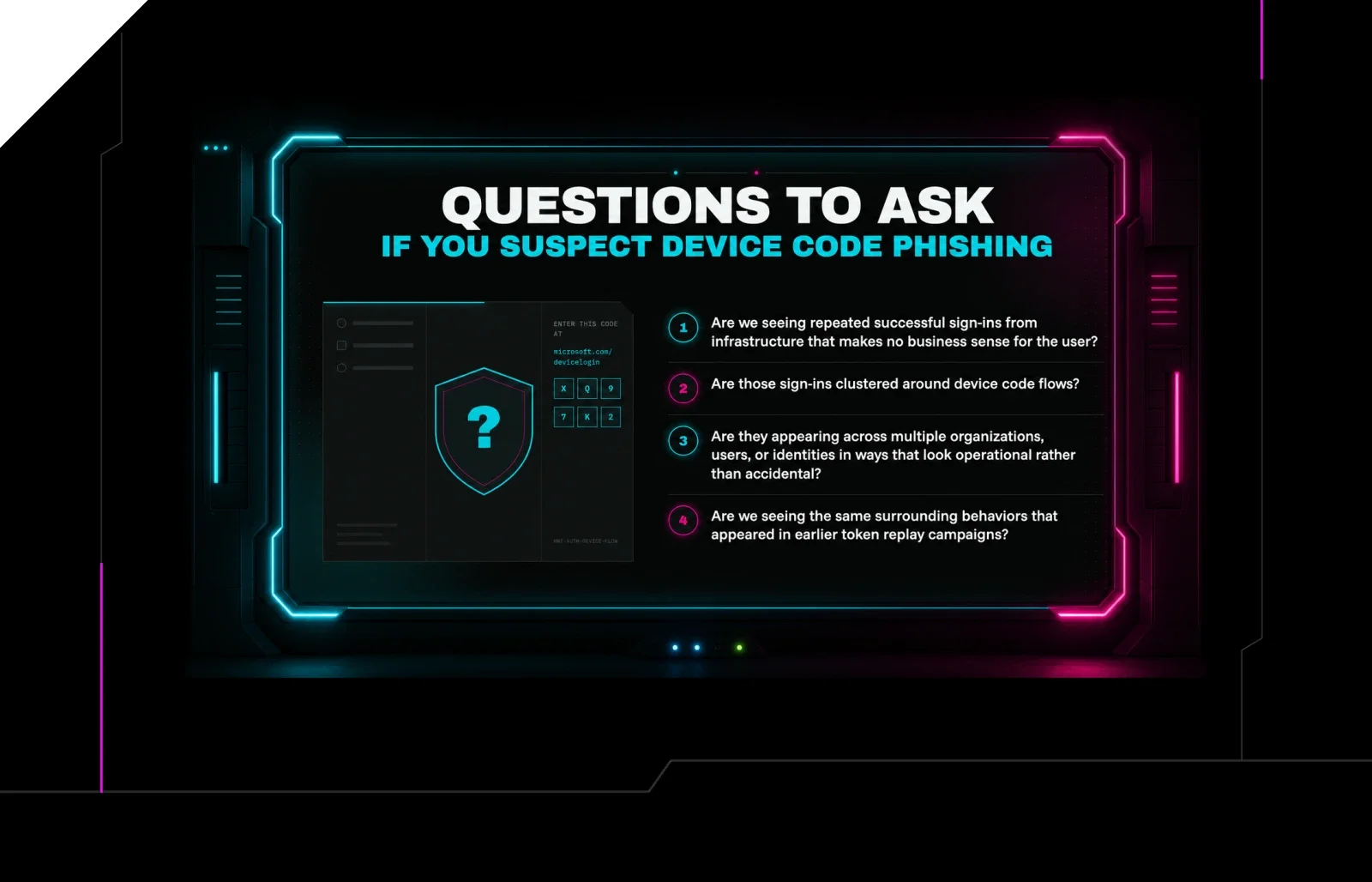
The page's actionable core is a set of behavioral questions to ask instead of waiting for a named-campaign or "pristine attribution" match:
- Are we seeing repeated successful sign-ins from infrastructure that makes no business sense for the user?
- Are those sign-ins clustered around device code flows?
- Are they appearing across multiple organizations, users, or identities in ways that look operational rather than accidental?
- Are we seeing the same surrounding behaviors that appeared in earlier token replay campaigns?
The report also gives a usable internal threshold: Huntress classified BL Networks as adversary infrastructure on the basis that the disproportionate volume of device code logins alone was sufficient — not prior threat-report coverage. Beyond the IOCs already in the summary, the scale figures anchor what "disproportionate" looked like: 533 events tied to 216.203.20[.]95 between April 13–30, including 113 successful logins in a 48-hour window (April 20–21), and 26 critical-severity incidents across 23 identities between July 3–27.
flowchart TD
    A[M365 sign-in from unexpected infra] --> B{Device code flow?}
    B -- no --> Z[Lower priority]
    B -- yes --> C{Repeated / across many identities?}
    C -- no --> Z
    C -- yes --> D{Infra makes business sense for user?}
    D -- yes --> Z
    D -- no --> E[Treat as adversary infra<br/>don't wait for attribution]
Caveats
- The page states activity had "started to decrease" as of July but was ongoing — the specific IPs are point-in-time and BL Networks also hosts legitimate customers, so ASN/IP blocking risks false positives.
- The Kali365 link is hedged ("potentially"); attribution is explicitly the thing the report argues not to wait on.
- The fetched text is truncated mid-sentence at the final recommendation, so any concluding guidance after "waiting for pristine attribution can be" is not captured.
Organisations named here
- 193.149.176.151
- 193.149.176.238
- 216.203.20.95
- 45.61.136.129
- AS399629
- BitLaunch
- BLNWX
Technologies named here
- Railway
- Microsoft 365
- OAuth
- Huntress
Techniques named here
- Device code phishing
- Token replay / abuse
- Abuse of legitimate/trusted infrastructure
Threat actors named here
- EvilTokens
- BL Networks
- Kali365
Related in Threat Intel
 huntress.comwriteup
Reverse Engineering the Six Stages of MacSync Stealer and RAT
 huntress.comwriteup
AI-Coded Malware | Analyzing Vibe-Coded AD Enumeration | Huntress

 blog.talosintelligence.comtool
Introducing CAIRN: Frontier tracking for AI-integrated malware (Cisco Talos)
 huntress.comwriteup